
Alkermes’ Strategic Growth through Technological Moats and Capital Management Amid Market Dynamics
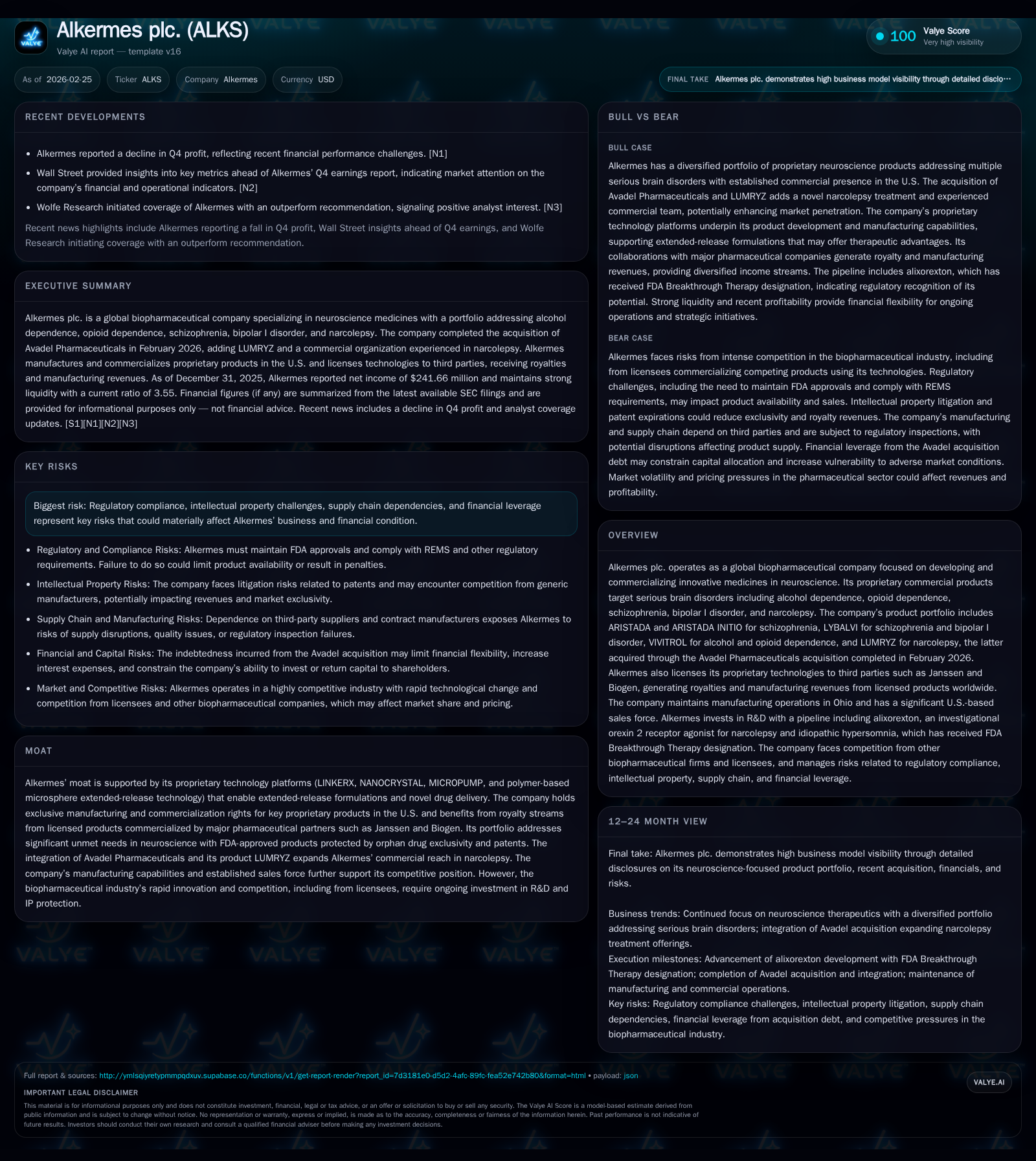
Alkermes leverages proprietary drug delivery technologies and recent strategic acquisition to extend its neuroscience portfolio while navigating regulatory and capital challenges.
Alkermes plc has demonstrated a notable financial recovery since 2022, achieving consistent profitability supported by its neuroscience-focused product portfolio. The February 2026 acquisition of Avadel Pharmaceuticals introduces LUMRYZ and strengthens its presence in narcolepsy treatment, accompanied by integration complexities. Alkermes' proprietary extended-release platforms underpin product differentiation, while a sizeable U.S.-based sales force targets key CNS indications. Regulatory scrutiny and evolving pricing environments remain risk factors. Capital allocation reflects solid ROE (~13.3% in 2025), robust free cash flow generation ($480M in 2025), and steady share repurchases, underscoring discipline amid growth initiatives. Ongoing monitoring of product uptake and regulatory developments will be essential to assess the trajectory.
Historical Financial Trajectory and Operating Income Shifts
Alkermes plc experienced significant financial volatility during the recent four-year period ending FY2025. In FY2022, the company recorded a steep operating loss of approximately -$142 million [F1], reflecting challenges inherent to commercialization costs and R&D expenditures typical in biopharma transitions. However, subsequent years showed recovery momentum with operating income stabilizing around $414 million in FY2023 and FY2024 before contracting modestly to $254 million in FY2025—a decline of roughly 40% year-over-year [F1]. Net income followed similar trends, improving from a net loss of -$158 million in 2022 to net profits exceeding $355 million in both FY23 and FY24 before easing to $242 million in FY25.
Operating cash flows tell a more encouraging story: CFO more than doubled from a modest $21 million in FY2022 to over $520 million by FY2025 [F1], indicating improved operational efficiencies or working capital management. Capital expenditures hovered between $33 million and $48 million annually, rising moderately by about 21% in 2025 relative to prior year levels. Equity increased steadily by approximately $775 million since 2022 reaching nearly $1.82 billion at the end of FY25.
This progression reflects Alkermes’ ability to transition from loss absorption stages toward profitable operations but also signals margin pressures emerging alongside increased investments or integration costs.
Historical performance (annual)
| FY | Net ($mm) | CFO ($mm) | OpInc ($mm) | Capex ($mm) | Net YoY |
|---|---|---|---|---|---|
| 2025 | 242 | 521 | 254 | 40 | -34.2% |
| 2024 | 367 | 439 | 421 | 33 | +3.2% |
| 2023 | 356 | 401 | 414 | 48 | +324.8% |
| 2022 | -158 | 21 | -142 | 38 |
Note: Omitted columns lack sufficient annual XBRL coverage in the provided tags (need ≥2 annual points): Rev, Div. Source: SEC companyfacts cache [F1].
Capital returns and efficiency (annual)
| FY | Buybacks ($mm) | FCF ($mm) | ROE% |
|---|---|---|---|
| 2025 | 200 | 480 | 13.3 |
| 2024 | 200 | 406 | 25.1 |
| 2023 | 353 | 29.6 | |
| 2022 | -17 | -15.2 |
Source: SEC companyfacts cache [F1].
Note: Revenue data not available; some YoY calculations omitted where appropriate data missing.
Impact of Avadel Acquisition: Portfolio Expansion and Integration Challenges
In October 2025, Alkermes agreed to acquire Avadel Pharmaceuticals for $21 per share plus contingent value rights potentially adding another $1.50 per share, finalizing the transaction on February 12, 2026 [S1][N8]. This strategic inorganic expansion added LUMRYZ (sodium oxybate extended-release oral suspension) to Alkermes’ commercial portfolio—the first extended-release oral formulation for narcolepsy approved by FDA—with orphan drug exclusivity benefits extending market protection [S22].
The acquisition complements Alkermes’ existing neuroscience portfolio addressing serious brain disorders and diversifies its therapeutic reach beyond schizophrenia (ARISTADA/ARISTADA INITIO/LYBALVI) and addiction treatments (VIVITROL).
However, management acknowledges substantive integration efforts underway involving harmonizing human resources, supply chains, finance systems, compliance programs, production capabilities inherited from Avadel’s operations [S9]. Potential cultural disparities between organizations as well as overlapping administrative functions create risks that anticipated synergies may take longer or cost more to realize [S26]. Lastly, uncertainties about LUMRYZ’s sustained commercial performance remain given REMS-related distribution complexities.
Proprietary Technologies as a Differentiation Moat in Neuroscience Therapeutics
Alkermes possesses technological moats in its drug delivery arsenal critical for chronic neurological disorders requiring sustained therapeutic effect. Platforms such as LINKERX—a polymer-based microsphere extended-release technology—permit injectable formulations like ARISTADA that improve patient adherence by reducing dosing frequency [S1][S6]. Complementary technologies including NANOCRYSTAL nanomilling enhance solubility profiles while MICROPUMP technology allows controlled subcutaneous drug administration.
These proprietary platforms underpin exclusivity through patents lasting well into the late decade safeguarding competitive positioning against generic erosion [S19]. Additionally, orphan drug exclusivities on select products (such as LUMRYZ) bolster market access barriers favoring Alkermes’ revenue streams.
Sales Force Deployment and Distribution Channels in Neuroscience Markets
Alkermes maintains a dedicated commercial infrastructure focused on U.S. healthcare providers treating serious CNS diseases: approximately 435 sales representatives promote ARISTADA, ARISTADA INITIO, and LYBALVI targeting psychiatrists managing schizophrenia and bipolar disorder cases [S6]. An additional roughly 105 reps specialize on VIVITROL therapy addressing alcohol and opioid dependence.
Distribution leverages major pharmaceutical wholesalers—McKesson (38%), Cardinal Health (15%), and Cencora (18%)—highlighting reliance on specialty distributors adept at managing complex payer reimbursement structures common for CNS agents [S6]. The company's marketing mix includes physician education programs alongside patient assistance services designed to improve engagement amidst stringent reimbursement challenges.
Regulatory and Compliance Terrain Influencing Product Lifecycle and Market Access
Extensive regulatory oversight defines Alkermes’ operational context: routine FDA inspections cover manufacturing processes with risks of delays or sanctions if standards lapse [S4][S7][S8]. Compliance with anti-kickback statutes dictates ethical promotional activity amidst growing federal enforcement [S7]. Recent legislations such as the Inflation Reduction Act introduce Medicare drug price negotiation mechanisms affecting revenue forecasting [S8].
Products like LUMRYZ carry REMS mandates due to sodium oxybate’s narrow therapeutic index requiring controlled distribution channels; any noncompliance may lead to market withdrawal [S27][S28]. Additionally, Medicaid rebate complexities alongside payer consolidation drive significant pricing pressures adversely impacting net realizations [S9][S29]. Legal proceedings linked to IP disputes over VIVITROL’s patent estate also present medium-term risk factors [S28].
Capital Allocation: Analyzing ROE, Free Cash Flow Generation, and Share Repurchases
Fiscal discipline remains evident: Alkermes reported an approximate return on equity of 13.3% for FY25 based on net income ($242 million) relative to shareholders' equity ($1.82 billion) [F1]. Operating cash flow generation climbed robustly to $521 million with capital expenditures rising commensurately but still maintaining strong free cash flow ($480 million) after capex deductions.
The company has executed consistent share repurchase programs totaling roughly $200 million during fiscal years up to end-2024 reflecting shareholder return priorities balanced with growth funding needs [F1]. No dividends were declared or paid per available data.
This cash generation profile supports reinvestment capacity into R&D pipelines plus funding acquisitions exemplified by the Avadel deal financed through debt facilities subject to covenants restricting excessive leverage increases [S12][S20].
Forward-Looking Growth Drivers and Potential Constraints from Market and Regulatory Perspectives
Future avenues for growth include pipeline progression notably around alixorexton—an orally administered selective orexin-2 receptor agonist targeting narcolepsy types NT1/NT2 with Breakthrough Therapy designation granted by FDA in December 2025—and ongoing expansion of LUMRYZ utilization following successful enrollment completions in phase III trials [N1][S24]. Royalty streams continue from licensing proprietary platforms deployed by partners Janssen and Biogen providing non-dilutive revenues.
Nonetheless integration execution risks for Avadel’s operations may temper near-term earnings visibility; payer landscape consolidation could pressure pricing further [N9][S29], while regulatory uncertainty around Medicaid rebate recalibrations persists. Competitive threats also loom as advanced CNS therapies targeting similar indications advance through trials potentially displacing existing products [S19].
Key Performance Indicators to Monitor Post-Earnings Release
Investor focus post Q4 earnings should concentrate on revenue cadence across core brands ARISTADA/LYBALVI/VIVITROL alongside the nascent LUMRYZ sales contribution given its recent acquisition [N2][N8]. Operating margins will signal profit conversion amidst integration costs incurred.
Monitoring R&D milestones such as Phase III initiation for alixorexton offers insight into future franchise viability along with updates on any FDA communications regarding REMS compliance or patent litigations affecting authorized generics entrance timelines is prudent.
Cash flow dynamics balancing ongoing capex requirements versus share repurchase activities will illustrate capital management stance under evolving economic conditions.
This analysis is based solely on publicly available information including SEC filings up to February 25, 2026 ([S1]-[S29]), recent news transcripts ([N1],[N8],[N9]), companyfacts XBRL data ([F1]), and Valye News proprietary report excerpts provided without extrapolation beyond verified facts. It does not constitute investment advice or recommendations.
Disclaimer: This is research-only, informational analysis and not investment advice. It may include AI-generated interpretation and general industry context. Always verify important details using primary sources.

Comments