
Solid Power Inc’s Growth Hinges on Electrolyte Scaling and Collaborative Partnerships
The company advances solid-state battery electrolytes with significant pilot line investments, yet remains challenged by operating losses and commercialization timelines.
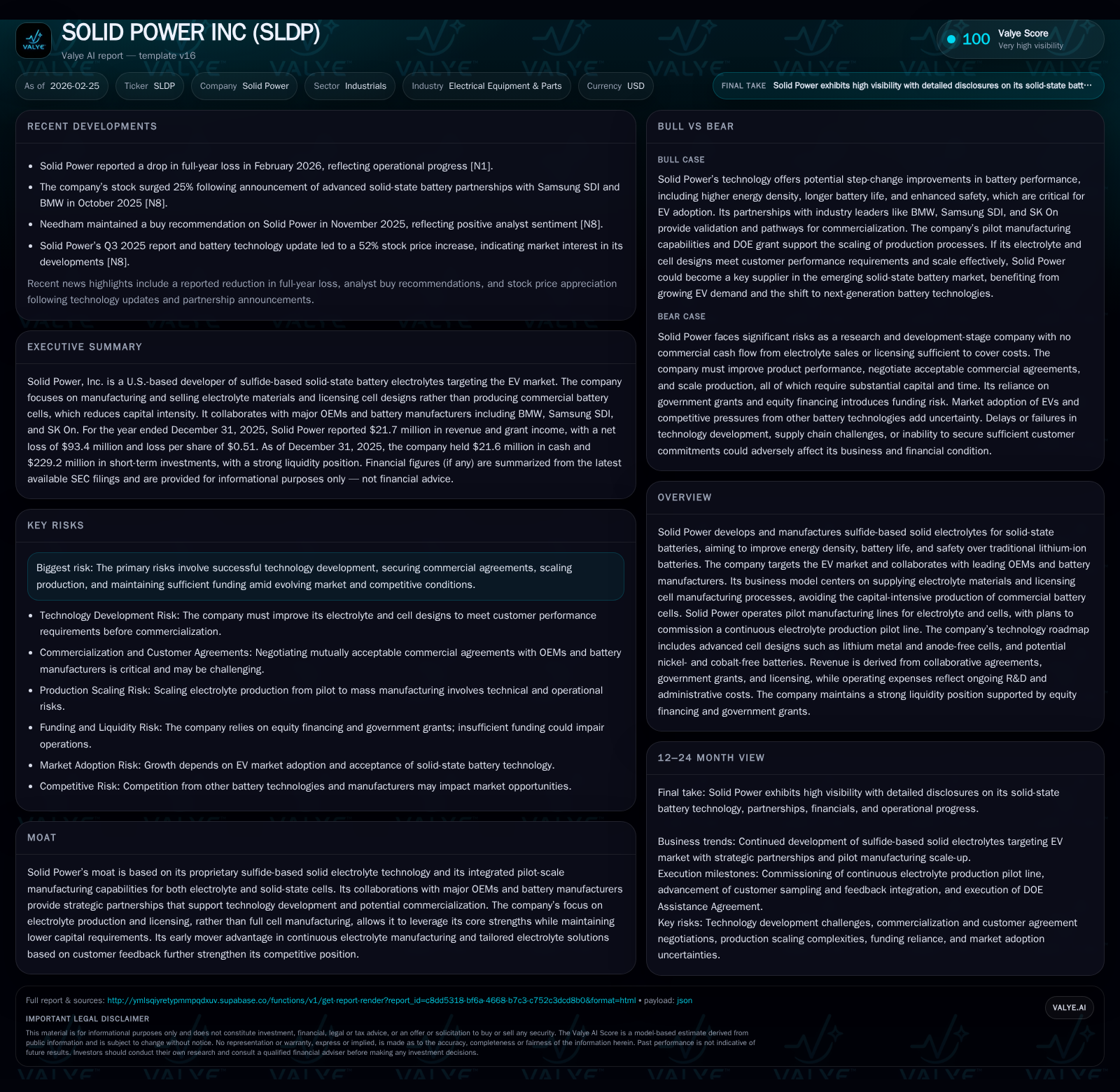
Solid Power Inc (SLDP) specializes in sulfide-based solid electrolytes for next-generation EV batteries, aiming to improve energy density, safety, and lifecycle over traditional lithium-ion technology. Its revenue growth has been modest but steady, driven by government grants and collaborative agreements primarily in the U.S. and Korea. The company is progressing on a continuous electrolyte production pilot line with DOE support, targeting scaled electrolyte supply rather than full cell manufacturing to conserve capital intensity. Despite increased revenues in 2025 (+8% YoY), Solid Power continues to run substantial operating losses with cash burn expected to persist as R&D and pilot production efforts advance. Key risks lie in technology development, commercial deal-making, and scaling supply chain processes. Capital allocation includes opportunistic stock repurchases totaling $12.6 million over two years amid ongoing investment needs. Return metrics including ROE are negative given sustained net losses, and free cash flow remains significantly negative reflecting heavy investment phases.
Company Overview
Solid Power Inc (SLDP) operates at the frontier of solid-state battery innovation, specifically developing sulfide-based solid electrolytes aimed at enabling next-generation battery cells with enhanced energy density, lifespan, and safety compared to current lithium-ion cells [S1]. Unlike many competitors pursuing full cell manufacturing capacity, Solid Power’s business model focuses on electrolyte material supply and licensing of cell manufacturing technologies to Tier 1 battery manufacturers and automotive OEMs. This approach allows the company to avoid heavy capital expenditure associated with battery cell factories while positioning itself as a critical materials supplier for the evolving EV ecosystem.
The core sulfide electrolyte material incorporates lithium sulfide (Li2S) as a key precursor among other inputs. Sulfide electrolytes strike a balance between ionic conductivity—and hence performance—and processability on industry-standard roll-to-roll manufacturing lines [S1]. This pilot-scale capability distinguishes Solid Power within a competitive field split between sulfide- and oxide-based electrolyte research.
Historical Performance and Growth Drivers
Solid Power’s top-line has advanced steadily from $11.8 million in FY2022 to $21.7 million in FY2025 (an approximate CAGR of ~25%), driven predominantly by revenues from government grants—such as its Department of Energy award—and collaborative agreements with major OEMs clustered between geographic markets in the U.S. and South Korea [F1][S7].
Historical performance (annual)
| FY | Rev ($mm) | Net ($mm) | CFO ($mm) | OpInc ($mm) | Rev YoY | Net YoY |
|---|---|---|---|---|---|---|
| 2025 | 22 | -93 | -73 | -101 | +8.0% | +3.2% |
| 2024 | 20 | -97 | -64 | -105 | +15.7% | -47.2% |
| 2023 | 17 | -66 | -58 | -91 | +47.7% | -586.0% |
| 2022 | 12 | -10 | -34 | -59 |
Note: Omitted columns lack sufficient annual XBRL coverage in the provided tags (need ≥2 annual points): Capex, Div. Source: SEC companyfacts cache [F1].
Capital returns and efficiency (annual)
| FY | Buybacks ($mm) | FCF ($mm) | ROE% |
|---|---|---|---|
| 2025 | 4 | -84 | -22.5 |
| 2024 | 9 | -80 | -23.5 |
| 2023 | -93 | -13.0 | |
| 2022 | -92 | -1.7 |
Source: SEC companyfacts cache [F1].
Despite revenue growth, operating losses remain substantial due to sustained R&D investments supporting pilot manufacturing scale-up [F1][S8]. Net income trends mirror operating results with large annual losses.
Operating expenses remain heavily weighted towards R&D—$72.5 million reported in FY2025—which reflects substantial commitment towards pilot manufacturing lines for electrolyte (including continuous process development), cell designs featuring lithium metal anodes or nickel- and cobalt-free cathodes under exploration [S8][S9]. Administrative costs decreased modestly (-8%) due primarily to lower external contractor spend [S18].
Capital Allocation and Liquidity Position
Solid Power has funded its growth largely through equity offerings including a notable ATM program raising gross proceeds of over $91 million during FY2025 [S4]. As of December 31, 2025, total liquidity—cash plus marketable securities—stood at approximately $336 million [F1][S5].
Capital expenditures declined significantly to $10.2 million in FY2025 from $15.9 million the prior year reflecting completion of major buildout phases ahead of commissioning the continuous electrolyte pilot line later this year [F1][S8]. Combined operational cash burn remained high with operating cash flows negative at about $73.4 million for FY2025 [F1]. Free cash flow (operating cash flow minus capex) was approximately negative $83.6 million.
Stock repurchases totaled about $3.6 million during FY2025 following a larger program initiated previously ($9.1 million spent in FY2024), indicating opportunistic use of capital despite ongoing investment needs [F1][S12].
Return on equity (ROE) is negative approximately -22.5%, reflecting continued net losses relative to stockholders’ equity of roughly $416 million at year-end FY2025 [F1]. Dividend payments are not disclosed in available data.
Technology Roadmap and Commercialization Strategy
Solid Power’s strategic focus centers on commercializing sulfide-based electrolytes that enable advanced solid-state battery architectures tailored for EV applications [S23]. Their pilot manufacturing currently produces batch electrolytes used internally for cell development as well as customer sampling programs which generate valuable feedback loops for product iteration.
A critical upcoming milestone is commissioning a continuous electrolyte pilot line expected by end-2026 funded partly through a DOE grant up to $50 million under the Infrastructure Investment and Jobs Act [S16]. This transition aims to validate scalable production processes addressing key supply chain reliability and cost competitiveness concerns before mass production.
By steering clear of direct cell manufacturing investments—offering licensing instead—the company targets integration with established Tier-1 battery producers or OEMs that prefer managing final cell assembly internally [S1]. The technology roadmap also includes innovations such as anode-free cells promising further cost reductions by eliminating metallic lithium anodes.
Industry Context Analysis
The electrification transition places an intense premium on battery technology breakthroughs that extend driving ranges while improving safety profiles amidst rapidly declining EV battery costs globally. Sulfide electrolytes represent one competing chemical pathway; their trade-off resides between superior ionic conductivity versus chemical stability challenges compared to oxide ceramics.
The global push—backed by policy incentives and consumer demand—for EV adoption powers underlying demand growth for advanced batteries though time-to-market uncertainties create execution risk for developers like Solid Power [S10]. Commercial agreements between material suppliers and OEMs are complex owing to stringent qualification standards plus evolving technical specs affecting revenue recognition patterns [S20][S22].
Risks & Uncertainties
Key risks include:
- Achieving required electrolyte performance metrics reliably at scale before broader commercialization.
- Securing binding commercial contracts with OEMs/battery makers at acceptable terms given emerging competition.
- Managing consistent supply chain inputs for critical raw materials (notably Li2S precursor).
- Maintaining financial runway given ongoing cash burn exceeding revenues without positive cash flow forecast available publicly.[S1][S10][S23]
Looking Forward: Milestones & What to Watch
While explicit forward guidance is not provided beyond referenced milestones [N1], watch points include:
- Successful installation and commissioning of continuous electrolyte production pilot line (targeted end-2026).
- Progression toward initial commercial licensing agreements translating into scaling revenue streams.
- Developments around customer feedback integration indicating product-market fit improvements.
- Management commentary on potential new partnerships or expansion into adjacent sectors beyond automotive.
- Cash burn trajectory relative to cash reserves considering planned R&D ramp-up or cost-saving initiatives.
Taken together, Solid Power sits at an inflection point common among industrial-stage cleantech developers: moving from pilot demonstration toward commercialization entails operational scaling complexities alongside persistent funding demands amid evolving market dynamics.
Disclaimer: This analysis is for informational purposes only based on publicly available data as of the dates cited including SEC filings and news sources; it does not constitute investment advice.
Disclaimer: This is research-only, informational analysis and not investment advice. It may include AI-generated interpretation and general industry context. Always verify important details using primary sources.

Comments