
SolarEdge’s Return to Profitability Highlights Strategic Portfolio Focus and Innovation
SolarEdge Technologies narrowed losses and grew revenue sharply in 2025 through streamlined operations, product innovation, and reshored manufacturing.
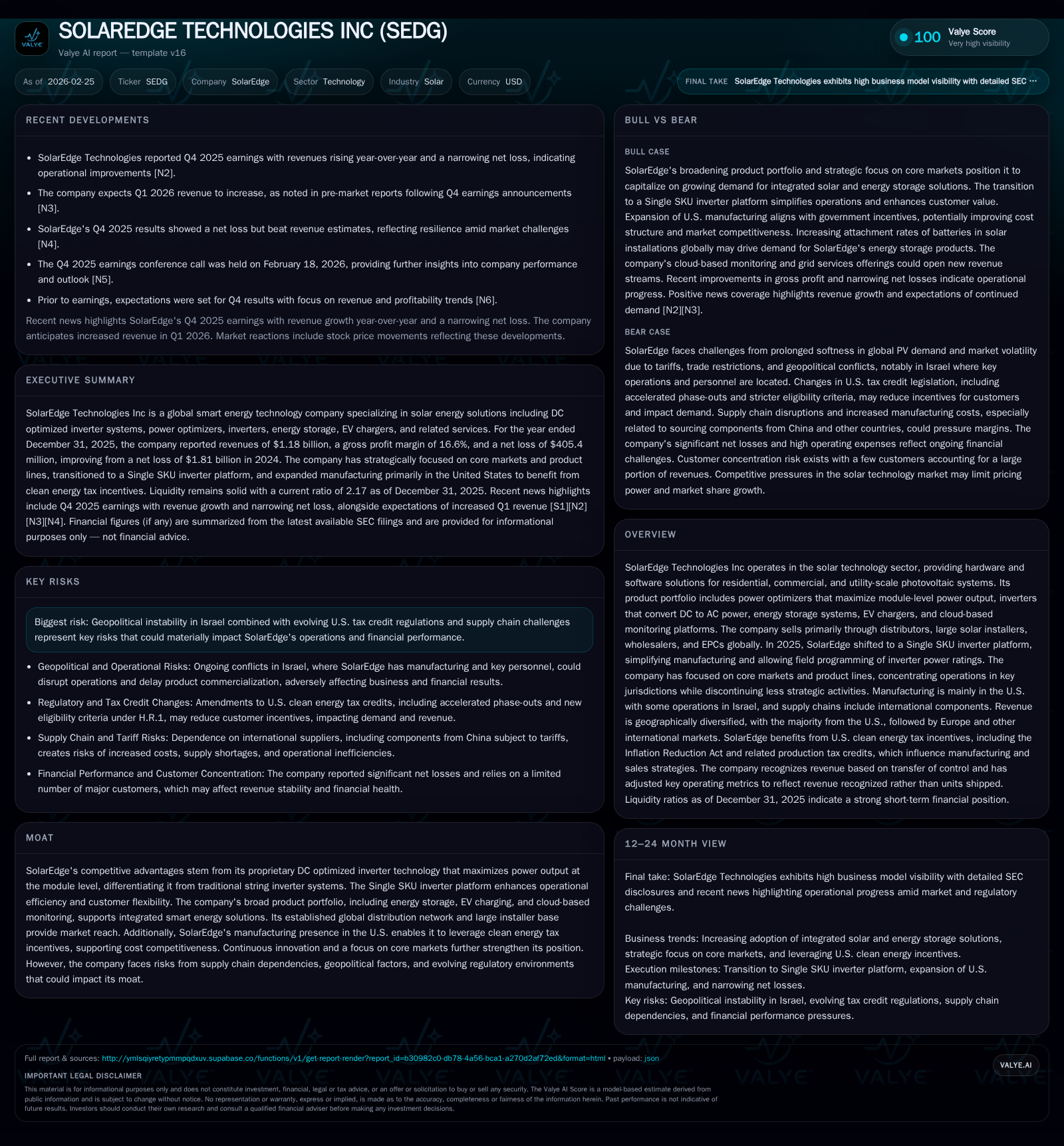
In fiscal 2025, SolarEdge Technologies Inc marked a significant financial turnaround with a 31.4% increase in revenue and a return to gross profitability after a steep loss in 2024. This recovery aligns with its strategic shift to a Single SKU inverter platform, manufacturing reshoring to the U.S. to capitalize on IRA tax incentives, and portfolio rationalization focusing on core markets and products. While net losses remain elevated, operating cash flows turned positive, supported by reduced capital expenditures and suspended buybacks. Going forward, growth hinges on new product adoption, regulatory developments including solar tax credit rules, and supply chain resilience amid geopolitical risks centered around its Israeli operations.
2025 Financial Recovery: Revenue Surge and Margin Expansion
SolarEdge Technologies demonstrated significant financial improvement in fiscal year 2025. Revenues increased by 31.4% year-over-year to $1.18 billion from $901 million the prior year [F1][S1], reversing earlier declines primarily caused by substantial inventory write-downs.
The company transitioned from an extreme gross loss of -97.3% in 2024 to a gross profit margin of 16.6% in 2025 [F1][S15]. This turnaround was driven largely by reduced inventory impairment accruals alongside better absorption of fixed costs due to increased sales volume. The Inflation Reduction Act's Advanced Manufacturing Production Tax Credits (AMPTCs) materially contributed to margins; excluding these incentives would have resulted in a gross loss [S15].
Despite improved gross profitability, SolarEdge reported a net loss of $405 million in 2025, significantly narrower than the $1.81 billion net loss recorded in the previous year [F1][S1]. The ongoing net losses reflect restructuring expenses and investments associated with portfolio realignment.
Operating income losses narrowed by more than 82%, indicating early operational stabilization following challenges related to supply chain disruptions and shifting demand patterns post-subsidy adjustments [F1].
Historical performance (annual)
| FY | Rev ($bn) | Net ($mm) | CFO ($mm) | OpInc ($mm) | Rev YoY | Net YoY |
|---|---|---|---|---|---|---|
| 2025 | 1.2 | -405 | 104 | -302 | +31.4% | +67.7% |
| 2024 | 0.9 | -1255 | -313 | -1708 | -69.7% | -3754.5% |
| 2023 | 3.0 | 34 | -180 | 40 | -4.3% | -63.4% |
| 2022 | 3.1 | 94 | 31 | 166 |
Note: Omitted columns lack sufficient annual XBRL coverage in the provided tags (need ≥2 annual points): Capex, Div. Source: SEC companyfacts cache [F1].
Capital returns and efficiency (annual)
| FY | Buybacks ($mm) | FCF ($mm) | ROE% |
|---|---|---|---|
| 2025 | 0 | 81 | -94.8 |
| 2024 | 50 | -421 | -190.6 |
| 2023 | -351 | 1.4 | |
| 2022 | -138 | 4.3 |
Source: SEC companyfacts cache [F1].
Transitioning to a Single SKU Inverter Platform: Operational Simplification and Market Flexibility
A major innovation supporting SolarEdge’s turnaround is the introduction of its Single SKU software-defined inverter platform late in 2025 [S1]. This approach enables shipment of one generic hardware unit configurable via software for various power ratings across residential and commercial applications globally.
This simplification reduces manufacturing complexity, inventory SKUs, and logistical burdens while improving forecasting accuracy and after-sales service efficiency for installers and EPC contractors.
From an end-user standpoint, it offers scalability through software upgrades without requiring hardware replacement—a competitive advantage over traditional string inverter systems reliant on multiple fixed SKUs.
Strategic Portfolio Rationalization: Sharpened Focus on Core Markets and Products
Since late-2024, SolarEdge has strategically focused on core markets and product lines exhibiting strong growth potential by discontinuing less strategic energy storage offerings and withdrawing from lower-performing geographies [S1][S5].
This enables tighter alignment of R&D efforts, sales focus, and manufacturing capacity toward sustainable market segments primarily in North America and Europe.
The company now operates as a single consolidated segment post-divestitures such as Automation Machines—enhancing transparency into its core business performance [S1].
Manufacturing Footprint Shift: Leveraging U.S. Tax Incentives Amid Geopolitical Risks
SolarEdge reshored most manufacturing activities to the United States—specifically Texas (inverters), Florida (optimizers/inverters), and Utah (batteries)—to capitalize on IRA domestic content incentives that enhance installer rebates and manufacturing subsidies [S1][S21].
This relocation reduces exposure to tariffs associated with prior production sites in China, Mexico, and Hungary while maintaining minor manufacturing capacity at Israeli facilities.
Nevertheless, some critical inverter components continue to be sourced internationally—including from China—exposing the company to tariff risks requiring active supplier diversification efforts [S13].
Geopolitical tensions affecting Israel-based R&D teams pose additional operational risks despite primary assembly being U.S.-based [S20][S23].
Growth Drivers: New Product Launches and Integrated Smart Energy Solutions
Alongside the Single SKU inverter platform rollout, SolarEdge expanded its residential portfolio with the Nexis series targeting next-generation PV system efficiency improvements [S1].
Commercial energy storage offerings were also enhanced through the CSS-OD modular battery system scalable up to megawatt-hour installations suitable for indoor/outdoor use.
These developments support SolarEdge’s transition toward an integrated smart energy ecosystem combining optimized PV hardware with advanced storage solutions, EV charging infrastructure, and cloud-based monitoring platforms—differentiating it from simpler inverter-only competitors.
Capital Allocation Review: Improving Cash Flows with Reduced Capex and No Buybacks
SolarEdge improved financial discipline during 2025 with operating cash flow turning positive at approximately $104 million versus a negative $313 million outflow in the prior year due to better working capital management coupled with revenue growth momentum [F1][S17].
Capital expenditures fell sharply by over 78% year-over-year to roughly $23 million as expansion projects were completed or scaled back under restructuring plans designed for liquidity preservation.
No share repurchases occurred during the year compared with $50 million repurchased in 2024—a clear signal of cautious capital management amid ongoing operational challenges [F1].
Return on equity remains negative at approximately -95%, reflecting continued net losses; however positive free cash flow generation (~$81 million) provides foundation for potential future profitability gains once restructuring completes.
Outlook Considerations: Growth Expectations and Regulatory Factors
While explicit long-term guidance beyond Q4 results is not publicly provided, initial trends suggest continued revenue growth driven by a robust order pipeline especially within North America where IRA incentives remain supportive [N2][N3].
Key uncertainties include evolving U.S. solar tax credit policies impacting installer economics which directly influence near-term demand dynamics.
Ongoing investments into next-generation product development alongside scaling integrated smart energy platforms will be critical milestones signaling sustained competitive positioning.
Monitoring supplier stability is essential given past volatility impacting component availability.
Risks: Supply Chain Concentration and Geopolitical Instability
SolarEdge faces supply chain risks due to dependence on certain single-source suppliers for critical inverter components amidst global semiconductor shortages or shipping disruptions requiring active diversification strategies [S20][S23].
Geopolitical instability linked to Israeli operations remains a notable risk given that approximately 13% of Israeli employees were called into active reserve duty since late-2023 affecting R&D continuity despite U.S.-based manufacturing predominance.
Though risk mitigation measures like inventory buffers are employed, systemic geopolitical uncertainties cannot be fully eliminated.
This report synthesizes information from filings as of February 25th, 2026 alongside recent earnings disclosures without projecting investment outcomes or recommendations.
Disclaimer: This is research-only, informational analysis and not investment advice. It may include AI-generated interpretation and general industry context. Always verify important details using primary sources.

Comments