
Simon Property Group’s Earnings Surge Reflects Premium Retail Asset Strength and Focused Capital Strategies
Simon Property Group’s expansive retail portfolio and disciplined capital management underpin its pronounced FY2025 financial outperformance.
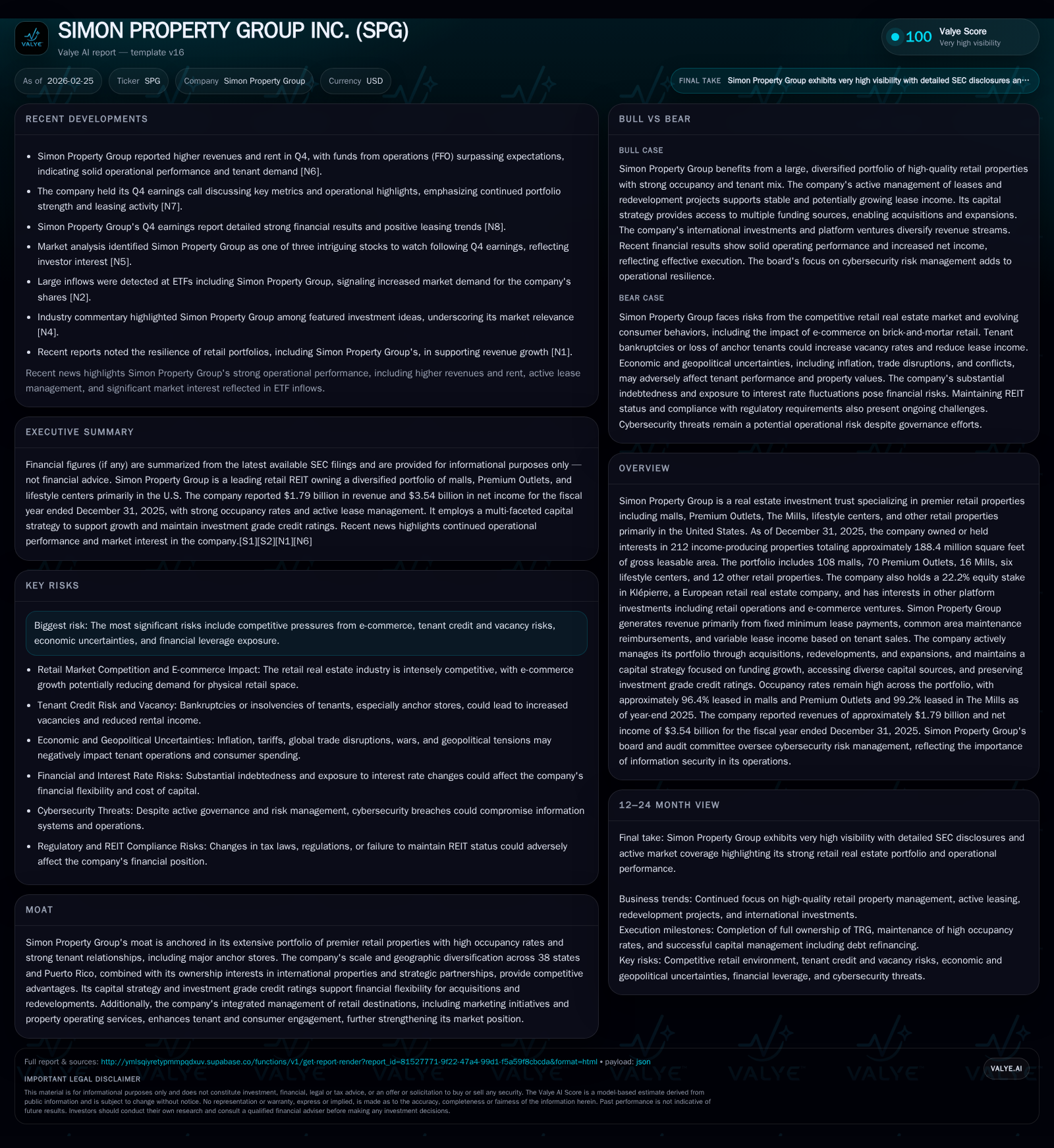
Simon Property Group (SPG) reported robust financial results in FY2025, driven by strong leasing momentum across its premier malls, Premium Outlets, and The Mills segments. Revenue increased 13.2%, with operating income up 6.6%, while net income surged 358.7%, reflecting both core operational strength and significant non-cash valuation gains tied to the TRG acquisition. The company maintains high occupancy rates (~96-99%) and leverages fixed and variable rent structures that align with tenant sales performance to bolster cash flows. Capital allocation balances significant dividends with opportunistic share repurchases and elevated redevelopment capex, supporting long-term asset enhancement. SPG’s investment-grade credit rating enables access to multi-billion-dollar revolving credit facilities and a diversified unsecured debt profile, facilitating strategic acquisitions and refinancing activities. Looking ahead, monitoring occupancy trends, funds from operations (FFO), and capex execution will be key to assessing sustainability of growth amid retail sector headwinds including e-commerce competition.
Growth Through Premier Retail Assets: Historical Performance Overview
Simon Property Group’s FY2025 earnings reflect the power of a diversified retail portfolio encompassing malls, Premium Outlets, and The Mills properties totaling roughly 188 million square feet of gross leasable area (GLA) [S1]. Over four years through 2025, Simon has steadily grown revenues from $1.40 billion in FY2022 to nearly $1.79 billion in FY2025—marking a sharp 13.2% surge last year alone [F1]. This top-line expansion translated into rising operating income, which climbed 6.6% year-over-year (YoY) to approximately $891 million.
What stands out is the outsized jump in net income—soaring nearly 359% to just under $3.54 billion in FY2025 [F1]. This result includes significant non-cash valuation uplifts notably related to the consolidation of TRG assets which remeasured interest previously held at fair value [S17]. Despite these accounting inflections, core operational metrics demonstrate solid fundamentals: operating cash flow advanced a healthy 8.4% to over $4.13 billion while capital expenditures (capex) grew sharply (+23.7%, reaching $934 million) signaling aggressive reinvestment in redevelopment projects aimed at enhancing shopping experiences [F1][S25].
Historical performance (annual)
| FY | Rev ($mm) | Net ($bn) | CFO ($bn) | OpInc ($mm) | Rev YoY | Net YoY |
|---|---|---|---|---|---|---|
| 2025 | 1791 | 3.5 | 4.1 | 891 | +13.2% | +358.7% |
| 2024 | 1582 | 0.8 | 3.8 | 836 | +3.6% | -10.2% |
| 2023 | 1527 | 0.9 | 3.9 | 792 | +9.1% | +11.2% |
| 2022 | 1400 | 0.8 | 3.8 | 684 |
Note: Omitted columns lack sufficient annual XBRL coverage in the provided tags (need ≥2 annual points): Capex, Div. Source: SEC companyfacts cache [F1].
Capital returns and efficiency (annual)
| FY | Buybacks ($mm) | FCF ($bn) | ROE% |
|---|---|---|---|
| 2025 | 227 | 3.2 | 68.0 |
| 2024 | 141 | 3.1 | 26.2 |
| 2023 | 141 | 3.1 | 28.4 |
| 2022 | 180 | 3.1 | 24.6 |
Source: SEC companyfacts cache [F1].
Note: Dividends paid are not available from tagged data; buyback figures are fiscal year totals [F1]
This combination of sustained revenue improvement and enhanced profitability underscores not only effective property-level management but also astute balance sheet usage enabling redevelopment undertakings critical for consumer engagement.
Leasing Strength and Tenant Mix: Foundations of Revenue Expansion
The backbone of Simon's growth lies within its meticulously curated tenant roster complemented by expansive property types across geographies [S1]. The portfolio comprises:
- 108 Malls ranging from ~130k sqft up to mega-regional centers at ~2.7M sqft GLA,
- 70 Premium Outlets focused on branded designer/manufacturer stores situated near metropolitan hubs or tourist destinations sized between ~150k-920k sqft,
- 16 Mills blending traditional mall formats with outlets and entertainment venues spanning roughly 1.2M–2.4M sqft,
- Plus six lifestyle centers (~170k–940k sqft) and a dozen other smaller-scale properties considered non-core [S1].
Occupancy levels stand impressively firm, with malls/Premium Outlets leased around ~96.4%, while The Mills holdings command an even loftier ~99.2%, indicating deeply entrenched demand despite wider retail sector pressures tied to online alternatives [S1]. This lease foundation allows SPG to collect predominantly fixed minimum rents supplemented by variable rental components tied directly to tenant sales performances—a hybrid structure aligning landlord incentives with retailer viability.
Importantly, anchor tenants in many locations, often national department stores or big-box chains with robust credit profiles, provide economic moat qualities—stabilizing foot traffic flows that sustain smaller specialty stores within the mall interiors.
This mix affords resilience against e-commerce penetration as outlet centers continue drawing consumers via discounted branded goods unavailable online at similar price points, while experiential retail elements within The Mills foster destination shopping appeal beyond mere convenience.
Capital Structure and Liquidity: Navigating Debt Facilities and Credit Ratings
Simon Property manages a substantial capital structure with consolidated indebtedness hitting approximately $28 billion by end-FY2025 [S13][F1]. Predominantly composed of senior unsecured notes exceeding $19 billion plus mortgage debt (~$8 billion), the company effectively maintains an investment-grade rating profile supporting access at reasonable cost.
The weighted average interest rate on total debt stood near a modest 3.86%, influenced heavily by fixed-rate issuance across maturities extending well into the next decade [S14]. Floating rate exposure is minimal (1%) given active interest rate hedging programs designed to reduce volatility relating to benchmark shifts such as LIBOR transitioning to SOFR [S17].
Liquidity buffers remain substantial; cash and equivalents totaled approximately $823 million complemented by availability under two major revolving credit facilities aggregating about $7.7 billion net after letters of credit as of December ‘25 [S4][S5][S6]. These revolvers bear interest rates typically set at SOFR plus spread margins ranging from roughly ±70 bps based on investment-grade standing—with built-in extension options providing flexibility through mid-2028 [S6]. Additionally, a commercial paper program capped at ~$2 billion provides short-term funding versatility fully backed by these credit lines [S8].
This prudent maturity laddering combined with conservative leverage ratios facilitates refinancing upcoming maturities without undue pressure while enabling opportunistic acquisitions or capital projects funded internally or via capital markets issuance when conditions allow.
Capital Allocation: Dividends, Share Repurchases, and Development Investments
Simon’s capital allocation philosophy strives for a balanced return approach given REIT distribution mandates requiring minimum taxable income payout—yet also prioritizes accretive reinvestment into accelerating property improvements aimed at future growth.
FY2025 witnessed common stock repurchases totaling roughly $227 million—a meaningful increase relative to prior periods—underscoring management’s opportunistic stance toward returning excess capital when share price levels warrant [F1][S24]. Concurrently, dividends paid approximated an annualized $8.55 per share based on reported commentary ([N14],[S24]), though explicit dividend payment amounts are not available from provided XBRL tags.
Capex expansion was significant (+23%), reaching approximately $934 million during FY2025—highlighting focused spend on redevelopments, expansions, tenant improvements, and technological upgrades designed to improve shopper attractivity across flagship outlets [F1][S25]. Notable investments include large-scale projects like Jakarta Premium Outlets’ recent opening symbolizing ongoing geographic diversification efforts via platform partnerships abroad [S24].
Overall this disciplined deployment seeks optimal free cash flow generation alongside sustainable dividend yields while selectively acquiring or enhancing assets capable of driving longer-term NOI growth.
Forward Prospects: Market Drivers and Company-Specific Growth Initiatives
Looking forward beyond calendar year-end actuals, Simon Property emphasizes strategic initiatives supporting resilient revenue streams despite persistent headwinds such as e-commerce competition or macroeconomic uncertainties affecting consumer spending patterns.
Key avenues anticipated include further development of lifestyle centers—a segment gaining traction as consumers seek open-air environments combining shopping with leisure experiences—as well as bolstering international exposure notably via its sizable equity interest (22%) in Klépierre—the European retail real estate player that diversifies revenue sources beyond U.S.-centric malls/outlets [N3][S1].
Management has indicated focus on integrating e-commerce platforms synergistically with physical retail through technology-enabled consumer engagement tools enhancing omnichannel experiences—a recognized competitive necessity given shifting shopper behavior trends [N13]. Some risk remains from tenant credit quality variation amid economic cycles; however high portfolio occupancy coupled with solid variable rent components indexed on actual sales provide partial economic insulation.
While explicit numeric guidance was not provided in latest releases, milestones revolve around measured expansion completion timelines (Jakarta project recently delivered), ongoing redevelopment pipeline activation spending effectiveness, lease renewal success across anchor tenants, and maintenance of robust FFO growth per quarter results trending positively post-Q4 beat described by management commentary [N13][N3].
Metrics Not Available from Provided Tags
Explicit dividend payments amount is not available from provided XBRL tags; estimates referenced derive from SEC narrative disclosures but exact values are not tagged in [F1]. Return on equity is approximated below based on net income over equity figures detailed in tagged data.
Summary Financial Metrics Snapshot (FY2025)
| Metric | Value (USD Billion) |
|---|---|
| Revenue | $1.79 |
| Operating Income | $0.89 |
| Net Income | $3.54 |
| Operating Cash Flow | $4.14 |
| Capital Expenditures | $0.93 |
| Common Stock Buybacks | $0.23 |
| Cash & Equivalents | $0.82 |
| Total Consolidated Debt | ~$28 |
| Equity | ~$5.21 |
Approximate Return on Equity (ROE): ~68% calculated as Net Income / Equity based on latest annual data points [F1] Estimated Free Cash Flow (FCF): Operating Cash Flow minus Capex equals approximately $3.20 billion for FY2025 [F1]
This analysis is based exclusively on publicly filed SEC documents and recent market reports as cited; it does not constitute investment advice or recommendations.
Disclaimer: This is research-only, informational analysis and not investment advice. It may include AI-generated interpretation and general industry context. Always verify important details using primary sources.

Comments