
How First Mid Bancshares Balances Regional Expansion, Risk, and Shareholder Returns
An analysis of First Mid Bancshares’ growth via acquisition, credit risk controls, and disciplined capital allocation.
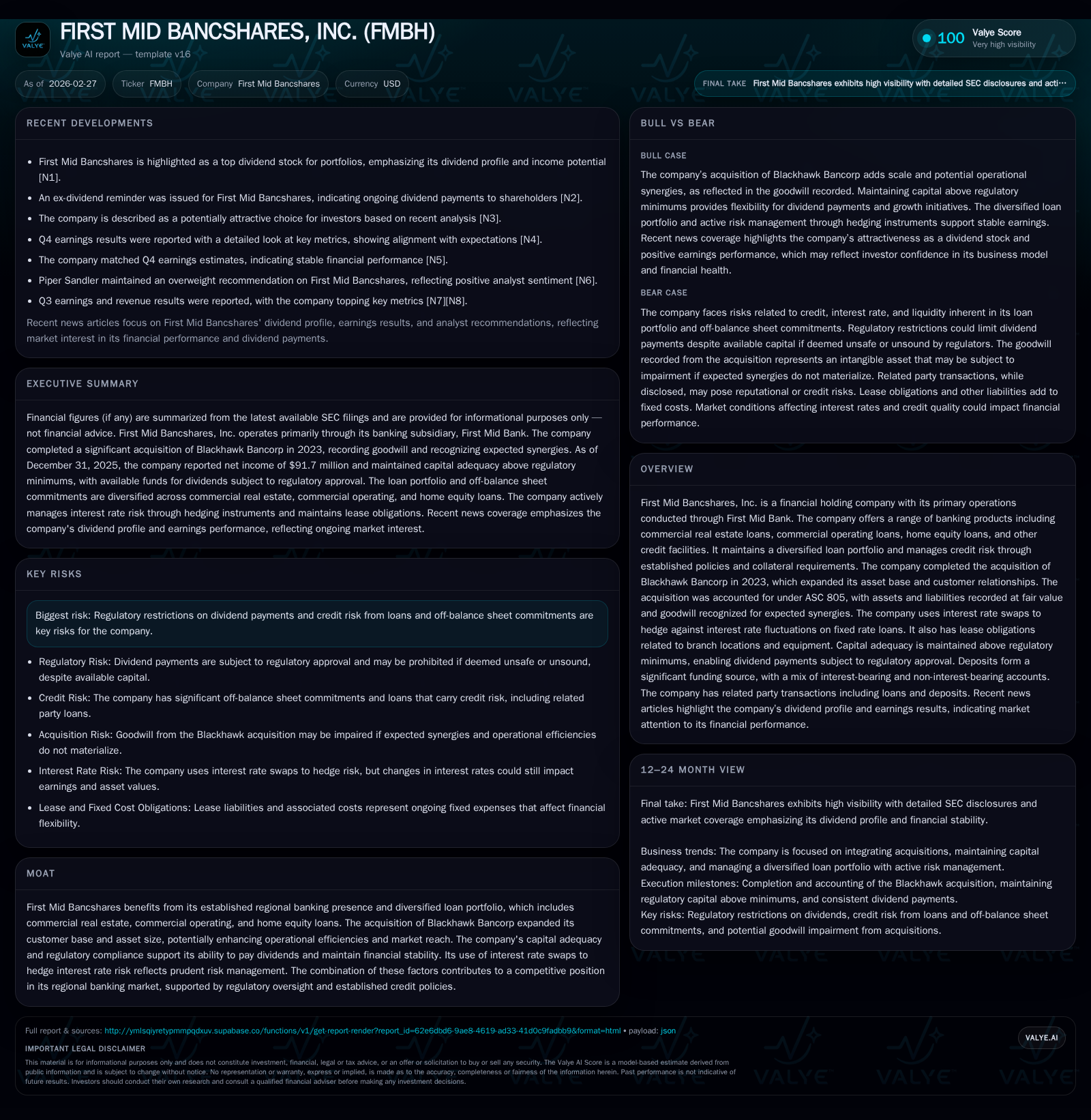
First Mid Bancshares has demonstrated consistent net income growth driven notably by its 2023 Blackhawk Bancorp acquisition, which expanded both its loan portfolio and customer base. The company adheres to prudent credit risk management through diversified lending segments and collateral requirements, while maintaining capital adequacy above regulatory minimums to support dividend payments. Operating cash flows show steady improvement alongside increased investments in branch infrastructure. Looking forward, continued acquisitions like the Two Rivers deal may fuel growth, balanced by regulatory dividend restrictions and exposure to economic factors influencing credit quality.
Growth Milestones: Acquisition-Driven Expansion and Historical Performance
First Mid Bancshares' trajectory over recent years is punctuated by steady earnings advancement propelled by its 2023 acquisition of Blackhawk Bancorp. This strategic move expanded the asset base and customer relationships considerably. Net income progression exemplifies this impact: growing from approximately $72.95 million in FY2022 to $68.94 million in FY2023, before rising more sharply to $78.90 million in FY2024 and culminating at $91.75 million in FY2025—a +16.3% year-over-year increase from FY2024 to FY2025 [F1].
Equity also rose markedly during this period—from $633.15 million at end-2022 to $958.69 million at end-2025—reflecting enhanced capitalization partly from acquisition accounting under ASC 805 standards that recorded assets and liabilities at fair value alongside goodwill recognition tied to expected synergies [S1]. This integration fosters operational scope expansion while maintaining a diversified loan portfolio.
Historical performance (annual)
| FY | Net ($mm) | CFO ($mm) | Capex ($mm) | Net YoY |
|---|---|---|---|---|
| 2025 | 92 | 131 | 7 | +16.3% |
| 2024 | 79 | 124 | 5 | +14.5% |
| 2023 | 69 | 72 | 4 | -5.5% |
| 2022 | 73 | 66 | 5 |
Source: SEC companyfacts cache [F1].
Capital returns and efficiency (annual)
| FY | Div ($mm) | Buybacks ($) | FCF ($mm) |
|---|---|---|---|
| 2025 | 23 | 724000 | 124 |
| 2024 | 22 | 659000 | 119 |
| 2023 | 20 | 465000 | 69 |
| 2022 | 18 | 340000 | 61 |
Source: SEC companyfacts cache [F1].
Table data sourced from [F1], representing fiscal year-end figures.
Loan Portfolio Composition and Credit Risk Management Evolution
First Mid's loan book comprises three primary segments: commercial real estate loans, commercial operating loans, and home equity loans — each maintained within a framework of disciplined credit risk management grounded in collateral requirements and regular monitoring.
At December 31, 2025, off-balance sheet unused commitments total approximately $1.38 billion compared to $1.41 billion at the prior year-end [S1][S5], showing careful contraction predominantly in commercial real estate lines ($214 million vs $324 million), balanced against increases in commercial operating lines ($675 million vs $649 million) and home equity commitments ($119 million vs $106 million). These commitments include lines of credit with fixed expiration dates and fees designed to offset undrawn credit risk.
Additionally, standby letters of credit issued reached around $17.6 million at year-end versus $16.9 million previously—extensions guaranteeing customers’ financial performance mainly for trade facilitation or borrowing arrangements lasting under one year [S1].
The bank’s policy treats these off-balance instruments with equivalent underwriting rigor applied on-book: same credit approval criteria coupled with similar collateralization standards are enforced before commitments are granted or letters issued; thus limiting potential loss exposure despite higher contractual amounts compared to recognized assets.
Capital Adequacy and Regulatory Considerations Shaping Dividend Policies
Capital structure strength remains a cornerstone of First Mid's operating model supporting sustainable dividends while navigating regulatory constraints.
As detailed in the FY2025 annual filing, the bank maintains capital levels comfortably exceeding minimum regulatory thresholds established under applicable guidelines administered by the OCC [S1]. This positions First Mid Bank subsidiary with an estimated $54.5 million dividend capacity available for distribution to the holding company.
Nonetheless, dividend payments remain subject to OCC discretion that may suspend payouts if deemed unsound even when formal limits allow otherwise—a prudent safeguard reflecting ongoing supervisory emphasis amid evolving market conditions.
The calculated approximate return on equity stood near 9.6% for FY2025 ([Net Income / Equity] = $91.7M / $958M), an indicator aligned with moderate profitability preserving capital while generating shareholder returns [F1].
Operating Cash Flow Dynamics and Investment in Core Banking Infrastructure
Operating cash flows have exhibited robust upward momentum: growing from roughly $65.8 million in FY2022 to about $130.9 million by FY2025—a compound trajectory averaging low double-digit percentage gains annually with a notable surge between FY2023 and FY2024 coinciding with acquisition-related inflows [F1].
Capital expenditures (capex), meanwhile, escalated substantially (+38.4%) from $4.95 million in FY2024 to nearly $6.85 million in FY2025 after a modest decline preceding that period; this increase correlates with investments primarily earmarked for branch network leasing commitments and essential technology improvements required to service an expanded customer base post-acquisition [F1][S1].
These capex patterns underscore the bank’s intent on sustaining scalable operations amidst growing competitive pressures within regional banking markets.
Future Growth Drivers and Potential Constraints in Regional Markets
First Mid's future expansion prospects remain linked closely to both organic lending growth opportunities—particularly within commercial loan segments—and strategic acquisitions aimed at increasing market footprint.
The recent announcement of the merger agreement with Two Rivers Financial Group highlights continuation of an acquisitive approach that broadens geographic reach within Iowa's regional landscape [S3]. This transaction is set to unfold as integration processes marry operational synergies realized previously through Blackhawk acquisition.
However, growth could encounter caps imposed by tighter regulation or adverse macroeconomic dynamics elevating credit risk profiles—for example, interest rate volatility affecting borrower repayment capacity or softness in commercial real estate markets impacting collateral values—both risks acknowledged explicitly by management disclosures [N5][S1].
Navigating Interest Rate Exposure: Hedging Strategies and Implications
To mitigate duration mismatches between fixed-rate loan assets and funding liabilities sensitive to rate changes, First Mid employs interest rate swap contracts as hedging instruments.
These derivatives are used specifically to offset earnings volatility ensuing from fixed-rate loans exposed during periods of rising or falling benchmark rates—a key element within regional banks’ asset-liability management frameworks aiming to preserve net interest margins amid fluctuating rate environments [S1].
By designating these swaps appropriately for fair value hedging accounting treatment under GAAP, the company maintains transparent earnings impact reporting while reducing balance sheet sensitivity.
Capital Allocation Strategy: Dividends, Buybacks, and Reinvestment Priorities
Shareholder return strategy reveals a clear prioritization of dividend distributions over buybacks.
Dividend payments edged up steadily each year (e.g., rising from $17.8 million in FY2022 to $23.4 million in FY2025), demonstrating commitment to predictable income streams favored by investors seeking yield stability within banking stocks [F1][N3]. Conversely repurchase activity remains minimal — less than a million dollars annually — reflecting restrained treasury stock acquisition likely influenced by strict capital guidelines limiting discretionary buyback volume relative to earnings retention needs.
Substantial free cash flow availability (approximately $124 million calculated as operating cash flow minus capex for FY2025) supports ongoing earnings reinvestment while sustaining payout capacity without jeopardizing capital buffer levels critical for meeting regulatory requirements [F1].
What To Monitor: Key Milestones and Market Signals Ahead
Following current strategies entails close observation of several pivotal indicators:
- Successful closing and operational integration of Two Rivers Financial Group deal evidencing realization of synergy aspirations.
- Regulatory communications concerning dividend authorizations particularly regarding OCC assessments balancing safety against shareholder expectations.
- Quality trends within credit portfolio metrics including delinquency rates or reserve builds signaling early signs of economic stress.
- Capital adequacy ratios evolution tracking buffer maintenance needed for strategic flexibility.
- Announcements regarding adjustments in buyback programs or capex plans potentially shifting capital return priorities.
Such developments will shape First Mid's valuation outlooks and risk profiles beyond fiscal results encapsulated herein.
Disclaimer: This document is an informational company analysis produced solely based on publicly sourced evidence cited herein; it does not constitute investment advice or recommendations.
Disclaimer: This is research-only, informational analysis and not investment advice. It may include AI-generated interpretation and general industry context. Always verify important details using primary sources.

Comments