
Rackspace Technology’s Road to Profitability: Cloud Partnerships and Financial Resilience
Analyzing Rackspace Technology’s evolving business model through growth drivers, financial recovery, and capital discipline amid ongoing operational losses.
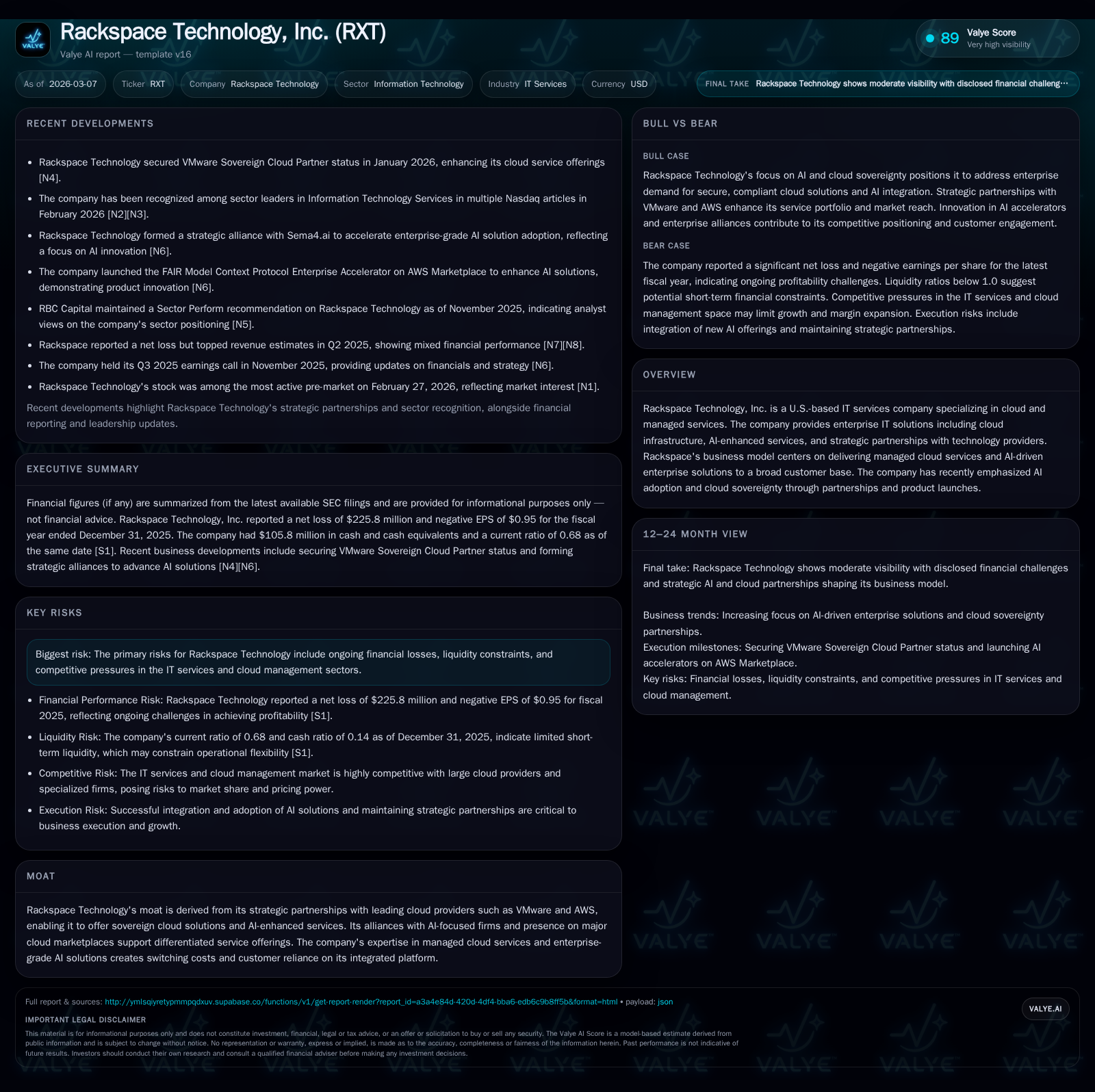
Rackspace Technology materially narrowed its operating and net losses in fiscal 2025 compared to prior years, signaling progress toward profitability despite a challenging liquidity and capital structure environment. The company's revenue growth is supported by managed cloud services and AI-enhanced offerings, fueled by strategic partnerships with major cloud providers like VMware and AWS. However, ongoing debt leverage and liquidity constraints impose operational risks. Capital allocation remains focused on cash flow preservation and selective reinvestment without share buybacks or dividends.
Financial Trajectory: Improving Yet Challenging Trends in Operating and Net Income
Rackspace Technology’s financial results for fiscal year 2025 show a significant reduction in operating losses, with operating income improving from a steep negative $909 million in 2024 to a much narrower loss of $101 million in 2025 [F1]. This reflects an impressive 88.9% year-over-year improvement highlighting operational leverage improvements albeit still remaining unprofitable at the operating level.
Similarly, net losses narrowed substantially, declining by approximately 73.7% year-over-year from -$858 million to -$226 million over the same period [F1]. This step-change improvement signals progress toward sustainable profitability but is offset by sustained negative equity of nearly -$1.2 billion at year-end 2025 after moving through a severe contraction phase since 2022 [F1]. The company remains structurally challenged on the balance sheet despite pronounced earnings recovery.
This trend captures Rackspace's trajectory from deep operational distress toward stabilizing core operations but confirms excess leverage and an extended path before net positive earnings can be achieved.
Historical performance (annual)
| FY | Net ($mm) | CFO ($mm) | OpInc ($mm) | Capex ($mm) | Net YoY |
|---|---|---|---|---|---|
| 2025 | -226 | 151 | -101 | 61 | +73.7% |
| 2024 | -858 | 40 | -909 | 111 | -2.4% |
| 2023 | -838 | 375 | -899 | 97 | -4.1% |
| 2022 | -805 | 247 | -679 | 80 |
Source: SEC companyfacts cache [F1].
Capital returns and efficiency (annual)
| FY | Buybacks ($mm) | FCF ($mm) | ROE% |
|---|---|---|---|
| 2025 | 91 | 18.5 | |
| 2024 | 0 | -71 | 85.5 |
| 2023 | 0 | 278 | 542.3 |
| 2022 | 31 | 166 | -127.8 |
Source: SEC companyfacts cache [F1].
Table: Rackspace Technology historical financial performance summary showing a steady narrowing of losses alongside improving operating cash flow and reduced capital expenditure intensity [F1]
Revenue Drivers: Growth Catalysts Behind Managed Cloud and AI-Enhanced Services
Revenue expansion for Rackspace is primarily rooted in its managed cloud services portfolio, increasingly augmented by AI-driven enterprise solutions—a strategic direction emphasized by recent company communications and sector leadership mentions [N1],[N3],[N4]. These offerings address enterprise demand for hybrid cloud infrastructure coupled with intelligent automation layers.
Incorporating advanced AI capabilities into cloud infrastructure management supports efficiency gains for clients and establishes switching costs that enhance revenue visibility through multi-year contract structures familiar within enterprise IT service engagement models.
Cloud Sovereignty and Key Alliances: Differentiation in a Competitive IT Services Market
Rackspace's competitive moat fundamentally arises from its deep partnerships with major cloud platform providers including VMware and AWS—pillars underpinning its ability to deliver sovereign cloud solutions tailored for jurisdictions with strict data residency requirements.
These alliances integrate proprietary solutions that marry cloud sovereignty mandates with AI-enhanced automation frameworks embedded within the managed services stack, creating higher switching costs due to increased implementation complexity for customers [N1],[N3],[N4].
This structural advantage reinforces resilience against commoditization prevalent in the broader IT services landscape dominated by large systems integrators.
Liquidity Landscape and Capital Structure Pressures Post-2025
Despite operational improvements, Rackspace faces tangible liquidity pressures as evidenced by a current ratio of approximately 0.68 at the end of fiscal 2025 owing to current liabilities ($767 million) significantly exceeding current assets ($518 million) [F1]. This shortfall underscores stresses in meeting near-term obligations without reliance on external financing or asset monetization.
The company holds cash & equivalents of about $106 million which provides some cushion but must be prudently deployed given sizable outstanding obligations detailed in regulatory filings during late 2025 and early 2026 [S8],[S10],[S14],[S15].
Moreover, total equity remains deeply negative (-$1.22 billion), reflecting accumulated losses and sustained leverage levels that could impact access to longer-term funding or negotiation power with credit providers.
The liquidity environment requires ongoing careful balance sheet management combined with strategic refinancing initiatives as signaled in recent SEC disclosures [S3],[S16].
Capital Allocation Focus: Limited Buybacks, Strategic Investments, and Cash Flow Management
Rackspace has maintained a conservative capital allocation approach with no share repurchases recorded since at least FY2022; likewise it does not currently pay dividends reflecting priorities on preserving operational liquidity amid ongoing loss reduction efforts [F1],[S11],[S12],[S13].
Capital expenditures contracted significantly by over 45% year-over-year from $111 million in 2024 to $61 million in FY2025 [F1], consistent with management’s intent to moderate capex intensity while focusing resources on optimizing existing infrastructure rather than rapid expansion.
Operating cash flow generation improved strongly reaching approximately $151 million (+279%) enabling free cash flow around $91 million (operating cash flow minus capex) for the full year—a positive structural indicator supporting self-funding potential for selective innovation or partnership expansions.
This pragmatic reinvestment stance suggests Rackspace aims for financial resilience while cautiously advancing key strategic initiatives including emerging AI product rollouts detailed elsewhere [N3,N4].
Future Roadmap: Watching Milestones Around AI Adoption, Partnership Expansion, and Financial Targets
Explicit forward-looking guidance or definitive milestones are not disclosed publicly; however analysts should closely monitor several indicators:
- Adoption metrics for newly introduced AI-driven managed services platforms reported as sector leaders recently [N3,N4]
- Expansion updates regarding sovereign cloud deals leveraging VMware/AWS alliances cited internally as moat drivers [N1]
- Refinancing or capital structure adjustment developments reported quarterly or via unscheduled filings given existing debt maturities discussed in filings through early 2026 [S3,S16]
- Executive leadership transitions completed within last year may influence strategic execution cadence going forward [S22]
Absent explicit company guidance these factors constitute key barometers to assess whether the operational turnaround translates into sustained revenue growth and margin improvement.
Risks and Cautions: Ongoing Losses, Competitive Intensity, and Debt Leverage
While progress is notable, ongoing material net losses indicate underlying cost structure challenges remain entrenched even after sharp improvements versus prior years—inherent risks cited extensively across multiple regulatory filings cover competitive technology shifts, customer concentration exposure, evolving market demands for cloud-native capabilities beyond traditional managed services, regulatory uncertainties around data sovereignty compliance frameworks, plus intrinsic liquidity risk due to leverage profile [S4,S5,S6,S7].
The company’s moat derived largely from alliances is vulnerable to disruption from both hyperscale public cloud incumbents expanding managed service capabilities internally and new entrants offering next-generation AI-augmented deployments directly competing within selective commercial verticals.
Contract renewal dynamics similarly bear watching given client negotiating power increases amid proliferating third-party options.
These factors form a backdrop requiring cautious monitoring while recognizing that Rackspace's currently defined strategy seeks to mitigate such headwinds via differentiated offering sets tied closely to partnership ecosystems rather than competing solely on commoditized infrastructure management fees.
Disclaimer: This analysis is based solely on publicly available information as of early March 2026 including SEC filings ([F1], [S#]) and reputable news sources ([N#]). It is intended for informational purposes without providing investment advice or recommendations concerning Rackspace Technology shares or securities.
Disclaimer: This is research-only, informational analysis and not investment advice. It may include AI-generated interpretation and general industry context. Always verify important details using primary sources.

Comments