
Exclusive BAFF-R Antibody Licensing Drives Jade Biosciences’ Clinical and Capital Trajectory
Jade Biosciences leverages an exclusive licensing agreement as it expands clinical trials and manages capital amid escalating operating losses.
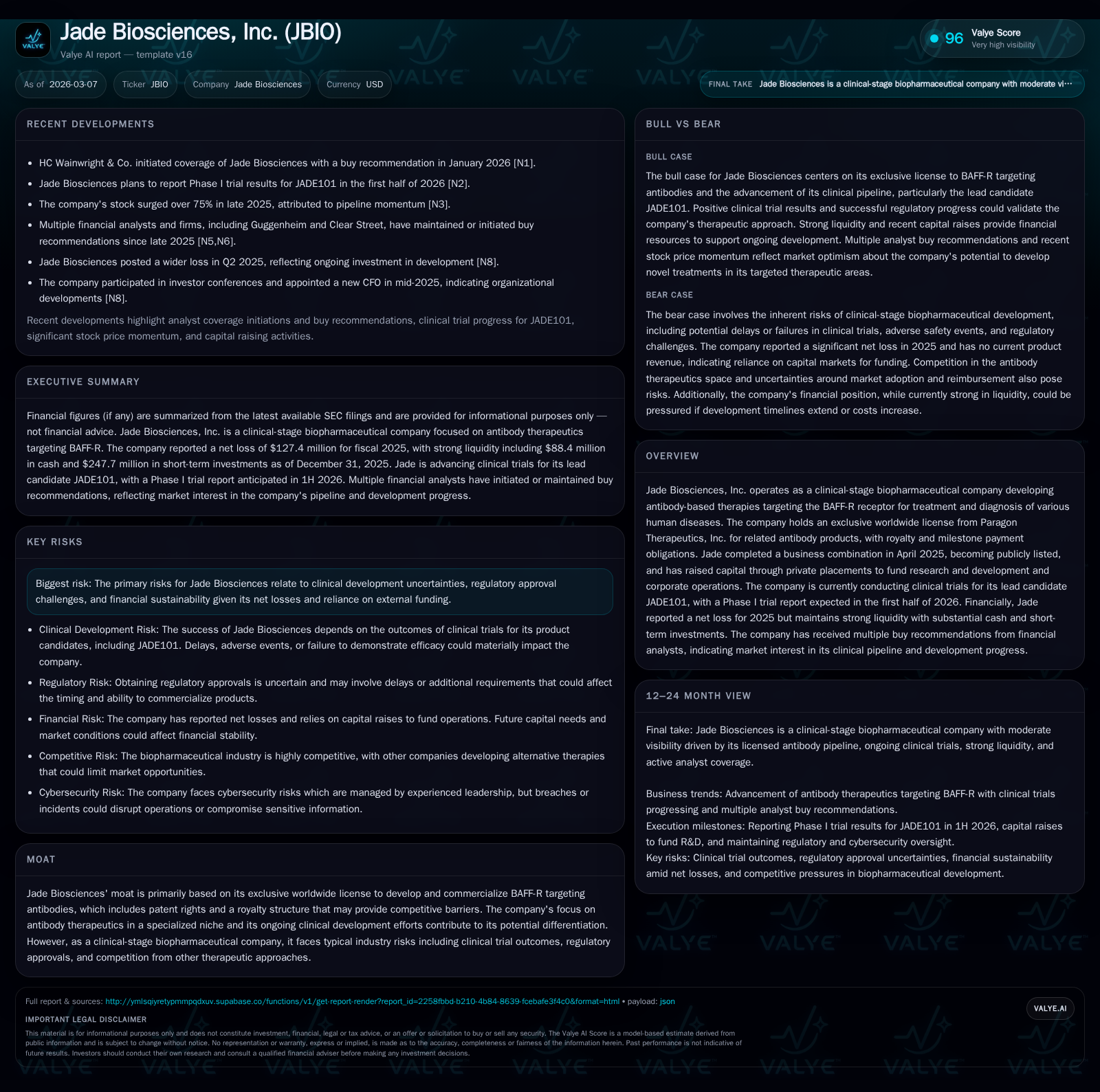
Jade Biosciences, a clinical-stage biopharmaceutical company, operates primarily under an exclusive worldwide license for BAFF-R targeting antibodies. Since its public listing via a 2025 business combination, the company has raised substantial capital through private placements, maintaining robust liquidity to fund ongoing R&D and operations. Despite deepening operating and net losses in 2025, Jade’s financial position is anchored by a sizable cash reserve projected to sustain operations into mid-2028. The imminent Phase I readout of its lead candidate, JADE101, represents a critical near-term milestone amid typical development and regulatory risks.
From Private Placement to Public Listing: Early Capital Growth and Utilization
Jade Biosciences transitioned from a private clinical-stage entity to a publicly traded company following a business combination consummated in April 2025 [S16]. This event enabled access to public markets alongside substantial private capital raises. Notably, on October 6, 2025, Jade secured approximately $135 million through a private placement involving common stock sales and pre-funded warrants at roughly $9.14 per share [S18]. Subsequently, in December 2025, the company closed another private placement raising about $45 million with proceeds allocated toward expanding research and development efforts alongside general corporate expenses [S12][S22].
As of December 31, 2025, Jade reported cash, cash equivalents, and short-term investments totaling approximately $88.4 million within current assets of $348.8 million [F1]. This liquidity position supports the company's operational runway well into the first half of 2028 according to management estimates [S11], offering financial stability despite ongoing losses.
Sole License to BAFF-R Targeting Antibodies: Strategic Differentiation in Clinical Development
Central to Jade's value proposition is its royalty-bearing exclusive worldwide license from Paragon Therapeutics to develop antibodies targeting BAFF-R—a receptor implicated in various immune-related disorders—including rights across prophylaxis, treatment, palliation, and diagnosis fields [S8][S20]. The agreement stipulates milestone payments totaling up to $22 million keyed to specific regulatory and clinical development accomplishments for the first product reaching such thresholds. For example, a $1.5 million fee was paid upon nomination of the development candidate earlier in 2025 and a $2.5 million subsequent payment hinges on dosing the first patient in Phase I trials [S20].
Under this arrangement, Jade benefits from exclusive patent rights covering the antibodies' composition and manufacture while limiting Paragon’s capacity to independently develop competing anti-BAFF-R monospecific antibodies for at least five years [S20]. The deal features tiered low-to-mid-single-digit royalties payable on product sales with step-down provisions if patents lapse during royalty terms lasting up to twelve years post first commercial sale or until patent expiry [S20]. This intellectual property moat establishes competitive barriers critical for differentiation in antibody therapeutics.
Financial Performance Trends: Operating Losses Deepen Despite Strong Liquidity
Jade’s fiscal years from 2022 through 2025 evidence escalating operating deficits aligned with intensified R&D investment inherent in clinical-stage biopharma development:
Historical performance (annual)
| FY | Net ($mm) | CFO ($mm) | OpInc ($mm) | Capex ($) | Net YoY |
|---|---|---|---|---|---|
| 2025 | -127 | -95 | -114 | 196000 | -83.0% |
| 2024 | -70 | -71 | -75 | 142000 | +7.8% |
| 2023 | -76 | -57 | -81 | 142000 | -46.6% |
| 2022 | -52 | -39 | -53 | 195000 |
Source: SEC companyfacts cache [F1].
Capital returns and efficiency (annual)
| FY | FCF ($mm) | ROE% |
|---|---|---|
| 2025 | -95 | -38.3 |
| 2024 | -71 | -91.1 |
| 2023 | -57 | -69.0 |
| 2022 | -39 | -40.6 |
Source: SEC companyfacts cache [F1].
Source: [F1]
Operating income declined sharply by over half (-52%) in FY2025 compared with FY2024 levels while net losses widened by approximately 83%, demonstrating intensified expenditure on pipeline advancement and related activities [F1]. Concurrently, operating cash flow outflows grew about 33%, consistent with expanded clinical operations consuming liquidity [F1]. The company's equity base increased substantially in FY2025 primarily due to capital infusion from financing events stated above [F1].
Capital expenditures remain immaterial relative to operating cash burn—hovering below $0.2 million annually—signaling minimal fixed asset consumption typical for development-stage biopharma entities relying heavily on outsourced capabilities rather than large capex investments [F1]. Notably, approximate return on equity stands at negative ~38%, reflecting expected negative profitability profiles prevailing prior to any commercialization success [F1].
Clinical Pipeline Outlook: Near-Term Milestones with JADE101 Phase I Readout
Jade’s lead antibody candidate, JADE101, currently undergoing Phase I clinical trials targeting diseases modulated via BAFF-R receptor pathways represents the cornerstone of its developmental pipeline [S3][S21]. A topline Phase I report is anticipated during the first half of calendar year 2026 [S3], marking a major catalyst event critical for validating safety and initial pharmacodynamic signals.
This readout will not only influence regulatory positioning but also impact ongoing capital deployment decisions throughout subsequent phases (Phase II onward). As highlighted in SEC filings, trial outcomes carry typical industry risks including risk of delay, failure to meet efficacy/safety endpoints, or enrollment challenges borne by many early-stage immunotherapeutic programs [S21]. Thus this milestone assumes significant strategic importance.
Capital Allocation Priorities: Balancing R&D Spend and Corporate Expenses
Aligning with typical biotech startup norms during clinical validation stages, Jade channels most capital toward research and development activities aimed at advancing antibody candidates rather than infrastructure or fixed assets investments [F1][S12]. Use of proceeds from recent capital raises explicitly emphasize funding R&D programs alongside supporting general corporate expenses essential for sustaining organizational capability [S12][S22].
With minimal capex (~$196K in FY2025 compared to nearly $95M negative operating cash flow), investment predominantly supports clinical trial execution costs including site management fees, regulatory compliance monitoring, manufacturing batches for study material supply chains as well as scientific personnel expenses [F1][S12]. This funding balance illustrates junior biopharma’s reliance on external financing rounds amid large near-term cash burn until pivotal data readouts materialize.
ROE remains deeply negative (-38%) reflective of pre-revenue stage operating economics governed predominantly by upfront R&D commitments rather than mature capital returns [F1]. Successful future capital raises or partnership arrangements will remain necessary unless near-term efficacy data sufficiently derisks the pipeline prospects.
Governance and Risk Management: Focus on Cybersecurity and Regulatory Challenges
Jade’s governance disclosures indicate a deliberate focus on cybersecurity risk oversight integrated within its Board audit committee responsibilities—a standard yet crucial safeguard given increasingly complex IT environments across clinical-stage biopharma firms handling sensitive proprietary data [S7]. The audit committee regularly reviews cybersecurity matters supplemented by management updates originating from technically experienced IT leadership constituted by a Vice President with over two decades in IT security domains including cyber risk program administration plus oversight experience vested in the CFO role [S7].
Additionally, regulatory risks inherent across clinical-trial execution frameworks are candidly described encompassing potential delays or failures during product approval processes as well as dependencies on third-party manufacturers supplying investigational materials—all standard but material risks for specialty biopharmas developing novel antibody therapeutics like JADE101 that rely heavily on external service providers for GMP manufacture and IND approvals [S4][S21].
This combined governance posture denotes conscious adherence to mitigating operational risks impacting sustainable pipeline progression.
What to Watch: Upcoming Clinical Data and Financing Activities
Looking forward into mid-2026 horizons several key developments warrant attention:
- The Phase I interim report for JADE101 expected H1 2026 will provide crucial insights into candidate safety/tolerability — an inflection point shaping subsequent Phase II design decisions [S3][S21];
- The progress on filing effectiveness of registration statements related to resale of privately placed shares per agreements executed during late-2025 financings which may affect shareholder liquidity dynamics [S10][S12];
- Potential additional financing rounds or partnership collaborations expected if further capital needs arise before meaningful product revenue generation given ongoing negative operating cash flows evident since inception [F1];
- Any updates regarding timeline adjustments or regulatory feedback stemming from current trial enrollment efforts or IND amendments should also be tracked closely as indicators of operational momentum or bottlenecks.
Monitoring these milestones is imperative given their immediate implications both clinically and financially as Jade attempts to translate its BAFF-R licensing advantage into tangible developmental progress while sustaining fiscal health.
Disclaimer: This report is prepared solely for informational purposes based on publicly available sources without investment advice or recommendations. Financial figures are drawn strictly from audited SEC filings where cited; projections represent analytical observations grounded in reported facts without speculative assumptions about future outcomes beyond disclosed company guidance or statements.
Disclaimer: This is research-only, informational analysis and not investment advice. It may include AI-generated interpretation and general industry context. Always verify important details using primary sources.

Comments