
SBA Communications Unfolds Growth Trends and Capital Dynamics in 2025
The company’s 2025 performance reveals modest revenue growth amid margin pressures, with significant customer concentration and disciplined capital allocation.
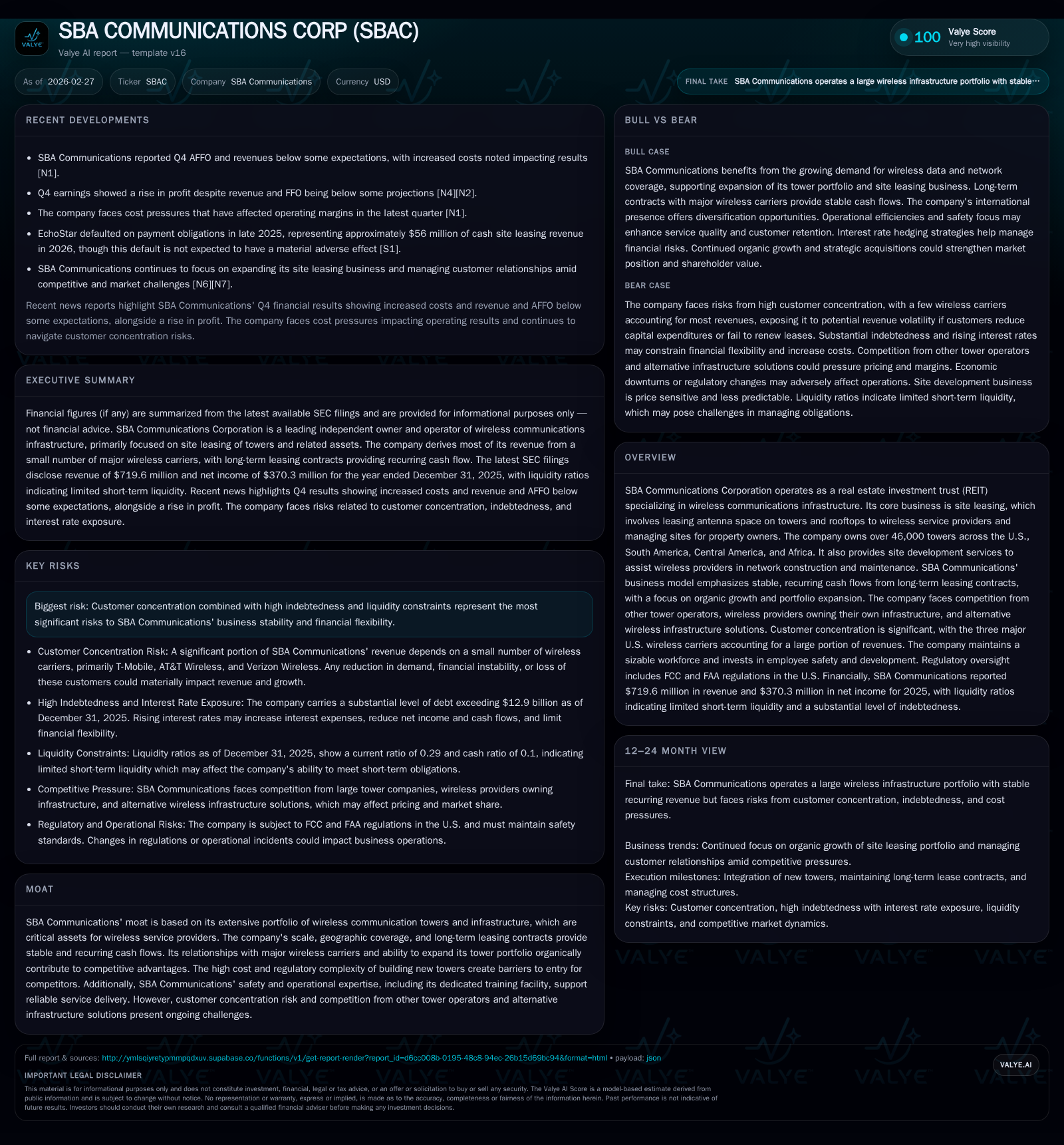
In 2025, SBA Communications Corporation, a leading REIT in wireless infrastructure, posted a 3.7% revenue increase driven by site leasing expansions despite rising operating costs that compressed operating income by 21.8%. Net income more than doubled due to non-operating factors. The firm remains heavily reliant on its top three wireless carriers—T-Mobile, AT&T, and Verizon—for over two-thirds of its revenue, presenting concentration risks especially amid reduced carrier capital expenditures. Capital allocation balanced $479 million in dividends with nearly $498 million in share repurchases. Despite strong free cash flow generation, leverage and liquidity metrics require ongoing attention. Growth prospects focus on organic tower densification and international expansion supported by recent acquisitions.
Historical Financial Performance and Growth Drivers
SBA Communications Corp (SBAC) reported revenue of $719.6 million for FY2025, a 3.7% increase from $693.7 million in FY2024 [F1]. This growth was driven primarily by incremental leasing volumes across its portfolio exceeding 46,000 towers globally under long-term leases averaging initial terms from five to fifteen years with escalators embedded [S5][S16]. Despite revenue gains, operating income declined by approximately 21.8% to $298.9 million from $382.3 million the prior year [F1], reflecting increased site development costs, regulatory compliance expenses, and maintenance overhead as noted in Q4 earnings commentary [N4][N5].
Net income rose sharply by 113% to $370.3 million from $173.6 million principally due to non-operating gains including tax benefits or one-time events referenced in earnings releases [F1][N6], indicating mixed trends on core profitability.
Operating cash flow decreased modestly by 3.3%, totaling about $1.29 billion amid network expansion investments [F1]. Capital expenditures contracted slightly by 1.5% to $224.8 million demonstrating disciplined investment focused on enhancing tower capacity and selective acquisitions [F1][S11].
Historical performance (annual)
| FY | Rev ($mm) | Net ($mm) | CFO ($mm) | OpInc ($mm) | Rev YoY | Net YoY |
|---|---|---|---|---|---|---|
| 2025 | 720 | 370 | 1291 | 299 | +3.7% | +113.3% |
| 2024 | 694 | 174 | 1335 | 382 | +2.8% | +58.5% |
| 2023 | 675 | 110 | 1544 | 210 | -1.6% | +6.0% |
| 2022 | 686 | 103 | 1286 | 235 |
Source: SEC companyfacts cache [F1].
Capital returns and efficiency (annual)
| FY | Div ($mm) | Buybacks ($mm) | FCF ($mm) |
|---|---|---|---|
| 2025 | 479 | 498 | 1067 |
| 2024 | 424 | 200 | 1107 |
| 2023 | 370 | 100 | 1308 |
| 2022 | 307 | 432 | 1071 |
Source: SEC companyfacts cache [F1].
Note: Percent changes are year-over-year relative to prior fiscal year.
Segment and Customer Concentration Dynamics
SBAC's primary revenue source is site leasing services where antenna space is leased mainly to the three largest U.S wireless carriers: T-Mobile (31%), AT&T Wireless (20%), and Verizon Wireless (15%) representing roughly two-thirds of total revenue in FY2025 [S5][S6][S7]. These contracts generally have initial terms between five and fifteen years with renewal options that provide stable recurring cash flows [S5][S16]. However, consolidation within the carrier industry has introduced churn risk; SBA estimates that post-merger effects such as T-Mobile-Sprint may cause approximately $75 million in lease revenue churn over forthcoming years as overlapping leases expire or are not renewed [S24]. Additionally, EchoStar's exit from the network led to payment defaults impacting about $56 million in expected revenues without material operational disruption so far [S26].
Internationally, SBA operates mainly across South America and Central America with customers like Millicom providing scale through recent acquisition of over 7,000 sites under long-term leases averaging around fifteen years plus renewals [S20][S22]. While geographic diversification reduces some concentration risk, many international tenants lack explicit financial support guarantees from parent companies increasing credit risk exposure.
Operational Challenges Driving Margin Compression
Despite top-line growth, operating income declined due to cost pressures highlighted notably in Q4 reporting which flagged misses on adjusted funds from operations (AFFO) alongside increased expenditures related to site development and regulatory compliance mandates enforced by FCC/FAA standards and local permitting challenges [N4][N5][S11][S18]. Rising input costs for materials and subcontractor labor contributed to increased selling, general & administrative expenses as well as maintenance workloads driven by aging tower infrastructure.
Capital Allocation: Dividends, Buybacks, and Leverage Profile
SBAC returned capital aggressively with dividends rising to $479 million in FY2025 from $424 million the prior year while share repurchases more than doubled to nearly $498 million reflecting an intensified buyback program despite a shareholders’ deficit exceeding -$4.85 billion largely related to accumulated losses and financial structuring effects [F1].
The balance sheet carries heavy debt nearing $13 billion comprising revolving credit facilities and term loans exposed partially to variable interest rates indexed off SOFR but mitigated somewhat through interest rate swaps fixing rates near mid-5%s through April 2028 [S4][S9][S14][S15]. Free cash flow after capex remained strong at approximately $1.07 billion supporting these capital returns though liquidity ratios remain constrained with a current ratio near only ~0.29 requiring vigilant management of working capital needs especially given refinancing schedules [F1][S18].
Organic Growth Outlook and External Constraints
Growth initiatives focus on optimizing multi-tenant capacity — currently averaging about 1.8 tenants per site — alongside build-to-suit new builds domestically or internationally based on network demand insights [S11][S20]. The Millicom acquisition provides exclusivity rights for up to an additional 2,500 new builds over seven years underpinning international growth strategy.
Market dynamics depend heavily on wireless carriers’ capital expenditure plans which may be constrained by macroeconomic factors including elevated interest rates raising cost of capital potentially delaying network upgrades or spectrum rollouts crucial for densification strategies such as small cells or backhaul improvements [S27]. Carrier consolidation impacts lease renewal volumes while competition from alternative technologies could limit organic tower additions.
Financial Health and Liquidity Considerations
SBAC’s significant leverage requires ongoing liquidity oversight amid credit facilities supporting operations but exposing the firm to interest rate volatility given substantial variable rate borrowings tied to elevated SOFR levels relative to historical norms [S4][S12][S14][S15]. Interest rate swaps covering roughly $2 billion notional reduce some exposure but unhedged portions remain.
Working capital remains tight with current liabilities substantially exceeding current assets yielding a ratio near ~0.29 which mandates prudent cash flow management during periods of elevated capex or unexpected tenant churn affecting receivables or capital structure flexibility.
Customer concentration amplifies risk given three major customers accounting for most revenues; any financial distress or reduced spending among these carriers could materially impact SBA’s ability to service debt or maintain dividend policies as cautioned within regulatory filings [S9][S26][S29].
Key Metrics and Milestones for Investor Monitoring
Critical indicators include quarterly AFFO stability relative to revenues following recent Q4 misses ([N1],[N2],[N4],[N5]). Lease renewal metrics—tenant roll rates—and churn levels post-carrier consolidations remain key drivers of recurring cash flow quality.
Capital expenditure efficiency balancing growth against free cash flow generation is pivotal alongside monitoring leverage trajectory given high debt levels influencing sustainable distributions and repurchase programs under restrictive covenants.
International market execution success related to Millicom integration plus build-to-suit pipelines will serve as important diversification milestones mitigating domestic cyclicality tied closely to U.S.-based wireless carriers’ spending patterns.
This analysis is based solely on publicly available information through February 27th, 2026 including SEC filings and verified news sources; it does not constitute investment advice.
Disclaimer: This is research-only, informational analysis and not investment advice. It may include AI-generated interpretation and general industry context. Always verify important details using primary sources.

Comments