
From Loss to Leap: Columbia Financial’s Strategic Transformation and Capital Moves
Columbia Financial’s dramatic turnaround from a 2024 loss to strong 2025 profitability sets the stage for its merger-driven evolution within New Jersey’s competitive regional banking landscape.
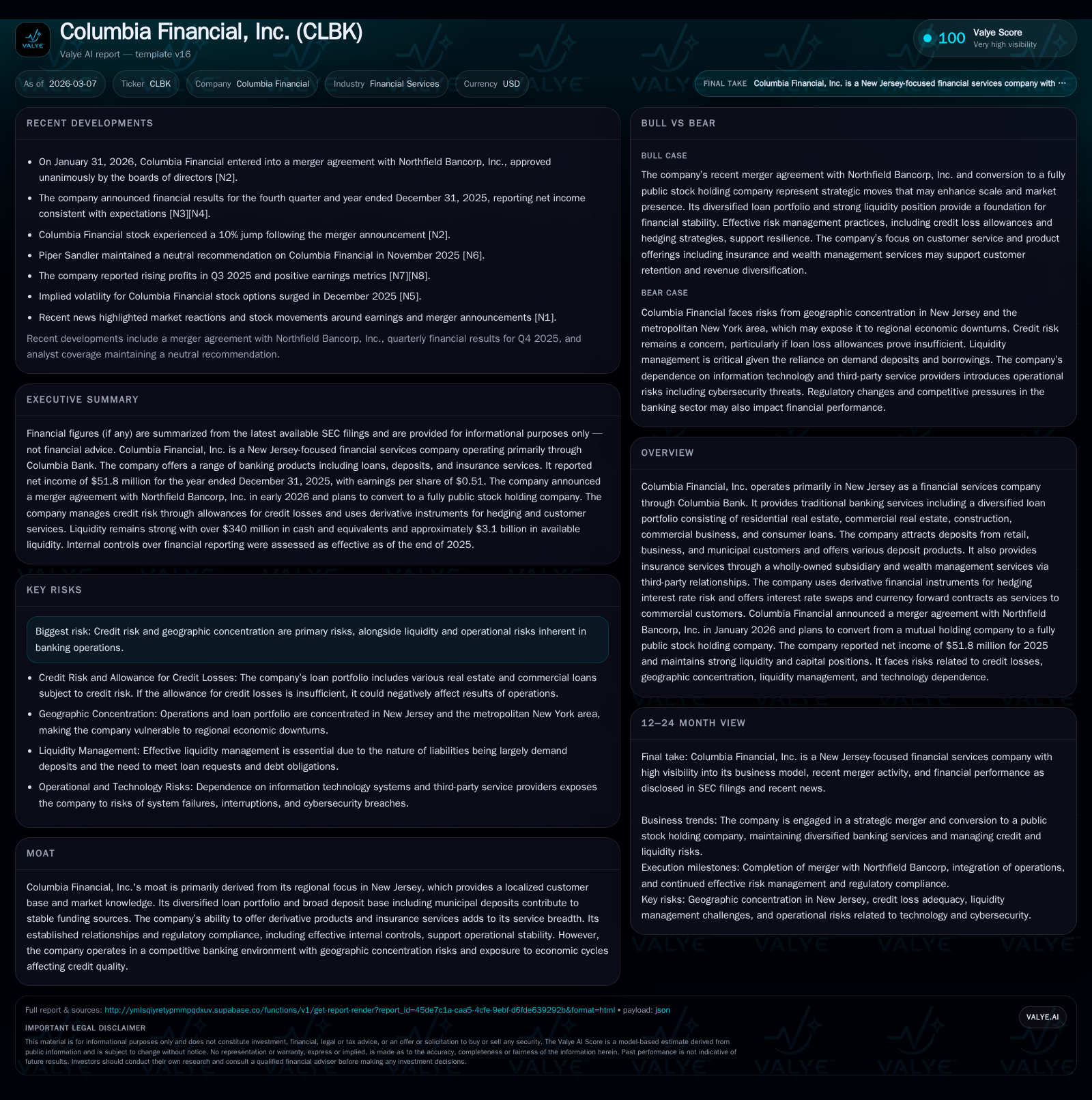
After suffering a net loss in 2024, Columbia Financial posted a robust $51.77 million net income in 2025, reflecting a 544% turnaround underpinned by effective management of credit risk and operating cash flow. The company’s announced merger with Northfield Bancorp in early 2026 signals a strategic shift from mutual holding company to full public stock ownership, expanding its footprint modestly while enhancing capital flexibility. Growth prospects hinge on its diversified loan portfolio concentrated in New Jersey, deposit strategies focused on core and municipal funds, and expanded derivative and insurance offerings. However, regional concentration and credit quality remain key risks amid economic cycles.
Turnaround Trajectory: Historical Earnings and Cash Flow Trends
Columbia Financial’s financial trajectory over the four years leading into 2025 illustrates significant volatility but an especially sharp recovery recently. After posting net income of $86.17 million in 2022 and declining sharply to a $11.65 million loss in 2024, the company engineered an impressive turnaround to $51.77 million net income in 2025—a +544% year-over-year improvement [F1]. This swing reflects both improved credit quality management amid economic pressures and disciplined operational control.
Operating cash flow (CFO) expanded from $33.32 million in 2024 to nearly $68.40 million in 2025—more than doubling the available internal liquidity to support ongoing operations and investments [F1]. Capital expenditures grew moderately by roughly one-third year-over-year to $9.84 million in 2025 from $7.45 million prior, indicating measured reinvestment into infrastructure without excessive strain on cash resources [F1]. Equity increased modestly over the period from approximately $1.08 billion at end-2024 to about $1.16 billion at end-2025, bolstering the capital base that underpins this profitability rebound [F1].
This financial revitalization suggests management effectively navigated the confluence of credit provisioning needs, funding cost pressures, and loan book quality issues that weighed heavily on the prior year. The following table summarizes these key financial performance data points:
Historical performance (annual)
| FY | Net ($mm) | CFO ($mm) | Capex ($mm) | Net YoY |
|---|---|---|---|---|
| 2025 | 52 | 68 | 10 | +544.2% |
| 2024 | -12 | 33 | 7 | -132.3% |
| 2023 | 36 | 41 | 8 | -58.1% |
| 2022 | 86 | 142 | 7 |
Source: SEC companyfacts cache [F1].
Capital returns and efficiency (annual)
| FY | Buybacks ($mm) | FCF ($mm) | ROE% |
|---|---|---|---|
| 2025 | 13 | 59 | 4.5 |
| 2024 | 6 | 26 | -1.1 |
| 2023 | 80 | 33 | 3.5 |
| 2022 | 94 | 135 | 8.2 |
Source: SEC companyfacts cache [F1].
Net income shows a significant bottoming out in FY24 followed by recovery; CFO similarly contracts before rebounding strongly.
Strategic Merger Promise: Impact and Integration Plans
In late January 2026, Columbia Financial announced an agreement to merge with Northfield Bancorp under a plan that simultaneously converts Columbia Bank's organizational structure from a mutual holding company (MHC) model into a fully public stock holding company [N3][S1][S3]. This dual transaction is designed to expand shareholder options by offering shares to depositors and eligible borrowers while creating a combined institution better positioned for growth through expanded capital flexibility.
The merger was unanimously approved by both companies’ boards, signaling broad strategic consensus around enhanced scale benefits within New Jersey’s competitive banking environment [N3][S3]. While not dramatically increasing geographical reach beyond Columbia’s core markets—largely in northern New Jersey—the consolidation promises stronger balance sheet metrics supportive of regulatory compliance under revised capital standards tied to covered savings associations [S1][S23].
The conversion eliminates certain constraints inherent to MHC structures such as limits on stock issuance flexibility, thereby potentially improving the institution's access to external capital markets post-merger [S1]. Integration efforts will focus on harmonizing technology platforms, streamlining lending procedures across product lines, and optimizing branch network overlaps while preserving local customer relationships.
Loan Portfolio Dynamics and Market Positioning
Columbia Bank operates principally within New Jersey but also has exposure extending into neighboring states such as New York and Pennsylvania albeit to lesser degrees [S5][S6]. Its loan portfolio is highly diversified across residential real estate (including one-to-four family homes), multifamily dwellings, commercial real estate (CRE), construction loans, commercial business loans, home equity advances, and some consumer loans [S1][S5][S6]. As a federal savings bank electing covered savings association status under the Home Owners’ Loan Act (HOLA), Columbia benefits from exemption of qualified thrift lender requirements enabling more sizable CRE exposures than typical savings associations [S1].
The composition fosters balance between retail mortgage demand stability and potential yield enhancement from higher-risk commercial or construction financing segments—but inherently carries elevated collateral dependency risk within its non-performing assets (NPAs) given local property market cyclicality [S2]. Management employs rigorous credit evaluation including loan-level collateral appraisal updates at least annually; charge-offs primarily occur upon sustained borrower delinquency supported by fair value collateral assessments less selling costs [S2][S18].
Notably for sector-savvy readers familiar with regional bank portfolios, Columbia appears vigilant against concentration risks by maintaining allowances for credit losses (ACL) based on quantitative macroeconomic forecasts—incorporating factors like unemployment trends, home price indices, vacancy rates—and layering qualitative adjustments for large loan concentrations or emerging delinquency patterns within segments [S2]. The bank annually adjusts reserves reflecting current forecast assumptions over six quarters plus reversion periods [S2].
Forward-Looking Growth Drivers Amid Regional Competition
Looking ahead without explicit company guidance disclosed thus far, growth drivers can be articulated based on strategic priorities revealed through recent filings and news releases:
Core Deposit Expansion: Columbia continues emphasizing shifting toward higher-quality core deposits — particularly retail checking/savings accounts alongside municipal funds — where it employs competitive pricing tactics supplemented by brokered deposits when necessary to optimize liquidity mix [S4]. Municipal deposits afford relatively stable funding given governmental account characteristics.
Derivative Services: Derivative product offerings encompassing interest rate swaps for hedging Federal Home Loan Bank advances alongside customer-driven swaps for CRE borrowers constitute incremental service lines deepening client relationships beyond traditional lending/products—though recognized gains/losses on these instruments flow directly through earnings given lack of hedge accounting treatment for client-forward transactions [S1].
Wealth & Insurance Services: Through wholly owned subsidiaries providing title insurance services and partnerships delivering wealth management solutions via third parties, revenue diversification reduces dependency on net interest margin fluctuations common across regional banks operating primarily in real estate sectors [S1].
Challenges tempering growth include competition intensity among regional peers targeting similar customer bases and geographic concentration limiting large-scale expansion without acquiring additional franchises or entering new states beyond current footprints [N1][N2][S13].
Capital Management and Shareholder Returns
Capital discipline is evident post-loss period as Columbia balances rebuilding equity levels with shareholder return initiatives:
The bank executed about $13.35 million in share repurchases during FY25 compared with $5.89 million prior year—a notable increase but well below peak repurchase activity seen earlier years [$80+ million level] allowing prudent capital preservation during earnings recovery phase [F1][S12][S23].
Dividend policy details remain unspecified in recent disclosures but absence of large-scale dividend distributions aligns with rebuilding retained earnings capacity following challenging credit cycles.
Based on reported financials, approximate return on equity stood near 4.5% for FY25 calculated as net income over average equity—a modest figure reflective of ongoing recovery rather than peak profitability yet consistent with industry peers facing tightening spreads post-rate hikes [F1].
Free cash flow generation after capital investment expanded substantially to an estimated $58.56 million given strong cash flows combined with controlled capex increases sustaining operational investments without exhausting liquidity buffers [F1].
Overall capital adequacy ratios comfortably exceed regulatory minimums supporting flexibility for organic growth or bolt-on acquisitions aligned with merger ambitions [S23].
Risks Embedded in Geographic Concentration and Credit Exposure
Despite strengths grounded in localized market understanding within New Jersey communities serving retail, business and municipal clients alike, geographic concentration remains material risk:
Economic downturns or housing market adjustments specific to the state could disproportionately impact collateral values backing significant portions of the loan book—particularly multifamily residential rentals or speculative construction projects—which may elevate NPA levels beyond current allowance forecasts if prolonged or severe enough [S10][S13].
Credit risk extends also through lending exposure categories susceptible to rising defaults should unemployment spike above baseline economic assumptions embedded into ACL estimates; macroeconomic variables such as GDP contractions or interest rate volatility pose further uncertainty to borrower repayment capacity amid tightening monetary conditions recently observed nationally [S2].
Liquidity risk arises due to asset-liability mismatches common among savings banks where liabilities are dominated by demand deposits payable immediately or short notice whereas assets (loans) are illiquid requiring scheduled amortizations making abrupt depositor withdrawals challenging without tapping supplemental borrowing sources like FHLBNY advances secured by extensive collateral pools managed conservatively by Columbia Bank [S4][S6][S21].
Regulatory compliance frameworks coupled with effective internal controls present mitigating factors but external shocks could stress test these defenses resulting in pronounced earnings pressure or capital consumption.
Service Diversification: Derivative Offerings and Insurance Services
Beyond traditional deposit-taking and lending activities fundamental to community banking models spanning nearly a century since Columbia Bank’s founding in 1927, diversification efforts have introduced ancillary services enhancing client stickiness:
Derivatives include interest rate swaps executed predominantly for hedging interest expense related to Federal Home Loan Bank borrowings classified as cash flow hedges satisfying accounting criteria thereby mitigating income statement volatility—with aggregate notional amounts near $394 million protecting short-term funding cost variability as of end-2025 [S1].
Customer-directed interest rate swap contracts provided as tailored risk management products are simultaneously offset via third-party swaps eliminating speculative positioning; changes in fair value impact earnings immediately rather than through accumulated OCI reflecting their service characterization rather than internal hedging intent [S1].
Currency forward contracts facilitate international trade transactions primarily for commercial customers—with matched counterparty offsets likewise minimizing net market risk exposure—all under plain vanilla derivative mechanics supporting transactional facilitation rather than principal trading activities [S1].
Complementary businesses include title insurance operations via wholly-owned First Jersey Title Services Inc., offering protective legal title assurance integral for real estate transactions central to Columbia’s core lending base; similarly, Columbia Insurance Services Inc., delivers personal/business lines insurance products reinforcing cross-selling opportunities while wealth management is provisioned via third-party alliances ensuring broader household financial needs coverage without direct underwriting risk exposure borne by the bank itself [S1].
What Investors Should Monitor Going Forward
Given no detailed long-term guidance was issued accompanying recent disclosures or merger announcements, several aspects merit close observation going forward:
Merger Completion & Integration: Regulatory approvals progress for the Northfield Bancorp transaction alongside initial integration successes or challenges will influence operational synergies realizable along with impacts on cost structure efficiency.
Credit Quality Trends: Monitoring NPAs trajectory relative to revised economic outlooks affecting residential/commercial real estate valuations locally will be critical especially considering annual ACL estimates subject to macroeconomic model revisions.
Deposit Composition Evolution: Shifts towards core versus brokered deposits or changes in municipal fund balances affect funding costs; overall liquidity position needs sustained vigilance given asset-liability mismatch inherent.
Capital Return Policies Post-Merger: Future buyback pacing or dividend policy adjustments post-public conversion completion will signal confidence level around sustainable earnings generation capacity.
Overall earnings consistency following the profound reversal last reported during calendar year-end results will indicate whether strategic transformation coupled with capital moves translate into durable franchise strength within New Jersey’s competitive banking sector.
This analysis is based solely on publicly filed documents including SEC registrations/filings ([F1], [S#]) and news releases ([N#]) dated through March 7th, 2026 without reliance on forecasts external to stated company disclosures or proprietary projections. Readers should interpret findings respecting inherent limitations stemming from geographic concentration risks typical for regional banks serving localized economies.
Disclaimer: This is research-only, informational analysis and not investment advice. It may include AI-generated interpretation and general industry context. Always verify important details using primary sources.

Comments