
Matson's Revenue Stability and Capital Intensification Spotlight Fleet Renewal and Regulatory Risks
Matson, Inc. sustains stable revenues with narrowing operating income amid a strategic fleet expansion bolstered by Jones Act protections.
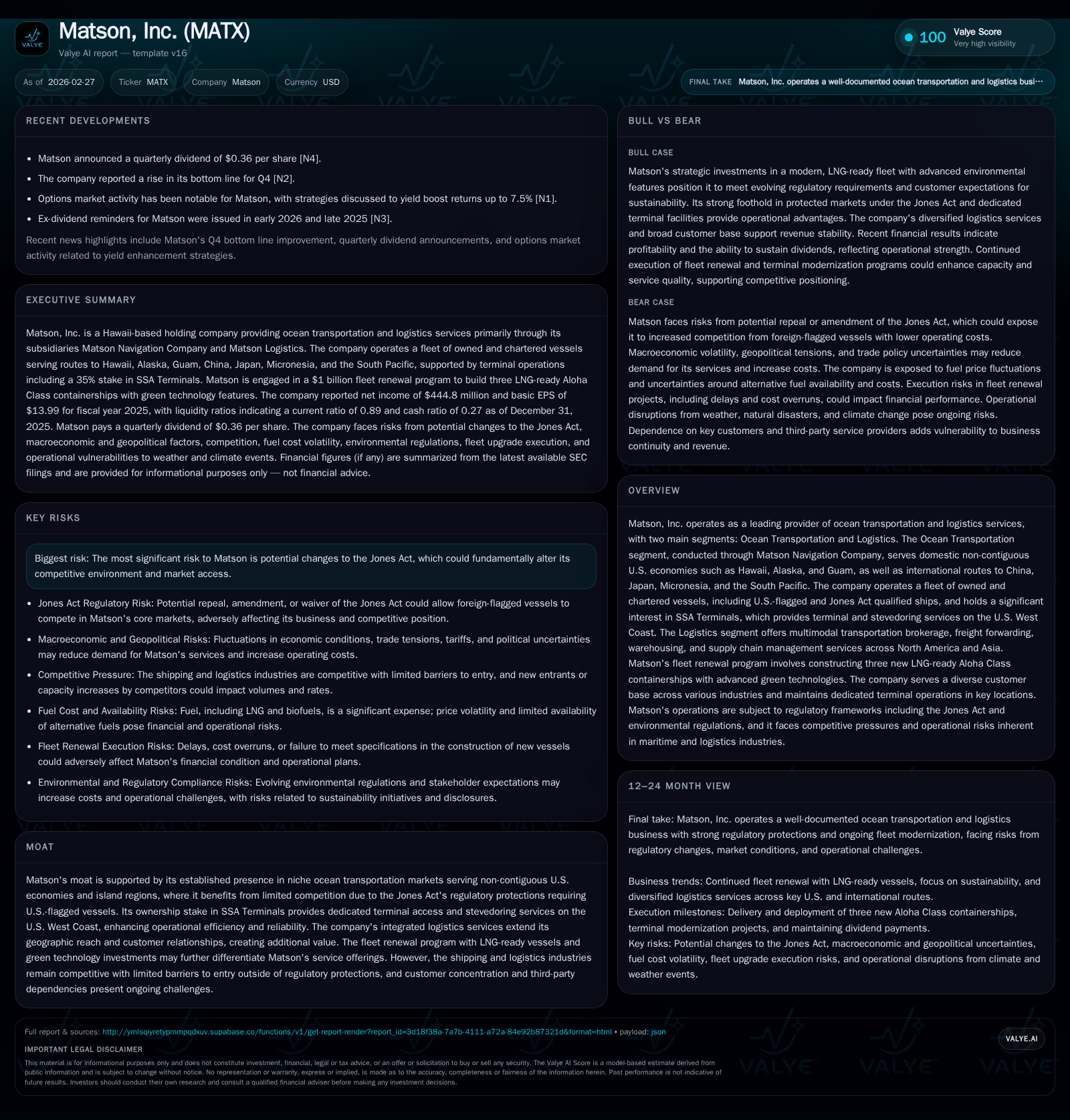
Matson, Inc., a key player in ocean transportation serving U.S. noncontiguous regions and Asia, posted marginally lower revenue in 2025 versus 2024 but maintained robust net income of $445 million. The company is advancing its LNG-ready Aloha Class containership program, reflecting a capital-heavy fleet renewal amid evolving environmental regulations. Matson’s competitive moat largely stems from Jones Act regulatory advantages and strategic terminal partnerships, though risks persist from regulatory challenges and market competition. Close monitoring of operational efficiencies, capital expenditures, and dividend policies will be critical to assess future growth trajectories.
Company Overview
Founded in 1882, Matson, Inc. (MATX) is a vertically integrated ocean transportation and logistics company focused on non-contiguous U.S. markets – notably Hawaii, Alaska, Guam – plus Asian services connecting ports such as China and Japan with the U.S. West Coast. Its two reporting segments are Ocean Transportation (via Matson Navigation Company) and Logistics (via Matson Logistics).
Ocean Transportation constitutes the backbone of Matson's business, moving diverse cargo—ranging from containerized consumer goods to roll-on/roll-off vehicles—throughout niche routes insulated by the Merchant Marine Act of 1920 (Jones Act). This long-standing cabotage law requires vessels moving cargo between U.S. ports to be U.S.-built, owned, flagged, and crewed; this creates significant entry barriers for foreign competitors on domestic lanes like Hawaii-to-California or Alaska routes.
In addition to owning and operating a fleet of U.S.-flagged vessels including roll-on/roll-off ships and container carriers, Matson holds a meaningful minority ownership (35%) in SSA Terminals LLC (SSAT), which operates stevedoring services on the U.S. West Coast providing dedicated terminal access—an operational advantage reducing berth delay risk.[S12][S15]
The Logistics segment complements ocean services by providing multimodal freight brokerage, warehousing, freight forwarding (notably LCL consolidation), customs brokerage, and supply chain management throughout North America and parts of Asia.[S5][S21]
Historical Performance & Drivers
Recent financial data demonstrate Matson's revenue stability amid shifting industry conditions:
Historical performance (annual)
| FY | Net ($mm) | CFO ($mm) | OpInc ($mm) | Capex ($mm) | Net YoY |
|---|---|---|---|---|---|
| 2025 | 445 | 547 | 500 | 393 | -6.6% |
| 2024 | 476 | 768 | 551 | 310 | +60.4% |
| 2023 | 297 | 511 | 343 | -72.1% | |
| 2022 | 1064 | 1272 | 1354 |
Source: SEC companyfacts cache [F1].
Capital returns and efficiency (annual)
| FY | Div ($mm) | Buybacks ($mm) | FCF ($mm) |
|---|---|---|---|
| 2025 | 45 | 303 | 154 |
| 2024 | 45 | 199 | 458 |
| 2023 | 45 | 155 | |
| 2022 | 48 | 397 |
Source: SEC companyfacts cache [F1].
*Note: Prior years reflect highly volatile pandemic/post-pandemic comparisons and supply chain shocks.
From these figures [F1], it is evident that revenue has plateaued with a slight decline last year; however operating income fell more sharply suggesting margin compression—potentially due to rising operating costs including fuel expenses and increased wages amid inflationary pressures.[S22][S18]
Operating cash flows demonstrated stress with a near-29% decrease to $547 million driven partly by elevated working capital requirements or timing factors.[F1]
Capital expenditures have intensified markedly (+27%), primarily driven by payments related to the construction of three new LNG-ready Aloha Class containerships as part of fleet modernization efforts initiating greener operations compliant with International Maritime Organization environmental mandates.[S22][S8]
Matson maintains consistent dividends near $0.36 per share quarterly and has increased share repurchases significantly year-over-year which suggests management confidence balanced with capital reinvestment priorities.[N4][F1]
Growth Prospects & Strategic Initiatives
Matson's future growth prospects hinge substantially on several interrelated factors:
Fleet Renewal & Environmental Compliance: The ongoing construction of three LNG-ready Aloha Class vessels represents a multi-year $1 billion capital commitment toward modernizing their fleet with cleaner fuel technology compliant with global emissions control areas (ECAs). This should increase fuel efficiency and reduce carbon intensity ratings aiding competitiveness especially on transpacific voyages.[S22][S8]
Jones Act Regime & Market Niche: As Matson serves isolated noncontiguous U.S. markets under Jones Act protections which limit effective foreign competition on domestic trades (Hawaii-to-California especially), their competitive moat remains strong barring substantive legislative changes.[S26][S15]
Integrated Terminal Access via SSA Terminals: Their minority stake in SSAT translates to guaranteed access at key terminals such as Long Beach with optimized stevedoring facilitating faster turntimes—a critical competitive edge for both ocean haulage reliability and customer service differentiation.[S12][S15]
Logistics Expansion: Continued leveraging of Matson Logistics' multimodal network spanning North America and Asia facilitates value-added services like supply chain management beyond shipping alone potentially broadening customer scope beyond traditional carrier customers.[S21]
Customer & Geographic Diversification: Serving various industries reduces dependency risks; however customer concentration exists to an extent with top ten logistics customers accounting for about ~17% of that segment’s revenues.[S5]
Risks constraining growth include persistent cost inflation (notably bunker fuel despite cleaner fuels), potential labor disruptions given substantial unionization across operations including those employed by SSAT subcontractors,[S19] possible regulatory tightening or adverse changes in maritime laws—especially attempts challenging the Jones Act's constitutionality now pending litigation—and heightened cybersecurity risk affecting operational continuity given increasing reliance on IT systems.[S18][S26]
Forecasts & Monitoring Points (Analysis)
No specific forward-looking financial guidance has been disclosed explicitly for FY2026 within filings available as of February 2026. Observers should watch:
- The completion schedule for Aloha Class vessels delivery milestones due over next few years impacting depreciation schedules and vessel deployment capacity[S8].
- Operating margin trends relative to fuel cost fluctuations given partial pass-through capabilities but still heavy exposure.
- Developments regarding the constitutional challenge to the Jones Act filed in early 2025 which Matson legally contests vigorously—as any material change threatens core protected trade lanes[S2][S26].
- Potential incremental revenue uplift from expanded logistics solutions offerings or enhanced intermodal partnerships.
- Capital allocation trends particularly balancing ongoing high capex against buybacks/dividends reflecting liquidity priorities[F1].
Returns & Capital Allocation Patterns
Matson exhibits disciplined capital allocation:
- Return on equity approximates ~16%, derived from net income of $445 million versus equity base near $2.76 billion indicating effective deployment of shareholder capital despite heavy reinvestment demands.[F1]
- Dividend distributions remain steady with approximately $45 million paid annually supporting predictable shareholder yield.[N4][F1]
- Share repurchases surged to over $300 million in FY2025 backing stock price support amid moderate earnings declines.[F1]
- Capex commitments are front-loaded linked tightly to vessel construction contracts totaling over $1 billion spanning through late decade years imposing significant cash flow demands.
- Operating cash flow remains positive but down trending from highs signposting caution over liquidity under pressure from operational expenses and capex timing.[F1]
This combination suggests management priorities focus on long-term asset base enhancements suitable for maintaining service quality while retaining investor value through dividends and buybacks—typical for mature shipping operators managing cyclical headwinds.
Industry Context & Sector Nuances (Analysis)
The ocean shipping industry is inherently capital intensive with significant barriers mostly regulatory (e.g., cabotage laws). Matson leverages this landscape adeptly while also navigating broad industry challenges: container shipping cycles face volatile demand shifts impacted by global trade tensions; technology integration enhances visibility but raises cybersecurity stakes; environmental regulations impose evolving compliance costs shaping vessel design choices; fragmented logistics markets require scale or specialization strategies to maintain profitable margins.
Jones Act compliance obligation differentiates Matson sharply from global competitors who favor foreign flags for cost efficiency but cannot serve key domestic trades; this gating factor explains consistent premium pricing power but exposes vulnerability if legislative shifts occur.
Conclusion
Matson continues as a vital maritime lifeline provider sustaining relative top-line stability through niche-market dominance supported by legal protections and terminal control advantages. The firm is heavily investing in fleet sustainability through an ambitious LNG-ready newbuild program aligning with regulatory trends but increasing near-term capital strain. Margin pressures and cash flow dips amid rising operational costs underline the need for operational discipline going forward. The pending judicial review challenging core Jones Act protections represents an existential risk despite current defenses. Dividend maintenance alongside robust buybacks illustrates balanced capital return philosophy backed by adequate profitability metrics. For stakeholders tracking MATX’s trajectory through volatile macroeconomic conditions, focus should remain on regulatory developments, vessel deployment progress, cost containment efficacy, and logistics unit growth execution.
This analysis is based entirely on reported data from public SEC filings through February 2026 along with recent news reports cited; it contains no investment recommendations or forward-looking projections unsupported by disclosed facts.
Disclaimer: This is research-only, informational analysis and not investment advice. It may include AI-generated interpretation and general industry context. Always verify important details using primary sources.

Comments