
Carter's Inc. Faces Growth Constraints and Margin Pressure Despite Market Leadership
North America’s leading children's apparel company grapples with operational challenges, evolving consumer dynamics, and supply chain complexities shaping its near-term trajectory.
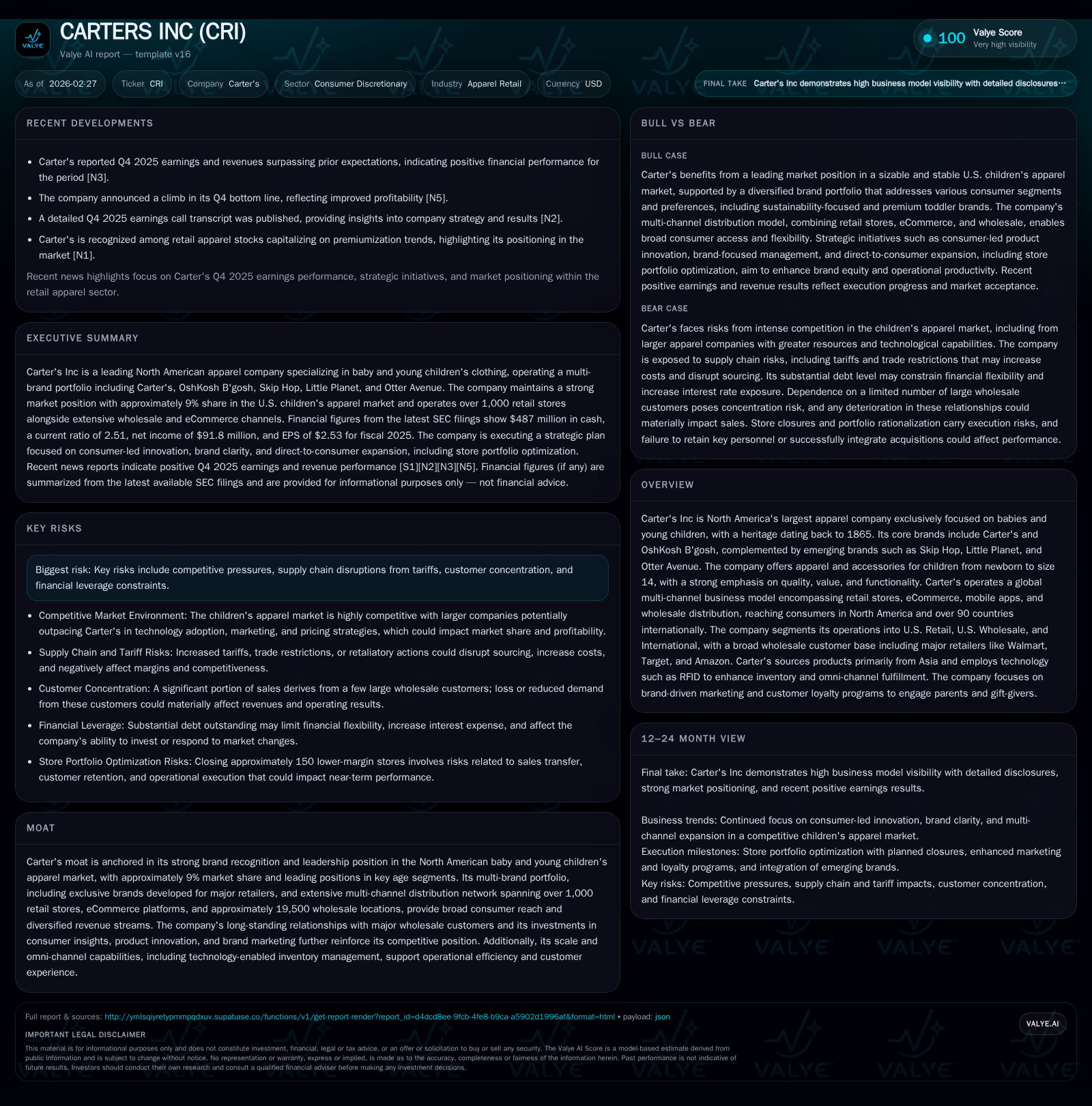
Carter's Inc., the dominant player in North American baby and young children’s apparel, experienced a marked decline in profitability in fiscal 2025 driven by intensified competitive pressures and elevated costs. While the company maintains a robust multi-brand portfolio and a wide-reaching omni-channel platform, growth is expected to be moderated by supply chain uncertainties, macroeconomic factors affecting consumer spending, and strategic store rationalization plans. Capital allocation remains disciplined with stable cash flow generation but a cautious approach to share repurchases. Monitoring inventory management efficiency and wholesale customer concentration will be critical for assessing future performance stability.
Company Overview
Founded in 1865, Carter's Inc. remains North America's largest brand retailer focused exclusively on apparel for babies and young children. Its core portfolio includes flagship brands Carter's and OshKosh B'gosh along with emerging lines such as Skip Hop (parenting essentials), Little Planet (organic/sustainable fabric-based apparel), and Otter Avenue (toddler-focused functional fashion). The company targets newborns through size 14 children with an emphasis on quality value propositions.
Carter's operates an extensive multi-channel business model comprising over 1,068 company-operated retail stores across North America as of January 2026, complemented by vibrant digital commerce platforms including mobile apps and websites [S1][S19]. The wholesale footprint is substantial—approximately 19,500 wholesale locations domestically plus over 1,100 international locations across more than 90 countries via licensees and distributors.
Historical Performance Review
Fiscal year 2025 marked a challenging period where Carter’s operating income declined sharply by approximately 43.5% year-over-year to $144 million from $255 million in FY2024. Net income followed suit falling over 50% to about $92 million [F1]. Operating cash flow contracted massively by nearly 60%, indicating tightened operating efficiency or higher working capital needs. Capital expenditures were slightly lower compared to prior years but remained above $53 million reflecting ongoing investments in retail infrastructure or technology.
Historical performance (annual)
| FY | Net ($mm) | CFO ($mm) | OpInc ($mm) | Capex ($mm) | Net YoY |
|---|---|---|---|---|---|
| 2025 | 92 | 122 | 144 | 54 | -50.5% |
| 2024 | 186 | 299 | 255 | 56 | -20.2% |
| 2023 | 233 | 529 | 323 | 60 | -7.0% |
| 2022 | 250 | 88 | 379 | 40 |
Source: SEC companyfacts cache [F1].
Capital returns and efficiency (annual)
| FY | Div ($mm) | Buybacks ($mm) | FCF ($mm) |
|---|---|---|---|
| 2025 | 56 | 0 | 69 |
| 2024 | 116 | 51 | 243 |
| 2023 | 112 | 100 | 469 |
| 2022 | 118 | 300 | 48 |
Source: SEC companyfacts cache [F1].
Note: Revenue values not provided directly; focus is on profit metrics illustrating margin contraction in FY2025.
Growth Prospects
Carter’s maintains leadership with approximately a 9% market share in the $29 billion U.S. market for zero-to-10-year-old children's apparel as of December 2025 [S19]. The acquisition of emerging brands such as Little Planet reinforces commitment to growing sustainable product offerings amid increasing consumer demand for eco-friendly apparel [S8]. The newly launched Otter Avenue brand aims at toddlers emphasizing independence through functional design launched July 2025.
Growth drivers include:
- Expansion of omni-channel capabilities integrating ecommerce with physical locations supported by RFID-driven inventory management optimizing fulfillment efficiency [S24].
- Enhanced brand focus allowing distinct positioning under the "house of brands" model fostering innovation and consumer engagement.[S25]
- Strategic initiatives targeting productivity improvements via store rationalization — approximately 150 low-margin stores planned for closure over three years — allowing reallocation towards digital channels and high-performing locations.[S24]
- Strengthening wholesale partnerships with key retailers like Walmart (exclusive Child of Mine brand), Target (Just One You), Amazon (Simple Joys), broadening reach within digitally native channels.[S20]
Constraints on growth are significant:
- Supply chain complexities linked to reliance on Asian manufacturers (Vietnam, Bangladesh, Cambodia, India dominate sourcing; China less than 3%) face tariff risks due to U.S. trade policy shifts under the Trump Administration since January 2025 [S6][S9].
- Consumer discretionary spending sensitivity risks amplified in economic downturns or periods of declining confidence impacting apparel purchasing decisions for children [S1].
- Competition intensifies from global players deploying advanced data analytics and AI applications for rapid trend adaptation potentially eroding market share [S21][S22].
- Wholesale customer concentration exposes revenue to credit risks; two largest customers accounted collectively for roughly one-fifth of consolidated net sales in FY2025 with no long-term contracts ensuring continuity [S12][S16].
Forecasts & Milestones
Explicit forward financial guidance was not disclosed in recent filings or earnings releases up to February 27, 2026 [N1][N2][S3]. However, strategic milestones to watch include:
- Execution of portfolio optimization through continued store closures with expected transfer of sales to online channels mitigating fixed cost burdens.
- Progress on the expansion of sustainable product lines aligned with growing consumer demand segments.
- Developments related to supply chain flexibility addressing tariff-induced cost pressures including regional manufacturing shifts or vendor diversification.
- Improvements in omni-channel customer engagement metrics driven by loyalty program enhancements such as Carter's Rewards integrated across digital and physical platforms [S11][S17].
Returns & Capital Allocation
Despite the operational setbacks reflected in earnings contraction during FY2025, Carter’s generated positive free cash flow approximating $68.6 million based on reported operating cash flow minus capital expenditures [F1]. Return on equity for FY2025 stood near ~9.9%, indicating continued modest profitability though well down from prior years due to earnings pressure.
The company suspended share repurchases starting third quarter of FY2024 while continuing dividend distributions albeit at lower aggregate amounts ($56 million dividends paid in FY2025 vs $116 million prior year) reflecting cautious capital stewardship amidst tightening credit facility covenants governed under its asset-based revolving loan agreements [F1][S14][S7][S13]. Dividend payouts remain subject to board discretion influenced by liquidity status and broader financial strategy considerations.
Company covenant restrictions limit the flexibility around additional indebtedness or large asset transactions which may constrain aggressive capital returns or reinvestment strategies absent improved operating cash flows.[S4][S7]
Industry & Competitive Context (Analysis)
The children's apparel sector is characterized by intense competition among both branded specialists like Carter's and private label products offered via large mass-market retailers. The industry's fragmented nature challenges companies to maintain price discipline while balancing consumer expectations on quality and sustainability credentials. Retailers are increasingly investing heavily in AI-driven data analytics to forecast trends rapidly while enhancing customer personalization through digital channels—areas Carter's has acknowledged needing continuous improvement to sustain competitiveness.[S22]
Supply chains remain vulnerable given complex international sourcing predominantly from Asia influenced heavily by tariffs introduced during recent geopolitical shifts which bear heavily on input costs requiring sophisticated mitigation strategies such as geographic diversification or supplier negotiation leverage.[S6]
Consumer behavior shifts toward omnichannel shopping coupled with loyalty programs that seamlessly integrate online-offline experiences dictate operational priorities whereas inventory optimization enabled by RFID technologies plays an increasingly critical role in minimizing markdowns caused by excess stock or missed demand opportunities.[S24]
Risk Factors Summary
Principal risk elements underpinning Carter's outlook include:
- Macro sensitivity: Consumer spending variability tied strongly to economic cycles impacting discretionary purchases.
- Supply chain disruption risk tied primarily to dependency on Asian manufacturers amid tariff environments.
- Wholesale customer concentration posing credit risk exposures without binding contracts restricting revenue visibility.
- Litigation exposure inherent to intellectual property claims or product safety issues that could incur recall costs or reputational harm.[S21][S26]
- Competitive risk from global peers better capitalized or more technologically advanced reducing market position.[S22]
- Operational risk from restructuring execution uncertainties potentially delaying margin recovery.[S26]
- Regulatory compliance risks spanning data privacy laws (e.g., GDPR/CCPA), labor regulations overseas suppliers, environmental standards affecting raw material sourcing practices.[S23]
- Cybersecurity risks impacting customer data protection given reliance on third-party systems.[S26]
Conclusion
Carter's Inc.'s entrenched position as the premier childrenswear specialist in North America gives it a solid foundation supported by diversified brands, a broad channel mix including digital innovation, and significant wholesale partnerships. Nonetheless, fiscal year trends reveal material headwinds primarily arising from supply chain inflationary pressures, shifting trade policies impacting costs, evolving competitive dynamics fueled by technology advances across retail peers, and macroeconomic pressures dampening consumer spending appetite.
The next pivotal phase involves successful execution of the store fleet rationalization coupled with deepening digital commerce penetration supported through enhanced consumer insight capabilities aiming at product relevance advancement notably within sustainability-oriented offerings. Cautious capital deployment underscores prudent management responses toward securing financial flexibility amidst uncertain external conditions while preserving shareholder returns through dividends rather than buybacks currently suspended.
Key performance indicators going forward should focus on margin stabilization progress amid cost pass-through effectiveness measures, inventory turnover rates mediated through RFID systems implementation success, wholesale account credit quality indicators given concentration levels alongside direct-to-consumer loyalty program strength signaling brand affinity expansion.
This carefully calibrated approach reflects recognition of both strategic opportunity areas balanced against pragmatic risk mitigation essential within today’s dynamic children’s apparel industry environment.
This analysis is for informational purposes only based on publicly available regulatory filings and recent news transcripts. It does not constitute investment advice or recommendations regarding securities transactions.
Disclaimer: This is research-only, informational analysis and not investment advice. It may include AI-generated interpretation and general industry context. Always verify important details using primary sources.

Comments