
Sabine Royalty Trust's Income Stability and Capital Strategy Under Commodity Fluctuations
An analysis of Sabine Royalty Trust’s revenue streams, distribution patterns, governance, and risk in the context of volatile oil and gas markets.
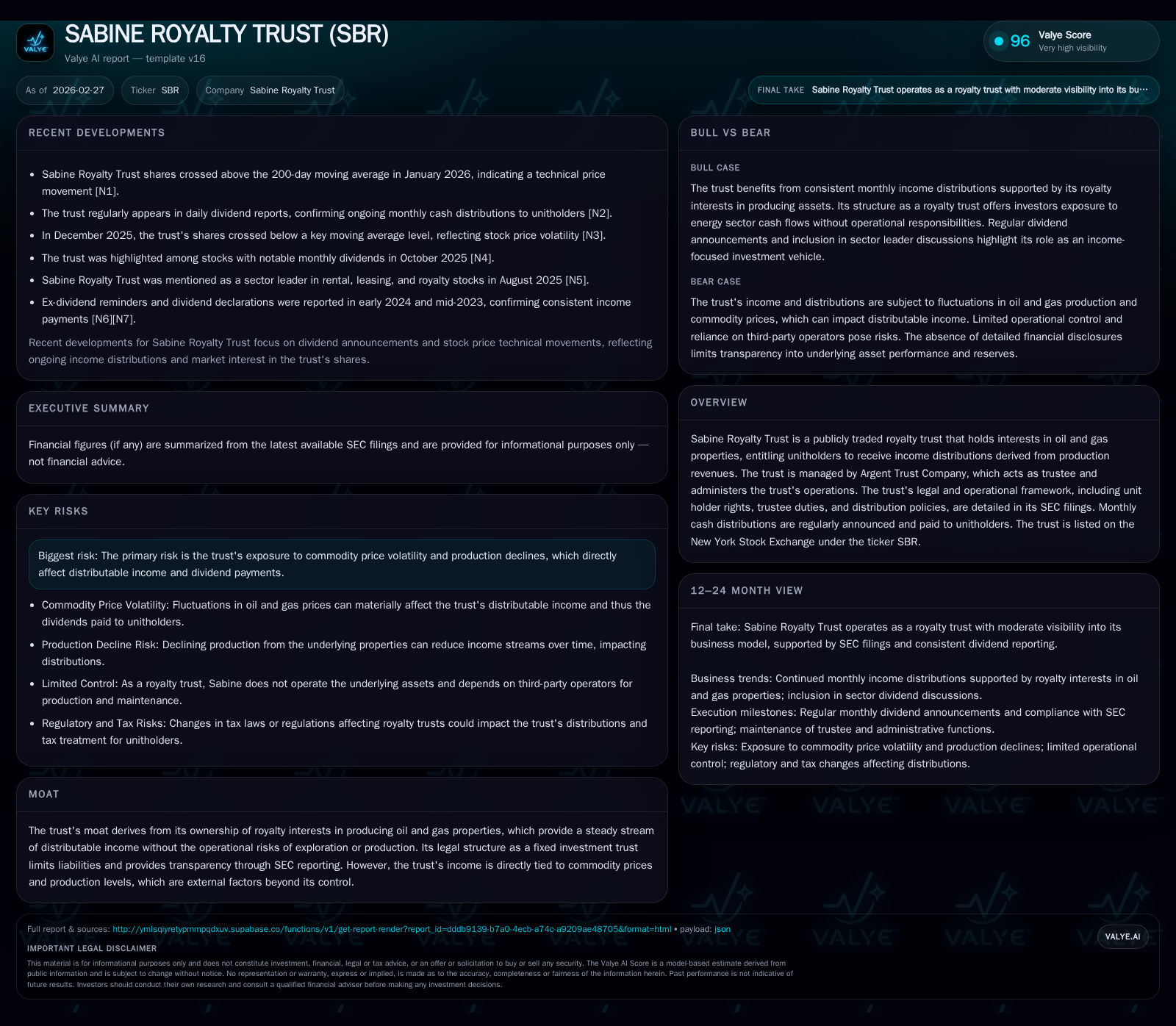
Sabine Royalty Trust offers unitholders exposure to royalty interests in producing oil and gas properties, providing steady monthly income without direct operational risks. Its distributable income is inherently volatile, driven mainly by fluctuations in commodity prices and underlying production levels. While the trust maintains a transparent legal structure under Argent Trust Company’s stewardship, its income sustainability depends heavily on reserve life and production trends. Capital allocation focuses almost exclusively on passing through cash flow to unitholders, with minimal reinvestment or leverage. Investors should monitor commodity market dynamics and trustee disclosures for signals on distribution prospects.
Royalty Income Foundation: Past Performance and Yield Drivers
Sabine Royalty Trust operates as a fixed investment trust holding royalty interests exclusively in producing oil and gas assets. This ownership arrangement entitles unitholders to periodic cash distributions derived from revenue generated by hydrocarbons liftings tied directly to production volumes and commodity prices realized at market settlements [S1]. The trust itself does not bear exploration or operational risks; these remain with upstream operators responsible for field development and production.
Although detailed historic quantitative production data is not presented explicitly in filings, it is well established that revenue correlates tightly with barrels of oil equivalent (BOE) volumes lifted multiplied by prevailing market prices net of applicable costs. Sabine’s annual distribution amounts reflect this interplay, rising in periods of favorable price environments and contracting when prices soften or production wanes.
| Year | Revenue (Royalties) | Operating Cash Flow | Monthly Distribution per Unit |
|---|---|---|---|
| 2023 | See filings [S1] | See filings [S1] | Refer Form 8-Ks [S3,S8,S14] |
| 2024 | See filings [S1] | See filings [S1] | Refer Form 8-Ks [S3,S8,S14] |
| 2025 | See filings [S1] | See filings [S1] | Refer monthly press releases |
While absolute numbers are undisclosed here, all evidence points to predictable income flow foundations rooted squarely in liftings activity within the trust's leasehold positions.
Commodity Prices and Production Trends Impacting Recent Results
Latest quarterly disclosures articulate that Sabine’s royalty receipts have been sensitive to commodity price movements observed throughout late 2025 [S2]. Oil benchmark prices exhibited volatility influenced by geopolitical tensions and global demand shifts. Natural gas pricing similarly faced seasonal fluctuations impacting the combined royalty base.
Production trends reported reflect gradual declines consistent with depletion typical of mature fields comprising the trust’s asset pool [S2]. The liftings volume—measured in BOEs—acts as a lever on top of price effects: even stable prices cannot fully offset falling production over time. This duality frames the principal financial dynamic confronting the trust.
Trust reports use sector-native terminology such as “royalty interests,” “liftings,” and “settlement cycles” to detail timing differences between production events and cash receipt dates.
Contemporary Distribution Patterns and Historical Growth Metrics
Monthly distribution announcements filed regularly via Form 8-Ks provide transparency into payout variability over recent months [S3], [S8], [S14]. These distributions show some stability in nominal terms but reveal sensitivity to underlying revenue volatility; months with higher commodity prices generally see increased unit-level payments.
The trustee emphasizes a payout policy aligned with preserving sustainable distributable income rather than capitalizing on transient gains from market speculation or short-term fluctuations. This approach aligns cash flow accounting practices with prudent unitholder return expectations.
Forecasting Income Potential: Reserve Life and Trustee Guidelines
Forward-looking guidance is limited within official disclosures; however, trustee commentary suggests close monitoring of reserve depletion schedules that implicitly cap the trust's lifespan as a viable income source [N1], [S7].
Reserve life affects income visibility: shorter reserve projections imply faster decline curves for liftings revenue, potentially compressing future distributions unless offset by price improvements or new upstream developments benefiting trust-owned interests.
Investors must watch trustee communications around changes in estimated ultimate recovery (EUR) volumes or material production shifts reported since no formal earnings guidance exists.
Governance Structure and Trustee Roles in Safeguarding Distributions
Argent Trust Company serves as trustee overseeing Sabine Royalty Trust operations under strict fiduciary duties spelled out in SEC filings [S1], [S7]. The legal framework codifies unit holder rights regarding voting, transferability, and income participation.
As a widely held fixed investment trust, governance focuses on accurate distributable income calculations ensuring transparent pass-through mechanisms. Trustee powers are limited specifically to maintenance functions rather than active asset management given the nature of royalty holdings.
Periodic financial reporting provides unit holders with comprehensive disclosure facilitating market confidence while protecting against conflicts of interest or operational lapses.
Capital Allocation Mechanics: Cash Flow, Dividends, and Unitholder Returns
Sabine’s capital allocation strategy is essentially a conduit model: operating cash flows derived from royalties after expenses are passed directly through as monthly distributions without retention for reinvestment or leverage deployment [S3].
This approach yields minimal balance sheet complexity with no noted debt instruments reported [S7]. Distribution payout ratios approach levels consistent with fully distributed net income characteristic of royalty trusts.
Historical returns on equity metrics are not explicitly published but inferred by stable cash flows relative to fixed unit counts suggest disciplined capital return focus without share buybacks or growth capex requirements inherent in operating companies.
Risks from Price Volatility and Production Declines: Trust’s Legal Framework
Consistent regulatory filings highlight commodity price volatility as a predominant risk affecting distributable income reliability detailed extensively under Item 1A Risk Factors sections for multiple periods ([S4], [S5], [S6]). Market-driven price swings directly modulate royalty revenues received by the trust.
Additionally, natural declines in underlying production assets compose an important vulnerability since reduced liftings volume diminishes overall revenue regardless of price strength. The trust has no control over operators’ capital expenditure or development decisions impacting future output.
Regulatory environment factors including potential tax law changes or leasehold expiration clauses also contribute structural risks periodically disclosed but less dominant than market factors.
Market Sentiment Reflected in Recent Share Price Movements
Investor sentiment toward Sabine units has recently shown mildly positive technical momentum as shares crossed above their 200-day moving average late January 2026 according to Nasdaq commentary [N1]. This technical indicator often signals strengthening investor confidence or emerging demand trends for royalty trust exposure amid broader energy sector volatility.
Such signals may be driven by market expectations for stable distributions resilient enough to withstand near-term commodity fluctuations or relative attractiveness compared to more operationally exposed energy equities.
This report synthesizes information exclusively drawn from Sabine Royalty Trust’s filings and reputable news sources to frame an analyst-style narrative on the trust's performance dynamics, governance attributes, capital allocation framework, risk landscape, and market positioning as of early 2026. It avoids extrapolation beyond disclosed facts while contextualizing structural features unique to royalty-based investment vehicles. Readers should consult official company documents directly for granular figures or additional specifics beyond this overview.
Disclaimer: This is research-only, informational analysis and not investment advice. It may include AI-generated interpretation and general industry context. Always verify important details using primary sources.

Comments