
Cheesecake Factory’s Strategic Push Amid Capital and Margin Dynamics
Cheesecake Factory leverages a multi-brand portfolio to drive incremental operating income growth despite margin pressures and a complex debt profile.
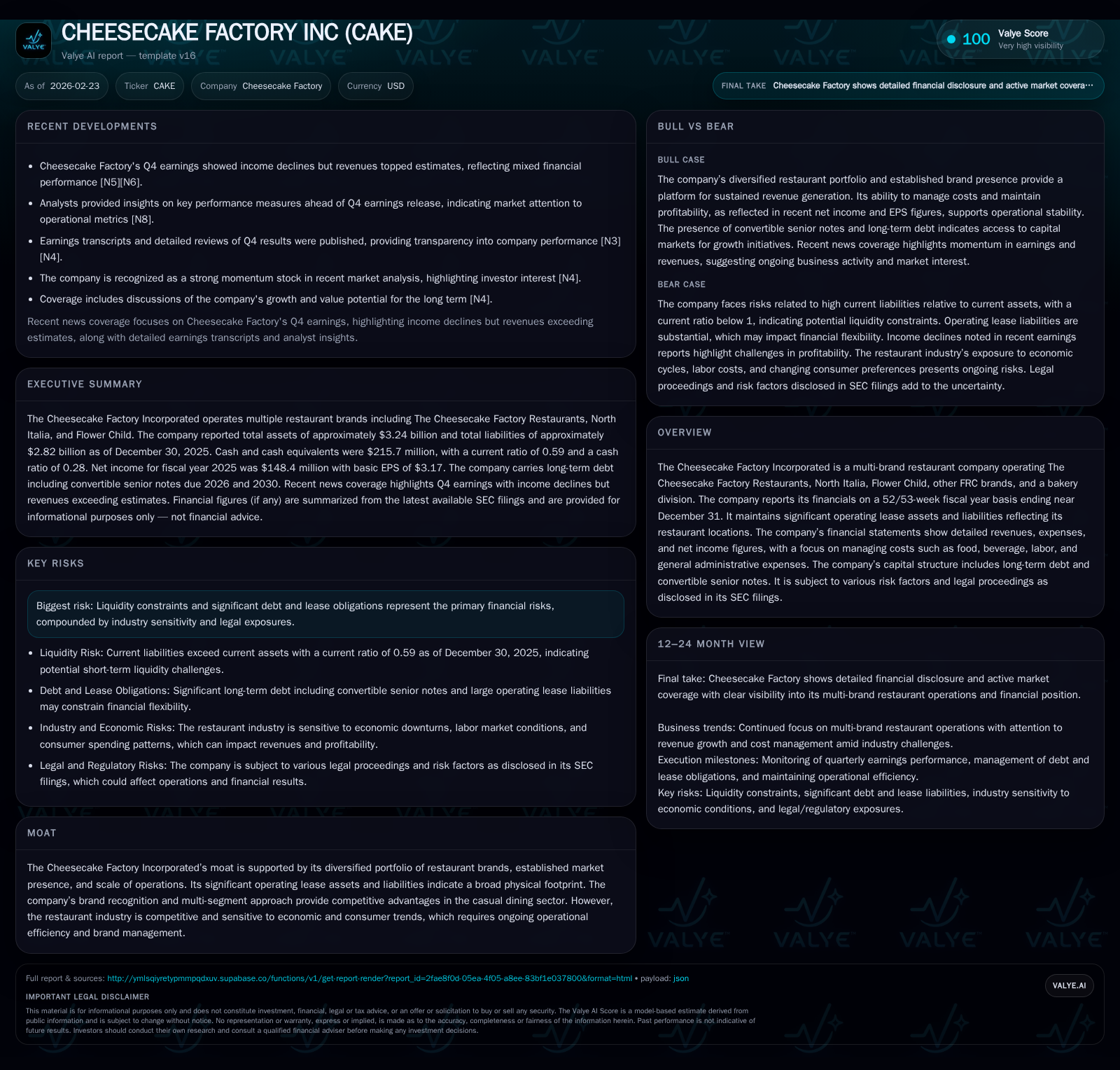
The Cheesecake Factory Incorporated operates a diversified set of restaurant brands, including its flagship Cheesecake Factory restaurants, North Italia, and Flower Child, alongside a bakery division. Over the past few years, the company has demonstrated steady operating income growth, largely driven by scale and brand diversification, even as net income contracted slightly amid rising expenses. Liquidity remains constrained with a current ratio below 1 and substantial lease liabilities impacting covenant calculations. The company's capital allocation reflects a balanced approach between dividends, significant share repurchases in fiscal 2025, and controlled capital expenditures. Legal exposures and operating lease commitments remain notable risk factors, while recent management commentary points to cautious optimism for sustaining sales momentum through pricing and traffic initiatives. Going forward, monitoring cash flow sustainability and debt maturity events will be key to assessing financial flexibility.
Brand Portfolio and Historical Growth Trajectory
The Cheesecake Factory Incorporated has evolved into a multi-brand restaurant operator encompassing its signature Cheesecake Factory casual dining outlets, plus North Italia and Flower Child fast-casual brands, and an associated bakery division primarily supporting in-house dessert inventory [S1][F1]. This diversified portfolio represents a strategic moat enabling the company to spread operational risk across distinct consumer segments within the casual dining space.
Geographically widespread and leveraging large-scale operating lease assets across locations, Cheesecake Factory benefits from physical presence advantages that create barriers to entry for new entrants. The integration of different culinary concepts enhances revenue streams and moderates volatility inherent in the casual dining sector—an industry notably sensitive to economic cycles and evolving consumer preferences.
Historically, this multi-brand approach has supported steady top-line expansion (though specific revenue figures are not available here) alongside controlled cost absorption. Through FY2021 to FY2025, operating income grew significantly from around $82 million up to $187 million, indicating effective scaling of operational leverage over time despite external headwinds [F1].
Operating Income Trends and Profitability Drivers Since 2021
Operating income growth accelerated notably post-2023, climbing from roughly $39 million in FY2023 to $187 million in FY2025 (+380%) supported by revenue expansion and efficiency gains [F1]. However, net income followed a less consistent path: after jumping to about $43 million in FY2023 it increased further but then decreased by approximately 5.3% year-over-year in FY2025 to about $148 million [F1].
This divergence stems largely from rising cost inputs—food inflation compounded by wage pressures have squeezed margins despite moderate price increases. General & administrative expenses also climbed alongside investments aimed at supporting brand positioning.
From a sector perspective, these dynamics underscore the challenge of balancing EBITDAR (Earnings Before Interest, Taxes, Depreciation, Amortization & Rent) margins with requisite pricing agility. EBITDAR forms the financial basis for leveraged covenant monitoring because lease expenses form an integral part of fixed operating costs; margin compression here stresses the importance of cost control to safeguard covenant compliance [N4][S4].
Liquidity Position and Debt Structure Challenges
At fiscal year-end December 30, 2025, Cheesecake Factory reported cash and equivalents of approximately $216 million against current liabilities nearing $777 million—a current ratio of just 0.59—which highlights material short-term liquidity constraints when viewed through traditional working capital metrics alone [F1].
Nevertheless, management mitigates this exposure via revolving credit facility access ($400 million available), letters of credit usage (~$33.5 million), and long-term debt instruments including $575 million convertible senior notes maturing in 2030 plus remaining convertible notes due in mid-2026 [S4][S6][S8].
Leverage is measured prudently by lenders via Net Adjusted Leverage Ratios involving EBITDAR multiples where operating lease rents multiplied by six are treated as debt equivalents—reflecting the underlying fixed obligations embedded in leased restaurant properties common across restaurant chains [S4][S6]. As of mid-2025 reporting dates, compliance with maximum net adjusted leverage ratios capped at 4.25x EBITDAR was maintained comfortably.
Interest rates on borrowings incorporate adjusted Term SOFR or prime rate spreads depending on leverage tiers; standby fees for unused revolver capacity add further financing costs but remain manageable given no outstanding revolver draws post Q1 fiscal 2025 repayments [S4][S6][S8].
Capital Allocation: Balancing Buybacks, Dividends, and Capex
Shareholder returns emphasize buybacks combined with steady dividends while cautiously controlling capital expenditure levels appropriate for sustaining brand infrastructure.
Fiscal 2025 saw over $154 million deployed on common stock repurchases—substantially higher than just over $18 million the previous year—demonstrating an opportunistic approach focused on offsetting equity dilution from employee compensation plans plus boosting per-share earnings metrics [F1][S7][S9]. The board maintains authorization for ongoing repurchases without expiration or minimum purchase requirements.
Dividend payments have remained consistent at roughly $0.27 quarterly per share since early 2025 (approximately aligned with prior periods), signaling commitment to reliable cash returns without risking balance sheet stress given capex or debt service needs [F1][S7][S16].
Capital expenditures declined by nearly 8.8% year-over-year to about $146 million in FY2025 from around $160 million prior year—a discretionary tightening that appears calibrated toward maintenance capital rather than aggressive expansion amid ongoing margin pressures and leverage considerations [F1][S25]. This measured capex profile complements overall liquidity stewardship while supporting multi-brand asset preservation.
Key Risk Factors: Lease Obligations and Legal Exposures
Operating leases constitute a substantial portion of reported liabilities because each restaurant location typically involves long-term leasing arrangements with varying escalations—commonplace in retail/restaurant sectors where owning real estate is less prevalent than leasing.
Leases are financially material not only as line-item obligations but also within EBITDAR-based credit covenants used for leverage assessment: escalating rent costs can effectively increase adjusted debt calculations even if nominal borrowing levels remain unchanged [S4][S21]. This "rental expense multiplier" factor converts lease fees into debt-service equivalents stressing liquidity under tighter scenarios.
Legal proceedings faced by Cheesecake Factory are typical yet diverse—from employment claims and operational lawsuits related to foodservice nuances to intellectual property disputes domestically and internationally [S15][S21]. While such exposures carry potential episodic costs or reputational impact risks, current disclosures suggest no material adverse effects expected on financial position or liquidity thus far.
Future Catalysts and Constraints from Recent Earnings Commentary
Q4 fiscal 2025 earnings transcripts reveal management actively managing price/traffic tradeoffs: initiatives include calibrated menu pricing increments aligned with cost inflation offsetting weak-to-flat guest counts nationally but preserving revenue growth momentum [N2][N4]. Labor cost management remains focal amid tight employment markets with wage inflation partly absorbed through enhanced productivity efforts.
Momentum characteristics identified in recent analyst coverage highlight investor focus on operational resilience despite sector-wide uncertainty—prompting cautious optimism for maintaining positive EBITDAR trends consistent with financial covenant comfort zones [N9][N12].
Constraints emerge chiefly from macroeconomic variables impacting consumer discretionary spending patterns—particularly relevant for casual dining where visitation frequency can fluctuate sharply based on economic cycles.
What to Watch: Earnings, Cash Flow Sustainability, and Debt Maturity Milestones
Looking ahead into fiscal 2026, stakeholders should monitor quarterly earnings releases focusing on comparisons versus analyst expectations especially underlying traffic data.
Free cash flow sustainability (defined as operating cash flow minus capital expenditures) will critically influence continued capacity for dividend distribution stability plus opportunistic share repurchases without deploying additional leverage unnecessarily —FY2025 achieved approximately $155 million free cash flow after capex deductions indicating moderate cushion currently exists [F1].
Key debt maturities lie primarily around mid-2026 for remaining convertible senior notes ($69 million gross principal as of early 2025 post-repurchase transactions) followed by larger notes refinancing decisions or conversions required approaching March 2030 maturity date for the recent issuance [$575 million principal amount]—events essential to watch given their potential balance sheet implications [S22][S26].
Macroeconomic environment shifts affecting interest rates or consumer confidence may adjust borrowing costs or sales forecasts respectively—thus warranting vigilant analysis of earnings call guidance updates throughout the year.
Historical Financial Performance Summary
Historical performance (annual)
| FY | Net ($mm) | CFO ($mm) | OpInc ($mm) | Capex ($mm) | Net YoY |
|---|---|---|---|---|---|
| 2025 | 148 | 301 | 187 | 146 | -5.3% |
| 2024 | 157 | 268 | 178 | 160 | +263.6% |
| 2023 | 43 | 162 | 39 | 112 | |
| 2021 | 72 | 213 | 82 | 67 |
Note: Omitted columns lack sufficient annual XBRL coverage in the provided tags (need ≥2 annual points): Rev, Div. Source: SEC companyfacts cache [F1].
Capital returns and efficiency (annual)
| FY | Buybacks ($mm) | FCF ($mm) | ROE% |
|---|---|---|---|
| 2025 | 154 | 155 | 34.0 |
| 2024 | 18 | 108 | 35.4 |
| 2023 | 63 | 49 | 14.8 |
| 2021 | 6 | 146 | 21.9 |
Source: SEC companyfacts cache [F1]. *Dividends paid data unavailable for these years from provided tags; see narrative for dividend discussion.
This analysis synthesizes publicly disclosed SEC filings including latest annual Form-10K dated February 23rd, recent quarterly filings throughout fiscal year ending December-30-2025 along with management commentary conveyed during Q4 earnings releases accessed via Nasdaq transcript sources [N2],[N4],[N12], among others. Significant care was taken not to infer beyond available data points respecting financial metrics such as revenue where absence precludes detail; accordingly all percentage changes refer strictly to documented values. While The Cheesecake Factory demonstrates strategic brand-driven operating income growth amidst challenging input cost environments paired with proactive capital return policies via buybacks/dividends complemented by controlled capex spending there remains cautious awareness around liquidity positioning affected by substantial lease obligations typical within casual dining sector frameworks using EBITDAR-adjusted leverage metrics. Potential investors must follow upcoming quarterly results intensely for indications regarding free cash flow generation ability supporting distributions combined with refinancing or conversion strategy clarifications addressing convertible note maturities approaching over next five years. As always market participants should weigh these complex tradeoffs comprehensively rather than reduce performance narratives solely down to headline earnings figures.
Disclaimer: This report is prepared solely for informational purposes reflecting data publicly available as of publication date without any investment advice or recommendation regarding securities mentioned herein.
Disclaimer: This is research-only, informational analysis and not investment advice. It may include AI-generated interpretation and general industry context. Always verify important details using primary sources.

Comments