
McDonald's Accelerates Restaurant Expansion and Digital Growth Amid Rising Capex
Record unit openings and enhanced digital capabilities drive top-line growth while rising investments signal capacity scaling.
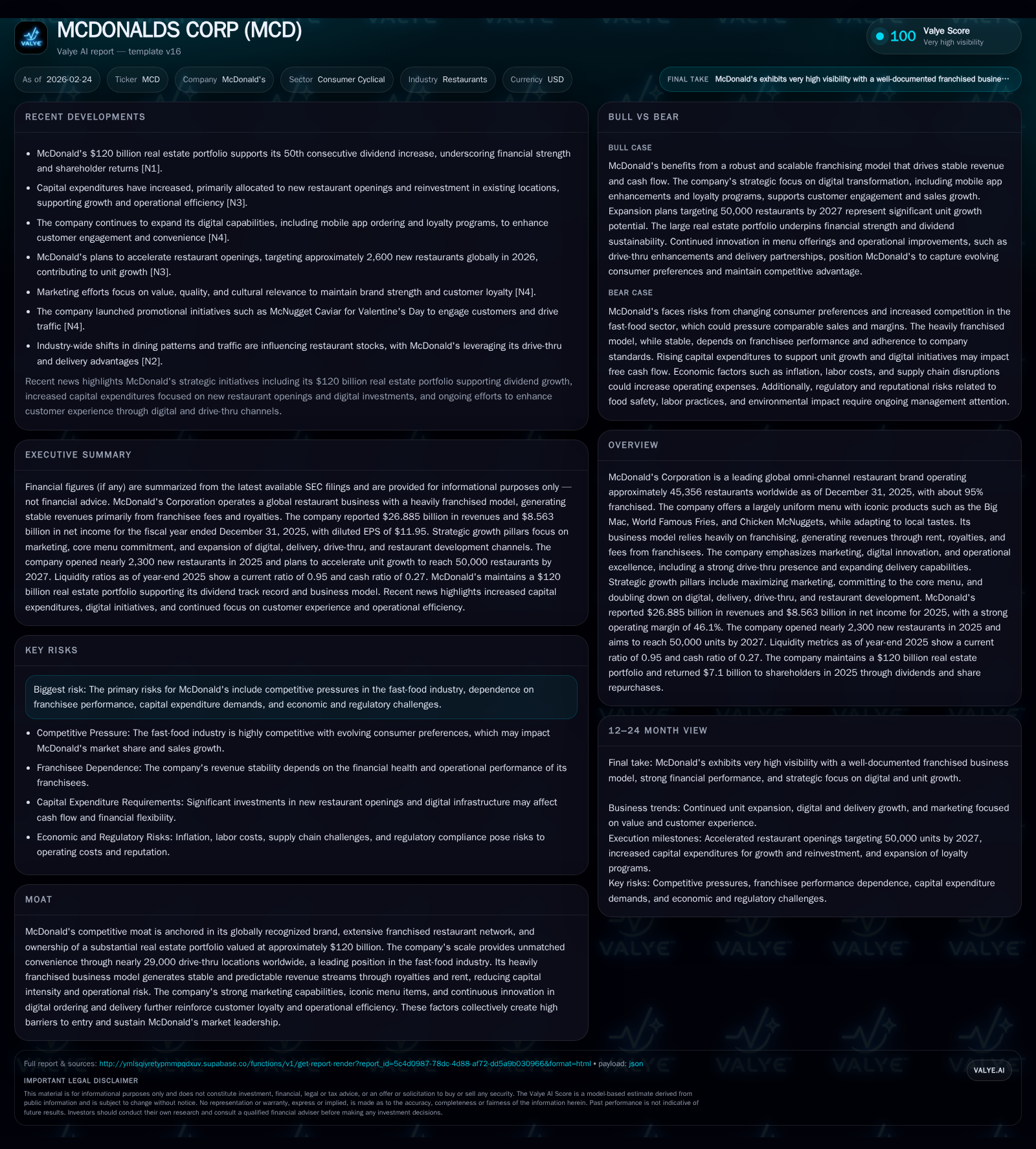
McDonald's Corporation reported moderate revenue growth in 2025, supported by new restaurant openings and expanding delivery and digital platforms. The company continues to leverage its extensive drive-thru network, iconic menu, and global brand strength. Capital expenditures increased significantly to fund aggressive unit development targeting 50,000 global locations by 2027. Operating margins showed improvement despite inflationary pressures, while capital allocation balances growth investments with a commitment to dividends and share repurchases amid a competitive quick-service industry.
Overview
McDonald's Corporation is the leading global quick-service restaurant (QSR) brand with approximately 45,356 restaurants worldwide at the end of 2025, of which about 95% are franchised. This asset-light model relies heavily on royalties, rents, and fees from franchisees rather than capital-intensive operations, supporting scalability while mitigating operational volatility typical in consumer cyclical sectors [S6][S16].
Historical Performance and Growth Drivers
From fiscal year 2022 through 2025, McDonald's showed consistent earnings momentum alongside measured revenue growth:
Historical performance (annual)
| FY | Rev ($bn) | Net ($bn) | CFO ($bn) | OpInc ($bn) | Rev YoY | Net YoY |
|---|---|---|---|---|---|---|
| 2025 | 26.9 | 8.6 | 10.6 | 12.4 | +3.7% | +4.1% |
| 2024 | 25.9 | 8.2 | 9.4 | 11.7 | +1.7% | -2.9% |
| 2023 | 25.5 | 8.5 | 9.6 | 11.6 | +10.0% | +37.1% |
| 2022 | 23.2 | 6.2 | 7.4 | 9.4 |
Note: Omitted columns lack sufficient annual XBRL coverage in the provided tags (need ≥2 annual points): Capex. Source: SEC companyfacts cache [F1].
Capital returns and efficiency (annual)
| FY | Div ($bn) | Buybacks ($bn) | FCF ($bn) |
|---|---|---|---|
| 2025 | 5.1 | 2.1 | 7.2 |
| 2024 | 4.9 | 2.8 | 6.7 |
| 2023 | 4.5 | 3.1 | 7.3 |
| 2022 | 4.2 | 3.9 | 5.5 |
Source: SEC companyfacts cache [F1].
Sources: SEC filings and company facts [F1]
Revenue growth was supported by systemwide sales expansion driven by comparable sales gains in key regions and robust unit development totaling approximately +2,300 net new restaurants in fiscal year 2025 [S18][S11]. The franchised segment constitutes the majority of margin dollars (~90%), benefiting from scalable royalty streams linked to system sales volumes.
Operating income grew steadily despite inflationary pressures on food costs and labor expenses, aided by efficiencies in drive-thru operations and technology deployments that enhance throughput and customer experience [S21]. Operating margin hovered near the mid-40s percentage range.
Strategic Growth Initiatives and Outlook
Restaurant Development
McDonald's targets approximately ~50,000 restaurants globally by end-2027, up from ~45,356 at the end of 2025—implying annual net unit growth above historical averages with about ~2,100 net additions expected for FY2026 alone [N3][S9][S14]. Planned openings include roughly ~750 new units in U.S./International Operated Markets with franchisees contributing an additional ~1,800 units.
Digital Transformation
The company continues investing heavily in digital capabilities: integrating delivery ordering into its mobile app (currently live in five major markets), expanding loyalty programs aiming for over 250 million active users by end-2027, and deploying "Ready on Arrival" technology that enables order preparation before customer arrival to reduce wait times [S13][S14]. These initiatives support personalized offers that increase customer spend.
Core Menu Focus
McDonald's remains committed to enhancing its iconic core menu items such as the Big Mac through the "Best Burger" initiative targeting improved burger quality globally by end-2026 while aggressively expanding its chicken offerings like the McCrispy sandwich family to capture growing category demand [S10][S13].
Financial Milestones & Guidance
For fiscal year ending December 31, 2026, management provided forward-looking expectations:
- Systemwide sales growth contribution from approximately +2.5% net restaurant unit expansion (constant currency).
- Selling, general & administrative expenses targeted at about ~2.2% of systemwide sales.
- Operating margin anticipated in the mid-to-high forties percentage range.
- Interest expense expected to rise between +4–6%, reflecting higher average interest rates.
- Effective tax rate forecasted between ~21–23%, acknowledging potential quarterly variability.
- Capital expenditures estimated between $3.7–$3.9 billion focusing primarily on new restaurant openings. These projections indicate sustained aggressive growth balanced against cost discipline amid macroeconomic uncertainties [S4][N3].
Capital Allocation & Returns
McDonald's capital allocation strategy prioritizes investing in growth initiatives alongside maintaining strong shareholder returns:
- Dividends paid increased to $5.12 billion in FY2025 (+5%), marking the company's ongoing commitment including its upcoming milestone of fifty consecutive annual dividend increases [F1][N6].
- Share repurchases totaled $2.06 billion in FY2025, lower than prior years but still significant within available free cash flow.
- Free cash flow (operating cash flow minus capex) approximated $7.19 billion in FY2025 supporting dividend coverage and repurchase activity.
- Shareholders' equity remains negative at approximately -$1.79 billion due primarily to accumulated treasury stock from extensive buybacks rather than operational weakness; leverage metrics remain within manageable levels typical for large-cap QSR firms [F1][S29].
Operational Advantages & Competitive Moat
McDonald's competitive advantage stems from its unparalleled scale—nearly ~29,000 global drive-thru lanes providing unmatched convenience—and an extensive real estate portfolio valued near $120 billion that generates steady rental income streams mitigating capital intensity risks associated with company-operated store models seen among peers like Wendy's or Chipotle [N6][S23]. Reinvestment into digital platforms enhances operating leverage through faster service times while deepening consumer loyalty via personalized digital engagement counters competitors' AI-driven personalization efforts [N4][N10].
Industry Context & Competitive Considerations
The quick service restaurant sector faces evolving consumer preferences favoring convenience and value alongside health-conscious menu innovation trends affecting broad peer groups. Competition includes fast casual entrants and third-party delivery ecosystems intensifying market dynamics; McDonald's scale advantage coupled with diversified ownership structures positions it well but requires ongoing innovation vigilance especially against regional players leveraging localization or premium positioning. Regulatory scrutiny around labor laws, food safety, and marketing remains elevated necessitating proactive compliance investments ([S23]).
Conclusion & Monitoring Points
McDonald's is positioned for a significant expansion phase complemented by enhanced digital penetration reinforcing its leadership within the global QSR segment. Key factors to monitor include:
- Execution pace of net restaurant openings managing supply chain or labor cost shocks.
- Adoption velocity of digital initiatives translating into measurable sales lift.
- Margin resilience amid inflationary pressures particularly commodity pricing and wages.
- Balance between increased capital expenditures versus maintaining strong free cash flow generation supporting steady dividends. The forthcoming quarters will clarify how effectively McDonald's navigates these dynamics sustaining its multi-decade brand dominance.
This analysis is based solely on publicly available information without investment advice or recommendations.
Disclaimer: This is research-only, informational analysis and not investment advice. It may include AI-generated interpretation and general industry context. Always verify important details using primary sources.

Comments