
Vir Biotechnology Confronts Capital Constraints and Clinical Uncertainties Weighing on Profitability
Vir Biotechnology's 2025 financials reflect revenue decline and sustained losses amid strategic restructuring and R&D investment.
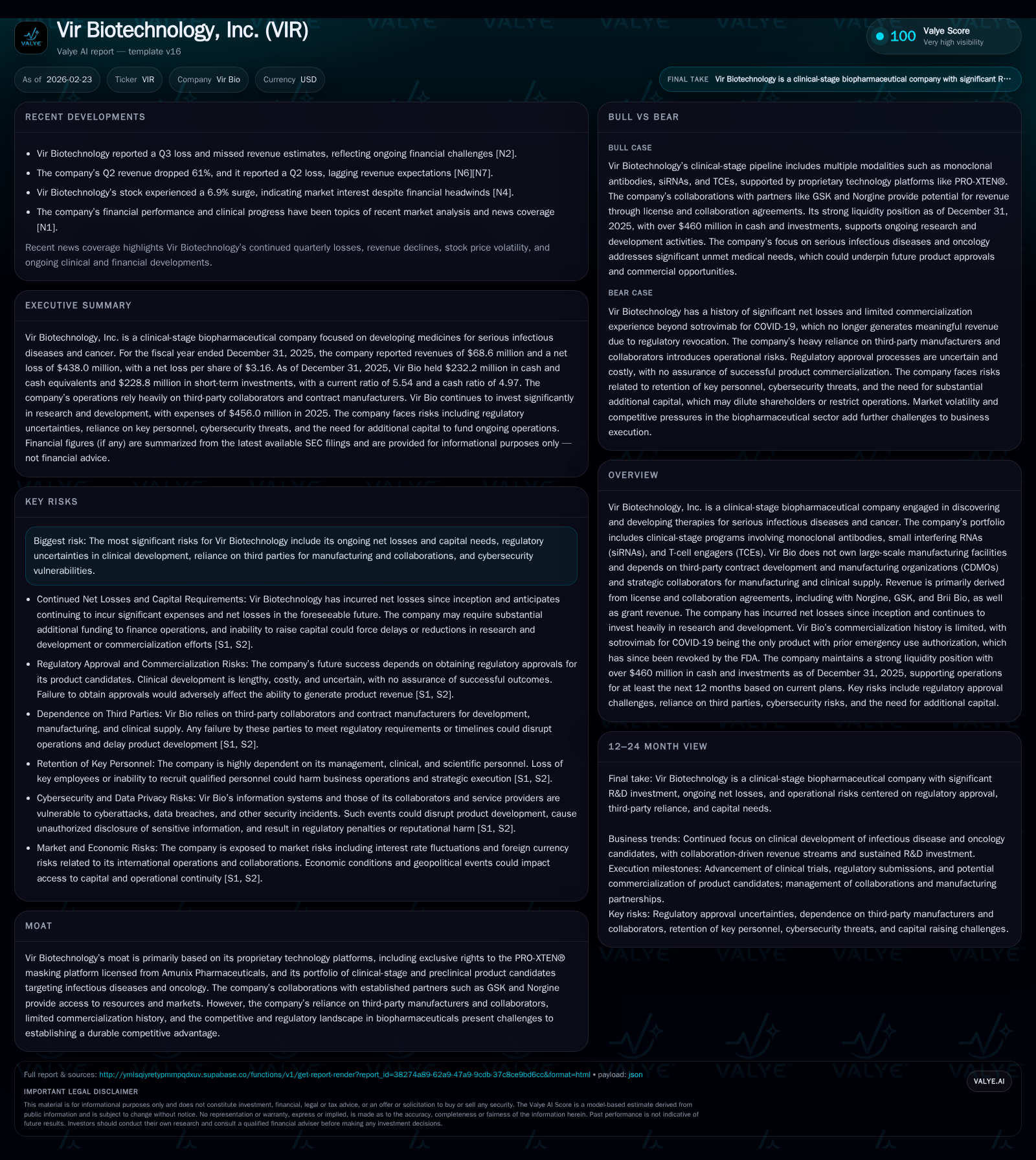
Vir Biotechnology, a clinical-stage biopharma focused on infectious diseases and oncology, reported 7.6% revenue decline in 2025 to $68.6 million, continuing its trend of net losses with a net loss of $438 million. The company remains heavily dependent on third-party collaborations for development and manufacturing, lacks a diversified commercial product portfolio beyond sotrovimab, and faces regulatory and operational risks. Cost-saving restructuring initiatives contributed to improved operating income margins, but significant cash burn persists. Future growth hinges on clinical progress of pipeline candidates like VIR-5500 under a new Astellas collaboration, while regulatory environments and reimbursement pressures pose ongoing challenges. Vir’s capital position is robust but constrained by high R&D expenses and no dividend or buyback programs.
Historical Performance: Declining Revenue Amid High Investment
Vir Biotechnology has maintained its position as a clinical-stage biopharmaceutical firm focused on infectious diseases and cancer therapies, operating with limited commercial products—most notably sotrovimab for COVID-19 under emergency use authorization previously granted. Its revenue primarily derives from licensing fees, collaboration agreements (with companies such as Norgine, GSK, and Brii Bio), and grant funding [S1][F1].
Financial highlights over the past four years reveal significant volatility linked both to product commercialization attempts during the pandemic era and ongoing R&D intensity:
Historical performance (annual)
| FY | Rev ($mm) | Net ($mm) | CFO ($mm) | OpInc ($mm) | Rev YoY | Net YoY |
|---|---|---|---|---|---|---|
| 2025 | 69 | -438 | -392 | -479 | -7.6% | +16.1% |
| 2024 | 74 | -522 | -446 | -587 | -13.9% | +15.1% |
| 2023 | 86 | -615 | -779 | -684 | -94.7% | -219.2% |
| 2022 | 1616 | 516 | 1663 | 833 |
Note: Omitted columns lack sufficient annual XBRL coverage in the provided tags (need ≥2 annual points): Capex, Div, Buybacks, ROE%. Source: SEC companyfacts cache [F1].
Capital returns and efficiency (annual)
| FY | FCF ($mm) |
|---|---|
| 2025 | -397 |
| 2024 | -454 |
| 2023 | -800 |
| 2022 | 1595 |
Source: SEC companyfacts cache [F1].
*Note: Revenue spike in FY2022 primarily driven by pandemic-related sales (sotrovimab EUA), not recurring.
Revenues have decreased steadily since the peak pandemic sales in 2022 as emergency use authorizations expired and grant receipts shrank from $10.5 million in 2024 to $2 million in 2025 [F1]. Operating losses narrowed by about 18% year-over-year in 2025 despite lower revenues due in part to restructuring efforts [S1][S24].
Expense Structure
The company’s steep operating losses are driven mainly by sustained investments in research programs — personnel costs increased prior to recent reductions — clinical trial expenditures, contract manufacturing fees (reflecting outsourced production needs), as well as selling, general and administrative expenses [F1][S1]. Restructuring concluded mostly by late 2024 reduced these burdens somewhat.
Future Growth Prospects: Pipeline and Collaborations
Vir’s future growth is tied closely to advancing its clinical pipeline beyond sotrovimab’s limited commercial footprint [N3][S1]. In February 2026, Vir entered a strategic licensing deal with Astellas US LLC to co-develop VIR-5500—a proprietary PRO-XTEN masked dual T-cell engager targeting PSMA for prostate cancer [S3]. This signals an important diversification into oncology leveraging Vir’s technology platform.
Other candidates involve monoclonal antibodies, siRNAs, and T-cell engagers against infectious agents including HIV (under Gates Foundation collaboration) and tuberculosis [S1]. However, timelines remain uncertain given regulatory complexities; development costs will fluctuate with trial enrollment rates, safety monitoring demands, and manufacturing scale-up overseen via third parties [S1]. The company’s capital requirements depend on how swiftly these programs proceed through costly clinical stages.
Forecasts and Milestones: What to Monitor
Explicit financial guidance is absent; however, investors should watch progress through key clinical phases such as Phase 1 initiation for VIR-5525 (noted milestone payment received in 2025) or patient enrollment velocity in registrational studies like ECLIPSE for coronary heart disease therapies [S22]. Commercialization milestones under collaborations also materially impact near-term cash flows.
Policy developments impacting drug pricing and reimbursement—particularly U.S.-based Medicare/Medicaid reform efforts—and international regulatory approvals bear close tracking for their potential downstream effect on market access [S4][S17][S19].
Returns Profile and Capital Allocation
Vir has yet to achieve profitability; net losses persisted for all recent years tracked except for the outsized positive year of FY2022 when pandemic product demand peaked [F1]. Approximate return on equity based on latest annual results is negative ~21% reflecting heavy net losses despite sizable equity capital raised since inception.
Operating cash flow remains deeply negative by nearly $392 million annually even after efficiency gains stemming from restructuring [F1][S22]. Capital expenditures are relatively modest (under $5 million yearly), consistent with Vir’s reliance on contract development/manufacturing organizations rather than owning production facilities [S1].
No dividend payments or share repurchase programs have been indicated; capital allocation prioritizes funding research activities through equity raises supplemented by upfront license payments including a recent $64 million initial receipt under Norgine agreement [S22].
Sector Context & Strategic Considerations
In the competitive biopharmaceutical space where Vir resides—clinical-stage specialty therapeutics—establishing a durable moat depends heavily upon proprietary platforms (such as Vir’s PRO-XTEN® masking technology), successful execution of clinical trials overcoming regulatory bottlenecks, securing robust intellectual property protection against biosimilars/generics post-approval, plus effective commercialization partnerships [S1][N3]. Reliance on third-party manufacturers inherently exposes Vir to supply chain risks amplified by geopolitical uncertainties limiting patient enrollment diversity or trial continuation [S1]. The drug development timeline variability combined with intensifying U.S. healthcare pricing reforms create additional uncertainty around launch economics.
Privacy landscape shifts (GDPR compliance in Europe; HIPAA-related standards domestically) impose rising complexity around data management crucial for clinical studies [S10][S16]. Furthermore, the company faces substantial compliance demands under anti-bribery/anti-money laundering laws relevant across international collaborations [S19][S12].
Conclusion
Vir Biotechnology illustrates a classic innovation-driven biotech at an inflection point: accelerating promising new clinical-stage assets while managing costly development expenses within an evolving healthcare ecosystem marked by pricing pressures and regulatory scrutiny.
Although cash reserves are supportive for near-term investment cycles ($781 million liquid at end-2025), the sustained cash burn coupled with limited revenue scaling until new asset commercialization poses ongoing financial challenges [F1][S22]. Monitoring key collaborations (e.g., Astellas partnership), pipeline milestones with clinical readouts, regulatory approvals outside emergency use contexts, plus healthcare coverage outcomes will be critical markers assessing Vir's trajectory toward establishing a commercial foundation beyond licensing revenues.
This analysis is based solely on publicly available SEC filings and company disclosures as of February 23, 2026, without provision of investment advice.
Disclaimer: This is research-only, informational analysis and not investment advice. It may include AI-generated interpretation and general industry context. Always verify important details using primary sources.

Comments