
Virtu Financial’s 2025: Scaling Market Making Against Rising Costs and Regulatory Complexity
Virtu Financial posted robust revenue and earnings growth in 2025, powered by its technology-driven market making business, while managing elevated operating expenses and regulatory demands.
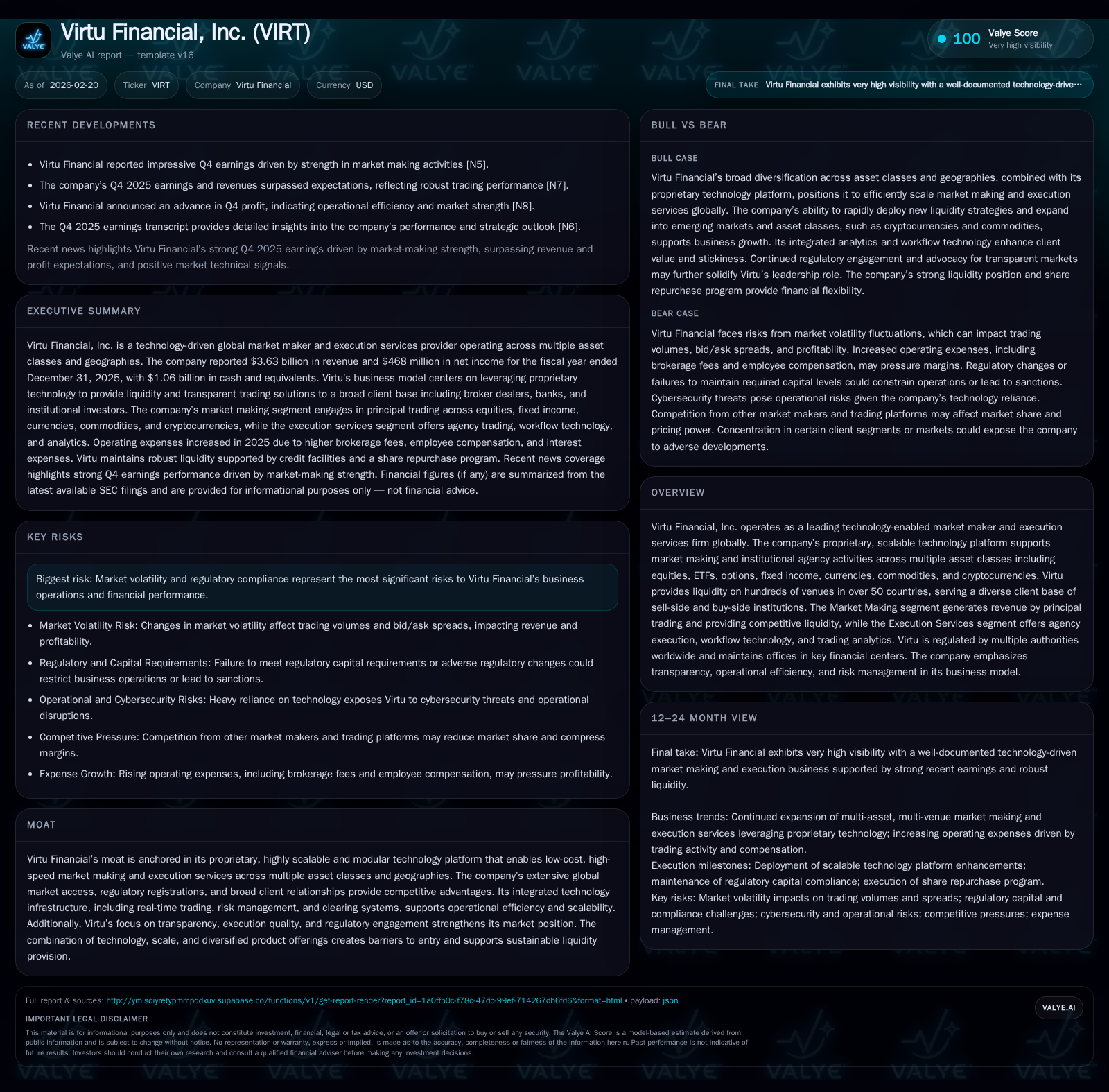
Virtu Financial exhibited strong top-line expansion with revenues up 26% year-over-year in 2025, supported by increased market making volumes across multiple asset classes globally. Its proprietary, scalable trading technology platform continues to confer competitive advantage amid a complex regulatory landscape. Despite rising brokerage fees, compensation costs, and interest expenses linked to securities lending and collateral financing, Virtu maintained solid profitability, delivering nearly 30% return on equity. Cash flow from operations remains healthy with ample liquidity to support capital expenditures and return of capital initiatives. Key growth drivers include geographic expansion and product diversification, though regulatory constraints and market volatility pose ongoing risks.
Historical Performance: Growth Fueled by Technology-Enabled Market Making
Virtu Financial’s trajectory over the past four fiscal years shows a compelling growth story underpinned by continuous technology innovation and scale expansion in its market making franchise. Revenues advanced from $2.36 billion in 2022 to $3.63 billion in 2025, representing a compounded annual growth driven largely by higher trading volumes across multiple asset classes including cryptocurrencies—an increasingly important area alongside traditional equities, ETFs, options, forex, fixed income, and commodities.
Net income trends demonstrate operational leverage beyond top-line growth, with a notable jump from $265 million in 2022 to $468 million in 2025 (+76% absolute), outpacing revenue gains due primarily to efficient cost control in non-variable expenses despite increased spend in areas tied directly to trading activity such as brokerage fees and incentives [F1].
Historical performance (annual)
| FY | Rev ($bn) | Net ($mm) | CFO ($mm) | Capex ($mm) | Rev YoY | Net YoY |
|---|---|---|---|---|---|---|
| 2025 | 3.6 | 468 | 518 | 23 | +26.2% | +69.4% |
| 2024 | 2.9 | 276 | 599 | 12 | +25.4% | +94.6% |
| 2023 | 2.3 | 142 | 492 | 38 | -3.0% | -46.4% |
| 2022 | 2.4 | 265 | 707 | 27 |
Note: Omitted columns lack sufficient annual XBRL coverage in the provided tags (need ≥2 annual points): OpInc, Div. Source: SEC companyfacts cache [F1].
Capital returns and efficiency (annual)
| FY | Buybacks ($mm) | FCF ($mm) | ROE% |
|---|---|---|---|
| 2025 | 2 | 496 | 29.6 |
| 2024 | 0 | 587 | 22.0 |
| 2023 | 2 | 454 | 11.8 |
| 2022 | 8 | 680 | 19.8 |
Source: SEC companyfacts cache [F1].
Note: Operating income not disclosed; Dividend payouts not fully available for all years.
Operating Expenses: Navigating Increased Brokerage Fees and Compensation Costs
The company's operating expenses rose meaningfully by $306 million (13.7%) in full year 2025 relative to prior year levels [S1], driven mainly by:
- Brokerage, exchange, clearance fees & payments for order flow: Increased by $95 million (14%), reflective of higher trading volume that increases variable transaction costs.
- Employee compensation & payroll taxes: Up over $93 million (21.5%), largely attributable to elevated incentive accruals mirroring improved profitability as well as mix shifts towards stock-based awards.
- Interest and dividends expense: Spiraled by $118 million (22%), stemming from more extensive securities lending activities requiring financing via secured collateral mechanisms which inflate interest outlays.
Other operating cost components such as communication/data processing modestly rose (~5%), while amortization decreased slightly given full absorption of some intangible assets last year.
Such cost trends reveal the dual-edge nature of Virtu’s business — scaling usage entails elevated variable costs notably around clearing/interchange fees plus securities financing which constitute critical tradeoffs against underlying technology-enabled efficiencies.
Future Growth Prospects: Expanding Global Footprint & Multi-Asset Liquidity Provision
Virtu's business model centers on providing consistent competitive liquidity via its proprietary scalable modules enabling automated principal trading alongside agency execution services across diverse venues worldwide . Growth drivers include:
- Geographic expansion into emerging markets where evolving market microstructures present new liquidity opportunities but entail complex regulatory navigation.
- Broader asset class penetration, particularly deepening crypto-related offerings as digital assets markets mature despite volatility challenges.
- Enhancement of Execution Services through analytics platforms that offer broker-neutral multi-dealer workflows enabling clients greater insight into execution quality.
- Technological innovation, including upgrades in colocation infrastructure that may lower latency significantly — critical at millisecond speeds necessary for high-frequency strategies prevalent in Virtu's operations.
However, future growth can be constrained by increasing regulatory compliance burdens which limit capital mobility or impose stricter risk controls; these are pertinent considering the complexity of cross-border securities regulations per subsidiary entity detailed filings [S4][S5]. Additionally, the company must continuously adapt to evolving market structure reforms impacting rebates/fees that influence effective spreads earned.
Forecasts & Milestones: Monitor Regulatory Capital & Trading Volume Trends
While explicit long-term guidance is not disclosed [N6], stakeholders should watch key indicators such as:
- Quarterly updates on Adjusted Net Trading Income which reflects net economics after direct transaction costs including payments-for-order-flow.
- Regulatory capital metrics at regulated broker-dealer subsidiaries indicating room for organic expansion or necessity for external funding/distribution constraints [S4][S5].
- Market volatility indices impacting trading activity volumes given correlation between volatility spikes and heightened market making opportunities but also risk exposures.
- Announcements regarding new venue integrations or product launches especially within cryptocurrencies or fixed income segments could materially shift revenue composition.
Returns & Capital Allocation: Strong ROE With Balanced Cash Deployment Strategy
Virtu delivered an approximate return on equity of nearly 30% in FY2025 ([F1]; calculated net income / average stockholders’ equity), underscoring healthy profitability amid elevated expenses.
Cash generation remains solid with operating cash flow at $518 million offset somewhat by increased capex spend primarily directed toward software development and infrastructure (up ~83.5% YoY) necessary for sustaining tech leadership [F1]. Free cash flow stays robust at about $495 million post capex expenditures.
Dividends remain a major use of cash — $326 million paid through the first nine months of CY2025 — reflecting management's commitment to returning capital while maintaining flexibility around share repurchases given repurchase volume was minimal in FY2025 but substantial historically with ~$1.4 billion spent cumulatively under the extended buyback program approved through April 2026 [S9][F1]. This balanced discipline supports shareholder value preservation without jeopardizing operational liquidity or growth investment capacity.
Industry Context Analysis: Ultra-Low Latency & Regulatory Complexities Define Scale Barriers
Market making firms such as Virtu operate on razor-thin margins necessitating relentless execution speed improvements often achieved through investments in colocation facilities near exchange matching engines plus sophisticated risk management systems handling real-time exposures across thousands of symbols simultaneously.
A unique sector element involves managing secured borrowings tied to outstanding short positions (securities lending), which elevates interest expense but enables the firm to monetize inventory effectively—a dynamic evident from rising interest/dividends expense disclosed [S1][S2]. Regulatory capital regimes vary across regions influencing permissible capital structures limiting dividend payouts or acquisitions; this makes multi-jurisdictional compliance a formidable operational challenge yet also a moat hard for smaller competitors to replicate seamlessly.
Risks Remain Centered on Volatility & Global Regulatory Compliance
Market volatility poses a double-edged sword—increased volatility typically spikes profits via wider spreads but also raises inventory risk exposures demanding robust risk controls built into the technology platform . Regulatory regimes globally continue tightening scrutiny over payment-for-order-flow mechanisms which are material components of Virtu’s P&L structure exposing it to policy-induced revenue shocks if such regimes change drastically.
Moreover, stringent regulatory capital requirements necessitate continual monitoring since shortfalls could lead to sanctions or license loss threatening operating continuity in critical jurisdictions like EU member states under MiFID II rules or U.S SEC oversight [S4][S5]. Vigilance regarding potential anti-trust or transaction reporting rules is prudent given growing regulatory activism targeting high-frequency router firms.
Conclusion
Virtu Financial emerges from its latest fiscal year exhibiting solid top-line momentum complemented by strong earnings gains amplified through superior technology-driven efficiencies inherent to its marketplace-making arsenal across multi-assets globally. Although confronted with rising variable costs related chiefly to brokerage fees and financing alongside ongoing regulatory complexities cutting across many jurisdictions, its proven ability to adapt within this landscape maintains it among industry leaders boasting nearly three-decade percent ROE returns coupled with robust cash flows facilitating continued shareholder distributions alongside prudent reinvestment in platform innovations.
Monitoring forthcoming quarters for trends around adjusted trading income measures, regulatory capital positions at discrete broker-dealer subsidiaries, and incremental expansions into nascent crypto or global fixed income spaces will provide deeper insights into sustaining Virtu’s competitive foothold during evolving financial ecosystem dynamics.
This analysis is intended for informational purposes only and does not constitute investment advice.
Disclaimer: This is research-only, informational analysis and not investment advice. It may include AI-generated interpretation and general industry context. Always verify important details using primary sources.

Comments