
Evercore’s Surge in 2025: Revenue Growth and Independent Advisory Strength
Evercore reported record revenues in 2025 driven by dominant M&A advisory leadership, solidifying its competitive moat amid industry cyclicality.
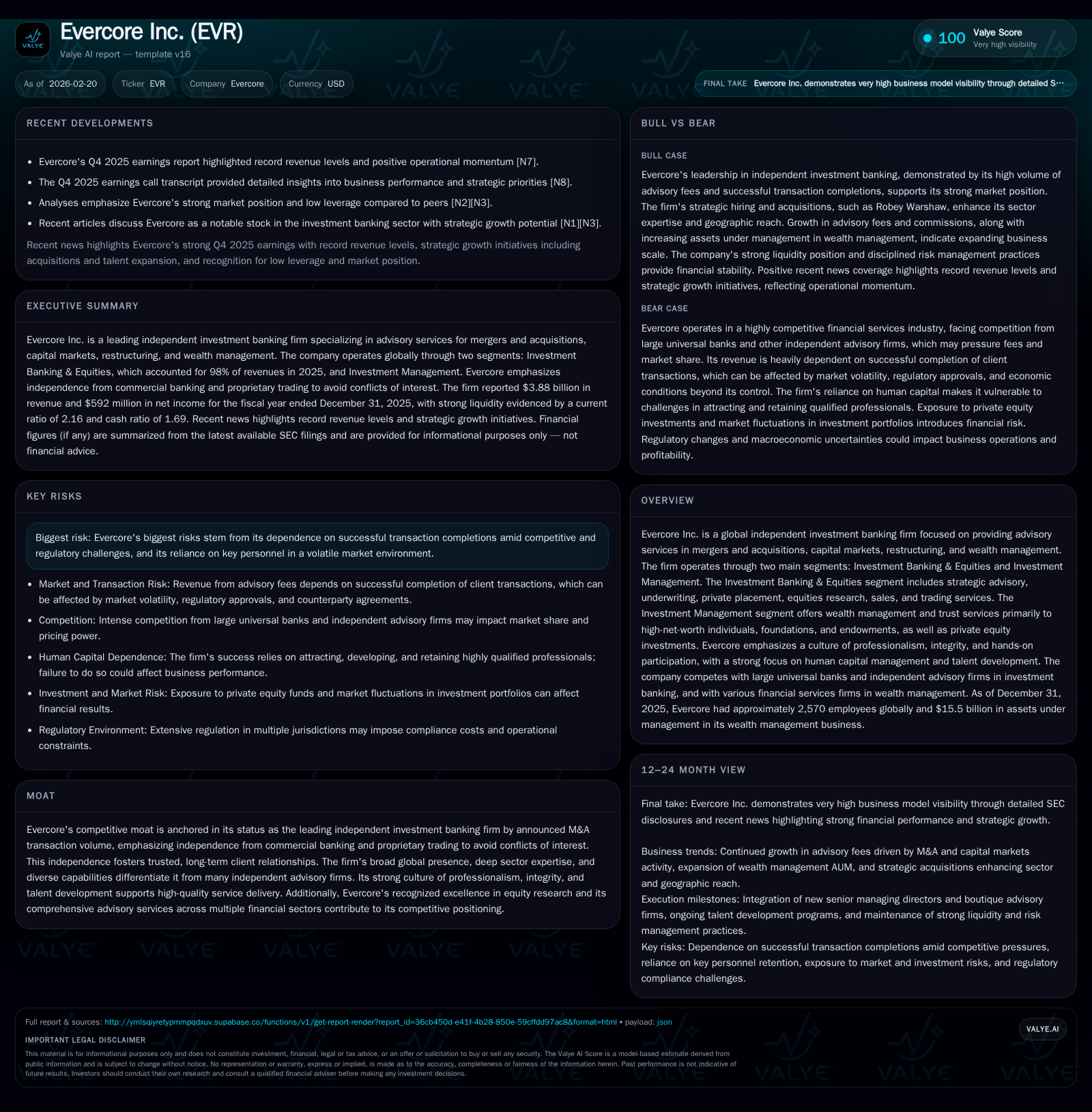
In 2025, Evercore Inc. achieved a robust 29.5% increase in revenue to $3.88 billion, propelled primarily by its Investment Banking & Equities segment focused on mergers and acquisitions advisory. Net income expanded even more sharply by 56.5% to nearly $592 million, reflecting strong fee realizations and operational leverage. The firm’s capital allocation remained disciplined with steady dividend growth and substantial free cash flow generation surpassing $1.18 billion. Looking forward, Evercore signals continued dominance in M&A while cautiously managing risks tied to deal flow volatility and regulatory headwinds inherent to independent advisory firms.
Historic Revenue Acceleration Fueled by Leading M&A Advisory
Evercore’s fiscal 2025 marked a milestone with revenues reaching $3.88 billion, a striking 29.5% increase over the prior year’s $2.997 billion [F1][N4][S1]. This surge was largely driven by the Investment Banking & Equities segment, which accounted for roughly 98% of revenues excluding other income sources [S1]. The firm's core strength remains its leading global M&A advisory franchise; Evercore is recognized as the top independent investment bank worldwide by announced deal volume over the last five years [S1].
Profitability gains were even more pronounced — net income soared 56.5% year-over-year to almost $592 million [F1]. This outperformance underscores the scalability of fee realizations within deal advisory amid favorable transaction cycles. However, as with any independent advisory firm, revenues hinge critically on successful deal closings — subject to factors like negotiation dynamics, financing availability, regulatory approvals, and market sentiment [S1]. This inherent variability defines the transaction cycle risk prevalent in this sector.
Dissecting Business Segments: Investment Banking & Equities vs Investment Management
The bulk of Evercore’s revenue derives from its Investment Banking & Equities segment, which delivered approximately $3.69 billion in sales in 2025 — up significantly from $2.81 billion in 2024 [S1]. This segment encompasses strategic advisory services including M&A, liability management and restructuring advisory, as well as underwriting and private placement activity, equity research services, sales and trading commissions — all critical elements generating recurring fee income aligned with deal flow and market volumes.
By contrast, the Investment Management segment provides wealth management and trust services mainly for high-net-worth individuals and institutional clients. Although smaller in scale relative to investment banking revenues (about 2%), this segment contributes stable fiduciary fees and investment management revenue that can partially counterbalance cyclical downturns in M&A [S1]. The differing cyclical profiles between segments provide some revenue diversification but underscore that Evercore's growth is heavily tied to capital markets dynamism.
Macroeconomic and Industry Conditions Shaping Near-Term Opportunities and Risks
Evercore operates within an environment characterized by financial market volatility, regulatory evolution, and geopolitical uncertainties — all impacting transaction volumes and client decision-making [S1][N6][N8]. The firm's disclosures flag sensitivity to adverse macroeconomic conditions that reduce M&A activity or delay deal closures, directly affecting fee timing and magnitude. Additionally, competition among financial advisors intensifies during slowdowns when fewer large mandates are available.
From an operational perspective, fixed cost leverage amplifies earnings fluctuations: if revenue dips due to declining deal flow, profitability compression may follow if variable costs cannot be reduced proportionally or quickly enough [S1]. Moreover, retention of senior talent remains a vital risk factor given their central role in origination and execution of mandates; uncertain macro conditions can heighten attrition or hinder recruitment.
Looking Ahead: What Evercore Signals About Its Future Growth Trajectory
Management commentary from recent earnings calls indicates a healthy client pipeline entering 2026 though no specific numeric guidance has been issued [N2][S2]. Evercore intends to sustain leadership in strategic advisory while seeking selective geographic expansion and deepening sector expertise areas such as restructuring advisory amid shifting market dynamics.
Analysts should monitor evolving product mix improvements along with the firm’s ability to capitalize on liability management deals or private capital markets activity that could offset periodic dips in traditional M&A fees . Equally important are signs of incremental growth in equities commissions or research monetization which complement primary advisory revenues.
Key Financial Forecasts and Milestones to Monitor in 2026
Though formal forecasts remain limited publicly, consistent quarterly earnings beats reported recently point toward resilient operational execution [N3][N4]. Transaction volume updates through league tables or announced mandates will serve as real-time barometers for maintaining top advisor status.
Additional considerations include geopolitical developments that may impact cross-border deal flow or introduce market uncertainty affecting client appetite for transactions . Close attention should also be paid to shifts in equity research commissions as part of overall revenue stability efforts amid fluctuating markets.
Capital Allocation Priorities: Dividend Policies, Cash Flows, and Equity Returns
Evercore’s approach to capital allocation demonstrates steady shareholder returns without aggressive share repurchases currently disclosed [F1][S27]. Dividends paid increased moderately each year reaching $144 million in FY2025 from about $136 million the prior year — signaling confidence in cash flow sustainability.
Operating cash flow reflected robust expansion reaching approximately $1.26 billion versus $988 million the year before (27.2% YoY increase) while capital expenditures rose moderately to around $74 million consistent with measured reinvestment strategies [F1]. Consequently, free cash flow after capex exceeded $1.18 billion—supporting balance sheet strength important for funding working capital during uneven transaction cycles.
Evaluating Return on Equity and Free Cash Flow Generation Trends
Evercore maintains a premium approximate return on equity of near 29% (calculated as net income divided by stockholders’ equity at year-end) consistent with elite investment banking peers known for efficient equity deployment [F1]. This reflects disciplined profit margin management alongside scaling revenue streams.
Free cash flow trends reinforce operational success through steady growth aligned with business cycles rather than procyclical spikes exposing downside risk excessively. Prudent capitalization combined with accumulated cash reserves enhances financial flexibility allowing strategic investments into talent acquisition or expansion initiatives required for long-term moat maintenance.
Historical performance (annual)
| FY | Rev ($bn) | Net ($mm) | CFO ($mm) | Capex ($mm) | Rev YoY | Net YoY |
|---|---|---|---|---|---|---|
| 2025 | 3.9 | 592 | 1256 | 74 | +29.5% | +56.5% |
| 2024 | 3.0 | 378 | 988 | 30 | +22.7% | +48.1% |
| 2023 | 2.4 | 255 | 458 | 20 | -12.1% | -46.4% |
| 2022 | 2.8 | 477 | 531 | 23 |
Note: Omitted columns lack sufficient annual XBRL coverage in the provided tags (need ≥2 annual points): OpInc, Buybacks. Source: SEC companyfacts cache [F1].
Capital returns and efficiency (annual)
| FY | Div ($mm) | FCF ($mm) | ROE% |
|---|---|---|---|
| 2025 | 144 | 1182 | 29.1 |
| 2024 | 136 | 958 | 22.2 |
| 2023 | 128 | 438 | 16.2 |
| 2022 | 127 | 508 | 31.0 |
Source: SEC companyfacts cache [F1].
Note: Operating Income not available; Buyback data unavailable per SEC tags.
In conclusion, Evercore’s strong performance trajectory through fiscal year-end positions it well within the competitive landscape dominated by large universal banks yet differentiated through independence-focused advisory expertise. The interplay between deal flow variability and disciplined capital management remains central to sustaining its competitive moat against cyclical industry headwinds.
Disclaimer: This analysis is based solely on disclosed financial data, official filings, and reputable news sources as cited; it does not constitute investment advice.
Disclaimer: This is research-only, informational analysis and not investment advice. It may include AI-generated interpretation and general industry context. Always verify important details using primary sources.

Comments