
Adamas Trust Rebounds Strongly on Strategic Mortgage Asset Management and Capital Discipline
Adamas Trust shifted from multi-year losses to profitability in 2025 through focused credit asset allocation and integrated loan origination.
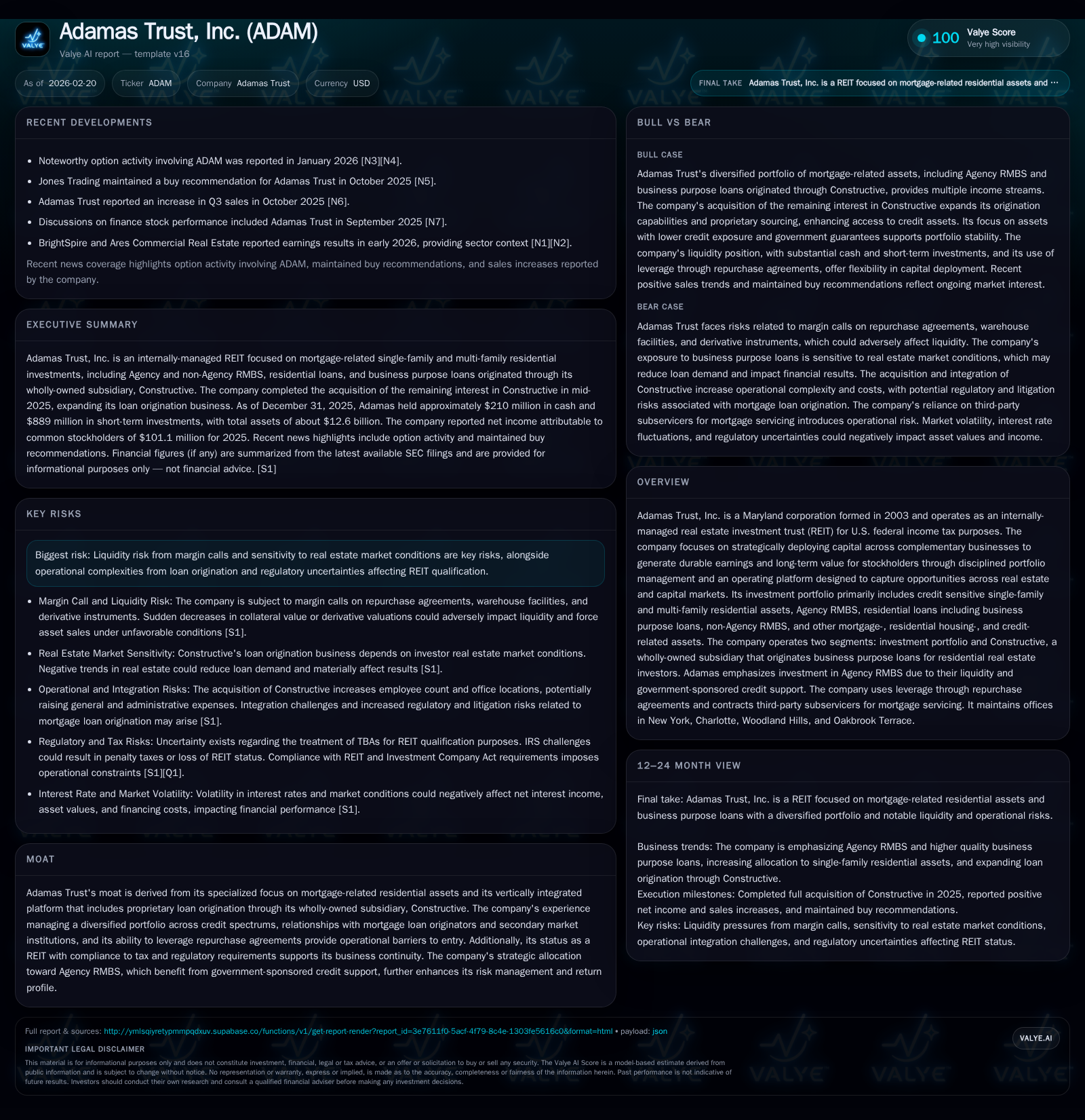
After posting operating losses for three consecutive years, Adamas Trust, Inc. recorded a strong financial turnaround in fiscal year 2025, driven by its specialized residential mortgage portfolio and disciplined capital management. The company's vertically integrated platform, including its wholly-owned loan originator Constructive, underpins improved earnings quality and liquidity. Moving forward, growth prospects hinge on navigating interest rate volatility, regulatory uncertainties regarding TBA treatment, and sustaining leveraged financing structures.
Transformation from Operating Losses to Positive Earnings (2022–2025)
Adamas Trust endured a challenging operating environment through fiscal years 2022 to 2024, marked by significant operating losses: -$340 million (FY22), -$78 million (FY23), and -$93 million (FY24) respectively [F1]. These losses mirrored portfolio rebalancing away from multi-family assets towards residential mortgage exposures amid volatile credit markets.
The sharp pivot culminated in FY2025 with operating income of approximately $138 million—a +248% year-over-year increase—and positive net income of $149 million (+340% YoY) [F1]. This reversal was underpinned by strategic repositioning towards credit-sensitive Agency RMBS and business purpose loans originated through its subsidiary Constructive.
Operating cash flows reflected this renewed health with a near ninefold increase to $134 million in FY25 compared to just $14 million the prior year, evidencing improved earnings quality and working capital management. Concurrently, capital expenditures contracted markedly by almost 67%, supporting free cash flow generation estimated around $126 million [F1].
Historical performance (annual)
| FY | Net ($mm) | CFO ($mm) | OpInc ($mm) | Capex ($mm) | Net YoY |
|---|---|---|---|---|---|
| 2025 | 149 | 134 | 138 | 8 | +340.3% |
| 2024 | -62 | 14 | -93 | 25 | -27.5% |
| 2023 | -49 | 30 | -78 | 50 | +83.7% |
| 2022 | -299 | 92 | -340 | 209 |
Note: Omitted columns lack sufficient annual XBRL coverage in the provided tags (need ≥2 annual points): Rev, Div. Source: SEC companyfacts cache [F1].
Capital returns and efficiency (annual)
| FY | Buybacks ($mm) | FCF ($mm) | ROE% |
|---|---|---|---|
| 2025 | 2 | 126 | 10.4 |
| 2024 | 3 | -11 | -4.4 |
| 2023 | 9 | -20 | -3.1 |
| 2022 | 44 | -118 | -16.9 |
Source: SEC companyfacts cache [F1].
Note: Dividends and buybacks omitted due to sparse data coverage.
Portfolio Composition and Core Business Model
Adamas Trust concentrates on mortgage-related U.S residential assets structured primarily across credit-sensitive single-family whole loans, Agency RMBS with government-sponsored enterprise guarantees (e.g., Fannie Mae or Freddie Mac), non-Agency RMBS, and business purpose loans originated through Constructive Loans LLC—a wholly owned subsidiary active in nearly all U.S states [S1][S24].
The vertical integration via Constructive supports proprietary sourcing of short-term loans collateralized by residential properties intended for investor rehabilitation and resale or rental use, strengthening pipeline velocity while optimizing margin capture at origination stage before loan sale or balance sheet retention.
Agency RMBS dominate given their liquidity profile and embedded GSE credit support reducing credit risk exposure relative to non-agency paper which carries higher yields but also elevated credit sensitivity [S13]. Liquidity is further enhanced through TBA contracts—forward trades settling Agency securities delivery at future dates—although these introduce accounting complexity given uncertain IRS treatment for REIT qualification purposes [S2].
Risk Management and Interest Rate Sensitivity
Adamas Trust’s portfolio repricing structures do not perfectly align assets with liabilities: residential loans often reset slower than repurchase agreement borrowings priced off short-tenor SOFR rates, causing floating rate liabilities to reprice earlier than assets potentially exposing net interest margins to compression during rising rate environments [S1].
Prepayment risk constitutes a key driver whereby declining rates accelerate borrower refinancing reducing asset life and yields; conversely slower-than-expected prepayments may increase carrying costs amid higher funding expenses or result in markdowns when loans were purchased at discounts expecting faster paydowns [S1][S11].
Interest rate derivative instruments deployed include caps limiting variable-rate exposure on underlying mortgages payable—protecting against indexed rate spikes—and swaps engaging fixed vs variable exchanges to smooth financing cost volatility [S17]. These are complemented by futures/options on Treasury securities and credit default swaps to hedge broader market movements.
Regulatory uncertainty arises over the tax treatment of TBA positions within the REIT’s qualifying income/assets tests due to lack of direct IRS guidance despite reliance on legal opinions permitting their inclusion; adverse rulings could impact REIT status or dividend distributions [S2].
Liquidity Position and Capital Structure Dynamics
As of December 31, 2025, total liabilities included approximately $6.75 billion financed via repurchase agreements/warehouse facilities and about $3.5 billion funded through collateralized debt obligations—both secured by residential loans and securities primarily bearing agency backing—with weighted average interest costs linked closely to SOFR plus spreads [S4][S18].
The company’s recourse leverage stood near a moderate-conservative level at about five times equity excluding non-recourse debt; repurchase agreements accounted for roughly a 4.7x ratio versus equity reflecting active collateralized borrowing strategies that are sensitive to market valuation haircuts triggering potential margin calls requiring additional collateral posting or accelerated debt repayment under covenant frameworks [S5][S8][S11].
Balance sheet agility benefits from a mix of short-term rolling repurchase agreements alongside longer-dated securitizations limiting immediate liquidity risk though increased expense profiles apply; mortgage payable maturities are staggered through early-2030s enhancing refinancing optionality while maintaining compliance with stipulated leverage limits approved by the Board based on portfolio composition changes over time [S14][S15][S16].
Capital Allocation Strategy: Share Repurchases and Dividend Policy
Reflecting stronger cash flow generation post-turnaround, Adamas Trust moderately resumed common stock repurchases during FY25 totaling approximately $1.5 million—a meaningful reduction versus more aggressive prior years buybacks which ranged up to around $44 million in FY22—indicating prudence amid ongoing stabilization efforts [F1][S6].
Dividend policy remains consistent with quarterly declarations at $0.23 per common share as of Q4 CY25; however, frequent dividend payment disclosures beyond mid-2010s are sparse suggesting variable payout approaches sensitive to earnings volatility inherent in mortgage finance cycles [S6].
Given the improved ROE approximated at 10% for FY25—the first positive return since FY21—and solid free cash flow after capex outlays ($126 million), Adamas appears positioned to pursue balanced returns between shareholder distributions and reinvestment opportunities while managing leverage prudently [F1].
Outlook: Growth Drivers and Operational Constraints
Looking ahead, growth is primarily dependent on sustained expansion of higher-quality business purpose loan originations through Constructive lending platforms coupled with opportunistic accumulation of Agency RMBS positions benefiting from government-sponsored credit enhancement mechanisms that reduce downside risks during economic stress periods [N3][S24].
Challenges include lingering ambiguity over TBA classification impacting tax treatment and accounting volatility since gains/losses on settlements can materially affect quarterly results; interest rate fluctuations influencing prepayment speeds create earnings lumpy effects complicating forecast accuracy; liquidity constraints via margin call sensitivities require vigilant collateral valuations especially amid volatile real estate markets; regulatory developments either tightening or easing REIT compliance may reshape permissible portfolio compositions constraining flexibility [S2][S11].
Sector vernacular hints relevant for attention involve pipeline velocity metrics tracking Constructive’s loan origination throughput efficiency; margin optimization balancing yield curves versus cost curves under different rate scenarios; asset repricing timing differentials critical for hedging calibration; collectively constituting the adaptive operational levers underpinning consistent earnings delivery.
Key Metrics and What Investors Should Monitor Next
Focused observation points should include:
- Quarterly updates on prepayment experience statistics particularly for Agency RMBS segments informing yield sustainability projections.
- Interest expense dynamics reflecting SOFR-linked borrowing cost movements impacting net interest margin-sensitive spread revenues.
- Regulatory guidance developments regarding TBAs recognition directly affecting REIT qualification reliability.
- Changes in collateral valuations defining margin calls risk exposure especially as real estate market conditions fluctuate.
- Execution velocity on Constructive’s loan origination commitments shaping franchise growth trajectory.
- Share buyback cadence aligned against free cash flow generation signaling confidence levels.
- Dividend declaration patterns indicating earnings stability perspectives.
Continued transparency in SEC filings combined with close tracking of secondary market derivative activities reported in options volumes may also reveal informed positioning insights pertinent to ADAM’s valuation sentiment.[N3]
This analysis synthesizes reported financial data with regulatory disclosures current as of early 2026 without extrapolating unverified projections or offering investment advice. Readers are encouraged to consult official SEC filings or company releases for primary information sources.
Disclaimer: This is research-only, informational analysis and not investment advice. It may include AI-generated interpretation and general industry context. Always verify important details using primary sources.

Comments