
Sonic Automotive Inc's Revenue Growth Masks Margin Pressure in 2025
The company experienced top-line expansion in 2025 amid declining profitability driven by segment-specific challenges and capital allocation shifts.
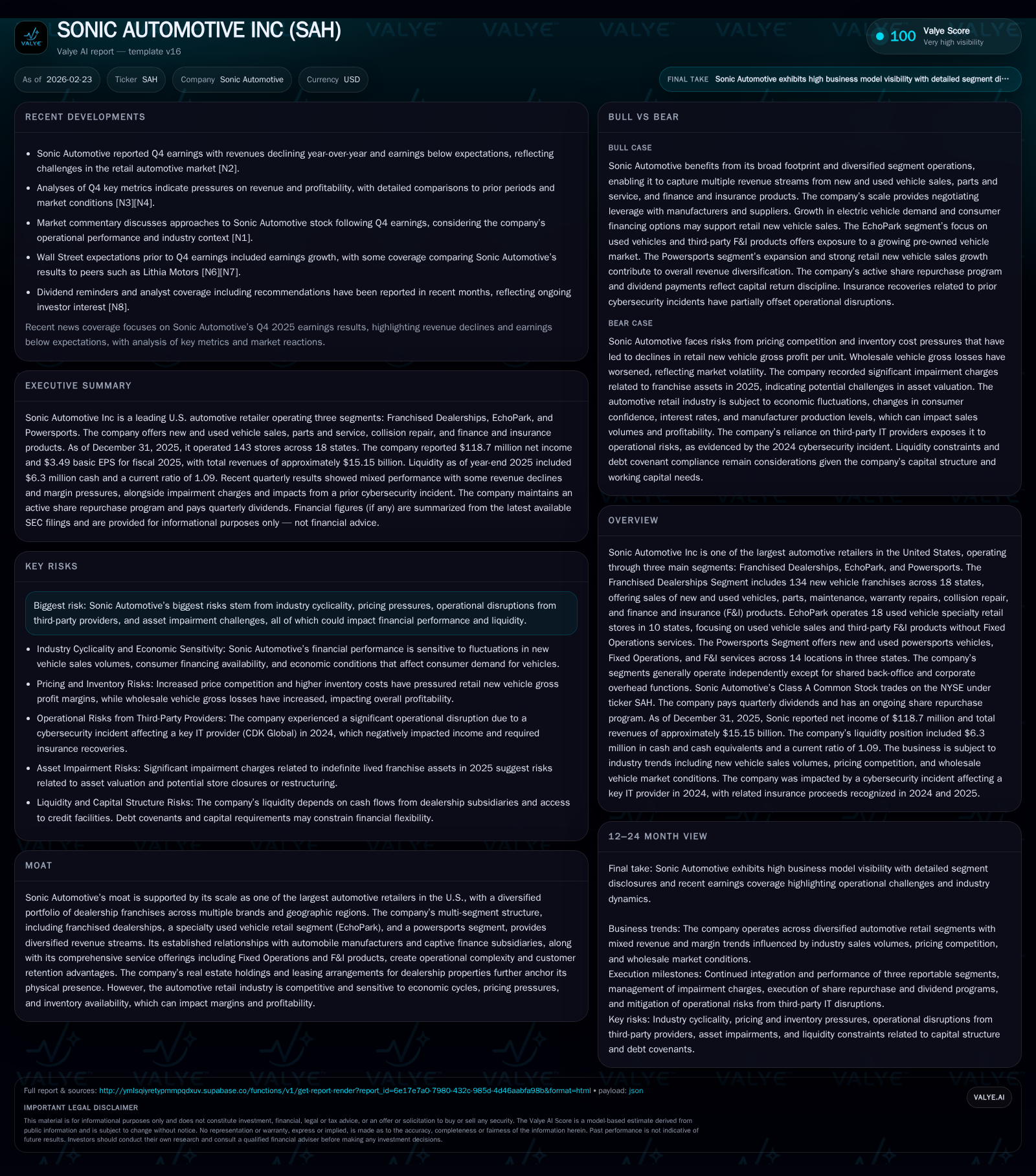
Sonic Automotive Inc posted a 6.8% increase in total revenue for fiscal year 2025, driven by growth across its Franchised Dealerships, EchoPark, and Powersports segments. Despite this expansion, operating income declined by 20.4%, reflecting margin compression due primarily to elevated inventory costs and operational complexities in used vehicle sales and third-party service disruptions. Net income fell about 45%. Capital allocation favored sustaining dividends and selective share repurchases, supported by robust operating cash flow of approximately $567 million. Liquidity remains adequate with a current ratio near 1.1 and access to sizable credit facilities; however, leverage covenants restrict aggressive shareholder returns beyond moderate dividend increases. Interest rate caps are employed to hedge borrowing cost exposure amid rising benchmark rates.
Historical Financial Performance: Revenue Growth Versus Profit Decline
Sonic Automotive's consolidated revenue has shown steady growth from $2.56 billion in FY2022 to an estimated $2.67 billion in FY2023, with a reported YoY increase of 6.8% into FY2025 based on available data ([F1]). Operating income peaked around $461 million in FY2024 before contracting by roughly 20.4% to about $368 million in FY2025. Net income followed a steeper decline of approximately 45%, falling from $216 million in FY2024 to $119 million in FY2025 ([F1]).
This divergence highlights margin pressures stemming from increased inventory costs, particularly within used vehicle segments, as well as impairments related to franchise assets.
Historical performance (annual)
| FY | Net ($mm) | CFO ($mm) | OpInc ($mm) | Capex ($mm) | Net YoY |
|---|---|---|---|---|---|
| 2025 | 119 | 567 | 368 | -150 | -45.0% |
| 2024 | 216 | 109 | 462 | -187 | +21.2% |
| 2023 | 178 | -16 | 424 | -204 | +101.4% |
| 2022 | 89 | 406 | 314 | 227 |
Note: Omitted columns lack sufficient annual XBRL coverage in the provided tags (need ≥2 annual points): Rev. Source: SEC companyfacts cache [F1].
Capital returns and efficiency (annual)
| FY | Div ($mm) | Buybacks ($mm) | FCF ($mm) |
|---|---|---|---|
| 2025 | -49 | -82 | 717 |
| 2024 | -41 | -34 | 297 |
| 2023 | -40 | -178 | 188 |
| 2022 | 35 | 262 | 179 |
Source: SEC companyfacts cache [F1].
Note: Revenue figures post-2019 not fully available; operating income, net income, CFO sourced from [F1].
Segment Dynamics: Franchised Dealerships, EchoPark, and Powersports Contributions
Sonic Automotive operates three reportable segments [S1]:
Franchised Dealerships include about 134 new vehicle franchises representing roughly two dozen brands such as BMW (19% of retail revenues) and Mercedes-Benz (11%) across eighteen states ([S1], [S14], [S22]). This segment delivers new/used vehicles plus Fixed Operations services (parts, warranty repairs, collision repair) along with finance & insurance products.
EchoPark operates eighteen pre-owned specialty retail stores across ten states focused exclusively on used vehicle sales paired with third-party F&I but excluding Fixed Operations ([S1], [S14]).
Powersports comprises fourteen locations with forty-one franchises mainly concentrated in three states offering motorcycles and other powersports vehicles along with associated Fixed Operations and F&I services ([S1]).
These segments contribute diversified revenue streams but also add complexity through varied operational models.
Earnings Review: Same-Store Sales Highlights and Challenges
In FY2025:
Franchised Dealerships saw new vehicle retail revenues grow via volume (+11%) and price (+7%) gains supporting gross profit increases; however, retail used vehicle gross profit per unit declined nearly $400 due to elevated inventory costs ([S20]).
EchoPark expanded footprint but faced same-store revenue softness during Q4 due to pricing pressures on used inventory amid competition ([N2], [N8]). The absence of Fixed Operations limits margin diversification.
Powersports benefited from improvements in inventory turnover days but is subject to seasonal demand variability impacting profitability ([S20]).
Operational headwinds included third-party service disruptions affecting margins plus intangible asset impairments linked to indefinite-lived franchise rights impacting net income ([N3], [S12]).
Capital Structure and Liquidity Position at Year-End 2025
As of December 31, 2025 ([F1], [S4]–[S8]):
- Cash & equivalents stood at approximately $6.3 million.
- Floor plan deposit balances totaled around $300 million offsetting interest expenses on related financing.
- Revolving Credit Facility availability exceeded $300 million within aggregate Credit Facilities commitments near $2.4 billion covering new/used floor plans plus revolving lines.
- Term borrowings included Mortgage Facility ($312.7M), Sidecar Facility ($143M), plus other mortgage notes with weighted average interest near low-to-mid four percent range.
Debt covenants permit quarterly dividends up to $0.18 per share without additional approvals; payments above this require covenant compliance assessment limiting flexibility ([S6], [S18]). Interest rate cap agreements help hedge against rising SOFR benchmark rates affecting borrowing costs ([S16], [S18]). The current ratio was approximately 1.09 indicating manageable short-term liquidity ([F1]).
Capital Allocation Priorities: Dividends, Share Repurchases, and Capex
For FY2025 ([F1], [S6], [S10], [S17]):
- Dividends paid totaled about $48.8 million reflecting modest increases constrained by covenant limits.
- Share repurchases amounted to approximately $82.4 million under an authorized program with roughly $170 million remaining capacity.
- Capital expenditures were near $149.9 million invested primarily into dealership properties consistent with manufacturer standards and equipment upgrades.
Robust operating cash flow of roughly $567 million enabled these investments while delivering free cash flow after capex of around $717 million underpinning balance sheet strength despite earnings pressure.
Outlook Signals: Risks and Growth Opportunities Ahead
No explicit forward guidance was issued recently ([N1], [N6]), reflecting management’s cautious stance amid economic uncertainty. Industry cyclicality remains a key risk alongside volatility in used vehicle pricing and supply chains. EchoPark’s growth offers margin scaling potential if operational efficiencies improve; Powersports requires careful inventory management given seasonality. Ongoing risks include third-party financing partner reliability and potential franchise asset impairments impacting liquidity or earnings ([S1], [N4]).
Key Investor Considerations Going Forward
Investors should monitor:
- Capital allocation balancing dividends versus buybacks constrained by debt covenants.
- Same-store sales trends especially within EchoPark’s pre-owned network amidst competitive pressures.
- F&I penetration rates affecting commission-based revenues tied closely to sales mix changes.
- Leverage metrics including Consolidated Total Lease Adjusted Leverage Ratio compliance given indebtedness near $1.64 billion across senior notes and credit facilities ([S19]).
- Potential goodwill or intangible asset impairments as macro conditions evolve impacting dealer agreement valuations.
This analysis relies solely on audited filings and publicly available news without projecting future performance or making investment recommendations.
Disclaimer: This is research-only, informational analysis and not investment advice. It may include AI-generated interpretation and general industry context. Always verify important details using primary sources.

Comments