
Artelo Biosciences Balances Clinical Progress with Intensifying Liquidity Strains
ARTL advances a lipid-signaling focused pipeline while grappling with severe financial headwinds and patent-related risks.
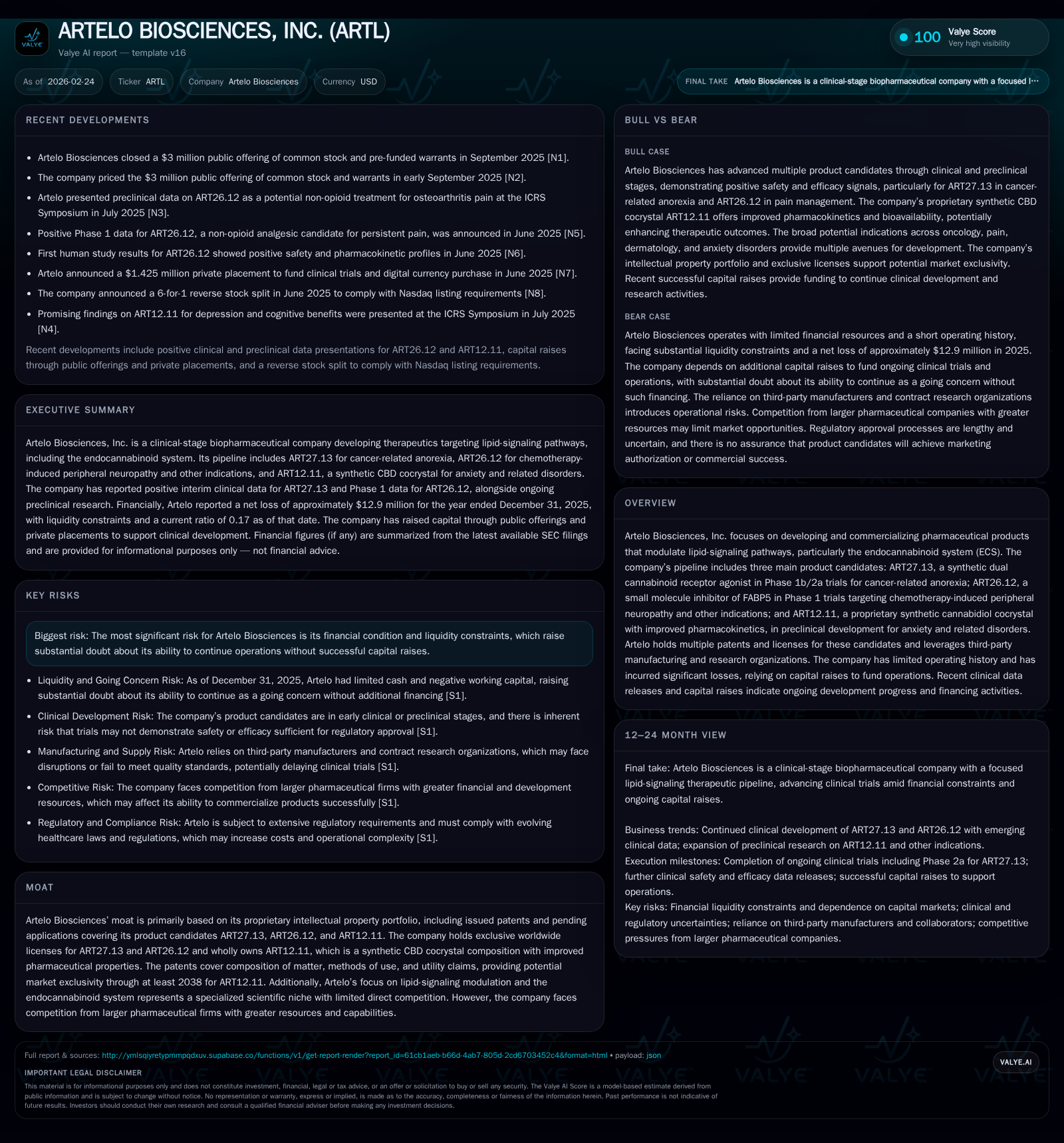
Artelo Biosciences, Inc. is advancing three novel drug candidates targeting lipid signaling and the endocannabinoid system, including ART27.13 in Phase 1b/2a trials for cancer anorexia. Despite promising early-stage data, the company faces acute liquidity constraints—holding $0.6 million in cash versus $4 million in current liabilities—and sustained operational losses exceeding $11 million annually. With no revenues or mature products, its capital-intensive development plan and reliance on external financing underpin critical risks. Investors should monitor clinical milestones and financing developments amid persistent cash flow deficits and equity erosion.
Company Overview
Artelo Biosciences, Inc., incorporated in Nevada and headquartered in San Diego, California, is a clinical-stage biopharmaceutical company specializing in therapeutics that modulate lipid-signaling pathways, particularly the endocannabinoid system (ECS) [S1]. The ECS is a biochemical network influencing physiological processes such as appetite and neuropathic pain.
The company's pipeline includes three proprietary product candidates:
- ART27.13, a synthetic benzimidazole dual cannabinoid receptor agonist targeting peripheral CB1 and CB2 receptors for cancer-related anorexia/cachexia syndrome.
- ART26.12, a small molecule inhibitor of fatty acid binding protein 5 (FABP5), currently in Phase 1 trials for chemotherapy-induced peripheral neuropathy (CIPN) with potential applications in oncology, dermatology, and anxiety disorders.
- ART12.11, an internally developed synthetic cannabidiol (CBD) cocrystal aimed at improved pharmacokinetics for anxiety spectrum disorders; currently preclinical.
Artelo holds exclusive worldwide licenses for ART27.13 and ART26.12 from third parties and fully owns ART12.11 [S1]. Patent protection extends through at least 2038 for ART12.11; details for other candidates are not explicitly provided [F1].
Historical Financial Performance
Artelo remains pre-revenue due to its early development stage; no revenue figures are available from SEC filings or XBRL data [F1]. The company has incurred significant operating losses primarily driven by R&D expenditures:
Historical performance (annual)
| FY | Net ($mm) | CFO ($mm) | OpInc ($mm) | Net YoY |
|---|---|---|---|---|
| 2025 | -13 | -9 | -11 | -31.1% |
| 2024 | -10 | -8 | -10 | -5.8% |
| 2023 | -9 | -8 | -10 | +7.9% |
| 2022 | -10 | -8 | -10 |
Note: Omitted columns lack sufficient annual XBRL coverage in the provided tags (need ≥2 annual points): Rev, Capex, Div, Buybacks, FCF. Source: SEC companyfacts cache [F1].
Capital returns and efficiency (annual)
| FY | ROE% |
|---|---|
| 2025 | 1012.5 |
| 2024 | -343.9 |
| 2023 | -79.0 |
| 2022 | -52.0 |
Source: SEC companyfacts cache [F1].
Operating losses increased approximately 13% year-over-year from FY2024 to FY2025, while net losses expanded by about 31%, reflecting rising development costs and overhead [F1]. Negative operating cash flows exceeding $8 million annually underscore ongoing cash burn without offsetting income.
Stockholders' equity declined dramatically from $19.4 million at FY2022 year-end to negative $1.27 million at FY2025 year-end, indicating accumulated deficits that erode shareholder value [F1].
No dividends paid or share repurchase programs were disclosed in the available filings or XBRL data.
Operating Context & Recent Developments
The Phase 1b/2a CAReS trial of ART27.13 addresses an unmet medical need with no FDA-approved treatments for cancer anorexia-cachexia syndrome [S1]. Interim results reveal patients receiving ART27.13 gained over 6% body weight on average compared to weight loss on placebo despite dose escalation—signaling potential efficacy with tolerability.
ART26.12 demonstrated favorable Phase 1 safety results with mild transient adverse events only and linear pharmacokinetics consistent with dose-dependent plasma profiles supporting further clinical evaluation [S1]. This candidate targets CIPN, a common debilitating side effect lacking approved treatments.
Maintaining licensed intellectual property rights under exclusive agreements is critical; failure to comply with obligations risks termination of licenses that are vital to the pipeline [S1].
Future Growth Prospects & Catalysts
Key growth drivers include clinical milestones that could enable out-licensing or eventual commercialization:
- Completion of Phase 2a CAReS trial demonstrating statistically significant benefit of ART27.13 over placebo.
- Advancement into proof-of-concept efficacy studies for ART26.12 addressing CIPN or other indications.
- Progression of ART12.11 into IND-enabling studies leading to early clinical trials.
- Securing patent protections that may extend exclusivity over a decade post-approval.
Constraints involve limited internal resources amid high capital requirements typical for biopharma development [S14]. Regulatory uncertainties arising from healthcare reforms like the Inflation Reduction Act could influence pricing and reimbursement landscapes impacting commercial potential [S5][S6].
Capital Allocation & Financial Health
Liquidity is severely constrained: Artelo reported approximately $600,000 cash against current liabilities exceeding $4 million at FY2025 year-end, yielding a current ratio near 0.17—well below safe operational thresholds [F1][S14]. The company discloses substantial doubt about its ability to continue as a going concern without additional financing [S14].
To alleviate funding pressure, Artelo entered an equity purchase agreement on January 30, 2026 granting the right to raise up to $25 million via sales to Square Gate Capital Master Fund LLC Series 5 subject to exercise conditions; realization of this funding remains uncertain [S3].
Cash burn is predominantly due to R&D spending tied to clinical trials; no dividends or share buybacks have been declared due to ongoing losses and liquidity constraints [F1][S9].
Industry & Regulatory Environment Analysis
Artelo's focus on ECS modulation aligns with increasing interest in lipid signaling-based therapies addressing neurological, oncological, and inflammatory conditions—a relatively less crowded niche compared to traditional small molecules or biologics but competitive given large pharmaceutical players’ involvement in cannabinoid research [S22].
Regulatory challenges include evolving FDA policies influenced by recent Supreme Court rulings reducing agency deference which may affect approval timelines [S13]. Additionally, Medicare Part D cost containment reforms may affect drug pricing dynamics relevant for Artelo’s small molecule candidates [S6][S16]. Compliance burdens under fraud and abuse statutes, HIPAA privacy rules, anti-kickback laws further complicate operations [S7][S15]. These factors amplify uncertainty around time-to-market and revenue generation.
Conclusion & Watches
Artelo Biosciences faces pivotal near-term challenges balancing promising science against acute financial stress:
- Upcoming clinical readouts for ART27.13’s CAReS trial will be critical indicators of therapeutic viability.
- Progression of ART26.12 into later-stage efficacy studies merits close attention.
- Execution of the Square Gate equity financing option will be essential for near-term liquidity.
- Maintaining IP license compliance is imperative to safeguard pipeline assets from termination risk.
- External pressures including healthcare reform impacts require monitoring given implications for commercial success.
While Artelo’s scientific approach leveraging ECS-focused lipid signaling modulation is differentiated, it must navigate stringent capital demands amid prolonged development cycles characteristic of clinical-stage biopharma companies.
This report synthesizes publicly available financial statements and SEC filings dated February 24, 2026 ([S1],[S3],[S9],[S14],[F1]) alongside industry context insights relevant as of early 2026 without providing investment advice.
Disclaimer: This is research-only, informational analysis and not investment advice. It may include AI-generated interpretation and general industry context. Always verify important details using primary sources.

Comments