
Harmony Biosciences’ Path to Diversified Rare Neurology Growth
Harmony leverages exclusive pitolisant rights and strategic acquisitions to expand its rare neurological portfolio amid disciplined capital allocation.
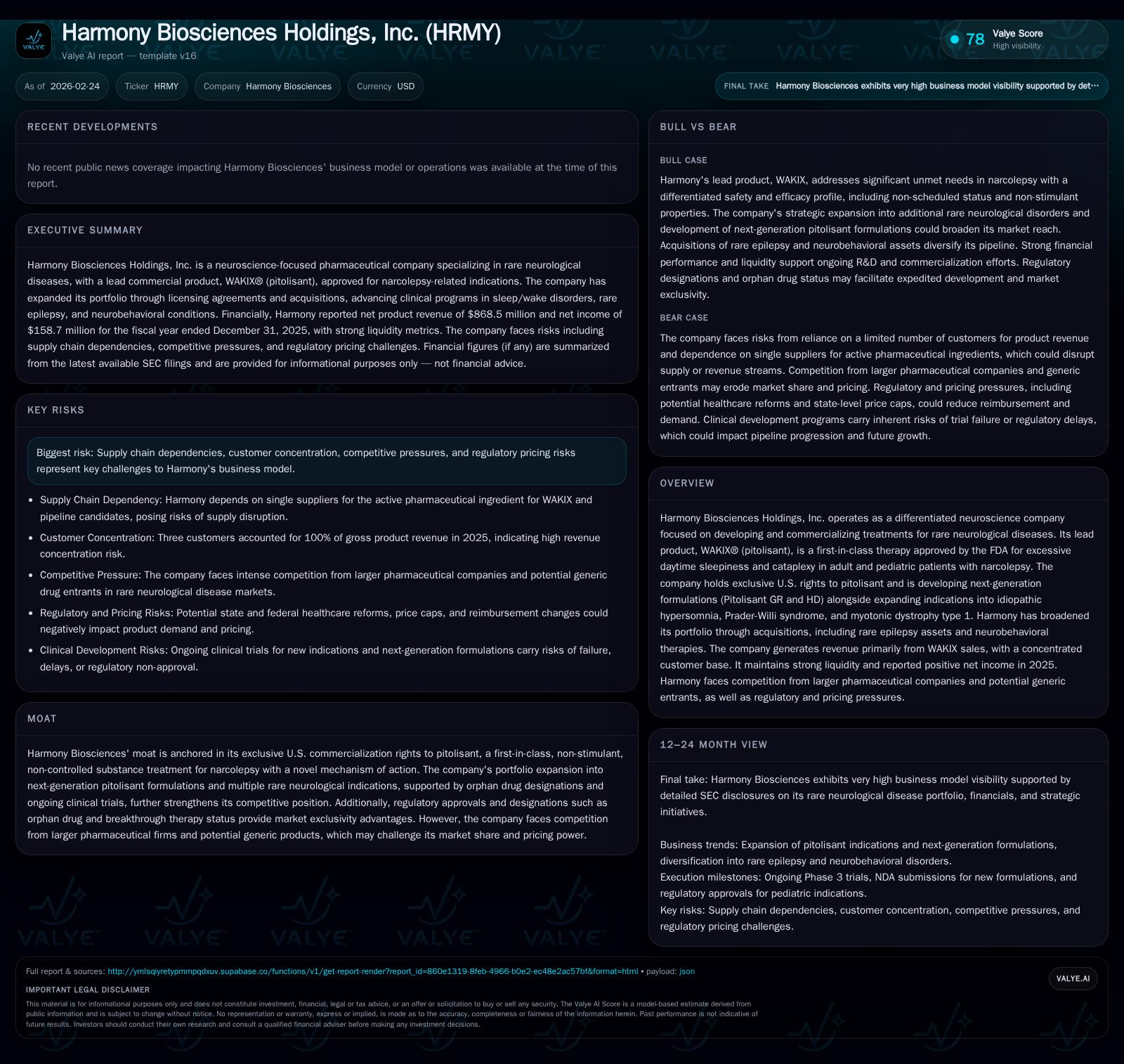
Harmony Biosciences has solidified its position in the rare neuroscience market through exclusive U.S. commercialization of WAKIX®, a pioneering non-controlled narcolepsy treatment. The company’s 2025 financials exhibit steady improvement, with operating income up 9.2% alongside robust operating cash flows supporting aggressive share repurchases. Its clinical pipeline is diversifying beyond narcolepsy with next-generation pitolisant formulations targeting idiopathic hypersomnia and genetic neurological disorders, complemented by recent expansion into rare epilepsy therapies. Regulatory exclusivities provide a moat; however, evolving pricing transparency and competition remain key risks. Market watchers should focus on upcoming Phase 3 readouts and integration of acquired assets as pivotal catalysts.
Evolution of Growth: WAKIX® Sales and Operating Income Trajectory
Harmony Biosciences’ growth narrative is deeply rooted in its pioneering commercialization of WAKIX® (pitolisant), a first-in-class histamine H3 receptor inverse agonist/antagonist approved by the FDA initially in 2019 for excessive daytime sleepiness (EDS) associated with narcolepsy in adults. The product’s unique non-stimulant profile combined with DEA’s classification as a non-controlled substance distinguishes it sharply within a narcolepsy treatment landscape often dominated by controlled stimulants and sodium oxybate derivatives [S1]. Subsequent label expansions to include cataplexy indications and pediatric patients have fortified its market presence through 2025.
Financially, Harmony's reported operating income advanced by 9.2% year-over-year to $208 million in fiscal year 2025, continuing a trajectory of solid operational leverage after posting $191 million in FY2023 and dipping modestly before rebounding from $121 million in FY2022 [F1]. Net income similarly improved by 9.1% to $159 million, supported by strong gross margins characteristic of pharmaceutical product sales but tempered by ongoing investments in pipeline expansion [F1].
This performance underscores Harmony’s dependence on WAKIX® sales under exclusive U.S. rights licensed from Bioprojet since 2017 – a relationship enabling tight commercial control but also exposing the company to some customer concentration risks given three specialty pharmacy distributors accounted for nearly all receivables as of mid-2025 [S8]. Nevertheless, Harmony has historically managed credit risk prudently with low bad debt experience.
Broadening the Pipeline: Next-Generation Formulations and Rare Neurological Indications
Demonstrating strategic foresight beyond single-product reliance, Harmony is actively advancing next-generation pitolisant-based products as part of exclusive manufacturing and commercialization rights secured via the July 2022 License and Commercialization Agreement with Bioprojet [S1]. Two lead candidates, Pitolisant Gastro-Resistant (GR) designed for enhanced gastrointestinal stability, and Pitolisant High-Dose (HD), aimed at increasing therapeutic exposure, are progressing through clinical development phases with registrational ambitions targeting idiopathic hypersomnia (IH), Prader-Willi syndrome (PWS), and myotonic dystrophy type 1 (DM1)—all rare neurological diseases with significant unmet need [N6][N8][S1].
The company’s mechanistic-based approach leverages the novel histaminergic modulation profile of pitolisant across sleep/wake disorders characterized by hypersomnolence or neurobehavioral disturbance. These indications benefit substantially from orphan drug designations conferring regulatory advantages on exclusivity duration, tax credits, and expedited development timelines typical within rare diseases [S1]. Moreover, the embrace of orexin science via BP1.15205 – an orexin 2 receptor agonist licensed in April 2024 – reflects an evolving platform strategy directed at abnormalities of arousal regulation often implicated in narcolepsy spectrum disorders [S1]. Such diversification is critical given competitive pressures from larger pharmaceutical incumbents exploring orexin modulators.
Strategic Acquisitions Fueling Portfolio Diversification
Harmony’s acquisition of Epygenix Therapeutics stands out as a transformational step toward portfolio resilience by incorporating rare epilepsy assets outside the wakefulness disorder domain [S1]. EPX-100—a selective serotonin (5HT-2) receptor agonist—is currently undergoing dual Phase 3 registrational trials for Dravet Syndrome (DS) and Lennox-Gastaut Syndrome (LGS), both epileptic encephalopathies characterized by severe neurodevelopmental impairment [S1]. Complementing this asset is EPX-200 targeting developmental epileptic encephalopathies (DEEs) still at pre-IND stage.
This acquisition complements Harmony's existing breadth with neurobehavioral assets, mitigating single-product dependency risk inherent to niche neurology franchises while aiming to capture synergies across specialized commercial infrastructure dedicated to orphan diseases [S1]. It additionally positions Harmony for future cross-indication insights leveraging serotonergic mechanisms increasingly recognized for modulating seizure susceptibility alongside neuropsychiatric comorbidities.
Capital Allocation Priorities: Share Repurchases, Cash Flow and Balance Sheet Strength
Harmony exhibits notable capital discipline sustaining more than $100 million annually in share repurchases consistently since fiscal 2023 – a considerable amount relative to its market capitalization segment [F1][S4][S8]. This reflects confidence in intrinsic valuation supported by strong free cash flow generation.
Operating cash flow expanded impressively by approximately 58.4% in FY2025 versus prior year to $348 million largely driven by tight working capital management around receivables and inventory coupled with continued robust product sales [F1]. With modest capex totaling around $310 thousand—an order of magnitude lower than typical biotech peers growing via expansive R&D facilities—the company's free cash flow remains healthy at about $348 million annually after capital expenditures [F1].
Equity increased significantly over recent years reaching $870 million at year-end FY2025 from $403 million just three years prior—reflecting net earnings retention alongside minimal dilution amid buyback activity [F1]. Return on equity sits near an attractive ~18.2%, underscoring effective deployment of capital into growth initiatives while returning value directly to shareholders [F1]. The absence of dividends points toward prioritizing reinvestment into pipeline advancement and debt servicing over yield.
Regulatory Exclusivities and Competitive Pressures to Monitor
Harmony benefits from several layers of regulatory protection that underpin its commercial moat: orphan drug designations across multiple indications grant extended exclusivity periods while the FDA’s breakthrough therapy status expedites review cycles [S5][S6]. Significantly, WAKIX remains unscheduled under DEA’s controlled substances act—a unique attribute reducing regulatory burdens related to prescribing restrictions common among narcolepsy therapeutics [S1].
However, these advantages coexist with increasing headwinds stemming from more stringent state drug price transparency laws mandating disclosure on planned price increases and rebate structures potentially limiting pricing flexibility amidst payer pushback [S5][S6][S7]. Compliance risks tied to anti-kickback statutes, false claims acts, healthcare fraud regulations, as well as privacy/security laws such as HIPAA impose operational overhead with potential substantial penalties if breached—an ever-present concern given government scrutiny intensifying across specialty pharma sectors [S11][S16][S17][S23].
Supply chain dependencies likewise pose vulnerabilities where disruptions could impair product availability; these factors coupled with looming patent expirations demand vigilant lifecycle management including generic entry preparedness once exclusivity wanes.
Key Financial Metrics and Historical Performance Snapshot
Historical performance (annual)
| FY | Net ($mm) | CFO ($mm) | OpInc ($mm) | Capex ($) | Net YoY |
|---|---|---|---|---|---|
| 2025 | 159 | 348 | 208 | 310000 | +9.1% |
| 2024 | 145 | 220 | 191 | 1153000 | +12.9% |
| 2023 | 129 | 219 | 192 | 312000 | -29.0% |
| 2022 | 181 | 144 | 120 | 172000 |
Note: Omitted columns lack sufficient annual XBRL coverage in the provided tags (need ≥2 annual points): Rev, Div. Source: SEC companyfacts cache [F1].
Capital returns and efficiency (annual)
| FY | Buybacks ($mm) | FCF ($mm) | ROE% |
|---|---|---|---|
| 2025 | 100 | 348 | 18.2 |
| 2024 | 100 | 219 | 22.1 |
| 2023 | 100 | 219 | 27.6 |
| 2022 | 0 | 144 | 45.0 |
Source: SEC companyfacts cache [F1].
Note: Revenue data unavailable from provided tags; figures reported per US GAAP filings as of Feb '26[F1]
This data shows Harmony’s consistent upward trend in operating results quarter over quarter aside from minor interim fluctuations tied mainly to investment cycles or accounting recognition shifts.
What to Watch: Clinical Milestones and Market Dynamics in 2026
Investors should monitor pivotal Phase 3 trial readouts for Pitolisant GR and HD formulations targeting idiopathic hypersomnia later this year—a decisive test of efficacy that could accelerate label expansions beyond narcolepsy thereby broadening commercial potential significantly [N6][N8]. Regulatory review progress on acquired epilepsy assets EPX-100 will also be critical given their late-stage advancement toward potential market entry.
Competitive landscape dynamics remain layered; established stimulant therapies retain entrenched prescriber habits particularly outside pediatric segments while new entrants developing orexin modulators or generic alternatives may erode market share post-exclusivity expiry [S1][N8]. Pricing scrutiny coupled with state-level legislation imposes additional uncertainty over net realizable pricing.
In summary, Harmony Biosciences maintains a defensible niche anchored by innovative pharmacology paired with agile portfolio extension efforts balanced against operational discipline underscored by robust free cash flow generation—an uncommon alignment poised for selective measured growth within complex neuroscience rare disease domains.
Disclaimer: This report is intended solely for informational purposes based on publicly available data as of February 24, 2026. It does not constitute investment advice or recommendations.
Disclaimer: This is research-only, informational analysis and not investment advice. It may include AI-generated interpretation and general industry context. Always verify important details using primary sources.

Comments