
Orthofix Medical’s Post-Merger Integration and Innovation Drive Amid Operating Losses
Orthofix Medical Inc. balances its expanded product portfolio and ongoing integration challenges with targeted growth strategies in spine and limb reconstruction markets.
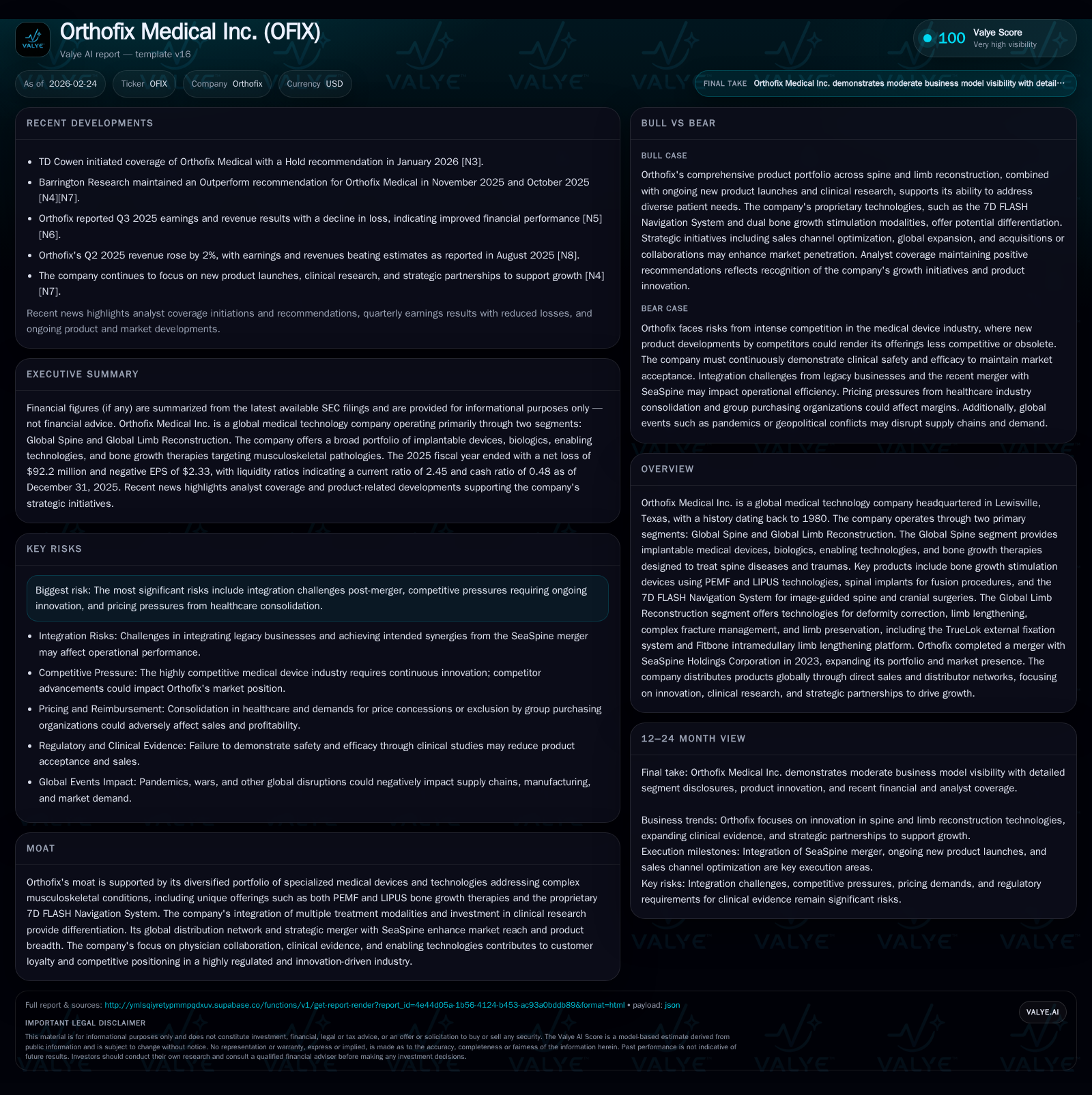
Orthofix Medical, a specialized global medical device company, has faced persistent operating losses over recent years despite strategic efforts including the merger with SeaSpine. Its portfolio spans implantable spinal devices, bone growth stimulation technologies, and limb reconstruction systems. The company’s future growth depends on leveraging clinical evidence and innovation, physician collaboration, new product launches, and operational synergies from its merger. While cash flow trends are improving, capital expenditures remain high, impacting free cash flow. Risks include integration headwinds, competitive pressures, regulatory hurdles, and healthcare consolidation influencing pricing dynamics.
Company Overview
Founded in 1980 and headquartered in Lewisville, Texas, Orthofix Medical Inc. is a global medical technology firm focused on musculoskeletal solutions through two primary reporting segments: Global Spine and Global Limb Reconstruction. The former dominates the company’s sales mix at about 84% of net sales [S8], encompassing implantable spine devices, biologics, enabling technologies like the proprietary 7D FLASH Navigation System for image-guided spine surgery, and bone growth therapies using pulsed electromagnetic field (PEMF) and low intensity pulsed ultrasound (LIPUS) technologies [S24]. Notably, Orthofix uniquely offers both PEMF and LIPUS stimulator products.
Global Limb Reconstruction accounts for roughly 16% of sales [S8] with advanced external fixation systems such as the TrueLok system for deformity correction and fracture management, along with internal limb lengthening platforms including Fitbone [S29]. The company's comprehensive approach addresses complex patient needs spanning spine diseases to limb deformities.
The strategic merger with SeaSpine Holdings Corp., completed recently prior to the 2025 fiscal year-end [S1], has broadened Orthofix's market reach and product breadth but also introduced integration complexities that remain an ongoing challenge [S4].
Historical Performance
Despite steady innovation efforts, Orthofix has reported sizeable operating losses consistently over recent years albeit showing signs of moderation:
Historical performance (annual)
| FY | Net ($mm) | CFO ($mm) | OpInc ($mm) | Capex ($mm) | Net YoY |
|---|---|---|---|---|---|
| 2025 | -92 | 33 | -81 | +26.8% | |
| 2024 | -126 | 26 | -85 | +16.8% | |
| 2023 | -151 | -46 | -139 | 60 | -666.6% |
| 2022 | -20 | -12 | -13 | 21 |
Note: Omitted columns lack sufficient annual XBRL coverage in the provided tags (need ≥2 annual points): Rev, Div, Buybacks. Source: SEC companyfacts cache [F1].
Capital returns and efficiency (annual)
| FY | FCF ($mm) | ROE% |
|---|---|---|
| 2025 | -20.5 | |
| 2024 | -25.0 | |
| 2023 | -106 | -25.3 |
| 2022 | -33 | -5.9 |
Source: SEC companyfacts cache [F1].
Note: Revenue data unavailable from provided tags; Capex for FY24 unavailable due to limited data points [F1]
The operating loss improved by approximately 3.8% in the latest reported year compared to prior year metrics. Net income losses contracted more sharply by nearly 27%, indicating some progress toward operational stabilization post SeaSpine merger integration [F1]. Concurrently operating cash flows swung significantly positive reaching $33 million in FY25 from negative territory two years prior, suggesting better working capital management or improved underlying business trends [F1]. However, capital expenditures spiked sharply — up about 182% relative to the previous reported capex — likely reflecting investment related to integrating SeaSpine assets or upgrading manufacturing capabilities [F1][S27]. This dynamic leaves free cash flow still negative by roughly $27 million in FY25.
Equity declined somewhat during this period but remains substantial above $450 million at end-2025 serving as a cushion amid accumulated deficits [F1]. The company maintains a robust current ratio around 2.45x reflecting solid near-term liquidity despite these losses [F1].
Growth Prospects
Orthofix's future growth hinges on several core strategic pillars detailed publicly:
- Continued cadence of innovative product launches targeting spine implants, biologics, enabling technologies including navigation systems that improve surgical precision [S8].
- Reinforcement and expansion of bone growth stimulation business leveraging clinical data dissemination; notably the company's dual offering of PEMF/LIPUS provides differentiation in noninvasive fusion adjunct therapies where FDA regulatory reclassification of devices may increase competition risk [S24][S9].
- Strategic expansion and optimization of global commercial sales channels aiming to deepen penetration internationally beyond the U.S.-centric distribution for certain products [S8].
- Aggressive development of clinical research programs supporting safety/effectiveness claims which underpin surgeon adoption—critical in this highly regulated medtech sector [S8][S6].
- Acquisitions or licensing agreements to supplement internal innovation capacity further diversify product offerings while enhancing synergies post-SeaSpine merger [S8][S29].
- Investment in digitally transformative technology platforms including the Orthofix Academy medical education initiative that supports physician training and awareness.
However, growth could be constrained by risks such as ongoing operational disruptions due to integration challenges, evolving reimbursement policies influenced by healthcare cost-containment reforms affecting demand/pricing power, intense competition requiring frequent innovation cycles to avoid obsolescence, supply chain vulnerabilities given reliance on select third-party manufacturers/suppliers as seen industry-wide during recent global disruptions [S9][S6][S11]. Regulatory scrutiny also poses uncertainty; FDA recommendations around device classifications may increase competitive substitutes especially for bone stimulation products historically generating meaningful revenues [S9].
Forecasts & Milestones
While Orthofix has not issued detailed forward guidance publicly within available disclosures [N3][S1], watchers should monitor milestones such as:
- Timing and commercial impact of new product launches particularly within limb reconstruction platforms (Fitbone enhancements) and spinal navigation enabling technologies.
- Progress against clinical study enrollments/publications reinforcing product efficacy benchmarks necessary for surgeon confidence.
- Post-merger synergy achievements reflected in reduced operating expenses or boosted segment margins.
- Regulatory developments regarding bone growth stimulation devices’ FDA classification status.
- Expansion progress in international markets via distributor partnerships or direct sales penetration.
These factors will critically influence top-line trajectory alongside margin improvement potential as scale benefits materialize.
Returns & Capital Allocation
Given the ongoing net losses reported — approximately -$92 million for FY25 — raw returns metrics like ROE remain negative at near -20% levels based on net income relative to equity base [F1]. Nonetheless improving operating cash flows indicate core operations moving toward break-even cash generation capability which is positive from a liquidity standpoint.
Capital expenditure levels have increased substantially reflecting either capacity expansion or upgrade projects linked to integration commitments or new product launches; this elevated spending suppresses free cash flow which must be watched closely for sustainability over medium term [F1][S8][S27].
No recent updates on dividend payments or share buybacks were available in disclosed filings or news sources suggesting capital prioritization remains focused on investment rather than returns to shareholders currently.
Industry Context & Competitive Positioning Analysis
The musculoskeletal device industry is characterized by rapid technological advances necessitating consistent R&D investment alongside rigorous clinical validation processes before broad surgeon adoption occurs—an inherently capital intensive cycle increasing pressure on margins for companies without scale advantages. Orthofix’s moat lies notably in its comprehensive portfolio combining multiple treatment modalities—mechanical implants plus biological agents plus electro-magnetic bone stimulation—with proprietary navigation tools that offer differential value in complex spine surgeries often requiring multimodal approaches for optimal outcomes [valye_report_excerpt.moat][S24]. In particular orthopedic surgeons increasingly demand platform solutions minimizing procedure times without compromising clinical outcomes—enabling technology integration enables Orthofix some leverage against commoditized competitors. Meanwhile limb reconstruction remains a niche segment with high complexity cases needing tailored external fixation or internal lengthening solutions; Orthofix’s TrueLok system leadership combined with innovative intramedullary nails like Fitbone provides key competitive moats though this remains an area exposed to smaller competitor activity given specialized nature [valye_report_excerpt.overview][S29]. Healthcare consolidation among hospital groups and payor entities raises risk around price concessions potentially pressuring volumes/margins if exclusive GPO arrangements exclude smaller vendors—a relevant factor for Orthofix’s independent distributor model particularly in U.S market segments where majority sales occur [valye_report_excerpt.risks][S4][S9]. Supply chain reliability post-pandemic disruptions continues industry-wide as well adding complexity to execution.
Conclusion
Orthofix Medical navigates a challenging phase shaped by legacy operating losses compounded by merger-related costs while expanding its distinctive spine and limb reconstruction product arrays including cutting-edge stimulators and digital surgery enhancements. Despite losing ground financially at an earnings level through FY25, traction toward positive operating cash flow signals improving underlying health anchored on solid integration progress and commercial expansion initiatives. Future prospects rely heavily on sustaining innovation momentum amid fierce competition coupled with effective risk management addressing regulatory shifts plus payer-driven pricing pressures prevalent across medtech sectors today. Capital allocation remains focused on reinvestment fueling growth ramps rather than immediate shareholder returns making it imperative for stakeholders to track execution against stated milestones alongside evolving macro healthcare dynamics.
This report is for informational purposes only; it does not constitute investment advice or recommendations.
Disclaimer: This is research-only, informational analysis and not investment advice. It may include AI-generated interpretation and general industry context. Always verify important details using primary sources.

Comments