
Chemours Co’s Financial Resilience Tested by Environmental and Market Challenges
Chemours delivered revenue growth in 2025 but faced widening net losses amid rising regulatory and remediation costs, spotlighting capital allocation pressures.
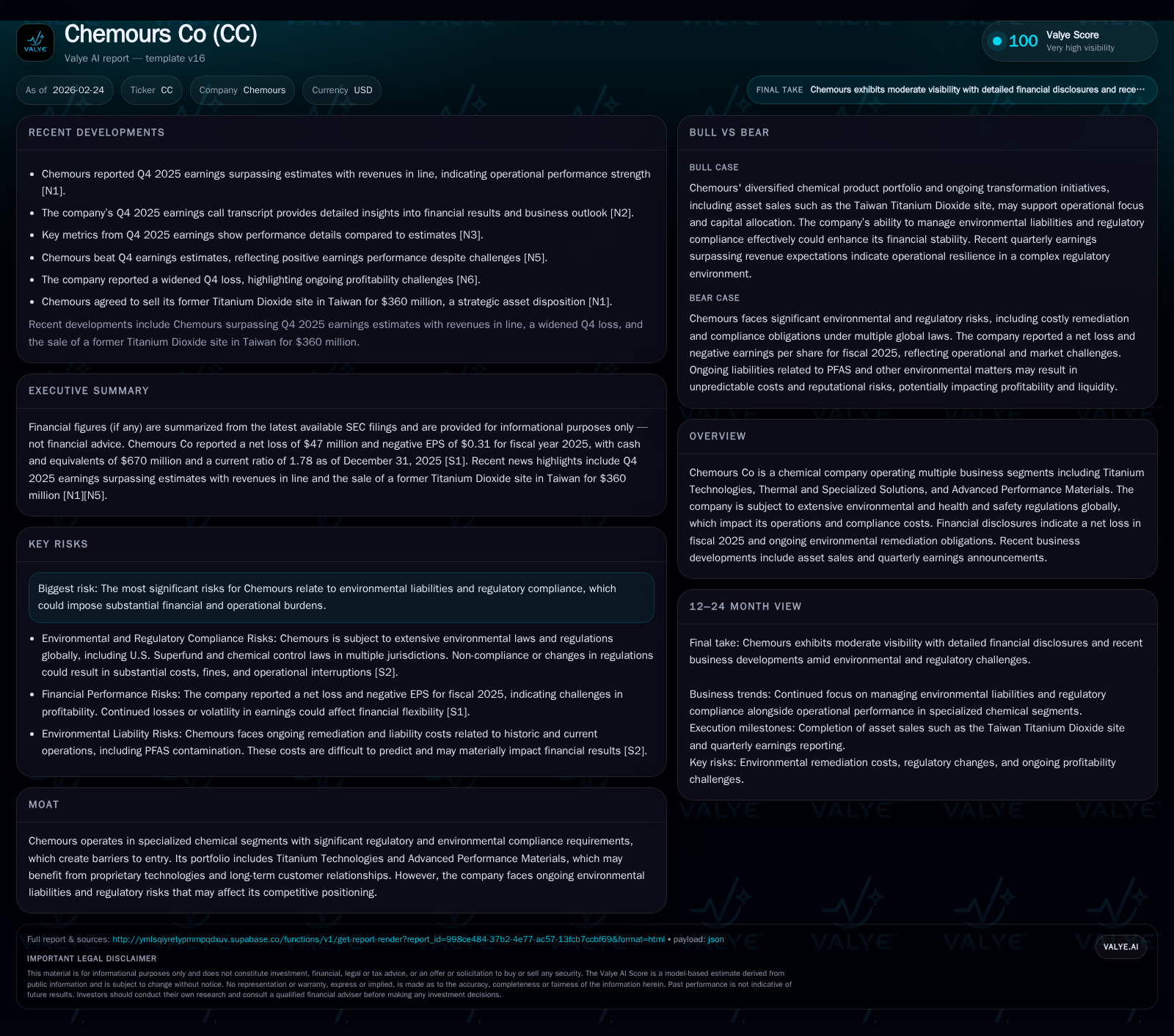
In 2025, Chemours reported a 7.4% increase in revenue reaching $6.63 billion, yet net income deteriorated to a loss of $47 million, reflecting escalating environmental liabilities and compliance expenses. Operating cash flow rebounded strongly, supporting modest free cash flow generation despite reduced capital expenditures. The company’s specialized segments like Titanium Technologies remain key revenue contributors, but ongoing CERCLA-related remediation obligations and tightening global chemical regulations impose substantial cost headwinds. Liquidity remains adequate with a current ratio near 1.78, although balance sheet leverage is accentuated by accrued environmental provisions. Dividend payments were maintained while share repurchases slowed considerably, underscoring cautious capital stewardship amidst operational headwinds. Going forward, stakeholders should focus on regulatory developments, remediation cost trajectories, and asset sales including the recent Taiwan site divestiture as factors influencing Chemours’ financial trajectory.
From Growth to Losses: Chemours’ Financial Trajectory through 2025
Chemours Co's fiscal year 2025 results present a nuanced picture of top-line expansion juxtaposed with bottom-line pressure. Revenues increased 7.4% year-over-year to approximately $6.63 billion [F1], a continuation of multi-year growth driven principally by strength in their Titanium Technologies and Advanced Performance Materials segments [S12]. However, this revenue growth was accompanied by a stark reversal in net income which swung further into the red, registering a loss of $47 million in 2025 compared to narrower losses in prior years ($8M loss in 2024; $18M in 2023) [F1]. This deterioration reflects mounting environmental remediation costs and higher regulatory compliance expenditures that exert downward pressure on margins.
Operational cash flows experienced a strong rebound after a notable dip in 2024; net cash provided by operating activities rose by nearly 142% YoY to $264 million in 2025 from a negative $633 million in the prior year [F1]. Concurrently, capital expenditures were curtailed sharply by over 40% to $213 million, down from $360 million the previous year [F1], highlighting a shift toward more conservative investment spending amid uncertain regulatory and environmental liabilities.
Historical performance (annual)
| FY | Net ($mm) | CFO ($mm) | Capex ($mm) | Net YoY |
|---|---|---|---|---|
| 2025 | -47 | 264 | 213 | -487.5% |
| 2024 | -8 | -633 | 360 | +55.6% |
| 2023 | -18 | 556 | 370 | -103.1% |
| 2022 | 578 | 754 | 307 |
Note: Omitted columns lack sufficient annual XBRL coverage in the provided tags (need ≥2 annual points): Rev, OpInc, Div. Source: SEC companyfacts cache [F1].
Capital returns and efficiency (annual)
| FY | Buybacks ($mm) | FCF ($mm) | ROE% |
|---|---|---|---|
| 2025 | 69 | 51 | -18.8 |
| 2024 | 69 | -993 | -1.3 |
| 2023 | 69 | 186 | -2.4 |
| 2022 | 495 | 447 | 52.2 |
Source: SEC companyfacts cache [F1].
Note: Operating income data not available; revenue shown for FY2018 and FY2025 to illustrate scale.
The net return on equity estimated at approximately –18.8% for 2025 underscores the profitability challenges facing Chemours under current market and regulatory conditions [F1].
Segment Dynamics: How Titanium Technologies and Advanced Materials Moved the Needle
Chemours' business is organized primarily into three key segments: Titanium Technologies; Thermal and Specialized Solutions; and Advanced Performance Materials [S12]. Titanium Technologies historically comprises the largest revenue base with products such as titanium dioxide used widely in coatings, plastics, and paper industries. The Advanced Performance Materials segment contributes through fluoroproducts serving high-growth applications primarily within electronics markets.
Despite volatile industry demand due to macroeconomic factors impacting customer capex cycles especially in electronics end-markets, both Titanium Technologies and Advanced Performance Materials demonstrated resilience fueling overall revenue growth [S12]. However, these segments operate within highly regulated environments requiring adherence to stringent permitting processes for emission controls, hazardous waste management, and chemical product approvals under legislations like TSCA (U.S.) or REACH (EU).
Operational margins remain squeezed given increased investments needed for emissions abatement technology upgrades as well as compliance assurance frameworks across geographies [S12]. Moreover, fluctuations in raw material pricing combined with transportation logistics complexity introduce supply chain risk factors typical for chemical OEM producers operating globally.
Environmental Compliance Costs: The Cost Headwind Underpinning Profitability
A defining factor clouding Chemours’ profitability outlook is the significant accrual of environmental liabilities arising from both historic operations and ongoing remediation obligations [S1],[S4],[S5],[S6]. These liabilities stem largely from Superfund sites governed under CERCLA alongside additional state-level directives concerning hazardous waste disposal practices.
The company disclosed that accumulated environmental loss contingencies have grown materially in recent years due to extended cleanup timelines and expanded regulatory demands [S1],[S6]. Cost estimates for site investigations, groundwater treatment systems installation, soil remediation efforts, and associated administrative legal proceedings have been increasingly onerous.
Regulatory compliance also encompasses enhanced controls necessitated by climate-linked statutes such as carbon emissions caps under the EU Emissions Trading System as well as emerging GHG reporting requirements that embed further operational constraints [S4]. Incremental outlays related to emission control equipment retrofits inflate both capital expenditure plans and recurring operational overheads.
These environmental cost burdens directly correlate with the company's reported net losses despite positive operational cash flow generation — an asymmetry that highlights the non-cash but material impact of accounting for these liabilities under U.S. GAAP guidance relating to contingent losses at chemical manufacturing facilities [S1].
Regulatory Landscape and Legal Liabilities Shaping Operations
Chemical producers like Chemours face an intricate regulatory matrix composed of overlapping federal statutes (e.g., Clean Air Act, Clean Water Act), international chemical substance controls (EU REACH, Japan CSCL), transport packaging standards, plus climate change related mandates imposing carbon limits [S2],[S9],[S14],[S15].
Permitting renewals are critical milestones as any failure or delays risk forced shutdowns impacting production continuity [S2],[S11]. Compliance requires robust hazardous materials management protocols encompassing inventory tracking under TSCA's risk evaluation process along with adherence to storage safety norms.
Legal risks remain salient given ongoing litigations linked principally to PFAS contaminants — issues resulting from legacy fluorochemical operations with significant potential for punitive damages or settlement costs as underscored in recent filings [S9],[N7],[N8]. The company must navigate these multi-jurisdictional enforcement landscapes without impairing supply reliability or incurring prohibitive fines.
Capital Structure and Liquidity: Navigating Debt Amidst Remediation Obligations
Chemours maintains an adequate liquidity posture entering 2026 with cash & equivalents totaling approximately $670 million against current liabilities around $1.69 billion yielding a current ratio near 1.78 indicating short-term resource sufficiency [F1],[S7],[S8],[S13]. This liquidity buffer is essential given unpredictable timing of large environmental payout events.
Debt maturities are staggered with notable tranches due beyond 2028 which limits near-term refinancing pressures however total leverage remains elevated partially attributable to accrued environmental loss reserves classified within long-term liabilities affecting covenant headroom assessments [S20],[S21],[S26],[S28].
The company's ability to generate positive free cash flow—estimated near $51 million after subtracting capex from CFO—affords some relief but deploying those funds must balance servicing debt while investing prudently in operational upgrades necessitated by regulatory compliance realities [F1].
Capital Allocation Priorities: Dividend Stability Versus Share Repurchases
In spite of persistent net losses over recent years including deeper weakness in FY25, Chemours elected to maintain dividend distributions reflecting an intent to signal steady shareholder returns even amid operational challenges [F1],[S10],[S16],[S22],[S29]. Dividend consistency may aim at supporting valuation stability during episodic earnings volatility.
Conversely, share repurchase activity has contracted significantly from historical highs (e.g., $495 million repurchased back in FY22) down to only $69 million per annum over the last three reported years suggesting more conservative deployment amid cost headwinds and balance sheet considerations [F1]. This measured approach indicates caution surrounding cash flexibility given unresolved environmental liability uncertainty.
Outlook Considerations: What Investors Should Monitor Going Forward
Explicit forward guidance remains limited; however recent disclosures signal key milestones warrant scrutiny including anticipated realization of proceeds from asset sales such as the divestiture of former Taiwan titanium dioxide site land valued at $360 million completed early this year providing significant liquidity reinforcement [N14],[N2],[N3],[N1],[S3].
Further attention should be paid to quarterly earnings trends especially margin recovery potential tied to cost control efforts offsetting steadily climbing compliance expense burdens plus any developments on multi-party litigation settlements influencing contingent liability recognition.
Operational execution involving permit renewals across critical manufacturing sites will also figure prominently impacting production uptime stability hence financial results quality remains intertwined with external regulatory factors beyond direct operational control which could prompt material swings quarter-over-quarter.
Focused Risks: Environmental, Regulatory, and Market Threats to Watch
Among principal risk exposures are:
- Prolonged Superfund liability obligations expanding environmental provisioning requirements adding unpredictability to cash costs including potential remedial acceleration expenses [S9],[N7].
- Tightening global chemical regulations such as enhanced REACH controls or emerging climate legislation amplifying compliance complexities heightening indirect cost inflation traps [S14],[S24].
- Litigation risks escalating from product safety or contamination claims notably related to PFAS legacy chemicals posing material reputational harm combined with punitive damages scenarios threatening financial resources allocation priorities [N8],[N7],[S23], all characteristic exposures within specialized chemical manufacturing sectors challenging risk management protocols.
- Market cyclicality affecting end-market demand variability particularly within key segments like advanced electronics materials necessitating flexible capacity utilization strategies balancing fixed cost leverage effects inherent in heavy chemical production operations.
Acknowledging these multifaceted risk vectors underscores why Chemours’ financial performance is heavily influenced not solely by market dynamics but also by stringent regulatory frameworks shaping operational integrity constraints common across the global specialty chemicals industry.
This analysis synthesizes public filings and news sources without providing investment advice or price forecasts.
Disclaimer: This is research-only, informational analysis and not investment advice. It may include AI-generated interpretation and general industry context. Always verify important details using primary sources.

Comments