
Primoris Services' Growth Balances Equipment Investment and Contract Risk Amid Sector Cyclicality
Primoris Services Corporation leverages its equipment-intensive model and Master Service Agreements to drive steady infrastructure services growth while managing project execution risks.
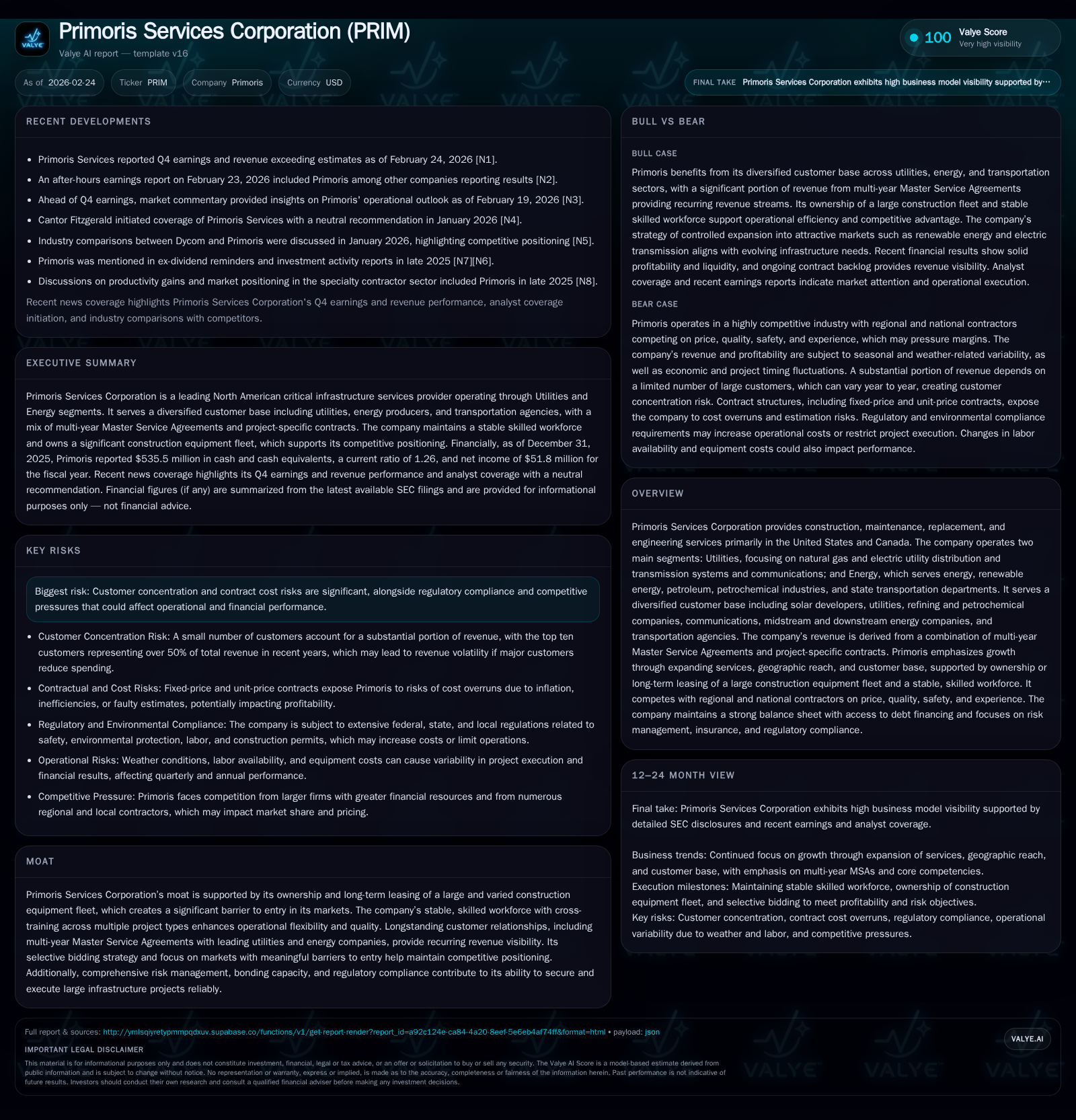
Primoris Services Corporation has exhibited solid operating income growth over recent years, driven by expansion in utility and energy infrastructure services across the US and Canada. Its business model emphasizes recurring revenue from multi-year Master Service Agreements (MSAs), complemented by selective fixed-price project work. Despite a robust backlog and capital investments in equipment, earnings are tempered by contract risk and some earnings volatility due to project timing and weather. Key metrics show operating income up nearly 30% year over year to $411.5 million in FY2025, though net income declined slightly from $54 million the prior year. Capital allocation prioritizes reinvestment in fleet assets and modest dividends, supporting operating cash flow of over $470 million in 2025. Going forward, growth depends on successful bidding in regulated utility expansions and renewable energy projects amid intense competition and cost pressures.
Company Overview and Business Model
Primoris Services Corporation operates as a critical infrastructure provider primarily serving the United States and Canada. The company’s operations center around two main reportable segments: Utilities and Energy [S1][S4]. The Utilities segment focuses on construction, maintenance, replacement, and engineering services for natural gas and electric utility distribution/transmission systems as well as communications infrastructure across broad geographic locations [S13]. The Energy segment serves energy-related industries including renewable energy projects, petroleum/refining/petrochemical complexes, midstream/downstream pipelines, state transportation departments, and power producers through EPC (engineering/procurement/construction) and maintenance contracts [S13].
A key characteristic of the Primoris business model is its dual focus on revenue streams derived from multi-year Master Service Agreements (MSAs) versus standalone project-based contracts [S4][S5]. MSAs – typically unit-price or time-and-materials based – represent about 32% of total revenue as of FY2025 but can vary year-to-year given their contingent usage nature by customers [S4]. These long-term agreements provide somewhat stable recurring business without mandatory minimum purchase guarantees for most contracts.
Coupled with this is Primoris’ ownership or long-term leasing of a large and diverse equipment fleet that supports complex construction demands across segments [S5]. This asset base creates significant entry barriers for competitors, who may lack such scale or machinery access. Also notable is Primoris' emphasis on a stable workforce with skilled tradespeople cross-trained across multiple project disciplines such as pipeline construction, fabrication, utility installation, refinery maintenance, and electrical grid servicing [S5].
Competition varies widely depending on project type: large-scale industrial projects see rivalries with companies like Quanta Services and Kiewit whereas smaller construction services face localized competitors [S17]. Primoris competes principally on price but also reputation for safety compliance, schedule certainty, financial strength, and technical expertise.
Historical Performance Analysis
The company has grown meaningfully over recent years — particularly apparent in its surge in operating income (OpInc) from $195 million in FY2022 to $411.5 million in FY2025 according to XBRL data [F1]. This nearly 110% rise over three years reflects successful execution on higher-margin projects along with organic growth in contracting volume facilitated by MSAs.
Net income (Net) followed a similar upward trend until FY2024 but dipped slightly (-4%) last year to $51.8 million [F1]. This divergence between operating profit gains and flat-to-declining net earnings aligns with higher interest expenses linked to Primoris’ accounts receivable securitization facility expansions that manage working capital requirements [S7][S12].
Revenue data points from earlier periods are not comparable post-2018 due to metadata constraints; however historical disclosures confirm diversification of client base involving utilities, energy firms including renewables developers, petroleum refiners, communications companies, and transportation entities [S4][S13]. Seasonality influences results significantly: Utilities work wanes early in calendar years correlating with internal budget cycles and weather impacts—primarily rain or snow during quarter ends—which introduces quarterly volatility [S8].
Annual Financial Snapshot
Historical performance (annual)
| FY | Net ($mm) | CFO ($mm) | OpInc ($mm) | Capex ($mm) | Net YoY |
|---|---|---|---|---|---|
| 2025 | 52 | 470 | 412 | 130 | -4.0% |
| 2024 | 54 | 508 | 317 | 127 | +43.3% |
| 2023 | 38 | 199 | 253 | 103 | -71.7% |
| 2022 | 133 | 83 | 195 | 95 |
Note: Omitted columns lack sufficient annual XBRL coverage in the provided tags (need ≥2 annual points): Rev. Source: SEC companyfacts cache [F1].
Capital returns and efficiency (annual)
| FY | Div ($mm) | Buybacks ($mm) | FCF ($mm) |
|---|---|---|---|
| 2025 | 17 | 341 | |
| 2024 | 13 | 6 | 382 |
| 2023 | 13 | 6 | 96 |
| 2022 | 13 | 6 | -11 |
Source: SEC companyfacts cache [F1].
Note: Revenue historic values are incomplete due to XBRL limitations; net income fluctuations likely reflect timing of large projects and accounting for finance costs.
Growth Prospects & Industry Dynamics
Primoris’ strategy prioritizes controlled expansion via broader scope of services within existing markets alongside geographic broadening targeting renewable energy infrastructure, power generation transmission/distribution upgrades, gas pipeline distribution expansions, and transportation agency contracts [S5]. The company consciously seeks acquisitions that complement these capabilities while maintaining strict fiscal discipline.
Recurring contractual revenue from MSAs helps smooth demand volatility although MSA revenues accounted for just about one-third of total revenue as of the latest fiscal year—with the remainder coming from discrete projects which expose margins to execution risks like cost overruns or delays [S4][S22]. Competition intensifies especially where new greenfield utility projects or renewables developments come under stringent pricing pressure amidst rising input costs for materials/labor/suppliers.
Regulatory trends fueling demand include federal/state incentives for renewable energy deployment plus mandated upgrades for grid resilience against climate extremes—addressed through transmission/distribution services offered by Primoris’ Utilities segment . However macroeconomic headwinds such as inflation-driven cost escalation could challenge margin recovery if not counterbalanced by contract provisions allowing escalation passthroughs or cost-sharing mechanisms with clients.
Longer-term opportunities also hinge on labor market conditions as availability of skilled craft professionals remains tight industry-wide; Primoris invests in workforce stability via cross-training programs aimed at reducing reliance on subcontractors which can erode profitability during peak demand cycles [S5].
Forecasts & Milestones To Watch
While explicit forward guidance has not been provided recently by management publicly beyond annual filing commentary [S6], monitoring the following indicators will be key:
- Renewal rates and expansion potential within existing MSAs since these underpin baseline volume stability;
- Backlog figures collectively reflecting both firm multi-year commitments plus expected work orders under MSAs which though variable give a rough gauge on near-term revenues;
- Execution outcomes on recently awarded renewable energy EPC projects – especially any margin compression or schedule slippages which could affect operating income;
- Pricing trends vis-à-vis commodity input inflation notably steel/equipment rental costs;
- Legal/regulatory developments impacting bonding requirements or contract security deposits that influence bid competitiveness [S20];
- Changes in debt capacity or terms attached to accounts receivable securitization facilities impacting liquidity profile.
Industry context suggests cyclical risk remains present given reliance on capital expenditure budgets set by regulated utilities or government agencies which can shift abruptly leading to delays/cancellations affecting quarterly recognition patterns . Weather-related disruptions especially during winter quarters add further unpredictability around timing albeit offset somewhat by diversified geographic footprints.
Capital Allocation & Returns
The company maintains a conservative capital structure supported by strong cash flows derived from operations coupled with strategic use of debt instruments such as the expanded accounts receivable securitization facility totaling up to $250 million maximum purchase capacity as of mid-2025 [S7][S12][F1]. Cash & equivalents have been elevated above $535 million at FY end indicating liquidity cushion.
Capex runs above $120 million annually reflecting ongoing investment into fleet renewal/expansion crucial given equipment intensity – about threefold less than operating cash flow ensuring ample free cash flow remains after reinvestment needs are met ($340+ million FCF estimate using CFO minus capex) [F1]. Dividend payouts have trended modestly upwards reaching approximately $17 million in FY2025 (~0.3x net income), emphasizing priority toward balance sheet strengthening over aggressive shareholder returns currently.
Share repurchases have been negligible or absent recently compared to prior years suggesting management favors reinvesting internally rather than returning capital via buybacks at this stage given industry cyclicality concerns.[F1]
Return on equity (ROE) calculated roughly at ~3.1% for FY2025 appears subdued relative to revenue scale but consistent with capital-intensive infrastructure service peers where margins compress returns amid high working capital needs [F1].
Risks & Challenges
Primoris faces several operational challenges including:
- Customer concentration risk: Top ten customers generated over half company revenue although individual constituents vary annually depending on project awards leading to potential revenue visibility fluctuations [S4][S14];
- Contract cost estimation risk: Fixed-price contracts subject company to adverse margin impact if labor/material cost estimates prove inaccurate or client modifications occur without full reimbursement [S22];
- Regulatory compliance risks including bonding/letter-of-credit requirements which if unmet can restrict winning new contracts particularly larger ones requiring financial guarantees [S20];
- Competitive pressure from larger national firms able to compete aggressively on pricing leveraging scale advantages;
- Cyclical exposure typical for engineering/construction industries subjecting results to economic swings influencing customer capex budgets;
- Weather-related operational disruptions impacting seasonal demand patters impacting quarter-to-quarter consistency).
The combination of self-insurance programs coupled with standard insurance policies addresses some liability exposures but major claims could impose material financial burdens temporarily diverting resources away from operational focus [S20].
Conclusion & Monitoring Considerations
Primoris Services Corp presents a company well-positioned within critical US infrastructure markets supported by tangible fungible assets like its equipment fleet alongside enduring MSAs that enhance stable revenue streams amidst cyclically volatile project allocations.
Robust historical operating income growth highlights effective scaling within target markets allied with prudent risk-managed bidding but flat net earnings denote attention required around financing costs linked to working capital structuring strategies.
Future success hinges upon navigating competitive pricing landscapes while controlling execution risk amid increasing input costs—especially material inflation—and ensuring renewal/growth within MSAs remains productive.
Key observations warrant watching revolve around backlog quality/size evolution post-large renewables wins; contract margin realization especially under fixed price commitments; liquidity positioning given sizeable capex commitments; continuing workforce availability/stability efforts; regulatory environment shifts affecting surety capability; plus any signs of material legal claims impacting operational focus.
This memo is prepared solely for informational purposes based on publicly available materials including company SEC filings up through February 24th, 2026 and reported earnings news releases without endorsement or investment opinion expressed herein.
Disclaimer: This is research-only, informational analysis and not investment advice. It may include AI-generated interpretation and general industry context. Always verify important details using primary sources.

Comments