
First Watch Restaurant Group Faces Growth Trade-Offs Amid Rising Capex and Supply Chain Pressures
Focused daytime dining concept fuels brand loyalty but debt and supply risks temper expansion prospects.
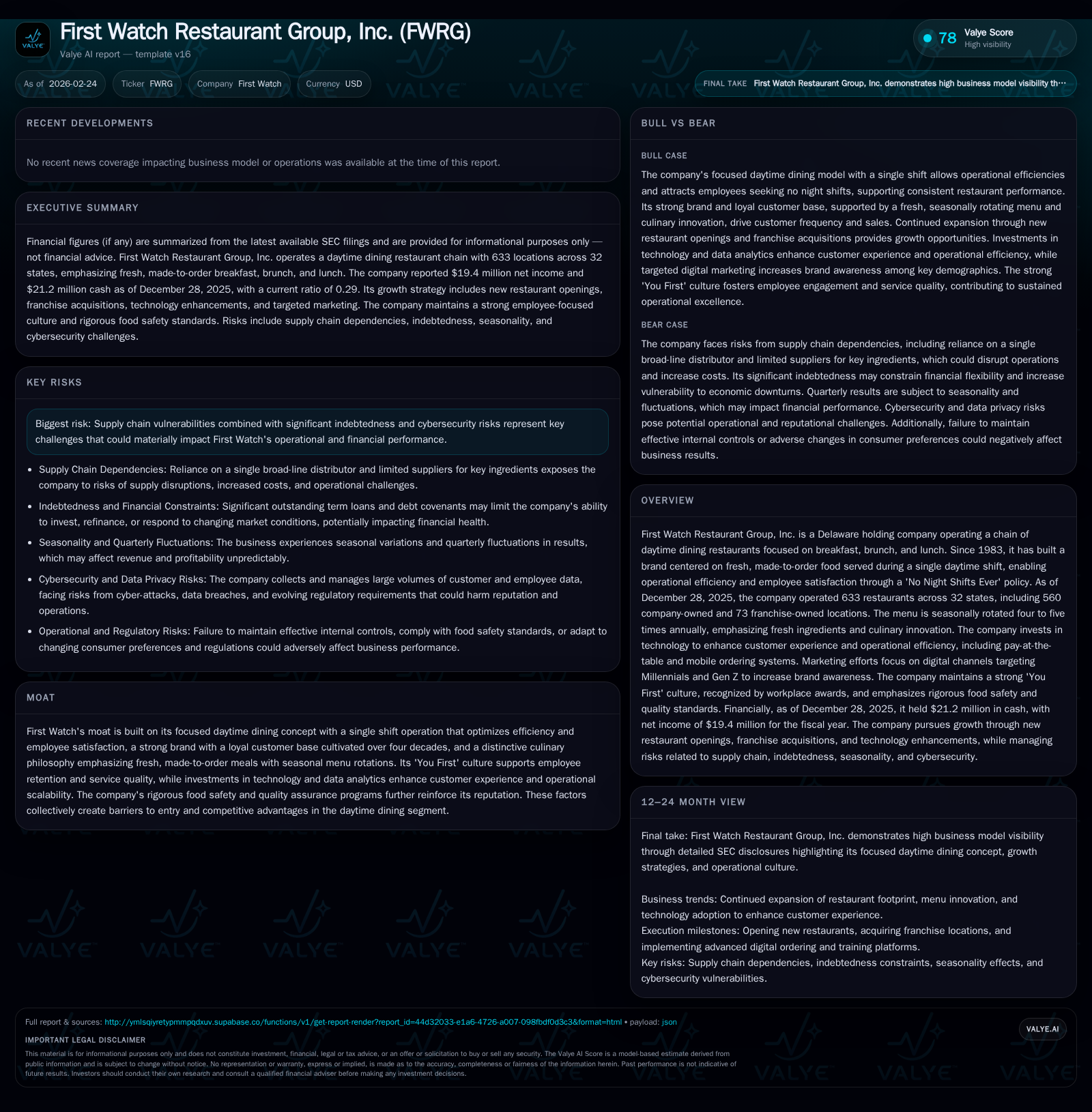
First Watch Restaurant Group, Inc. has built a distinctive daytime-only dining model with fresh, made-to-order menus across 633 restaurants, emphasizing operational efficiency and employee satisfaction. Historically, the company showed strong income growth through 2023 but faced profitability compression by 2025 due to higher expenses and increased capital expenditures largely related to expansion and franchise acquisitions. While it maintains strong cash flow generation, heavy reinvestment creates negative free cash flow in recent years. Going forward, growth hinges on successful new restaurant openings, franchise conversions, and digital marketing targeting younger demographics, though supply chain vulnerabilities and significant indebtedness remain critical headwinds.
Historical Performance: Growth Fueled by Operational Efficiency and Expansion
Since its founding in 1983, First Watch Restaurant Group, Inc. has pioneered the daytime dining segment, focusing exclusively on breakfast, brunch, and lunch during a single shift without night work. This operational specialization drives efficiency and employee satisfaction as evidenced by its "No Night Shifts Ever" policy. By December 28, 2025, the company operated 633 restaurants across 32 states: 560 company-owned locations supplemented by 73 franchise-owned units [S1], highlighting ongoing expansion.
The company has demonstrated solid historical earnings growth. Operating income grew significantly from $16.9 million in FY2022 to $41.3 million in FY2023 before retreating to $27.5 million in FY2025—a nearly 30% decline year-over-year [F1]. Net income rose from $6.9 million in FY2022 to $25.4 million in FY2023 and stabilized around $19.4 million in FY2025 [F1]. This pattern reflects an inflection after several years of operational leverage gains.
Operating cash flows expanded robustly from $62.9 million to $125.9 million between FY2022 and FY2025 [F1]. Such positive cash flow emphasizes the cash-generative nature of the business despite margin pressures. However, capital expenditures surged markedly from $62.2 million to $156.9 million over the same period—a reflection of aggressive investment in new restaurants as well as acquisitions of franchise outlets [S17][F1]. The capex spike outpaced CFO growth resulting in negative free cash flow circa -$31 million for FY2025.
Equity base increased steadily from $523.1 million to $626.3 million between FY2022-2025 [F1], although return on equity remains modest at approximately 3.1% for FY2025 based on trailing net income [F1]. This subdued ROE highlights capital intensity relative to reported earnings.
Historical performance (annual)
| FY | Net ($mm) | CFO ($mm) | OpInc ($mm) | Capex ($mm) | Net YoY |
|---|---|---|---|---|---|
| 2025 | 19 | 126 | 28 | 157 | +2.7% |
| 2024 | 19 | 116 | 39 | 128 | -25.4% |
| 2023 | 25 | 95 | 41 | 85 | +267.5% |
| 2022 | 7 | 63 | 17 | 62 |
Note: Omitted columns lack sufficient annual XBRL coverage in the provided tags (need ≥2 annual points): Rev, Div, Buybacks. Source: SEC companyfacts cache [F1].
Capital returns and efficiency (annual)
| FY | FCF ($mm) | ROE% |
|---|---|---|
| 2025 | -31 | 3.1 |
| 2024 | -12 | 3.2 |
| 2023 | 11 | 4.5 |
| 2022 | 1 | 1.3 |
Source: SEC companyfacts cache [F1].
Note: Revenue data unavailable; dividends paid and share buybacks are not disclosed in provided data.
Growth Prospects: Expansion Balanced Against Cost Pressures
First Watch's unique daytime-only operational model supports higher average unit volumes—approximately $2.3 million per restaurant in just a seven-and-a-half-hour daily shift as of FY2025 [S1]. This model enables lean staffing and better work-life balance for employees—a key competitive advantage leveraging its "You First" culture focused on empowerment and career development [S1].
Company management continues an aggressive growth plan pursuing new restaurant openings alongside acquisitions of franchise-operated outlets—19 franchise restaurants were acquired during FY2025 alone along with development territory rights [S17]. As of year-end, the company managed nine franchisees running about seventy-three restaurants with further development obligations outstanding [S17]. The strategy aims for higher company ownership to harness better operating control and value capture.
Menu innovation is central to customer appeal; rotating seasonal menus four to five times annually keep the offering fresh while sustaining brand loyalty via chef-driven creations like Chimichurri Steak & Eggs Hash or the Brooklyn Breakfast Sandwich [S1]. Combining this with high-quality freshly juiced beverages differentiates First Watch within casual breakfast/lunch concepts.
Furthermore, leveraging investments in technology underpins omni-channel growth; pay-at-the-table functionality, mobile ordering options including takeout integration plus third-party delivery partnerships have enhanced customer convenience and operational scalability [S17][S18]. Digital marketing initiatives increasingly target Millennials and Gen Z demographics using social media ads, connected TV spots, programmatic campaigns driven by extensive first-party data amassed through millions of customer profiles opted-in for direct communications (~7.6 million profiles collected recently) [S18]. This data-centric approach positions First Watch well for tailored promotions improving visit frequency.
Looking ahead, revenue growth potential depends on how effectively First Watch can open new restaurants profitably without cannibalizing existing unit sales—particularly given geographic concentration (~41% of units in Southeast US with heavy Florida presence accounting for ~22%) which may amplify region-specific economic risks [S12][S14][S15]. Additionally, navigating supply constraints from reliance on a handful of core suppliers—including sole-source eggs and coffee—poses risks amplified by distributor labor unrest episodes impacting deliveries in early 2024 [S14][S15]. Enhancing supplier diversification or securing long-term contracts could reduce vulnerability.
Financial Health: Debt Profile Limits Flexibility Amid Capital Intensity
The company's capital structure reveals significant indebtedness totaling approximately $267 million in term loans exclusive of amortization costs as of December 28, 2025 [S4][S5][F1]. Debt servicing absorbs a substantial portion of cash flows thereby constraining capacity for other investments or strategic optionality.
Furthermore, debt is subject to variable interest rates exposing interest expense volatility risk under rising rate environments [S5]. Credit facilities incorporate covenants restricting incremental borrowings or dividends which may restrict First Watch's ability to deploy capital rapidly if unexpected liquidity needs arise or market conditions tighten.
Liquidity analysis shows tight working capital coverage evidenced by a current ratio under one (approximate ratio ~0.29), reflecting elevated short-term liabilities relative to current assets including cash balances around $21 million at fiscal year-end which indicates modest cushion against near-term obligations [F1]. This necessitates continued positive operating cash flow generation for smooth operations.
Despite strong reported operating cash flow trends (+8–20% annual increases last three years), heavy capex spending related primarily to new restaurants build-outs plus acquisitions maintains persistent free cash flow deficits (estimated circa -$31 million), limiting funds available for deleveraging or shareholder distributions currently absent from reported dividends or buybacks disclosures [F1][S20].
First Watch does not anticipate paying dividends in the foreseeable future given reinvestment focus combined with debt repayment priorities; any investor returns are likely contingent upon long-term earnings growth improvements or potential capital structure optimizations [S20].
Operational Risks: Supply Chain Concentration & Regulatory Environment
A notable operational risk stems from supply chain dependency on limited vendors—for example all eggs sourced from one supplier—and reliance on one broad-line distributor responsible for most food deliveries nationwide [S14][S15]. Past disruptions due to union strikes caused higher costs and service delays underscoring vulnerability that could impair restaurant sales or margins if prolonged or repeated.
Food safety is another critical area extensively managed via protocols but remains an omnipresent risk inherent in restaurant operations; incidents could materially damage brand reputation impacting traffic despite proactive quality assurance efforts described as rigorous [S21][S24].
Labor market tightness coupled with escalating wages (minimum wage laws), potential unionization attempts within workforce segments plus benefit costs present margin pressure potential going forward [S10][S29].
Cybersecurity exposures related to significant customer data collection mandate continued investment in IT security infrastructure plus compliance with evolving privacy regulations such as CCPA impact costs while noncompliance risks fines or reputational damage [S6][S8][S11][S29].
Regulatory compliance extends across multiple domains including health codes, alcoholic beverage control laws relevant due to First Watch’s limited bar service offerings as well as environmental sustainability initiatives that may increase operating costs requiring monitoring amid shifting stakeholder expectations [S22][S23][S28].
Industry Context Analysis
The casual dining sector focused on daytime meals faces competitive pressures both from traditional full-service restaurants expanding breakfast offerings and fast-casual concepts targeting convenience-conscious consumers seeking speed or takeaway options — areas where First Watch’s technology investments aim to compete effectively through omnichannel access and digital engagement.Seasonal menu innovation addresses consumer preference shifts seen industry-wide as diners increasingly demand freshness combined with health-conscious options bolstered by plant-forward dishes such as avocado toast variants.Financially,the restaurant industry contends with rising food inflationary pressures,a trend exacerbated by geopolitical events impacting fuel transportation costs linked closely with ingredient sourcing.Average unit volume metrics around $2m+ highlight premium positioning compared with typical casual breakfast peers whose AUVs often range lower,but intensified labor cost inflation may compress margins over time.Another sector-specific metric worth monitoring includes off-premises sales penetration which reached nearly one-fifth of total sales for First Watch,in line with fast-growing trends accelerated post-pandemic.Such shifts bring both opportunity via delivery channels yet add complexity with third-party fee structures eating into profitability.Analysts track how well players balance these trade-offs moving forward.
What To Watch Next: Indicators of Sustainable Growth Trajectory
- Profitability stabilization or improvement as capex-growth trade-offs evolve;
- Same-store sales trends reflecting traffic or pricing power under competitive menu landscapes;
- Successful integration of acquired franchise locations expanding operating margins;
- Advances in digital marketing ROI demonstrating traction among targeted Millennial/Gen Z cohorts;
- Supply chain resilience measures reducing volatility impact;
- Debt repayment progress enabling financial flexibility;
- Regulatory compliance developments especially privacy-related legislation affecting operational complexity;
- Labor market adaptations maintaining employee satisfaction consistent with "You First" culture ethos.
Conclusion
First Watch Restaurant Group’s focused single-shift daypart specialty model differentiates it within the competitive U.S casual dining field leveraging fresh culinary innovation alongside operational discipline crafting a loyal customer base over four decades.The company's recent financial results illustrate growing pains inherent when scaling through aggressive restaurant openings combined with franchise unit conversions amidst macroeconomic pressures including inflationary input costs.Cash flow generation remains solid but heavy capital spending drives negative free cash flow requiring prudent balance sheet management.Supply chain dependencies alongside concentrated regional exposure pose vulnerabilities requiring mitigation attention.Investments in technology paired with targeted digital outreach signal management’s intent to modernize consumer engagement keeping pace with evolving preferences.Stakeholders will be closely watching execution against these levers determining whether First Watch can sustain profitable growth while managing rising operational complexities embedded within its foundational "You First" culture.
Disclaimer: This report is for informational purposes only and does not constitute investment advice or recommendations regarding securities of First Watch Restaurant Group, Inc.. Readers should conduct their own due diligence before making investment decisions.
Disclaimer: This is research-only, informational analysis and not investment advice. It may include AI-generated interpretation and general industry context. Always verify important details using primary sources.

Comments