
TREASURE GLOBAL INC’s Strategic Shift Towards Scalable Digital Assets and AI Infrastructure
TGL narrows its focus to fintech and AI while grappling with steep revenue declines and capital challenges.
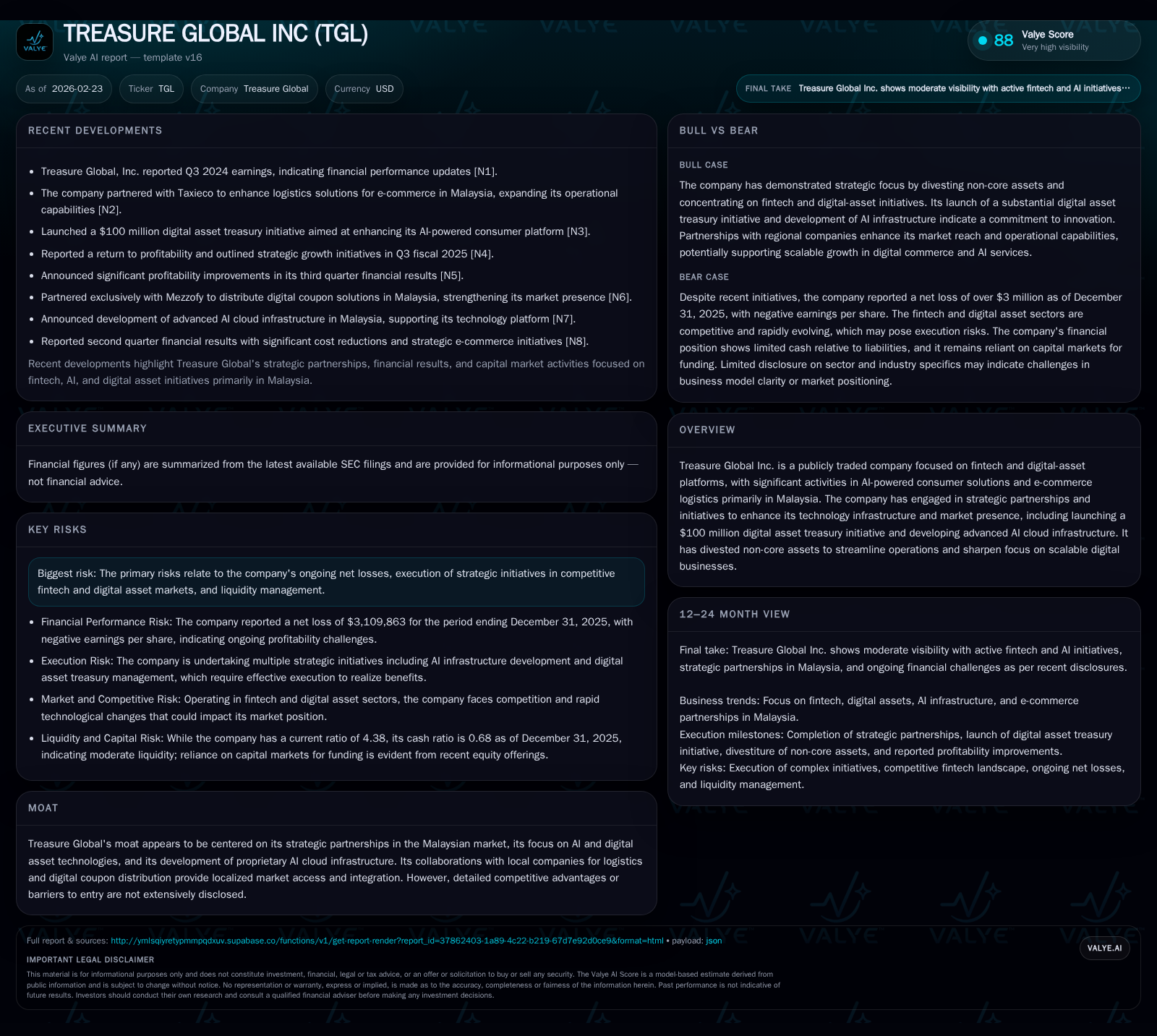
Treasure Global Inc. has undergone a marked transformation from diverse operations toward concentrated fintech and digital asset ventures, underpinned by proprietary AI cloud infrastructure and a significant $100 million digital asset treasury initiative. This pivot coincides with a dramatic revenue collapse exceeding 89% year-over-year as the company divests non-core assets and invests heavily in scalable digital platforms. Despite this strategic sharpening, TGL faces ongoing net losses, cash flow deficits, and liquidity constraints, raising execution and regulatory risks that will shape its near-term trajectory.
Historical Revenue Trends and Operating Performance Collapse
Over the past three fiscal years culminating in June 2025, Treasure Global Inc. has experienced precipitous declines in financial performance marked by a severe revenue contraction accompanied by ballooning operating losses. Revenue plummeted from approximately $22.07 million in FY2024 to just $2.33 million in FY2025 — an over 89% decline year-over-year according to reported XBRL data [F1]. The reductions align temporally with strategic restructuring efforts spotlighting a shift away from legacy business units.
Operating income deteriorated dramatically from a loss of roughly $6.06 million in FY2024 to nearly $22 million negative in FY2025, increasing about 263% on a negative base [F1]. Net income followed this downhill trend with losses climbing from approximately $6.58 million to nearly $23.38 million over the same periods, reflecting ongoing challenges in returning the company to profitability [F1]. Operating cash flow remained firmly negative, worsening from about -$4.71 million in FY2024 to -$9.48 million in FY2025 measured annually, emphasizing cash burn amid declining revenues.
The approximate return on equity was deeply negative at around -218% for FY2025 (net loss divided by equity), indicating destructive capital returns under current execution conditions [F1]. These figures suggest that despite investments in technology and restructuring efforts, the company has yet to stem financial erosion or scale new revenue streams sufficiently to offset fixed costs.
Historical performance (annual)
| FY | Rev ($mm) | Net ($mm) | CFO ($mm) | OpInc ($mm) | Rev YoY | Net YoY |
|---|---|---|---|---|---|---|
| 2025 | 2 | -23 | -9 | -22 | -89.4% | -254.9% |
| 2024 | 22 | -7 | -5 | -6 | -68.2% | +43.8% |
| 2023 | 69 | -12 | -10 | -10 | -12.9% | +0.2% |
| 2022 | 80 | -12 | -9 | -10 |
Note: Omitted columns lack sufficient annual XBRL coverage in the provided tags (need ≥2 annual points): Capex, Div, Buybacks. Source: SEC companyfacts cache [F1].
Capital returns and efficiency (annual)
| FY | FCF ($mm) | ROE% |
|---|---|---|
| 2025 | -9 | -217.6 |
| 2024 | -5 | -194.8 |
| 2023 | -10 | 8998.3 |
| 2022 | -9 | 75.3 |
Source: SEC companyfacts cache [F1].
Note: All values in USD thousands; parentheses indicate negative amounts.
Strategic Divestitures Driving Operational Focus
Consistent with its fiscal realities and strategic recalibration priorities revealed in December 2025 filings [S5], Treasure Global divested its non-core food & beverage platform comprising Tadaa Ventures Sdn Bhd and subsidiary Bowlcrafted Sdn Bhd through a share sale agreement valued around $1.4 million equivalent in escrowed shares of an external entity [S5][S16][S20][S26]. This disposal is part of the company’s methodical effort to sharpen management focus toward scalable fintech businesses characterized by asset-light models.
The divestment aligns with plans to concentrate resources on higher-margin digital asset initiatives including the OXI Wallet platform—a fintech solution focused on consumer payments—and related advisory-driven distribution ventures especially centered on real-world-asset tokenization within Malaysia’s growing e-commerce logistics space [S5]. By streamlining its corporate footprint away from traditional F&B operations toward core tech-driven segments, TGL aims for operational discipline and enhanced capital efficiency anticipated to support longer-term scalability.
Expanding AI Cloud Infrastructure: Technological Differentiation?
Treasure Global’s strategic blueprint involves fostering proprietary AI cloud infrastructure capabilities integrated through partnerships with local players like V Gallant SDN BHD specializing in generative AI services including digital human technologies [S17][S21][N1]. The original contracting for these services aggregated approximately $16 million with subsequent arrangements structured as equity participation following overpayments clarified by supplemental agreements reducing payable fees but yielding share interests reflecting technology collaboration[S18][S21].
This investment into advanced AI technology stack—especially contributory towards fintech platforms such as OXI Wallet—is critical given competitive pressures within Malaysia’s burgeoning fintech ecosystem where differentiators revolve around seamless integration of machine learning algorithms enhancing fraud detection, customer experience personalization, and real-time analytics for payment systems.
The company's embedding of tokenization solutions linked to real-world asset classes alongside e-commerce logistics realms suggests attempts at convergence between virtual financial instruments and physical product distribution chains—a vertical integration approach that could create switching costs or barriers if executed effectively . However, detailed quantifiable moat advantages remain undisclosed per latest reports.
Digital Asset Treasury Initiative: Growth Catalyst or Risk Exposure?
A noteworthy highlight is TGL's launch of an ambitious $100 million digital asset treasury initiative designed to underpin growth by allocating capital into blockchain-enabled financial innovations and asset tokenization projects primarily targeted within Southeast Asia’s markets . While representing strong growth potential via scale economies and access to emergent asset classes traditionally inaccessible to retail investors,
the venture carries significant risk exposure amid highly volatile cryptocurrency markets compounded by the company's recurring substantial operating losses indicative of constrained capital buffers [S4]. Regulatory ambiguity adds another layer of vulnerability given nascent global frameworks governing security tokens and digital currencies.
Hence despite promise as a driver for transformational revenue streams through advisory fees or transactional volumes associated with tokenized real-world assets deployment, the feasibility remains tempered until clear profit inflection points materialize alongside stable regulatory environments supportive of such hybrid fintech-financial innovations.
Liquidity Profile: Capital Structure, Cash Flow, and Debt Positioning
As of September 30, 2023 data points show Treasure Global held approximately $2.62 million in cash equivalents while maintaining current assets totaling nearly $17 million against current liabilities near $3.88 million resulting in a robust current ratio around 4.38 signaling short-term solvency resilience despite overall financial stress [F1].
Nonetheless operating cash flow remained deeply negative annually at roughly -$9.48 million most recently flagged indicating ongoing burn driven possibly by R&D expenses tied to platform developments plus legacy cost bases amidst shrinking revenue inflows [F1][S5–S25]. Capital expenditures have diminished sharply consistent with asset-light strategy at under $15K most recently compared with prior elevated outlays reflecting infrastructural investments earlier in the cycle.
The absence of detailed long-term debt disclosures limits precise assessment though filings hint at active equity financing programs supplemented by registered direct offerings raising over $2.5 million combined with At-The-Market offerings potentially worth up to ~$10 million aimed at shoring liquidity positions into early 2026 [S15][S17]. These moves underscore liquidity management challenges necessitating close scrutiny especially considering compounded prior reverse stock splits evidencing share price distress conditions impacting market perceptions.
Capital Allocation Policies: Reverse Stock Splits, Buybacks, and Dividends Insight
In late 2025 Treasure Global executed a significant one-for-twenty reverse stock split following earlier deep consolidations including one-for-fifty splits cumulatively exceeding ratios customary for Nasdaq compliance maneuvers as referenced by listing qualification notices documenting sub-$1 trading price breaches over sustained periods [S9][S24]. These actions primarily aim at restoring compliance with bid price rules rather than delivering direct shareholder value enhancement reflecting pressure on market capitalization levels.
No record exists of dividends issued or repurchase programs undertaken—consistent with typical priorities for emerging growth firms focused on reinvestment into tech development rather than cash return policies during high-risk turnaround phases[S9,S14,S22,S24,S27,S29,F1]. Equity-based incentives remain active serving as retention mechanisms amid executive turnover including CFO succession occurring late-2025 illustrating evolving management structures coordinating complex transformation efforts.[S26,S29]
Future Growth Drivers and Key Execution Risks
Management commentary emphasizes progress advancing OXI Wallet commercial traction alongside anticipated ripple effects from expanding tokenization initiatives predicated on emerging demand across Malaysian digital finance sectors reflecting government-backed smart city efforts supporting blockchain pilots [N1][S2][S3]. Further potential stems from evolving partnerships targeting integration of generative AI-enhanced services centralizing customer engagement capabilities facilitating broader fintech adoption curves.
Key risks contaminate this optimistic thesis however: volatile digital asset valuations possibly impairing treasury asset balance sheets; intense competition amongst nimble regional fintech startups capturing discrete consumer niches; rigorous scrutiny under tightening AML/KYC regulations limiting rapid product rollouts; operational execution risk anchored around capital allocation efficiency given persistent net losses curtailing runway durations as detailed under risk factors filings [S4].
Moreover "emerging growth company" status entails scaled disclosure obligations limiting transparency thereby contributing uncertainty regarding competitive positioning or intellectual property protections – elevating monitoring importance around realized milestones versus committed roadmaps.
What to Monitor: Milestones, Regulatory Environment, and Market Competition
Looking ahead stakeholders should pay particular attention to:
- Verified scale-up metrics concerning monthly active users or transaction volumes on the OXI Wallet platform acting as bellwethers for fintech monetization prospects;
- Completion timing and financial impact of divestiture closures reinforcing streamlined core exposures;
- Progress reports clarifying operational rollout status related to AI-powered cloud services partnerships especially linked to V Gallant equity involvement;
- Regulatory developments especially within Malaysian jurisdiction affecting permissible breadth for real-world-asset tokenization initiatives or stablecoin utilizations impacting TGL’s serviced markets;
- Competitive dynamics including new entrants leveraging decentralized finance (DeFi) architectures potentially eroding market share or altering user acquisition economics;
- Balance sheet replenishment events alongside effective burn rate controls dictating sustainable operational windows before further financings become imperative.
Maintaining focus on these elements will provide clearer insights into whether Treasure Global can convert technological ambitions into scalable earnings improvements while managing liquidity constraints inherent in current transition phases.
Disclaimer: This analysis is prepared solely for informational purposes based on available public disclosures including SEC filings and recent news articles without offering investment advice or recommendations.
Disclaimer: This is research-only, informational analysis and not investment advice. It may include AI-generated interpretation and general industry context. Always verify important details using primary sources.

Comments