
Woodside Energy Group’s Earnings Volatility Amid Production Growth and Capital Investment
Woodside's 2025 financial results reflect a tension between rising production volumes and fluctuating profitability driven by commodity prices and capital spending cycles.
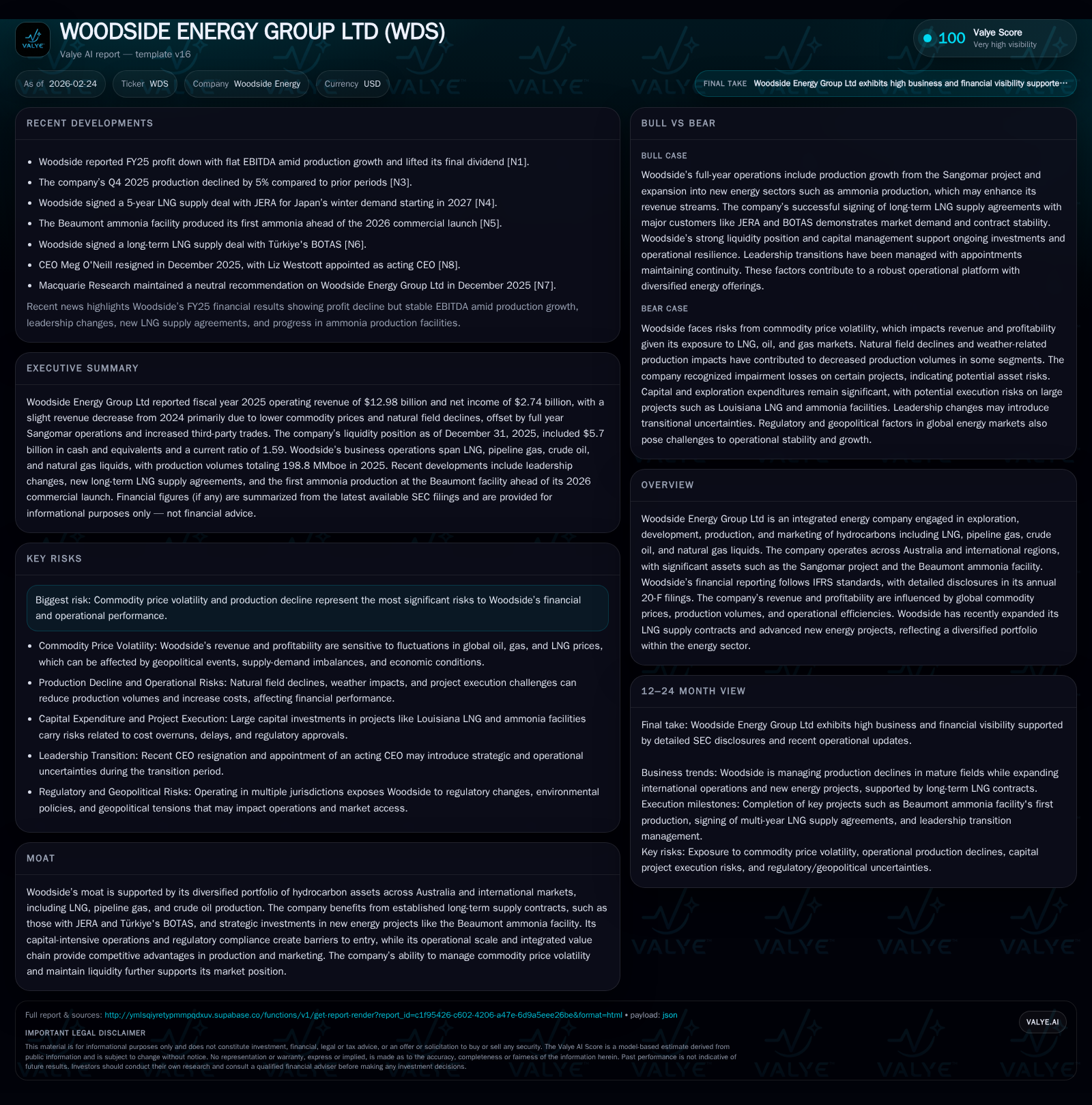
Woodside Energy Group navigated a complex 2025 with modest revenue contraction of 1.5% against increased production, weighed down by lower commodity prices and aging assets in Australia. The company advanced key projects like Sangomar and the Beaumont ammonia facility while strategically managing capital expenditure, which declined by 13% year-over-year. Free cash flow dynamics show robust liquidity supported by joint venture sell-downs and capital contributions, underpinning Woodside’s decision to raise dividends despite a nearly 25% drop in net income. Future growth hinges on successful ramp-up of new energy assets and long-term LNG contracts, balanced against commodity price volatility and natural field declines.
Evolution of Woodside’s Revenue and Profitability: Underlying Drivers and Headwinds
Woodside’s financial trajectory over the three years ending 2025 reveals a nuanced picture of operational growth counterbalanced by profit pressures largely attributable to commodity price erosion and asset maturity effects. Total revenue declined by around 1.5% from $13.18 billion in 2024 to $12.98 billion in 2025 [F1], despite an international production volume increase of about 24%, driven primarily by new assets like Sangomar entering full production [S23]. This decline is because lower average price markers for Brent crude oil, WTI crude, and JCC (Japan Crude Cocktail) weighed heavily on top-line receipts [S16][S17]. Australian segment revenue fell approximately 12% year-over-year due to field declines at the North West Shelf (NWS) as well as reduced realized pricing [S25].
Net income also contracted sharply—in fact nearly $900 million or about -25%, down to $2.7 billion [F1]—reflecting a combination of increased cost of sales (+13%) largely linked to full-year Sangomar operations and elevated third-party trade volumes offsetting some cost efficiencies [S17]. A notable impairment charge was recognized for the H2OK Project ($143 million) against no impairment the prior year [S17], though this figure pales relative to the sizable impairments recorded in earlier years (e.g., $1.9 billion in 2023). Lower net finance costs provided partial relief, dropping significantly due to interest capitalization on major projects such as Louisiana LNG [S16], but tax expenses rose moderately reflecting deferred tax asset recognitions tied to project investment decisions.
Historical performance (annual)
| FY | Rev ($bn) | Net ($bn) | Rev YoY | Net YoY |
|---|---|---|---|---|
| 2025 | 13.0 | 2.7 | -1.5% | -24.9% |
| 2024 | 13.2 | 3.6 | -5.8% | +111.7% |
| 2023 | 14.0 | 1.7 | -16.8% | -73.8% |
| 2022 | 16.8 | 6.6 |
Note: Omitted columns lack sufficient annual XBRL coverage in the provided tags (need ≥2 annual points): CFO, OpInc, Capex, Buybacks, FCF. Source: SEC companyfacts cache [F1].
Capital returns and efficiency (annual)
| FY | Div ($bn) | ROE% |
|---|---|---|
| 2025 | 2.1 | 6.9 |
| 2024 | 2.5 | 10.1 |
| 2023 | 4.3 | 4.9 |
| 2022 | -3.2 | 17.7 |
Source: SEC companyfacts cache [F1].
Note: Operating income & capex not available in provided tags.
Dissecting Woodside’s Asset Portfolio: LNG Contracts and Exploration Impact
The structural mix within Woodside’s upstream portfolio combines mature Australian fields with rapidly developing international assets — most notably the Sangomar project offshore Senegal which contributed significantly to international segment growth (+20% revenue; +39% PBT) [S23][S24]. The company continues strategic pivots toward its new-energy projects, including the Beaumont ammonia facility acquired recently which signals Woodside’s expanding footprint beyond hydrocarbons into decarbonized products [N1][S1].
On the marketing front, revenues increased modestly (+15%) due to expanded third-party trading volumes even as realized LNG prices softened [S9]. Woodside strengthened its long-term off-take book with contracts such as the pivotal five-year LNG supply deal with JERA commencing in winter 2027 that enhances revenue visibility amid spot market volatility [N1]. Exploration expenditure remains selectively capitalized under IFRS rules given assessments of economic recoverability; ongoing exploratory well costs edged up slightly reflecting active drilling programs particularly at Wheatstone JDP3 [S7][S12].
Capital Expenditure Decline: Balancing Project Milestones and Operational Leverage
Total capital and exploration expenditure eased approximately 13% from about $5.63 billion in 2024 down to $4.91 billion in 2025 [S4][S5]. This decline primarily reflects milestone completions at large development projects like Scarborough where major construction phases wrapped last year reducing immediate capex needs [S5]. Conversely, targeted drilling activity continues at Wheatstone JDP3 supporting incremental reserve replacement efforts.
Geographically, Australian capex decreased markedly (29%) while international spend saw a moderate uptick (10%) consistent with project ramp-up cycles including Louisiana LNG where significant investment was directed again during the year [S6]. The interplay between reaching final investment decisions (FID) on new energy projects versus managing operational leverage amid volatile commodity pricing shapes this capital allocation strategy.
Free Cash Flow Dynamics, Liquidity, and Funding Sources in 2025
Despite earnings headwinds, Woodside demonstrated solid free cash flow resilience supported by adept working capital management and financing initiatives [S6][F1]. Cash & equivalents stood impressively at $5.7 billion heading into FY26-end while the current ratio remained healthy at ~1.59 illustrating short-term solvency strength.
Investing activities’ cash outflows grew substantially driven primarily by Louisiana LNG capitalization expenditures (approximate $3.7 billion) confirming ongoing commitment to flagship projects but were partly offset by cash inflows from joint venture stake sell-downs (Stonepeak and Williams participation notably) [S6]. Financing activity included repayment of certain bilateral credit facilities alongside proceeds from equity-like contributions emphasizing diversified funding sources.
Dividend Policy Adjustments and Shareholder Returns Amid Profit Decline
Notwithstanding a nearly one-quarter drop in net income during FY25, Woodside elected to lift its final dividend payout, signaling confidence underpinned by stable EBITDA performance metrics and healthy liquidity buffers [N2][F1]. Dividend payments totaled approximately $2.07 billion versus $2.54 billion prior year reflecting both capital discipline measures post strong earlier years plus cautious retention for reinvestment.
ROE held modestly around ~6.9%, indicative of challenging margin compression but not straying far from sustainable levels given capital-intensive upstream nature [F1]. No buyback data is available for assessment however absence suggests preference for maintaining balance sheet flexibility.
Long-Term Growth Prospects: Sangomar, Ammonia Facility, and International Ventures
Looking ahead, Woodside’s growth narrative centers on further maturation of Sangomar contributing materially to production baselines plus scaling innovations through ammonia derivatives at Beaumont promising diversification benefits aligned with global energy transition themes [N1][S23]. New contractual commitments such as those with JERA for LNG winter supply enhance revenue predictability over medium term horizons.
Challenges remain including pacing operational ramp-ups while controlling costs amid inflationary pressures common across upstream sectors but secured off-take arrangements provide mitigants reducing exposure especially when spot market dislocations occur.
Risks from Commodity Price Volatility and Production Decline: Assessing Mitigations
Commodity price volatility remains the primary performance risk as fluctuations directly influence realized pricing across liquid hydrocarbon streams marketed globally [S13]. Natural field decline notably within the NWS region contributes further downward pressure on volume-weighted margins necessitating ongoing exploration success or asset diversification strategies.
Woodside reports active hedging programs mitigating some volatility relating gains/losses noted historically alongside benefits from diversified geographic footprint spanning Australia-international segments offering partial cushioning effects against region-specific shocks [S14]. Cybersecurity risks are monitored meticulously without material incident disclosures reported currently constructing operational resilience layers ensuring business continuity under evolving threat landscapes.
What to Watch: Upcoming Contract Renewals, Project Deliveries, and Market Signals
Key forward catalysts include commencement timing of the JERA five-year LNG supply contract starting winter 2027 which will be closely watched as an indicator of contracted revenue growth stability beyond near term spot uncertainties [N1]. Production volumes trending post-2025 Q4 showed some moderation (-5%) signaling need for continuous asset optimization or replacement strategies via exploration successes or acquisitions [N4].
Completion milestones for Louisiana LNG project funding further capacity expansion coupled with progression on ammonia facility scale-ups exhibit tangible markers reflecting Woodside’s evolving integrated energy profile refreshing investor focus towards multi-fuel energy solutions.
Discerning shifts in global demand driven by economic factors or geopolitical developments will materially affect pricing dynamics necessitating vigilance around OPEC+ policies alongside Asian import patterns that fluctuate seasonally impacting LNG demand balances [S1][N4].
Disclaimer: This report is prepared solely for informational purposes based on publicly available documents including SEC filings (20-F, Form 6-K) dated through February 24, 2026 ([F1]–[S29]) and recent news articles ([N1]–[N4]). It does not constitute investment advice or recommendations.
Disclaimer: This is research-only, informational analysis and not investment advice. It may include AI-generated interpretation and general industry context. Always verify important details using primary sources.

Comments