
Jumia Technologies AG’s Recovery: Reduced Losses and Strategic Growth in African E-Commerce
Jumia narrows net losses in 2025 while investing in technology and managing inflationary headwinds across African markets.
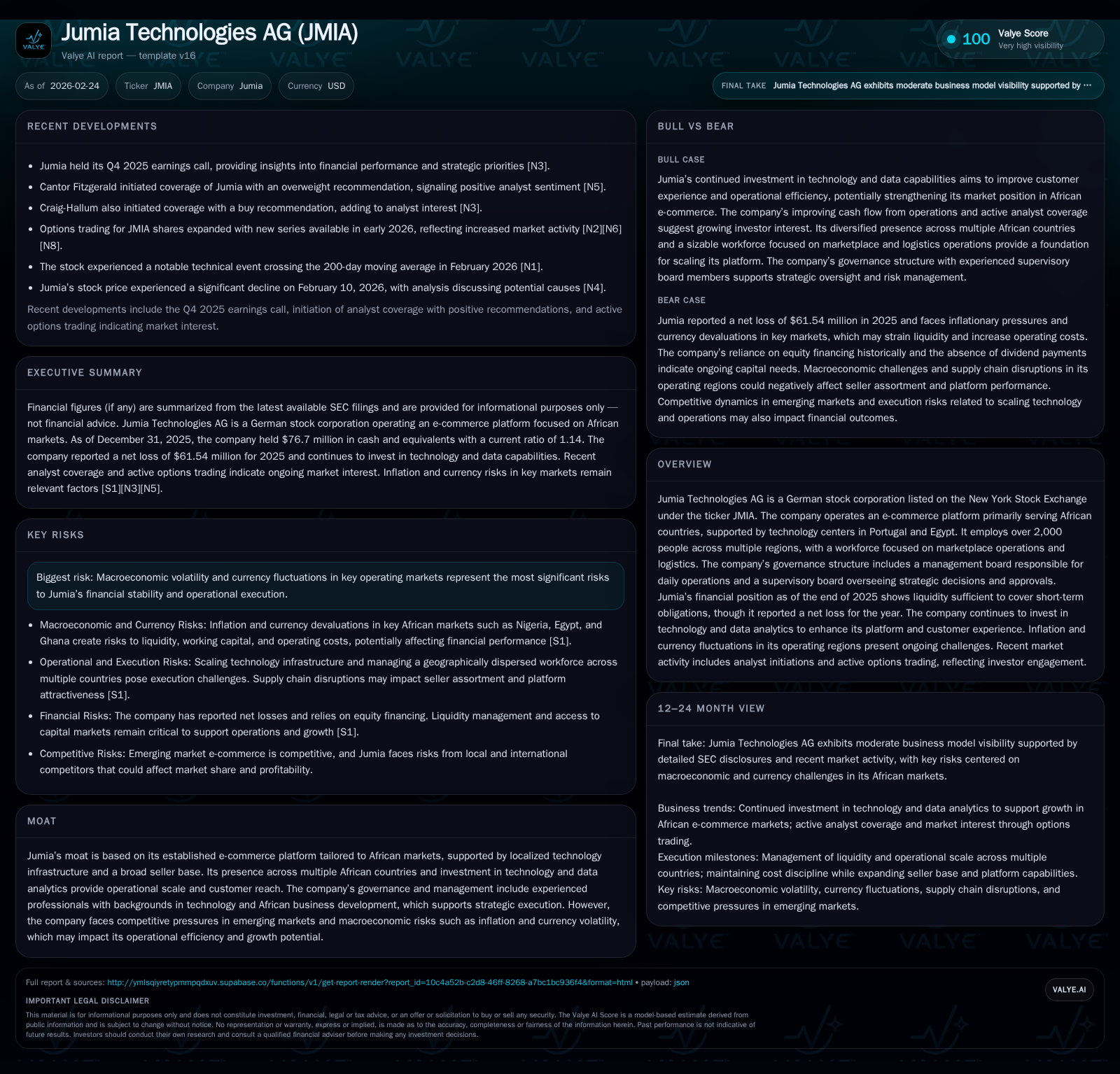
Jumia Technologies AG posted a notable improvement in its financial results for fiscal year 2025, reducing its net losses by 38% year-over-year to $61.5 million. The company's enhanced liquidity position, lowered operating cash burn, and optimized working capital cycle contributed significantly to this recovery. Investments in localized technology hubs in Portugal and Egypt underpin Jumia's marketplace resilience amid a challenging macroeconomic environment marked by elevated inflation and currency volatility. While equity financing has fueled growth initiatives, the absence of earnings and dividends reflects ongoing operational scaling with capital allocation focused on long-term platform building.
From Heavy Losses to Measured Improvement: Jumia’s Historical Financial Trajectory
Jumia Technologies AG has demonstrated a marked trajectory of improving its financial position from FY2022 through FY2025. The net income figures indicate a progressive reduction of losses—shifting from an acute net loss of approximately -$238 million in fiscal year 2022 down to -$61.5 million by the end of 2025 [F1]. This nearly fourfold improvement is underscored by declining equity levels, which peaked at about $174 million at the close of 2022 before compressing to $25.7 million at the end of 2025.
While the company has yet to reach profitability, the approximate return on equity (ROE) remains negative (-239% in 2025), a reflection of both continued net losses and diminishing shareholders’ equity [F1]. This trend highlights the sustained challenge for Jumia to convert its operational scale into profitable returns.
Historical performance (annual)
| FY | Net ($mm) | Net YoY |
|---|---|---|
| 2025 | -62 | +37.9% |
| 2024 | -99 | +4.9% |
| 2023 | -104 | +56.3% |
| 2022 | -238 |
Note: Omitted columns lack sufficient annual XBRL coverage in the provided tags (need ≥2 annual points): Rev, CFO, OpInc, Capex, Div, Buybacks, FCF. Source: SEC companyfacts cache [F1].
Capital returns and efficiency (annual)
| FY | ROE% |
|---|---|
| 2025 | -239.1 |
| 2024 | -114.9 |
| 2023 | -151.6 |
| 2022 | -136.7 |
Source: SEC companyfacts cache [F1].
Note: Operating income, revenue, CapEx unavailable from provided tags.
The decline in equity principally reflects accumulated operating losses outpacing any capital injections during these years.
Decoding the Drivers of 2025 Performance: Cash Flow, Working Capital, and Operational Efficiency
A critical factor underpinning Jumia's financial recovery is the marked improvement in operating cash flows detailed for calendar year 2025 [S1]. Net cash used in operating activities contracted by approximately 16% from $57.2 million outflow in 2024 to $47.9 million outflow in 2025—signaling tighter control over cash burn.
This amelioration was chiefly driven by a more efficient working capital cycle: inventory levels rose modestly while accounts payable increased, alongside a reduction in accounts receivable balances generating an overall $7 million decrease in net working capital requirements versus a $1.5 million increase prior year [S1]. These factors together lowered liquidity strain, evidencing stronger cash conversion dynamics within fragmented supply chains.
Conversely, Jumia’s investing activities shifted favorably with net cash inflow totaling $75.6 million due primarily to the maturation and liquidation of financial assets [S1]. Financing activities saw an outflow of $6.4 million after absorbing proceeds from the August 2024 equity offering—a contrast to substantial inflows seen previously.
In sum, operational reflexes including leaner days inventory outstanding (DIO) and tighter accounts receivable collections contributed materially toward reducing the overall cash burn rate—a key operational metric for e-commerce platforms scaling across emerging markets.
Africa-Focused Innovation: Technology Backbone Supporting Marketplace Resilience
Central to Jumia’s business model is its differentiated technology infrastructure tailored for African e-commerce ecosystems characterized by fragmentation across geography and payment systems . Jumia operates technology centers strategically located in Porto, Portugal and Cairo, Egypt which provide crucial centralized capabilities for software development, data analytics, logistics coordination, and platform management.
These tech hubs enable customization of marketplace functionalities responsive to varied local consumer preferences, payment modalities (including mobile money integrations), and network conditions intrinsic to Africa’s digital landscape . Incorporation of advanced data analytics supports assortment optimization to balance seller supply constraints against dynamic customer demand—a growing competitive edge.
This technological investment mitigates typical infrastructural limitations found across emerging market e-commerce platforms where connectivity reliability and fragmented market structures often suppress scalability prospects.
Macroeconomic Risks and Inflation: How External Factors Shape Jumia’s Operating Landscape
Operating within multiple African countries exposes Jumia substantially to macroeconomic headwinds such as inflation persistence and currency depreciation risks that complicate cost management and pricing strategies . Notably:
- Nigeria registered a CPI inflation rate near 21% YoY at December-end;
- Egypt faced approximately 14% YoY inflation;
- Ghana experienced inflation around 5% YoY according to respective national statistics agencies [S1].
Elevated inflation pressures labor expenses alongside utility, fuel costs impacting variable operating expenditure lines directly tied to fulfillment networks [S1]. Currency devaluation introduces foreign exchange exposure primarily through cash holdings denominated outside local functional currencies as well as intercompany balances.[S11]
Although some natural currency hedging exists given matched local currency revenues against expenses, absence of derivative hedging amplifies volatility risk impacting reported margins [S11].
Management continues cost efficiency initiatives targeting mitigation of inflationary impacts yet residual macroeconomic uncertainties inherently limit visibility on longer-term profitability improvements.
Capital Structure and Liquidity: Navigating Funding Needs amid Market Uncertainties
Jumia’s liquidity position remains sound with total cash and equivalents amounting to roughly $77.8 million at fiscal year-end December 31, 2025—sufficient to cover short-term obligations given current operating plans [S1,S4,F1]. Historically the company has relied predominantly on equity financing sourced through public offerings:
- IPO proceeds of $280 million in April 2019;
- Subsequent equity raises totaling hundreds of millions (e.g., $231 million Dec-2020; $341 million Mar-2021; $95 million Aug-2024) underpinning operational scale-up phases without material debt leverage [S4].
Jumia maintains no reported interest-bearing debt which positions it conservatively against financial stress but limits access to low-cost leverage common among mature peers [F1,S4]. Capital raising has primarily funded working capital needs, technology CapEx focused on equipment and leasehold improvements alongside general corporate purposes [S4].
The lease obligations aggregated near $12 million annually with purchase obligations tied largely to supplier payables reinforcing standard vendor credit practices for managing short-term liquidity cycles [S5].
Outlook and Milestones: Expectations for Growth and Profitability Trajectory
Explicit company guidance on future revenue growth or margin targets was not disclosed within available filings or recent earnings announcements [N1,S1]. Management commentary emphasizes ongoing strategic priorities focused on expanding total Gross Merchandise Value (GMV) via increased seller onboarding while exercising disciplined cost control measures.
Key milestones to watch include enhancements to platform functionality enabled by continued investment in R&D—especially analytics capabilities driving assortment optimization—and potential geographic market expansions aligned with demand growth trajectories observed across sub-Saharan Africa [N1,S1].
From an operational lens analysts should monitor quarterly trends in operating cash flow stabilization alongside incremental margin expansion as leading indicators for durable improvement absent explicit numeric guidance.
Assessing Returns and Capital Allocation: Absence of Dividends vs. Future Shareholder Value
Despite progress toward narrowing net losses there remains no intention nor history of dividend payments or share repurchase programs reported through fiscal year-end December 31, 2025 [F1,S19,S24,S25]. The board endorses a strategy emphasizing reinvestment into technology infrastructure and platform ecosystem expansion over shareholder distributions—a common stance among growth-stage emerging market digital operators.
Total target compensation for management incorporates base salaries plus virtual restricted stock units linking pay with longer-term value creation variables such as GMV growth or adjusted EBITDA improvements underscoring alignment between leadership incentives and shareholder interests [S24].
Given persistently negative ROE metrics linked largely to developmental expenditures this approach reflects tradeoffs typical among high-growth tech marketplaces balancing scale versus short-run profitability.
Long-Term Risks and Cybersecurity Governance as Pillars of Sustainable Growth
Cybersecurity forms an integral pillar supporting operational reliability within Jumia’s digital commerce environment—a sector increasingly targeted by malicious attacks [S9,S16]. The supervisory board exercises formal oversight delegated specifically to the audit committee which continually reviews cybersecurity risk monitoring implemented by executive management boards.
An information security team led by a Chief Information Security Officer (CISO) employs internal specialists augmented by external consultants providing expertise around risk assessment frameworks (e.g., NIST Cybersecurity Framework), incident response planning and regulatory compliance aligning with PCI-DSS standards relevant for payment processing integrity [S16]. Reporting lines facilitate monthly risk updates ensuring swift detection mitigation actions maintaining platform trustworthiness necessary for sustaining buyer/seller engagement.
No material cybersecurity incidents causing significant operational disruption were reported historically suggesting robust controls though evolving threat landscapes necessitate ongoing vigilance—particularly given reliance on third-party service providers within complex African ICT infrastructures.
This analysis synthesizes publicly available regulatory filings alongside relevant market commentary up through February 24th, 2026 without offering investment advice or price targets. All financial figures cited are sourced directly from SEC filings or company disclosures identified herein [F1],[S#],[N#]. The company remains exposed to macroeconomic variability common across emerging developing regions; thus projected outcomes should be understood within attendant risk parameters outlined above.
Disclaimer: This is research-only, informational analysis and not investment advice. It may include AI-generated interpretation and general industry context. Always verify important details using primary sources.

Comments