
Valmont Industries’ Divergent Trajectories in Infrastructure and Agriculture Drive Mixed 2025 Results
Valmont’s bifurcated business segments delivered contrasting results in 2025 amid sector-specific challenges and strategic investments.
Valmont Industries reported revenue growth of approximately 14.5% for fiscal 2025, driven primarily by stable Infrastructure segment demand supported by government programs, while Agriculture faced headwinds from cyclical farm income weakness and water scarcity issues. Operating income declined by 20.8% due to rising raw material costs and margin pressures, offsetting sales gains. Management responded with robust capital expenditure increases aimed at capacity expansion and technology integration alongside a significant uptick in share repurchases, maintaining dividend payouts. Return on equity remained healthy at roughly 21.5%, underscoring efficient equity use despite margin compression. Legal risks related to Brazilian litigation pose additional uncertainties, but ongoing acquisitions and government infrastructure investments offer growth avenues heading into 2026.
Segmented Growth Paths: Infrastructure Steady, Agriculture Volatility Evident
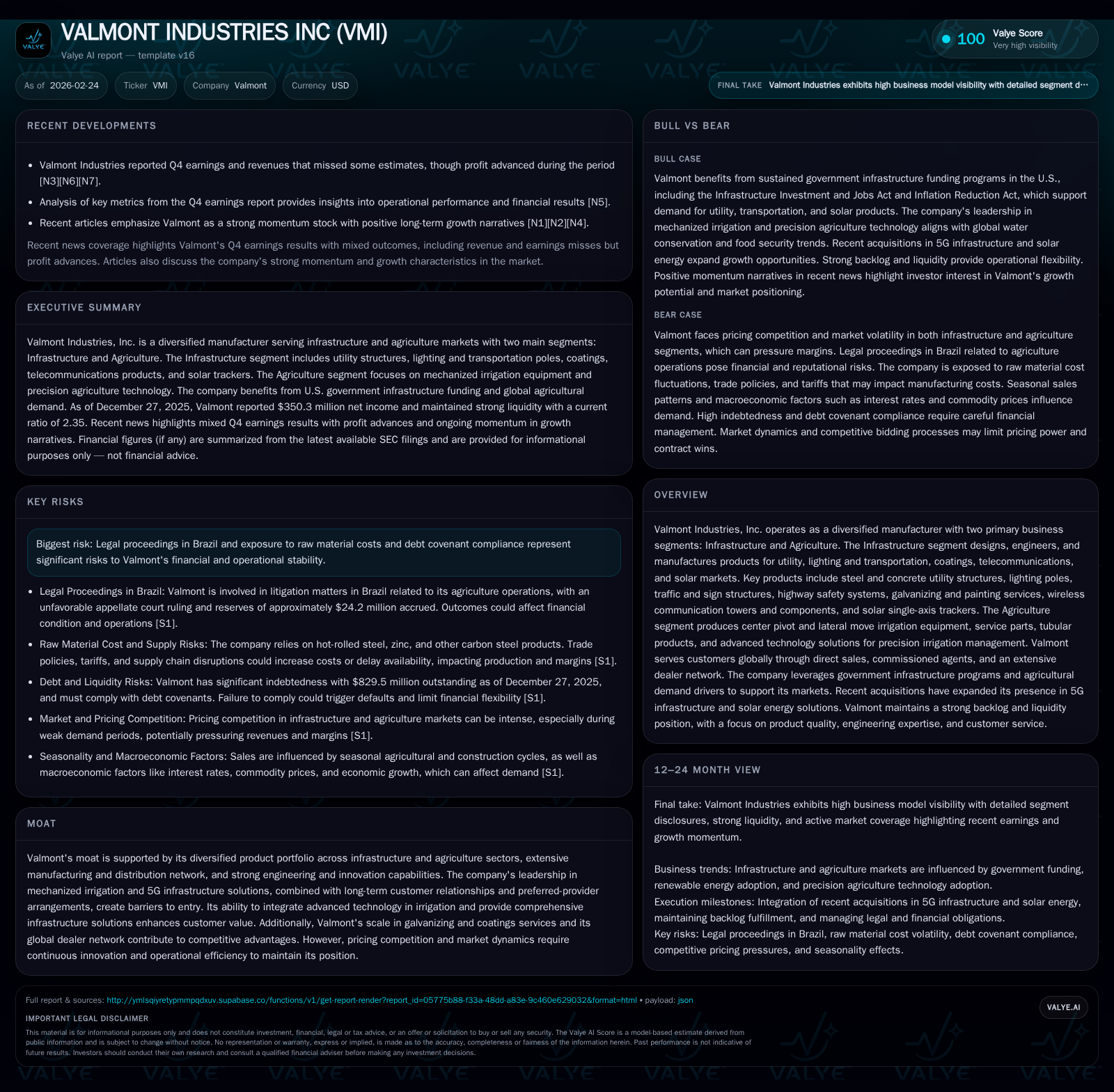
Valmont Industries operates through two distinct segments: Infrastructure and Agriculture. The Infrastructure segment includes engineered support structures such as steel and concrete utility poles, lighting structures including traffic signals, wireless communication towers especially for growing 5G networks, highway safety systems like guardrails and crash attenuators, and coatings services including galvanizing critical for corrosion resistance [S4][S6][S17]. This segment benefits substantially from multi-year government funding programs like the Infrastructure Investment and Jobs Act (IIJA) and Inflation Reduction Act (IRA), which underpin stable demand for transmission grid upgrades, transportation lighting projects, and solar energy infrastructure. Grid resilience efforts against natural disasters intensify the need for robust electric utility transmission assets.
The Agriculture segment focuses on center pivot and lateral move mechanized irrigation systems under the Valley® brand — a leading global product line — along with service parts and advanced precision agriculture technologies employing IoT sensors across over 175,000 connected devices [S5][S12]. This segment is more cyclical due to exposure to farm incomes influenced by commodity price swings, crop yields, weather patterns (notably droughts), farming input costs (fuel, seed, fertilizer), and evolving government agricultural support policies [S1]. Recent years have seen sales plateau following strong growth post-2022 as tightening water use regulations in key regions have constrained farmers' irrigation investments [S1]. The contrast between reliable infrastructure demand versus volatile agricultural markets shapes Valmont's overall trajectory.
Revenue and Operating Income Patterns: Dissecting the 2025 Earnings Performance
Fiscal year 2025 revenue grew approximately 14.5% year-over-year to an estimated $4 billion range (exact figures not explicitly provided in the filings) [F1]. However, operating income contracted sharply by about -20.8%, declining from $524.6 million in 2024 to $415.6 million in 2025 [F1]. This divergence is largely attributable to soaring raw material prices — hot-rolled steel coil alone accounts for roughly half of utility product costs — alongside aluminum used extensively in lighting pole fabrication and zinc crucial for galvanizing processes [S1][S19]. Fixed-price contracts prevalent in some Infrastructure product lines limited the ability to fully pass through rapid steel cost escalation leading to margin erosion.
Q4 earnings releases confirmed these cost pressures as revenues missed expectations amidst weakening utility capital expenditure rhythms compounded by softer Agricultural orders [N1][N3]. Operating leverage was further pressured by rising labor costs and supply chain lead time extensions requiring higher inventory buffers [S13][S20]. Despite sales strength primarily within Infrastructure's grid modernization push and solar track record expansion [N9], sustaining margins remains a key challenge.
Historical performance (annual)
| FY | Net ($mm) | CFO ($mm) | OpInc ($mm) | Capex ($mm) | Net YoY |
|---|---|---|---|---|---|
| 2025 | 350 | 456 | 416 | 145 | +0.6% |
| 2024 | 348 | 573 | 525 | 79 | +130.9% |
| 2023 | 151 | 307 | 292 | 97 | |
| 2022 | 326 | 433 | 93 |
Note: Omitted columns lack sufficient annual XBRL coverage in the provided tags (need ≥2 annual points): Rev. Source: SEC companyfacts cache [F1].
Capital returns and efficiency (annual)
| FY | Div ($mm) | Buybacks ($mm) | FCF ($mm) |
|---|---|---|---|
| 2025 | 52 | 198 | 311 |
| 2024 | 48 | 70 | 493 |
| 2023 | 50 | 345 | 210 |
| 2022 | 46 | 40 | 233 |
Source: SEC companyfacts cache [F1].
Note: Revenue data is not explicitly available for FY2024-FY2025; all financials are sourced from SEC XBRL data [F1].
Navigating Sector-Specific Market Headwinds: Regulatory, Cost, and Demand Factors
The Agriculture segment faces headwinds from regulatory uncertainties about future farm subsidies alongside local water scarcity policies restricting irrigation water allocations—prompting delays or cancellations of farm equipment purchases [S1][S7]. Rising farming input costs including labor shortages also pressure growers’ capital spending cycles [S1]. These factors create episodic troughs on what was previously accelerating mechanized irrigation adoption.
Infrastructure contends with potential delays or reprioritization of large utility transmission builds amid fluctuating state budgets despite federal programs like IIJA providing overarching support [S22]. Wireless telecommunications product demand remains cyclical as carrier consolidation leads to cautious capital plans despite long-term mandatory densification of networks driven by data consumption growth [S17][N9]. Galvanizing service demand is impacted regionally given freight cost constraints limiting viable service radii around plants [S12]. These dynamics contribute to visibility challenges around backlog conversion timing.
Capital Allocation Review: Buybacks, Dividends, and Elevated Capex Priorities
In response to mixed operational results yet fundamental long-term prospects:
- Capital expenditures soared to $145 million (+82% YoY), signaling commitments to expand production capacity notably for utility structures and integrate advanced technology across segments [F1][S11].
- Share repurchases jumped approximately +183% YoY to $198 million reflecting management’s confidence in intrinsic valuation despite short-term profitability pressures [F1].
- Dividends remained steady near $52 million showing dedication to returning cash while balancing strategic investments [F1].
- Return on equity stood at approximately 21.5%, evidencing effective equity utilization amid cost headwinds [F1].
This balanced capital strategy attempts to sustain shareholder value through buybacks while investing in infrastructure upgrades intended to buttress competitive advantages amid pricing pressure among rivals [S11][S4].
Operating Cash Flow Trends and Free Cash Flow Generation
Operating cash flow declined approximately ~20% year-over-year during fiscal 2025 to $456 million reflecting margin pressure coupled with working capital increases necessary due to extended lead times and inventory buildup [F1][S20]. Despite this decline, free cash flow remained positive at nearly $311 million after subtracting substantial capex spend ($456M CFO minus $145M capex), demonstrating healthy liquidity cushions supported by cash & equivalents near $187 million as of fiscal year-end [F1][S11]. This liquidity backdrop supports continued operational funding flexibility but warrants monitoring given debt levels exceeding $829 million with covenant compliance considerations outlined in filings [S11][S18].
Legal Backdrop: Brazil Litigation Impact on Agricultural Operations
A significant risk arises from several litigation matters related to operations in Brazil within the Agriculture market where Valmont received an unfavorable ruling from the appellate court system in Q4 fiscal year 2025 [S7]. The company has accrued approximately $24 million in estimated potential liabilities but awaits a motion for clarification expected during the first half of fiscal year 2026 before deciding further legal actions such as appeals or settlements [S7]. This unresolved legal exposure imposes contingent financial risk as well as potential operational disruption considerations given Brazil’s importance within regional agricultural markets.
Growth Catalysts on the Horizon: Government Programs, Technology Integration, and Acquisitions
Valmont is leveraging recent acquisitions including:
- Full ownership of ConcealFab enhances capabilities in electromagnetic interference mitigation supporting telecom infrastructure demands especially around emerging 5G buildouts,
- Increased stake in Solbras Energia Solar expands footprint within Brazil’s solar agriculture energy market addressing renewable transitions intersecting with Agriculture segment needs,
- Additional investments into Valmont Irrigation Argentina aim at solidifying dealer networks critical for regional market penetration [S4][N9].
Precision irrigation technology integration via smart devices continues expanding technological moats enhancing farmer water efficiency gains aligning with global water scarcity mandates boosting long-term embedded tech value propositions within mechanized systems. Simultaneously, federal infrastructure spending programs maintain multi-year tailwinds underpinning steady Infrastructure order inflows amid policy-backed energy transition priorities driving utility grid enhancements and solar tracker deployments adding pipeline backlog robustness primarily within the Infrastructure segment ($1.55 billion backlog vs $105 million Agricultural backlog at end FY25) [S9].
Forward-Looking Considerations & Key Metrics to Monitor
Explicit forward guidance remains absent post-Q4 earnings releases; therefore monitoring next quarters will require close attention on:
- Margin stabilization or recovery linked closely to any easing raw material pricing volatility or improved contract pricing power,
- Progress on resolution of Brazilian litigation matters,
- Execution effectiveness of elevated capex spend translating into improved production throughput supporting volume growth,
- Order backlog trends particularly improvements in Agricultural bookings beyond current softness indicating resumed growth momentum,
- Cash flow dynamics balancing investment outlays against debt covenant diligence. Caution persists because profit outlooks hinge heavily on managing persistent commodity cost inflation alongside navigating competitive pricing environments.[N11]
This analysis synthesizes publicly available SEC filings ([F1],[S#]) and news reports ([N#]) without speculative estimates or invented data points.
Disclaimer: This is research-only, informational analysis and not investment advice. It may include AI-generated interpretation and general industry context. Always verify important details using primary sources.

Comments