
Telefonica Brasil's Capital Structure and 5G Expansion Shape Growth and Risk Profile
Extensive spectrum licenses and a transition to authorization regime underpin Telefonica Brasil's growth while capital allocation and regulatory challenges loom.
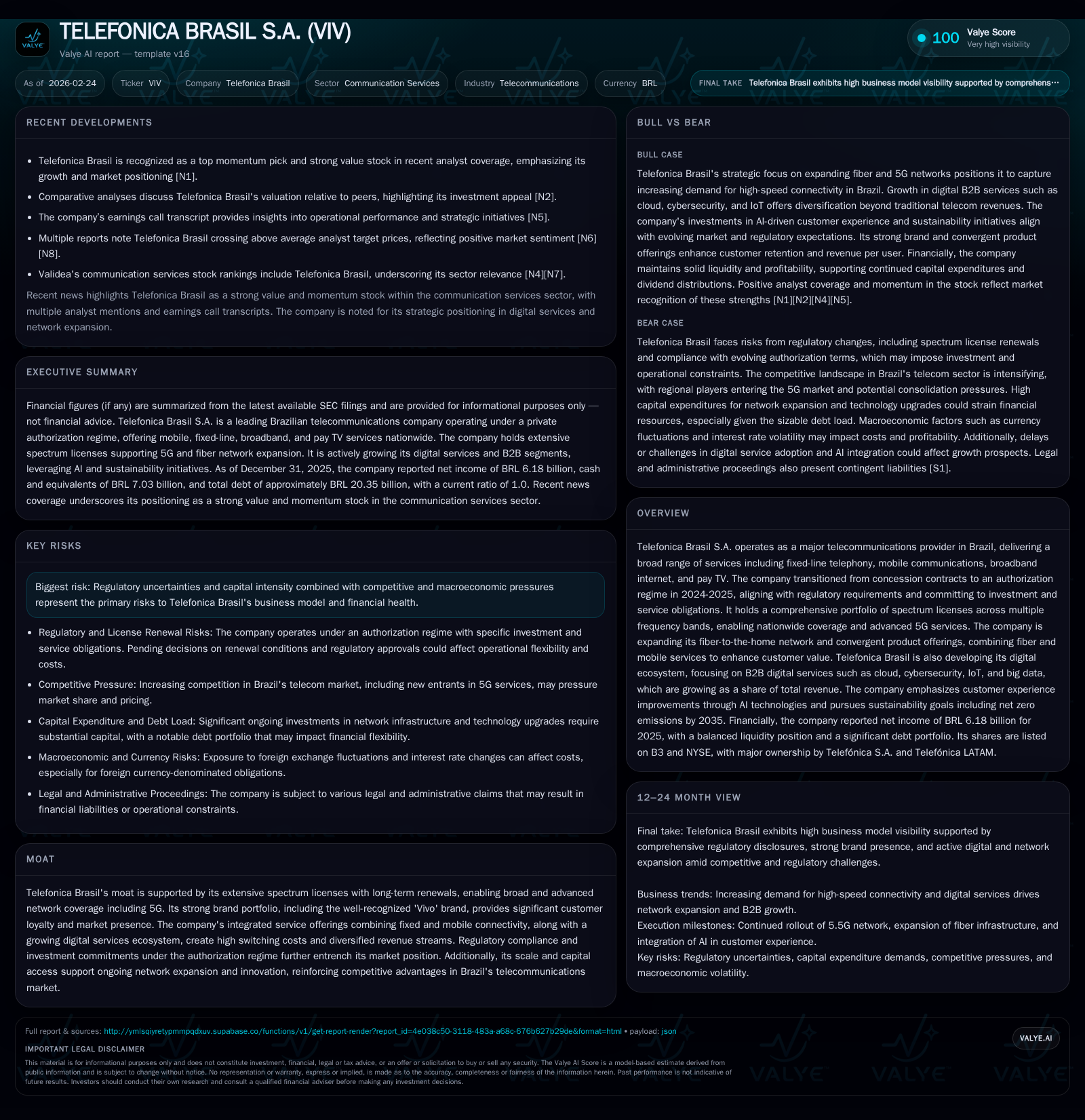
Telefonica Brasil S.A. (VIV) operates as Brazil’s leading telecom provider with a broad service portfolio spanning mobile, fixed-line, broadband, and pay TV. The company’s growth over recent years has been supported by brand strength, network enhancements including 5G rollout, and a shift from concession contracts to an authorization regime finalized in 2025. Financially, it showed solid net income growth and maintains a moderate return on equity around 9%. Significant capital allocations via share buybacks, dividend distributions, and ongoing investments in fiber and digital services define its near-term outlook. Regulatory complexities and an elevated capital base remain key constraints. Monitoring execution of fiber expansion milestones and regulatory developments will be crucial to assessing future performance.
Historical Financial Performance
Telefonica Brasil has demonstrated consistent profitability improvements over the recent four-year span ending FY2025. Net income rose from R$4.06 billion in 2022 to R$6.18 billion by the end of 2025, marking an approximate compound annual growth rate of 11% [F1]. Despite operating within a mature telecom market characterized by heavy capital requirements and regulatory oversight, the company has maintained equity capitalization close to R$69 billion across these years, thereby sustaining an estimated return on equity (ROE) near 9%, which aligns with typical levels observed among large Latin American telecom operators [F1].
Historical performance (annual)
| FY | Net ($bn) | Net YoY |
|---|---|---|
| 2025 | 6.2 | +11.2% |
| 2024 | 5.6 | +10.3% |
| 2023 | 5.0 | +24.2% |
| 2022 | 4.1 |
Note: Omitted columns lack sufficient annual XBRL coverage in the provided tags (need ≥2 annual points): Rev, CFO, OpInc, Capex, Div, Buybacks, FCF. Source: SEC companyfacts cache [F1].
Capital returns and efficiency (annual)
| FY | ROE% |
|---|---|
| 2025 | 9.0 |
| 2024 | 8.0 |
| 2023 | 7.2 |
| 2022 | 5.9 |
Source: SEC companyfacts cache [F1].
Note: Revenue, Operating Income, CFO, Capex data are not available from provided XBRL tags.
Business Model Evolution and Market Position
Telefonica Brasil operates as a dominant telecommunications provider in Brazil offering fixed-line telephony, mobile services under the Vivo brand—one of the country’s most valuable brands at R$50 billion value—broadband internet including extensive fiber-to-the-home (FTTH) infrastructure, and pay TV services [S11]. A pivotal structural development occurred during late 2024 into early 2025 when the company transitioned from legacy concession contracts to a unified authorization regime as confirmed by agreements with ANATEL and Brazilian government entities [S1][S22]. This shift removed prior spectrum concessions subject to periodic renewals in favor of long-term authorizations tied to public interest investment commitments over up to a decade.
This regulatory adaptation enforces new obligations such as maintenance of fixed telephony in low competition areas until at least the end of 2028 and comprehensive settlement of outstanding administrative proceedings involving ANATEL [S1]. The authorization framework enables Telefonica Brasil to consolidate its nationwide SMP license portfolio covering all major frequency bands necessary for advanced mobile services including expanded nationwide 5G coverage [N1][S11]. Notably, Brazil’s multi-band spectrum holdings include A and B band licenses renewed variably through the coming decade with supplementary licenses supporting emerging technologies like dynamic spectrum sharing for enhanced mobile broadband.
The company's strategic emphasis on convergent offerings—bundling FTTH with mobile services—in conjunction with growing its digital ecosystem targeting business-to-business digital solutions (cloud computing, cybersecurity, IoT platforms) positions it competitively amid rising customer demand for comprehensive telecom plus digital service suites [N1][S11][S23].
Future Growth Drivers and Constraints
Future growth prospects trace largely to several pillars: accelerated rollout of fiber networks beyond urban centers driving ultra-broadband household penetration; extension of advanced mobile technologies (including pioneering launches of the evolving "5.5G" standard); scaling B2B digital solutions leveraging existing customer relationships; and ongoing brand-driven customer loyalty programs reinforcing market leadership under Vivo's banner [N1][S11].
However, this outlook is conditioned by factors restraining pace or scale:
- Regulatory scrutiny remains intense with ongoing litigations particularly focused on spectrum usage fee disputes related to revenue definitions for installment calculations affecting cost structures [S22].
- Capital intensity required for nationwide fiber expansion along with macroeconomic conditions such as elevated interest rates in Brazil increase funding costs despite active debt management including sustainability-linked debt issuance [S1][S7].
- Competition has intensified due to regional ISPs scaling operations on fiber backbones but constrained by limited access to affordable capital compared with incumbents; thus consolidation is expected making scale a critical advantage [S11].
Capital Allocation Patterns and Financial Milestones
Telefonica Brasil has consistently allocated capital toward both shareholder returns and investment initiatives balancing cash deployment prudently:
- Share Repurchases: The company repurchased about 49.6 million shares during calendar year 2025 under publicly announced buyback programs conducted on B3 exchanges at prevailing market prices capped at resource limits defined by statutory reserves [S4][S6][S19]. A subsequent program commenced February 23, 2026 targeting acquisition of up to approximately R$1 billion worth of shares over one year.
- Dividend / Interest on Capital Distributions: Multiple interest-on-equity payments were approved throughout early-to-mid-2025 totaling several hundred million Reais distributed pro-rata among common shareholders. For example, interest on capital declared in February amounted to roughly R$0.1017 per share payable by April 30, 2027 [S16][S19]. Historical dividend/interest payments per share have ranged from R$1.37 in FY25 down from higher payouts in prior years (e.g., R$3.49 in FY22), reflecting payout variability linked to earnings cycles [S16].
- Capital Reductions: The Board approved shareholder resolutions regarding capital stock reductions without cancellation lowering share capital through returning funds without impacting shareholding percentages; cumulative reductions reached approximately R$3.5 billion between early-2024 through late-2025 improving capital efficiency [S5][S9].
Regarding debt structure: Total indebtedness stood around R$20.3 billion as of December 31, 2025 comprising finance leases primarily related to infrastructure assets (towers etc.), debentures indexed variably (e.g., CDI + spreads or IPCA + fixed coupon), acquisition-related financing tranches tied to recent M&A transactions such as CloudCo Brasil’s minority acquisitions, tax amnesty program liabilities under SELIC rate adjustments plus intercompany loans denominated both in BRL and Euro-based EURIBOR linkages covered via currency swaps [S1][S7][S15]. Interest-payments due during calendar year 2026 amount to approximately R$5.35 billion which reflects a step-down from prior years' maturities easing short-term liquidity pressures.
Foreign exchange risk management is actively practiced through derivative instruments mitigating exposure especially on overseas equipment procurements denominated largely in US dollars that impact capex budgeting cycles [S7].
Sector Context & Digital Transformation Initiatives
Brazil represents one of Latin America’s largest telecom markets encompassing roughly two-thirds population coverage with existing mobile broadband access broadly served via LTE but rapidly accelerating towards more dense deployment of fiber-optic connectivity paired with cutting-edge mobile standards transitionally evolving from early-stage commercialized 5G networks into extended "5.5G" capabilities enhancing throughput for both consumer multimedia use cases and low-latency enterprise IoT applications [N1][S11].
Telecom operators like Telefonica Brasil increasingly leverage integrated service bundles combining fixed broadband plus mobile voice/data plans offering customer retention advantages through simplicity and value-added digital content options while driving incremental average revenue per user (ARPU). Concurrently B2B digital cloud-related offerings have emerged as incremental margin enhancers complementary to core connectivity.
Governance & Risk Management
Telefonica Brasil demonstrates rigorous risk oversight including structured identification, evaluation, monitoring frameworks aligned with COSO ERM guidelines administered under supervision of Audit & Control Committee along with dedicated corporate risk management teams embedded within internal audit functions reporting regularly to board-level committees emphasizing both operational risks such as cybersecurity protections led by Chief Security Officer (CSO) function supported by sizeable dedicated teams numbering around four hundred professionals managing physical security alongside cyber defense programs applying recognized best-practice standards [S22]. The exposure to litigation primarily involves regulatory fee disputes requiring contingency reserves but does not currently threaten solvency or trigger acceleration clauses conditional upon default events [S22].
What To Watch Going Forward (Analysis)
- Execution progress on fiber-to-the-home expansion plans critical for sustaining top-line momentum while preempting regional ISP penetration gains.
- Regulatory developments around ANATEL rulings especially pertaining to spectrum fee classifications that could alter cost structures materially.
- Market reception and adoption rates for emergent "5.5G" mobile technology extensions driving incremental ARPU enhancement prospects.
- Share repurchase program uptake intensity reflecting confidence signals from insider perspectives post recent issuance activity.
- Macroeconomic factors influencing borrowing costs given significant floating-rate debt elements linked predominantly to CDI benchmark rates affecting interest expense volatility.
Summary
Telefonica Brasil anchors its market presence through a substantial spectrum license portfolio enabling extensive network coverage that supports advanced telecommunications including next-generation mobile standards while benefiting from one of Brazil's most robust brands under Vivo branding. Its integration into an authorization regulatory framework since early 2025 coupled with clear investment commitments shapes operational mandates going forward. Financially sound results marked by consistent net income improvement combined with prudent capital allocation via dividends plus buybacks underscore balanced stewardship amid sector headwinds from regulatory challenges and macroeconomic capital intensity constraints. Moving ahead requires attentive navigation of regulatory environments alongside focused execution on technological innovation deployments particularly fiber expansion complemented by evolving digital service ecosystems fostering sustainable revenue diversification.
Disclaimer: This is research-only, informational analysis and not investment advice. It may include AI-generated interpretation and general industry context. Always verify important details using primary sources.

Comments