
Otter Tail Corp’s Multi-Segment Model Balances Regulated Utility Stability and Manufacturing Dynamics
Otter Tail Corp leverages a verticially integrated electric utility foundation to offset volatility from its cyclical manufacturing and plastics segments.
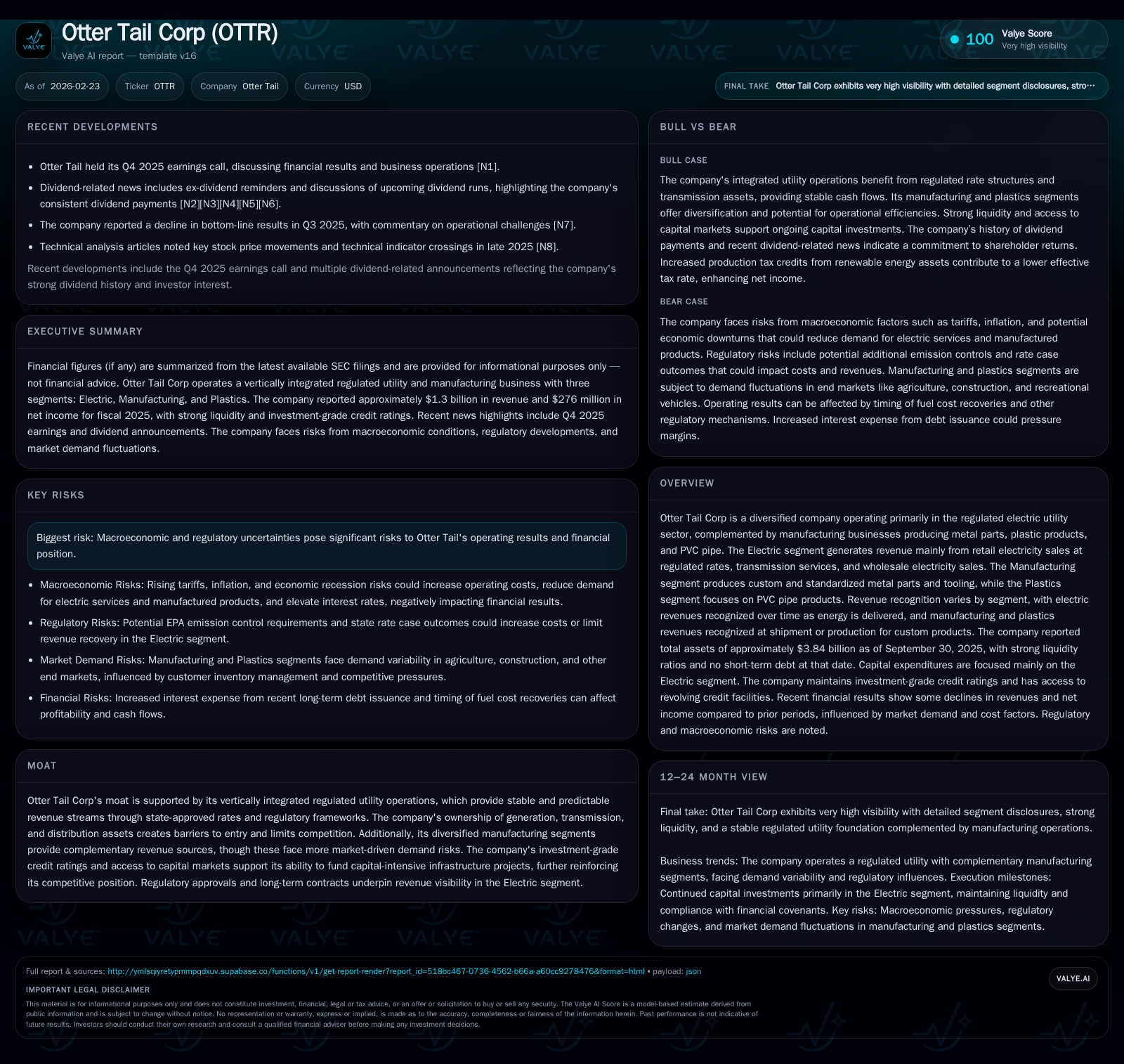
Otter Tail Corporation combines a regulated electric utility, delivering stable and predictable revenues through state-approved cost recovery, with manufacturing and plastics operations that face greater market exposure and regulatory risks. The company experienced modest revenue and operating income declines in FY2025 driven by softer manufacturing demand, partially offset by electric segment growth. Capital investments remain focused on utility infrastructure to sustain long-term rate base growth, supported by strong liquidity and investment-grade credit ratings. Key near-term uncertainties include ongoing PVC pipe antitrust litigation, tariff impacts on input costs, and regulatory rate case outcomes in multiple jurisdictions.
Historical Growth Patterns: Strength in Electric, Challenges in Manufacturing
Otter Tail Corp's consolidated revenue softened by 2.3% in fiscal 2025 compared to the prior year, falling to approximately $1.30 billion from $1.33 billion [F1]. This decline was primarily attributable to weakening manufacturing sales linked to tariff-driven raw material cost pressures and moderated end-market activity, as highlighted during the Q4 2025 earnings call [N1] and detailed in the MD&A [S2]. Despite this, the Electric segment—anchored by retail electricity sales under regulated tariffs—showed steady revenue growth benefiting from incremental rate cases filed in Minnesota and South Dakota, contributing partial offset against manufacturing softness.
Operating income displayed a sharper contraction of 9.1%, down to roughly $346 million in FY2025 from $380 million the prior year [F1], indicating margin compression largely stemming from the Manufacturing division’s exposure to inflated steel prices that are only partially recoverable through customer pricing adjustments [S2]. The Electric segment sustained more resilient margins owing to vertically integrated assets enabling effective capital cost recovery through state regulatory frameworks.
Net income followed a similar downtrend, declining 8.5% to $276 million [F1], evidencing overall operational challenges outside the utility business.
Historical performance (annual)
| FY | Rev ($mm) | Net ($mm) | CFO ($mm) | OpInc ($mm) | Rev YoY | Net YoY |
|---|---|---|---|---|---|---|
| 2025 | 1300 | 276 | 386 | 346 | -2.3% | -8.5% |
| 2024 | 1330 | 302 | 453 | 380 | -1.7% | +2.5% |
| 2023 | 1353 | 294 | 404 | 378 | -7.9% | +3.5% |
| 2022 | 1469 | 284 | 389 | 390 |
Note: Omitted columns lack sufficient annual XBRL coverage in the provided tags (need ≥2 annual points): Capex, Buybacks. Source: SEC companyfacts cache [F1].
Capital returns and efficiency (annual)
| FY | Div ($mm) | FCF ($mm) | ROE% |
|---|---|---|---|
| 2025 | 88 | 98 | 14.8 |
| 2024 | 78 | 94 | 18.1 |
| 2023 | 73 | 117 | 20.4 |
| 2022 | 69 | 218 | 23.3 |
Source: SEC companyfacts cache [F1].
Note: Dividends and buybacks omitted due to insufficient sequential data coverage.
Segment Performance Dynamics: Electric, Manufacturing, and Plastics Breakdown
The Electric segment remains Otter Tail's financial linchpin; it operates a vertically integrated utility model including generation plants primarily fueled by lignite coal at Coyote Station along with transmission and distribution assets servicing parts of Minnesota, North Dakota, and South Dakota [S26]. This integration secures stable revenue streams largely insulated from economic cycles through regulated retail rates allowing for capital cost recovery plus an allowed return on equity typically approximating low double digits—recent filings cite requested ROEs around or just above ~10-11% with corresponding equity ratios near mid-50%s [S21]. The segment also factors wholesale energy sales and transmission service revenues which add modest variability.
In contrast, the Manufacturing segment supplies custom metal fabrication products whose demand correlates strongly with broader industrial activity yet is pressured recently due to tariff escalations on steel imports pushing raw material costs upward [S2]. While price increases have been passed through largely so far per management commentary [N1], sustained inflationary costs could impair future margin recovery if end-user demand contracts or if competitive pressures limit pricing power.
The Plastics segment manufactures PVC piping products tailored chiefly for municipal water infrastructure projects but faces acute legal risks related to allegations of anticompetitive conduct involving PVC price fixing [S4]. Both U.S.-based DOJ investigations—with motions underway through late 2025—and parallel Canadian class action claims impose uncertainty on operating results here [S4]. Although management is defending vigorously claiming factual and legal bases for dismissal, exposure remains unresolved.
Collectively these dynamics mean that while Electric delivers steady EBITDA underpinned by regulatory frameworks allowing stable cash generation capacity (supported by earnings call disclosures), Manufacturing is subject to wobblier margin profiles reflecting commodity price pass-through lags and volume sensitivity; Plastics introduces litigation-related risk contingencies affecting near-term profitability visibility.
Emerging Regulatory and Macroeconomic Pressures Affecting Operations
Macro-level uncertainties significantly impact Otter Tail’s operational outlook with particular emphasis on tariffs raising steel prices—a critical input for both Manufacturing fabrications as well as certain Electric capital projects requiring steel-intensive infrastructure components [S2]. Inflation effects compound these risks driving higher labor and material costs across segments.
From a regulatory perspective, multiple rate cases are underway or anticipated:
- Minnesota Public Utilities Commission expects decisions governing significant revenue adjustments including accelerated recovery of generation investments such as Coyote Station plant capacities slated for phase-out post-2031 [S21].
- South Dakota cases seek similar base rate increases alongside changes transferring certain investment recoveries from rider mechanisms into base rates enhancing predictability but also potentially increasing regulatory scrutiny [S21].
Moreover, the DOJ’s antitrust inquiry into PVC pipe pricing practices represents an acute legal risk for the Plastics segment with potential reputational fallout alongside uncertain financial impacts dependent on lawsuit trajectories and settlements dynamics [S4][S12].
Notably, FERC proceedings addressing transmission owner funding authority may influence Otter Tail Power Company’s ability to self-finance certain grid upgrades affecting timing of capex recoupment trajectories embedded within customer rates [S6]. This regulatory flux amplifies near-term earnings variability potential.
Capital Investment Strategy Focused on Utility Infrastructure
Capital expenditures declined about 20% year-over-year in FY2025 versus FY2024 ($288 million vs ~$359 million), reflecting adjusted pacing after completion of noted expansions at Vinyltech plastics manufacturing facilities plus moderating project schedules across key utility upgrades [F1][S24][N1]. Approximately half or more of capex is allocated toward electric plant infrastructure involving transmission line modernization, substation enhancements, and selective generation asset overhauls aimed at maintaining reliability under evolving regulatory standards.
Management continues emphasizing prudence aligning investment spend with expected rate base growth approved by regulators ensuring capital cost recovery plus justified ROE contributions underpinning investor returns indirectly via regulated tariff structures [N1]. The capex moderation also fits within broader industrial trends balancing supply chain constraints against inflationary pressures on materials pricing.
Balance Sheet Robustness and Liquidity Position at Year-End 2025
Otter Tail demonstrates a solid balance sheet profile underpinning capacity for ongoing capital program funding:
- Total assets amounting to approximately $3.84 billion at December 31, 2025 with predominantly long-lived utility assets recorded at net book value after depreciation considerations [S1][F1].
- Current assets stand near $800 million versus current liabilities around $351 million delivering a robust current ratio of roughly 2.28 supporting short-term liquidity stability [F1][S23].
- Cash & equivalents increased year-over-year reaching ~$386 million at fiscal year-end ensuring ample liquidity buffers amidst operational volatility [F1].
- Absence of short-term debt as of September quarter end marks disciplined working capital management despite sizeable long-term debt obligations structured via fixed-rate senior notes maturing between mid-decade horizons extending into the mid-century period providing refinancing flexibility under investment-grade credit conditions evidenced by Moody's/Fitch/S&P stable outlook ratings ranging broadly Baa/BBB category for OTC/OTP entities respectively [S20][S9].
- Equity capital grew about +12% year-over-year ($1.86 billion vs $1.67 billion) lifted by retained earnings accumulation supporting ~14.8% approximate ROE consistent with the regulated utility framework aligned expectations [F1].
Overall balance sheet soundness coupled with access to revolving credit lines totaling nearly $390 million (mostly unutilized) strengthens financial flexibility for capital deployment or working capital needs [S16][S14].
Dividend Sustainability and Capital Allocation Priorities
Despite moderated earnings relative to prior periods, Otter Tail maintained shareholder distributions exhibiting prudent payout discipline:
- Dividends paid increased year-over-year reaching approximately $88 million in FY2025 compared with roughly $78 million in FY2024 reflecting sustainable dividend growth policy tied closely to cash flow realizations rather than aggressive payout ratios risking financial stress under adverse conditions [F1][N2][N3][S10].
- Share repurchases have been largely muted given capital investment priorities favoring infrastructure projects essential for long-run rate base expansion; open market buybacks were paused during recent periods while share issuances under dividend reinvestment plans remained modest ensuring controlled equity capital structure evolution without dilution surprises [S19].
- Free cash flow generated (operating cash flow minus capex) remains positive near $98 million range providing internal funding sources supporting dividends supplemented by external financing when required per regulatory allowances supporting balanced capital allocation approach blending shareholder return stability with infrastructural growth needs [F1].[N1]
What to Watch: Earnings Guidance and Regulatory Developments in 2026
Looking forward into calendar year 2026 presents several pivotal points warranting close observation:
- Pending final resolutions on Minnesota Public Utilities Commission decisions expected imminently concerning requested base rate increases potentially amounting up to ~$45 million annual incremental revenues influencing allowed ROE parameters currently proposed near low double-digit percentage levels; interim rate approvals initiating early-2026 will materially affect near-term revenue streams but are subject to refund provisions pending final adjudication creating some earnings timing uncertainty [N1][S21].
- South Dakota filings similarly target roughly ~$6 million revenue uplift subject to regulatory review timelines similarly bearing upon consolidated financial outcomes.
- Progression of federal court motions addressing PVC pipe antitrust class actions alongside remaining DOJ investigative activity will dictate risk provisioning needs or potential contingent liabilities within Plastics segment impacting earnings volatility beyond utility operations baseline [S4][N1].
- Tariff policy developments influencing steel prices remain critical given their cascading impact not only on manufacturing margins but also electric capital project cost structures particularly if inflation outpaces ability to pass through incremental expenses via customer rates or alters project execution timing strategies potentially deferring long-run returns.
- Monitoring evolving FERC interpretations on transmission self-funding authority remains key given potential broad implications on timing/certainty of capex recovery embedded in rates as Otter Tail pursues both fiduciary prudence alongside regulatory compliance mandates ensuring stable allowed returns justification within MISO regional transmission organization frameworks.
Investors should also watch for forthcoming corporate updates summarizing quarterly operating results vis-à-vis these uncertainties alongside management commentary shedding further light on strategic adjustments responding dynamically amid macroeconomic shifts intersecting with complex multi-jurisdictional regulatory environments shaping Otter Tail’s trajectory.
This analysis is based solely on publicly available information as of February 23, 2026, including SEC filings ([F1]/[S#]) and recent earnings call transcripts ([N#]). It does not constitute investment advice or recommendations regarding Otter Tail Corp securities.
Disclaimer: This is research-only, informational analysis and not investment advice. It may include AI-generated interpretation and general industry context. Always verify important details using primary sources.

Comments