
KeyCorp's Financial Turnaround and Future Growth Trajectory
KeyCorp’s sharp earnings rebound in 2025 highlights its segmented banking model, disciplined capital strategy, and robust risk controls shaping its growth outlook.
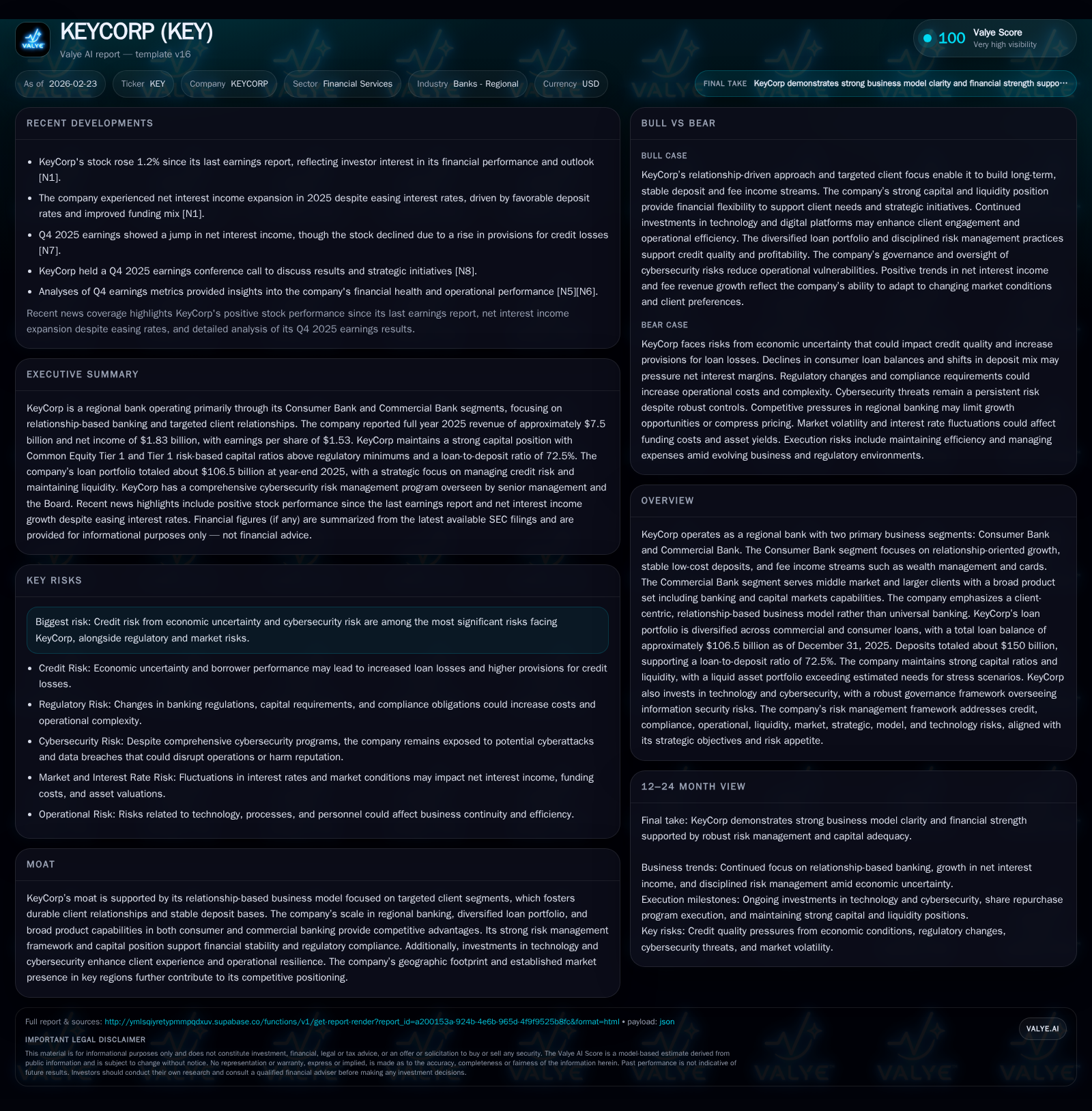
KeyCorp experienced a dramatic net income recovery in 2025, swinging from a $161 million loss in 2024 to nearly $1.83 billion in profit, driven by strong net interest income supported by prudent loan-to-deposit ratios and diversified business segments. The bank’s focused Consumer and Commercial Banking franchises underpin stable deposit bases and fee income streams, while conservative liquidity management and above-regulatory capital levels ensure resilience against market uncertainties. Going forward, interest margin dynamics, credit quality, and regulatory conditions remain key variables to monitor as KeyCorp balances growth opportunities with risk containment.
Historic Earnings Volatility and Key Revenue Drivers
KeyCorp delivered a spectacular turn-around in its earnings profile in fiscal year 2025. The bank recorded revenues of $7.51 billion, up sharply by 62.7% compared to the prior year’s $4.62 billion, which itself had contracted amid challenging operating conditions [F1]. More strikingly, net income swung from a loss of $161 million in FY2024 to a robust gain of $1.83 billion in FY2025—a more than twelvefold improvement reflecting operational recovery and margin expansion. Operating cash flow (CFO) followed suit with a strong uplift of 232.5%, rising to approximately $2.21 billion, underscoring improved core earnings quality [F1]. Capital expenditures remained stable near prior-year levels, pointing to controlled investments focused on sustaining infrastructure rather than aggressive expansion.
These metrics signal that after experiencing volatility tied partly to macroeconomic headwinds and credit cost pressures, KeyCorp regained footing through higher net interest income (NII). Industry-wide margin compression moderated amid improving loan yields supported by balanced asset-liability management strategies such as targeted loan-to-deposit ratios.
Historical performance (annual)
| FY | Rev ($bn) | Net ($mm) | CFO ($bn) | Rev YoY | Net YoY |
|---|---|---|---|---|---|
| 2025 | 7.5 | 1829 | 2.2 | +62.7% | +1236.0% |
| 2024 | 4.6 | -161 | 0.7 | -28.0% | -116.6% |
| 2023 | 6.4 | 967 | 2.9 | -11.8% | -49.6% |
| 2022 | 7.3 | 1917 | 4.5 |
Note: Omitted columns lack sufficient annual XBRL coverage in the provided tags (need ≥2 annual points): OpInc, Capex, FCF. Source: SEC companyfacts cache [F1].
Capital returns and efficiency (annual)
| FY | Div ($mm) | Buybacks | ROE% |
|---|---|---|---|
| 2025 | 1054 | 9.0 | |
| 2024 | 927 | -0.9 | |
| 2023 | 911 | 0 | 6.6 |
| 2022 | 854 | 0 | 14.2 |
Source: SEC companyfacts cache [F1]. Note: CapEx data unavailable for full recent period from tags.
Segmented Business Model Driving Diversified Growth Streams
KeyCorp operates primarily through two business segments: Consumer Bank and Commercial Bank [S25]. The Consumer Bank focuses on nurturing long-term client relationships that provide a durable base of stable, low-cost deposits—a crucial funding advantage typical among regional lenders—and generates recurring fee income from complementary areas like wealth management and cards services [S25]. Against the backdrop of digital transformation demands, Key has invested selectively to enhance client experience across online platforms while maintaining its relationship-centric ethos.
The Commercial Bank segment centers on serving middle-market businesses with comprehensive banking products augmented by capital markets capabilities for customized financing solutions [S25]. Commercial loans totaled roughly $76.5 billion at year-end 2025 spanning commercial & industrial loans ($57.7B), commercial real estate loans ($16.6B), and lease financing ($2.3B), balanced carefully against consumer lending ($30B) including residential mortgages and credit cards [S21]. Deposits aggregated roughly $150 billion supporting an overall loan-to-deposit ratio of a conservative 72.5%, well below the historical target of approximately 80%, reflecting prudence in asset growth relative to core funding sources [S4][S5].
This segmentation insulates revenue streams from cyclical shocks impacting any single portfolio slice; for instance, Consumer Bank’s consistent fee incomes help buffer episodic credit-related losses affecting Commercial Bank portfolios.
Capital Strength Underpinned by Conservative Liquidity Management
A key pillar enabling KeyCorp’s resilient performance is its robust capital position complemented by a conservative liquidity stance across multiple dimensions [S2][S4][S6][S8]. Regulatory capital ratios comfortably surpass both minimum requirements and stress buffers enacted post-global financial reforms: Common Equity Tier 1 ratio stands close to 11.8%, well exceeding Basel III thresholds plus the firm’s own stress capital buffer mandates near ~3.2% as of late September 2025 [S2]. Tier 1 leverage ratio approximates a solid >10%, further emphasizing ample loss-absorbing capacity.
Liquidity programs are multi-faceted with parent company cash coverage measured monthly providing headroom for meeting projected obligations over the ensuing two years without reliance on external capital injections [S6]. Key maintains a high-quality liquid asset portfolio composed predominantly of federal agency mortgage-backed securities with remaining maturities staggered prudently across one- to ten-year horizons to balance yield versus flexibility needs [S14]. At December-end 2025, contingent liquidity availability reached approximately $97 billion through sources such as unpledged securities holdings ($29B+) plus unused secured borrowing capacity at Fed Reserve Banks ($39B+), ensuring readiness for stress events that could impact wholesale funding avenues [S5][S6].
Notably, KeyBank continues access to sizable note issuance programs with approximately $13B available under Medium-Term Note Programs along with an additional $20B under Bank Note Programs established for effective debt issuance flexibility without restrictive covenants [S4]. This tiered funding approach reduces refinancing concentration risks.
Balance Sheet Quality Controls Secure Credit Health Amid Uncertainty
With economic uncertainty persisting, KeyCorp has reinforced its credit risk management framework anchored by the industry-acknowledged 'Three Lines of Defense' methodology for comprehensive oversight—a synergy between lines of business ownership, independent risk management monitoring, and internal audit assurance [S1]. This includes active surveillance of emerging cybersecurity threats under dedicated CISO leadership employing advanced tools such as network intrusion detection systems—a critical safeguard in modern bank operations vulnerable to digital attacks.
Credit exposure remains diversified by loan type and client segment while rigorous allowance for loan losses practices incorporate updated macroeconomic forecasts over defined look-back periods with periodic recalibration aligned to actual loss experience [S16][S20]. The total allowance for loan and lease losses at FY-end approached $1.52 billion including reserves related to lending commitments emphasizing forward-looking prudence despite improving net charge-offs recently reported [S18][S20].
Outlook: Net Interest Income Expansion Faces Multifaceted Influences
While explicit future guidance remains limited publicly, analysts have highlighted that KeyCorp's ability to expand net interest income despite easing interest rates during FY2025 stemmed from tactical portfolio rebalancing toward higher-yielding assets alongside optimized deposit mix dynamics—factors likely critical going forward given macroeconomic uncertainty surrounding rate trajectories [N13][N1].
Deposit franchise stability provides essential funding cost advantages enabling incremental lending or investment initiatives without excessive reliance on volatile wholesale markets; however, monitoring credit quality trends remains paramount particularly if recessionary pressures intensify given increased provisions observed in Q4 results signaling cautious provisioning behavior amidst signs of stress [N7][N9]. Regulatory changes around capital buffers also warrant close attention due to potential impact on distributable earnings or growth allowances.
Capital Allocation Reflects Balanced Shareholder Return Priorities
Throughout recent years KeyCorp has maintained consistent dividend payouts growing steadily—in aggregate around $1 billion distributed during FY2025 translating into about $0.82 per common share annually—reflective of sustained earnings power recovery alongside sound capital management policies endorsed by the Board [F1][S9].
Share repurchases re-emerged notably in late FY2025 following authorization of a new $1 billion buyback program focused initially on reducing overhang shares acquired previously via strategic agreements such as the Scotiabank investment arrangement while balancing liquidity needs prudently [S10][S15]. Buyback volume amounted to approximately $200 million or around eleven million shares repurchased during Q4 alone signaling confidence incrementally without undermining balance sheet strength.
Return on equity for FY2025 hovers near an estimated 9%, aligning well within regional banking peer norms noting continued room for accretion depending on organic growth execution combined with controlled expense leverage given ongoing investments in technology modernization platforms.
Key Operational Metrics Worth Watching in Coming Quarters
Investors tracking KeyCorp should focus initially on several pivotal indicators:
- Quarterly fluctuations in net interest income reflecting rate environment responsiveness alongside loan/deposit growth swings;
- Provision expense trends which act as early warning signals regarding asset quality trajectory under economic stresses;
- Deposit inflows and mix shifts sustaining liquidity buffers essential for measured credit deployment;
- Regulatory developments impacting capital adequacy requirements or dividend policy leeway;
- Execution progress on digital transformation initiatives supporting Consumer Banking engagement enhancing fee income sustainability.
Noteworthy was the upward revision in provisions seen within recent Q4 results despite beating consensus on profitability metrics—a reminder that earnings surprise narratives coexist with ongoing operational risks requiring balanced appraisal [N7][N9].
Disclaimer: This analysis is informational only based on disclosed data as of February 23, 2026, without any investment advice or recommendations.
Disclaimer: This is research-only, informational analysis and not investment advice. It may include AI-generated interpretation and general industry context. Always verify important details using primary sources.

Comments