
Omnicom's Growth and Profitability Stressed by IPG Merger Integration and Economic Pressures
The 2025 merger with Interpublic Group boosts scale but triggers earnings volatility amid macroeconomic challenges.
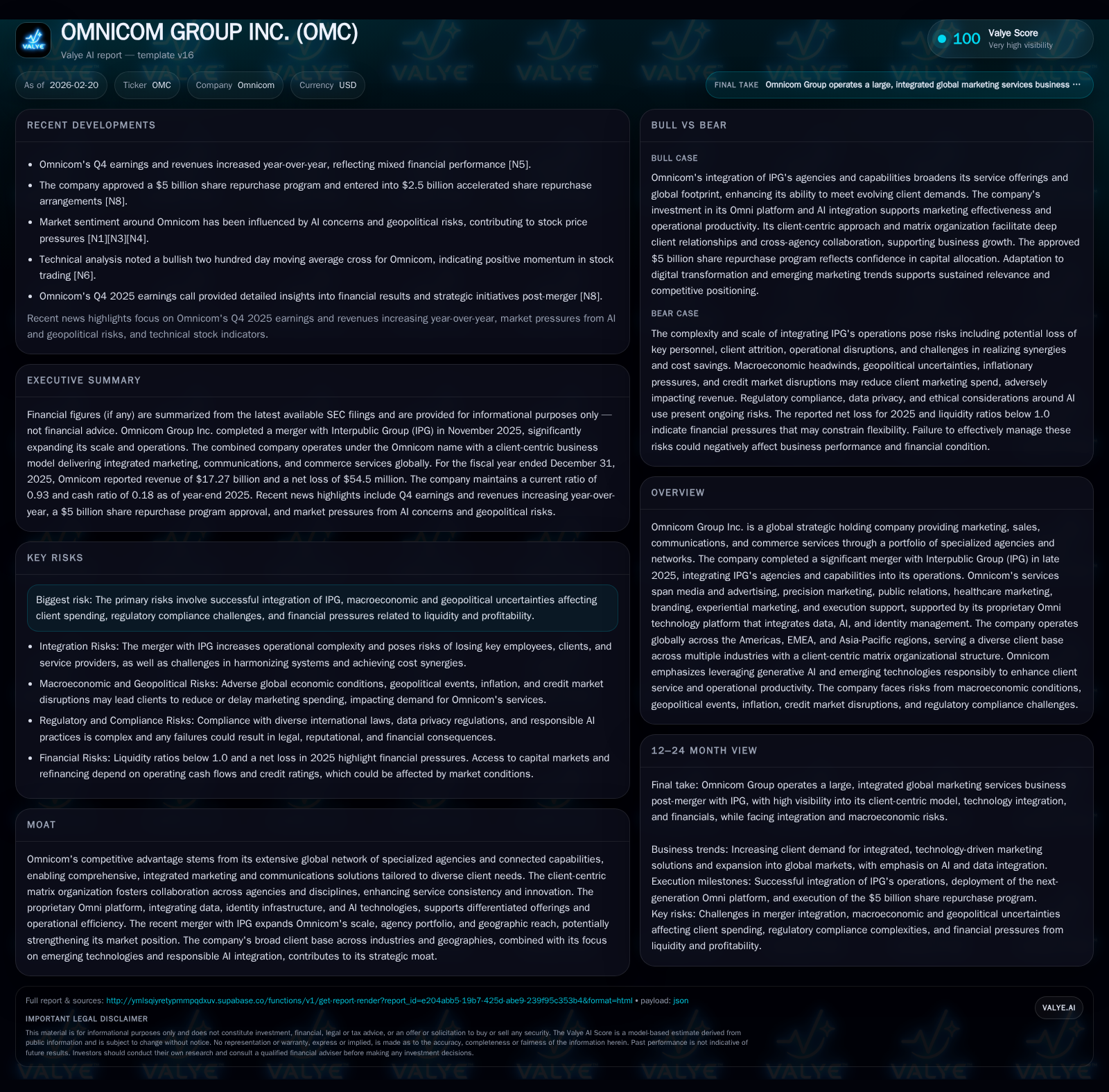
Omnicom Group’s fiscal 2025 results reflect the significant impact of its late-2025 merger with Interpublic Group (IPG), which expanded its global agency portfolio and services but introduced integration complexity. Revenue increased organically and through consolidation by 10.1% to $17.3 billion, yet operating income plunged over 80%, turning net income negative due to merger-related costs and restructuring. The company’s strategic emphasis on generative AI and its proprietary Omni platform highlight future growth prospects, though successful IPG integration, macroeconomic uncertainties, and regulatory compliance remain key risks. Solid operating cash flow growth supports capital returns, including dividends and share buybacks, although operating margins face near-term pressure.
Historical Growth and Performance
Omnicom Group Inc. has long been a leading global strategic holding company in marketing and communications services. Its portfolio spans specialized agencies covering media buying, advertising creative content, precision marketing, branding, healthcare marketing, public relations, experiential events, and execution support. Historically, Omnicom delivered steady revenue growth supported by diversified clients across industries worldwide.
The fiscal year 2025 marked a pivotal juncture due to the closing of a transformative merger with competitor Interpublic Group (IPG) on November 26, 2025 [S1][S3]. This deal expanded Omnicom's agency roster to include prominent IPG networks such as McCann, MRM, FleishmanHillard, and Weber Shandwick along with complementary capabilities like Acxiom data solutions integrated into its Omni platform.
Financial Snapshot FY2022–FY2025:
Historical performance (annual)
| FY | Rev ($bn) | Net ($mm) | CFO ($bn) | OpInc ($bn) | Rev YoY | Net YoY |
|---|---|---|---|---|---|---|
| 2025 | 17.3 | -54 | 2.9 | 0.4 | +10.1% | -103.7% |
| 2024 | 15.7 | 1481 | 1.7 | 2.3 | +6.8% | +6.4% |
| 2023 | 14.7 | 1391 | 1.4 | 2.1 | +2.8% | +5.7% |
| 2022 | 14.3 | 1317 | 0.9 | 2.1 |
Note: Omitted columns lack sufficient annual XBRL coverage in the provided tags (need ≥2 annual points): Capex, Div. Source: SEC companyfacts cache [F1].
Capital returns and efficiency (annual)
| FY | Buybacks ($mm) | FCF ($bn) | ROE% |
|---|---|---|---|
| 2025 | 708 | 2.8 | -0.5 |
| 2024 | 371 | 1.6 | 35.3 |
| 2023 | 571 | 1.3 | 38.5 |
| 2022 | 611 | 0.8 | 40.5 |
Source: SEC companyfacts cache [F1].
Source: SEC filings [F1]
While revenue grew steadily from $14.3 billion in fiscal 2022 to nearly $15.7 billion in fiscal 2024 pre-merger—driven by organic growth and acquisitions—operating income remained relatively stable around the $2 billion mark until FY24.
The inclusion of IPG from the fourth quarter of FY25 distorts comparability for operating metrics post-merger [S1], but highlights challenges integrating two large agencies' operational footprints: Operating income dropped precipitously to approximately $445 million despite revenues topping $17 billion for the full year. This implies elevated merger-related expenses such as restructuring costs, systems harmonization efforts, severance packages for overlapping roles, and consultancy fees.
Net income turned negative for the first time in years due largely to these exceptional expenses combined with non-cash goodwill amortization related to the acquisition of intangible intellectual capital embedded within IPG’s workforce [S4]. This goodwill represents significant premium value paid for customer relationships and know-how.
Conversely, operating cash flow showed resiliency rising ~69.5% year-over-year to nearly $3 billion in FY25 owing to integrated billing collections and ongoing strong client payment performance despite broader macroeconomic uncertainty.
Future Growth Prospects
Post-merger growth prospects primarily hinge on realizing synergies from combining complementary agency capabilities under a unified Omnicom umbrella while expanding regional market penetration globally [S10][S18]. The merger pooled IPG's diverse agencies alongside Omnicom’s existing networks into four principal global networks: Omnicom Advertising (OA), Omnicom Media (OM), DAS Precision Marketing (DAS), and Communications Consultancy Network (CCN).
This broad portfolio allows omnichannel client offerings across traditional advertising media planning/buying and emerging digital marketing techniques including:
- Generative AI-enhanced creative development using Omni tech platform data insights,
- Precision analytics for customer segmentation,
- Integrated e-commerce optimization,
- Healthcare communications,
- Experiential marketing leveraging live/digital hybrid events.
Of particular note is the Omni marketing intelligence platform unveiled January 2026 that integrates AI-driven decision sciences with comprehensive identity management infrastructure supporting privacy-compliant data usage [S21].
Increased adoption of AI tools—including agentic/ generative AI—is expected to transform campaign workflows by improving targeting accuracy while augmenting creative productivity [S21]. However, effective leverage depends on responsible governance protocols addressing ethical considerations and privacy compliance risks cited by management as critical going forward [S9][S16].
Growth drivers will likely include:
- Cross-selling enhanced multi-discipline solutions across enlarged client bases,
- Geographic expansion especially in high-growth Asia-Pacific markets where expertise is being scaled,
- Expansion in healthcare marketing which remains a high-margin segment,
- Capturing rising demand for sustainability-focused branding solutions aligned with ESG commitments.
However constraints include client budget reductions triggered by global economic volatility ranging from inflationary pressures to geopolitical disruptions affecting supply chains or consumer spending sentiment [S12][S26]. The company's reliance on a diverse but concentrated set of large clients—top 100 represent circa half revenue—also poses risk should these contracts not renew or reduce spend considerably [S15]. Currency fluctuations further add earnings variability given nearly half revenues are generated internationally [S14][S20].
Forecasts & Milestones to Watch
While explicit forward guidance is not provided post-merger due to accounting complexity introduced by acquisition accounting treatment [S1], investors should monitor:
- Progressive realization of synergy cost savings from combined overhead rationalization,
- Stabilization or rebound in operating margin as integration costs level off,
- Retention rates among top clients during contract renewal seasons,
- Expansion velocity of Omni platform adoption across agencies,
- Regulation developments impacting use of AI technologies,
- Quarterly updates on international economic conditions affecting client spending patterns.
Returns & Capital Allocation
The company continues a shareholder-friendly capital allocation policy backed by robust cash generation:
- Operating cash flows sufficiently cover capital expenditures which remain modest (approximately $150 million annually) relative to total revenue [F1].
- Free cash flow approximates $2.78 billion after capex deductions.
- Dividends have been consistently paid historically though recent data points lack full current-year payout disclosure.
- Share repurchases remain active; Omnicom authorized a sizable $5 billion buyback program concurrent with FY25 results announcement reflecting confidence in cash flow sustainability despite earnings pressure [N12]. Actual repurchases totaled around $708 million during the fiscal year reflecting early-stage implementation.
Estimated Return on Equity is negative at approximately -0.5% due mainly to net losses recorded post-merger impacting equity balances [F1]. ROE normalization depends heavily on returning profitability as integration matures.
Industry & Competitive Context
The marketing services industry faces considerable disruption fueled by technology innovation—especially AI transformation—and shifting consumer privacy norms tightening data access required for targeted advertising campaigns. Omnicom’s extensive agency breadth positions it well compared to pure-play digital rivals who might lack full-service multinational footprints.
However competitive pressures are fierce from other holding companies like Publicis Groupe and WPP as clients increasingly demand integrated solutions covering both creativity and technological sophistication [N14]. Effective deployment of generative AI could become a major competitive differentiator or risk if competitors execute faster [S9][S21]. Resilience also depends on talent retention amid intense competition for skilled personnel versed in digital analytics plus AI algorithmic expertise [S22].
Risks Summary
Key risks spotlighted include:
- Potential failure or delay in full operational integration post-IPG merger causing lost clients or employee attrition [S24][S28],
- Macroeconomic headwinds reducing client marketing budgets leading to reduced orders or delayed payments impacting working capital management [S1][S12],
- Regulatory scrutiny related to data privacy laws such as GDPR or evolving AI governance frameworks increasing compliance costs or curbing service effectiveness [S9],
- Cybersecurity threats aggravated by expanding IT infrastructure complexity requiring ongoing investment [S22],
- Unknown liabilities arising from acquired businesses or legal proceedings that could materially impact financials [S16].
Conclusion
Omnicom’s transformative acquisition of Interpublic Group solidifies its position as a dominant global marketing holding company with unparalleled agency breadth and technological integration capability through Omni platform innovation. Nonetheless, FY25 financials reveal pronounced near-term profit compression caused largely by merger-related expenses amid an uncertain global economic backdrop.
Successfully realizing anticipated synergy benefits while managing regulatory challenges around AI application will be key determinants of restored profitability trajectories going forward. Meanwhile strong cash flow generation remains a cornerstone supporting continued shareholder returns including dividend payments and aggressive share repurchase programs.
Disclaimer: This analysis is prepared solely for informational purposes based on publicly available information as of February 20, 2026; it does not constitute investment advice or recommendations.
Disclaimer: This is research-only, informational analysis and not investment advice. It may include AI-generated interpretation and general industry context. Always verify important details using primary sources.

Comments