
Regional Management Corp.'s Growth and Capital Strategy within a Complex Consumer Finance Securitization Model
RM leverages its structured finance platform and specialized servicing expertise for steady growth despite credit and regulatory challenges.
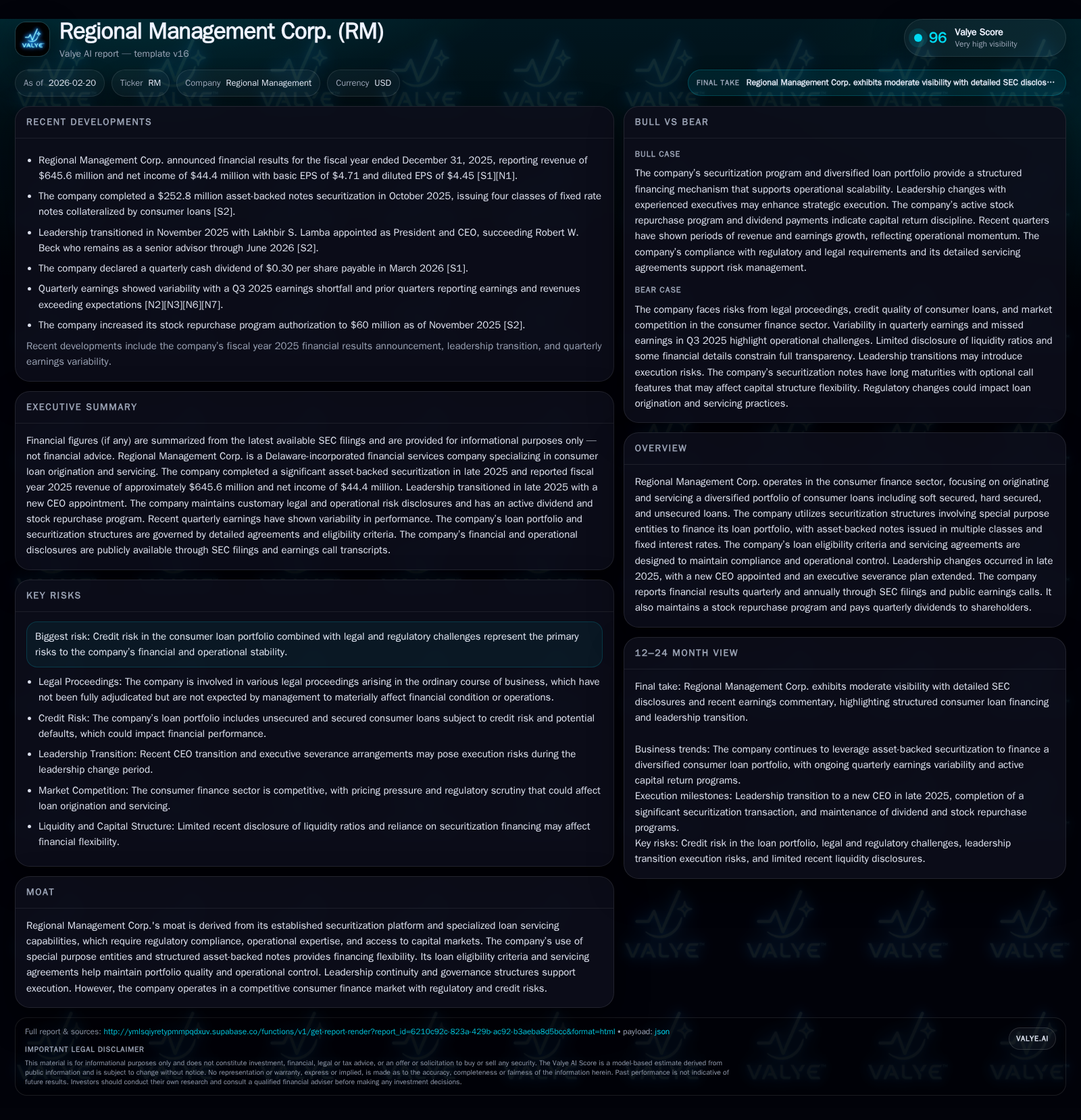
Regional Management Corp. (RM) operates in consumer finance, focusing on originating and servicing soft secured, hard secured, and unsecured loans. Historically, RM’s revenue increased by nearly 10% year-over-year through 2025, supported by its securitization financing model. The company completed a $252.8 million asset-backed notes securitization in late 2025, maintaining flexibility in capital structure while navigating credit risks inherent in consumer lending. Recent leadership changes include a new CEO with extensive consumer lending experience, underpinning a strategic emphasis on digital capabilities and analytics. RM’s capital allocation has involved expanded share repurchases and quarterly dividends, supporting returns on equity near 12%. Key milestones to watch include loan portfolio quality stability amid economic shifts and execution of securitization transactions.
Company Overview
Regional Management Corp. operates as a consumer finance company specializing in the origination and servicing of diversified consumer loans including soft secured, hard secured, and unsecured products [S1][S7]. The firm finances its loan portfolio primarily via structured securitizations utilizing special purpose entities (SPEs), which issue asset-backed fixed-rate notes rated investment grade by DBRS and S&P [S8][S10]. This model provides RM with capital markets access that supports loan portfolio growth while maintaining operational control through stringent loan eligibility criteria and servicing agreements [S13].
Historical Financial Performance
Over the past four years, RM has demonstrated consistent top-line growth driven by expanding loan originations underpinned by a disciplined credit approach. Revenue increased from approximately $507 million in FY2022 to about $646 million in FY2025 (a CAGR of roughly 8%) [F1]. Net income showed volatility but recovered strongly to $44.4 million in FY2025, up from $15.9 million during the COVID-19 impacted year of FY2023 [F1]. Operating cash flow increased steadily each year, reaching over $309 million in FY2025 — highlighting substantial cash generation capacity relative to net income levels [F1]. Capital expenditures remained modest consistent with the business model's asset-light nature.
Historical performance (annual)
| FY | Rev ($mm) | Net ($mm) | CFO ($mm) | Capex ($mm) | Rev YoY | Net YoY |
|---|---|---|---|---|---|---|
| 2025 | 646 | 44 | 309 | 5 | +9.7% | +7.7% |
| 2024 | 589 | 41 | 269 | 5 | +6.7% | +158.3% |
| 2023 | 551 | 16 | 249 | 5 | +8.7% | -68.8% |
| 2022 | 507 | 51 | 224 | 6 |
Note: Omitted columns lack sufficient annual XBRL coverage in the provided tags (need ≥2 annual points): OpInc, Div. Source: SEC companyfacts cache [F1].
Capital returns and efficiency (annual)
| FY | Buybacks ($mm) | FCF ($mm) | ROE% |
|---|---|---|---|
| 2025 | 24 | 304 | 11.9 |
| 2024 | 4 | 264 | 11.5 |
| 2023 | 21 | 244 | 5.0 |
| 2022 | 21 | 218 | 16.6 |
Source: SEC companyfacts cache [F1].
Note: Operating Income and Dividends are not available from provided tags.
Capital Structure and Financing
The cornerstone of RM’s financial strategy is its ability to package loans into securitized notes issued through SPEs such as Regional Management Issuance Trusts [S10][S11]. In October 2025, RM closed its latest transaction—the “2025-2 Securitization”—issuing roughly $253 million across four classes with fixed interest rates ranging from approximately 4.59% to just over 6% [S10]. This deal refinanced prior securitizations including the redemption of the RMIT 2021-1 notes earlier that month [S21]. The revolving period for this issuance extends until late October 2027, allowing ongoing collateral additions subject to compliance with predefined eligibility rules.
Loan eligibility criteria restrict loans sold into trusts by parameters including minimum financing amounts ($500), maximum APR caps (36%), servicing standards consistent with company policy, electronic contracting where applicable, and overall legal compliance [S13]. Servicing responsibilities rest primarily with RM but may be delegated to affiliates acting as subservicers under strict contractual protections including servicer default triggers that can prompt replacement by noteholders' direction [S13][S14].
Leadership Transition and Strategic Focus
Late in calendar year 2025, Regional Management announced a CEO transition: Robert W. Beck stepped down effective early November; Lakhbir S. Lamba assumed the role bringing deep expertise from PNC Financial Services with experience leading digital platform development, branch sales, consumer credit analytics, and product management [S22][S27]. Mr. Lamba’s compensation package included a signing bonus, inducement restricted stock awards for equity alignment, and multi-year incentive opportunities designed to focus performance on long-term value creation.
Strategically, management emphasizes evolving loan origination channels with technology enhancements while maintaining strict risk discipline through credit policy adherence embedded within their operational infrastructure.
Capital Allocation: Dividends & Share Repurchases
The Board approved an increase in share repurchase authorization from $30 million to $60 million as of November 2025 alongside quarterly dividend payments approximating $0.30 per share [S22]. These actions indicate confidence in free cash flow generation evidenced by operating cash flows significantly exceeding modest capital expenditures, facilitating shareholder returns without compromising balance sheet flexibility.
Returns & Cash Flow Metrics
Based on SEC XBRL data [F1], RM generated approximately $309 million in operating cash flow in FY2025 versus capital expenditures near $4.8 million resulting in estimated free cash flow around $304 million for the year—supporting robust liquidity for debt service and shareholder returns.
Equity totaled approximately $373 million at fiscal year-end FY2025 yielding an approximate return on equity (ROE) of about 11.9% based on net income reported for the same period.
Dividends paid data are not available from provided tags; however, declared quarterly dividends were noted at $0.30 per share [S22].
Industry Dynamics & Risks
Consumer finance faces persistent headwinds related to credit losses particularly within unsecured or subprime segments typical for RM’s portfolio mix . Regulatory scrutiny remains elevated requiring ongoing investments in compliance infrastructure—a significant moat factor due to complexity but also a risk if mismanaged [S5][S6]. Asset-backed securitizations remain sensitive to funding market liquidity conditions; RM's ability to issue notes at investment grade ratings serves as both an advantage and is continuously tested amid economic cycles.
Monitoring delinquency rates alongside charge-off trends within current reporting periods will be critical gauges of portfolio health reflecting macroeconomic influences such as inflationary pressures or shifts in employment dynamics.
What to Watch Going Forward
- Updates on loan performance metrics especially delinquency trajectories tied to unsecured segments.
- Continued execution of securitization transactions maintaining low-cost capital access.
- Progress on digital transformation initiatives spearheaded by new leadership potentially improving customer acquisition efficiency.
- Liquidity profile stability evidenced through warehouse lines availability supporting originations beyond revolving securitization windows.
- Capital return policy adherence relative to free cash flow sustainability amidst variable credit environments.
Conclusion
Regional Management Corp.’s recent financials reveal steady growth supported by an efficient securitization funding model coupled with operational expertise managing diverse consumer loans efficiently under complex regulatory conditions [F1][S10]. The recent leadership change spotlights strategic priorities emphasizing technological innovation intersecting with rigorous credit management disciplines—crucial for sustaining competitive advantage [S27]. Investor focus should maintain on fundamental credit quality indicators supplemented by new securitization deals which directly impact funding cost and flexibility [S22]. With solid free cash flow generation enabling enhanced shareholder returns [F1], RM navigates an often volatile consumer credit landscape balancing growth ambitions against inherent sector risks [S4].
Disclaimer: This report is for informational purposes only based on publicly available data as of February 20, 2026; it does not constitute investment advice or recommendations.
Disclaimer: This is research-only, informational analysis and not investment advice. It may include AI-generated interpretation and general industry context. Always verify important details using primary sources.

Comments