
Astera Labs’ Turnaround: From Operating Losses to Sustainable Profitability in AI Connectivity
Astera Labs reversed its operating losses in 2025 through targeted AI infrastructure connectivity solutions amid concentrated customer dynamics.
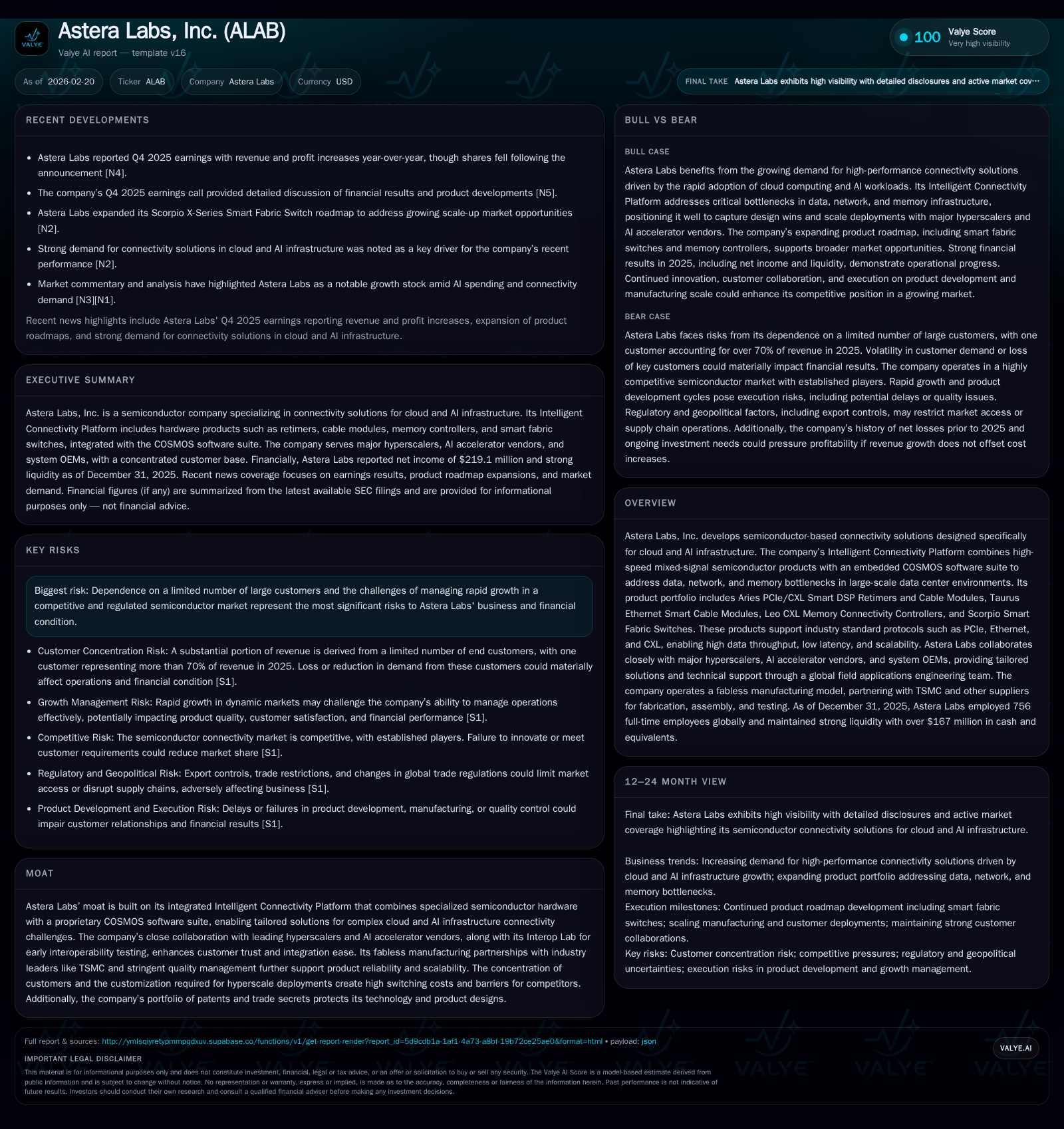
Astera Labs, a specialist in semiconductor-based connectivity for cloud and AI infrastructure, reported a dramatic financial turnaround in FY2025, swinging from sizable operating losses in FY2024 to substantial operating and net income gains. This shift was powered by strong execution of its Intelligent Connectivity Platform, strategic partnerships with hyperscalers, and scaling manufacturing via TSMC. Despite this progress, challenges remain including high customer concentration and dependence on a limited set of manufacturing partners. Looking forward, growth hinges on new design wins driven by CXL adoption and strong product differentiation via embedded COSMOS software, while risks around supply chain concentration and competitive pressures persist. Capital allocation reflects robust cash generation balanced against reinvestment priorities with no recent returns to shareholders.
Forging Growth: Historical Performance and Key Profit Drivers
Astera Labs experienced a pronounced financial inflection from fiscal year 2024 to fiscal year 2025. In FY2024, the company reported an operating loss of approximately $116.1 million, followed by a net loss of $83.4 million — reflective of the company's extensive investment phase targeting cloud and AI infrastructure connectivity challenges [F1]. By contrast, FY2025 marked a material pivot with operating income soaring by roughly 249% to $173.4 million and net income jumping more than threefold to $219.1 million (an increase of around 363% YoY) [F1]. This turnaround was accompanied by a robust expansion of operating cash flow (CFO), which grew from $136.7 million in FY2024 to $319.3 million in FY2025, representing a 133.6% increase [F1]. Capital expenditures remained modestly elevated at ~$37.5 million reflecting sustained R&D investments necessary to support next-generation connectivity solutions.
Historical performance (annual)
| FY | Net ($mm) | CFO ($mm) | OpInc ($mm) | Capex ($mm) | Net YoY |
|---|---|---|---|---|---|
| 2025 | 219 | 319 | 173 | 38 | +362.7% |
| 2024 | -83 | 137 | -116 | 34 |
Note: Omitted columns lack sufficient annual XBRL coverage in the provided tags (need ≥2 annual points): Rev, Div. Source: SEC companyfacts cache [F1].
Capital returns and efficiency (annual)
| FY | Buybacks ($) | FCF ($mm) | ROE% |
|---|---|---|---|
| 2025 | 0 | 282 | 16.1 |
| 2024 | 1066000 | 102 | -8.6 |
Source: SEC companyfacts cache [F1].
Note: Revenue data is not disclosed in the available filings; ROE derived as Net Income / Equity per [F1].
This dynamic improvement evidences Astera Labs' successful leveraging of its semiconductor connectivity expertise catering tightly to hyperscaler demands within AI infrastructure deployments.
Pivot Points: What Changed in 2025’s Financial Leap
The transformation seen in FY2025 reflects several interrelated factors coalescing into operational leverage gains and margin expansion despite the absence of explicit disclosed revenue figures [F1]. A large driver was the accelerated scaling of design wins among leading hyperscalers and AI accelerator vendors who increasingly integrated Astera’s Intelligent Connectivity Platform into their cloud data centers [N4][S25].
Astera's product suite — featuring Aries PCIe/CXL Smart DSP Retimers and Cable Modules alongside Leo CXL Memory Connectivity Controllers — found enhanced traction as Compute Express Link (CXL) became more widely adopted for memory coherence expansion critical to AI workloads [S25]. The embedded COSMOS software suite empowered differentiated device configurability and observability capabilities that facilitated close customer collaboration during deployment phases [S25][N10].
Manufacturing scale also improved through deepened partnerships with TSMC as the sole foundry for integrated circuits combined with support from ASE and Amkor for assembly/testing [S26]. This outsourcing enabled focused capital discipline while managing product complexity at scale.
Margins benefitted from favorable shifts in product mix toward higher-value offerings tailored for demanding hyperscale environments amid rigorous quality standards imposed by these customers [S8][S24]. Nonetheless, pricing pressure remains an industry norm requiring continual innovation and cost management.
In sum, amplified hyperscaler adoption combined with proprietary technology synergies drove the company’s FY2025 positive inflection [N4][S25].
Platform Strength: Recent Operational Highlights and Customer Partnerships
Astera Labs' Intelligent Connectivity Platform represents a unique integration of high-speed mixed-signal semiconductor hardware married with embedded COSMOS software designed specifically for complex cloud and AI infrastructure requirements [S25]. The platform encompasses multiple form-factors such as ICs, boards, and modular cable assemblies optimized for PCIe®, Ethernet, and CXL protocol standards essential for hyperscaler performance targets [S25][N10].
Crucial technical elements include "Smart DSP" retimers that address signal integrity degradation over extended channel lengths typical in large racks; advanced telemetry features enabling comprehensive link monitoring at scale; server-grade reliability availability serviceability (RAS) protocols; plus near-zero defect tolerance required by hyperscaler clients [S24][N10].
Astera’s commitment is reflected through proprietary patents protecting their software-defined architecture approach that allows customization lifecycle management aligned tightly with customer-specific system architectures—facilitated further by an Interop Lab enabling early-stage interoperability testing with major AI accelerator vendors [S25][N10].
Collaborations extend across leading digital giants employing both commercial GPUs and bespoke AI accelerator chips where seamless integration into burgeoning heterogeneous computing infrastructures necessitates low-latency memory expansion controllers like Leo CXL [S25][S24]. These strengths combine into a tough-to-replicate technical moat heightened by stringent quality management enforced through fabless manufacturing relationships with TSMC et al., underpinning both scalability and reliability critical for mission-critical applications [S25][N10].
Emerging Challenges: Customer Concentration and Market Competition
A prominent risk vector derives from acute revenue concentration: the top three end customers accounted for about 86% of total revenue in 2025 [S4][S5][S18]. Such reliance engenders significant revenue volatility should any one customer alter purchasing behavior or system designs exclude Astera products abruptly.
Further exacerbating this exposure is the lack of binding minimum purchase commitments within master agreements granting customers broad flexibility to vary order quantities or redesign systems potentially reducing dependency on Astera components on relatively short notice [S5][S9]. Moreover, many key accounts simultaneously maintain relationships with competitors or could internalize certain connectivity functions impinging on future sales volumes [S10].
Pricing pressures emanate from competitive bidding processes tied tightly to component costs and volume discounts negotiated to meet hyperscaler budget mandates while maintaining acceptable gross margins remains challenging amidst aggressive pricing dynamics across successive product generations [S8].[N2]
On the supply side, reliance on TSMC for all IC wafer fabrication introduces geopolitical risk given Taiwan's regional tension context plus potential capacity constraints during industry-wide upcycles [S7][S19]. Qualification cycles demanded by hyperscalers are lengthy and costly without guaranteed volume commitments raising execution uncertainty around new product ramps impacting near-term sales visibility [S10][S22].
Finally, evolving regulatory frameworks governing AI use—such as the EU AI Act—add compliance burdens potentially slowing adoption curves or imposing incremental development costs that Astera must absorb or pass along selectively risking customer resistance [S21][S26].
Horizon Scan: Visibility into Future Growth and Technological Innovation
Looking ahead, Astera Labs’ growth trajectory will hinge significantly on continued momentum securing design wins supporting expanding deployments of its Aries retimers, cable modules, Leo CXL memory controllers, and Scorpio fabric switches within hyperscale AI platforms incorporating increasingly complex interconnect fabrics [N10][S25]. The rapid evolution toward CXL memory pooling architectures anticipated across large data centers amplifies demand for specialized connectivity components addressing throughput bottlenecks and latency optimizations inherent in multi-node scaling scenarios.
While no specific granular guidance has been published recently that details exact revenue projections or volume targets due partly to customer confidentiality constraints ([N10]), market analysis suggests rising hyperscale capex allocations toward AI-tailored infrastructure could expand TAM favorably over medium-term horizons [N1][N9]. Attention should focus on updates regarding new design wins announcements from key hyperscalers or OEM partners as early indicators of incremental adoption.
Technical innovation efforts maintain pace via ongoing investments exceeding $300 million annually in R&D fostering next-gen mixed-signal ICs integrating enhanced telemetry capabilities alongside COSMOS platform evolutions delivering expanded configuration flexibility pivotal to retaining competitive edge over alternative solutions and commoditized components on price alone [S11][N10]. Monitoring successful qualification timelines vis-à-vis major customers will be critical barometers of near-term shipment ramp feasibility given previously encountered protracted qualification periods affecting volume booking certainty.
Capital Allocation Dynamics: Cash Flow, ROE, and Shareholder Returns
In FY2025 Astera Labs’ cash flow profile demonstrated marked strength consistent with profitability advancements. Operating cash flow reached $319 million marking a substantial increase over the $136 million generated the prior year [+134%] demonstrating improved working capital management alongside stronger core operations contributing ample liquidity for reinvestment needs [F1].[N1]
Capital expenditure remained controlled at approximately $37.5 million (+9.6% YoY), underscoring disciplined spend largely allocated toward tooling upgrades supporting advanced packaging steps rather than heavy asset builds given fabless model reliance housing IC fabrication at TSMC alongside third-party suppliers for module assembly/testing operations [F1].[S11]
Shareholder return initiatives have been minimal; notably no dividends were declared nor share repurchase programs completed post-2024 where buybacks totaled a modest $1 million indicating preference toward preserving capital inventory to fund organic growth projects over distribution activities currently reflecting growth phase priorities rather than mature capital return stance [F1].[N2]
ROE improved substantially reaching roughly 16%, signifying better asset utilization commensurate with higher profitability margins achieved during the year—reflecting successful operational scaling deriving tangible returns on equity base which also nearly doubled due to increased retained earnings underpinning balance sheet resilience heading into future periods FCF generation expected to remain robust barring unforeseen market shocks or investment pivots.
Risks to Monitor: Supply Chain, Market Volatility, and Regulatory Exposures
Astera's highly specialized semiconductor products are subject to multilayered material risks that investors should vigilantly track:
- Supply chain concentration: Total IC manufacturing is outsourced exclusively to TSMC located mainly in Taiwan—a region subject to geopolitical instability—heightening vulnerability from possible disruptions or export restrictions impacting production continuity affecting order fulfillment timelines critically important for hyperscale clients with tight deployment schedules [S7][S19].[N2]
- Customer dependency: Heavy reliance on few end-customers (~86%) entails risk if any major account reduces orders suddenly via redesigns or switches suppliers given nonbinding purchase commitments elevating sales volatility disproportionally relative to broader diversified peers [S18][S9]
- Qualification hurdles: Lengthy expensive certification processes mandated by data center OEMs can delay volume commercialization adversely impacting revenue recognition timing even when technical metrics pass laboratory validation stages adversely influencing short-term earnings visibility [S20]
- Competitive dynamics: Rapid innovation cycles demand continuous advancement whereas competitors may introduce alternative architectures or technologies threatening Astera’s positioning necessitating sustained R&D spending that might compress margins during higher competition intensity intervals [S8]
- Regulatory environment: Increasing artificial intelligence regulation (e.g., EU AI Act effective mid-2026) imposes compliance complexities adding design time/cost overruns along with potential demand dampening effects if customers hesitate pending clearer policy implementation landscapes resulting in uncertain near-term adoption rhythms particularly concerning ethical transparency/data governance mandates affecting embedded software suites like COSMOS indispensable to their hardware solution sets [S21][S26]
- Legal exposures: Although currently no material litigation exists ([S12]), risk persists around warranty claims derived from complex integrated device failures or intellectual property infringement disputes common within semiconductor sectors possessing multifaceted supply chains requiring rigorous quality assurance controls as well as IP defense strategies potentially resulting in costly legal proceedings diverting managerial attention if arising unexpectedly.[S6][S27]
Investor Watchlist: Milestones, Catalysts, and Red Flags
Key developments warrant close attention going forward:
- Announcements concerning new design wins especially prominent hyperscalers adopting next-generation Aries/CXL controllers signal expanded addressable markets presaging volume growth acceleration critical given current client concentration risk profile.[N2]
- Progression on qualification progress milestones aligned with multi-quarter production ramp schedules revealing cadence reliability indicative of potential revenue beats or misses due partly to long cycle times intrinsic within enterprise-grade hardware deployments[S10].[N10]
- Quarterly earnings trends scrutinized against analyst expectations especially gross margin trends signaling pricing leverage success or strain directly influence near-term valuation sentiment coupled with commentary around product mix shifts[S8].[N4]
- Any moves towards diversifying end-customer base mitigate concentration hazards assessing business development efficacy apart from legacy dominant accounts third-party manufacturing partner diversification would also serve as mitigants against geopolitical supply chain shocks.[N2]
- Updates regarding enhancements or expansions of COSMOS software functionalities could reinforce competitive moats whereas software-related vulnerabilities exposed publicly might trigger temporary reputational setbacks.[S25]
- Regulatory updates surrounding emerging AI legislation across jurisdictions impacting product approval timelines or cost structures require vigilance given material forward impact uncertainties[S21].[N2]
Together these indicators will affect perceptions about sustainability of current turnaround momentum versus emerging structural headwinds underlying Astera Labs’ unique business model within high-growth but volatile semiconductor AI infrastructure niche.
Disclaimer: This report is provided solely for informational purposes based on publicly available disclosures including SEC filings ([F1],[S#]) and reputable news sources ([N#]). It does not constitute investment advice or recommendations regarding buying or selling securities nor does it consider individual circumstances. Readers should conduct their own due diligence before making any business decisions related to Astera Labs or its securities.
Disclaimer: This is research-only, informational analysis and not investment advice. It may include AI-generated interpretation and general industry context. Always verify important details using primary sources.

Comments