
Donnelley Financial Solutions Reports Mixed 2025 Revenue with Software Growth and Margin Gains
DFIN’s revenue declined amid lower print and tech services, but operating income rose through cost controls and $185 million in stock repurchases despite a sharp net income drop.
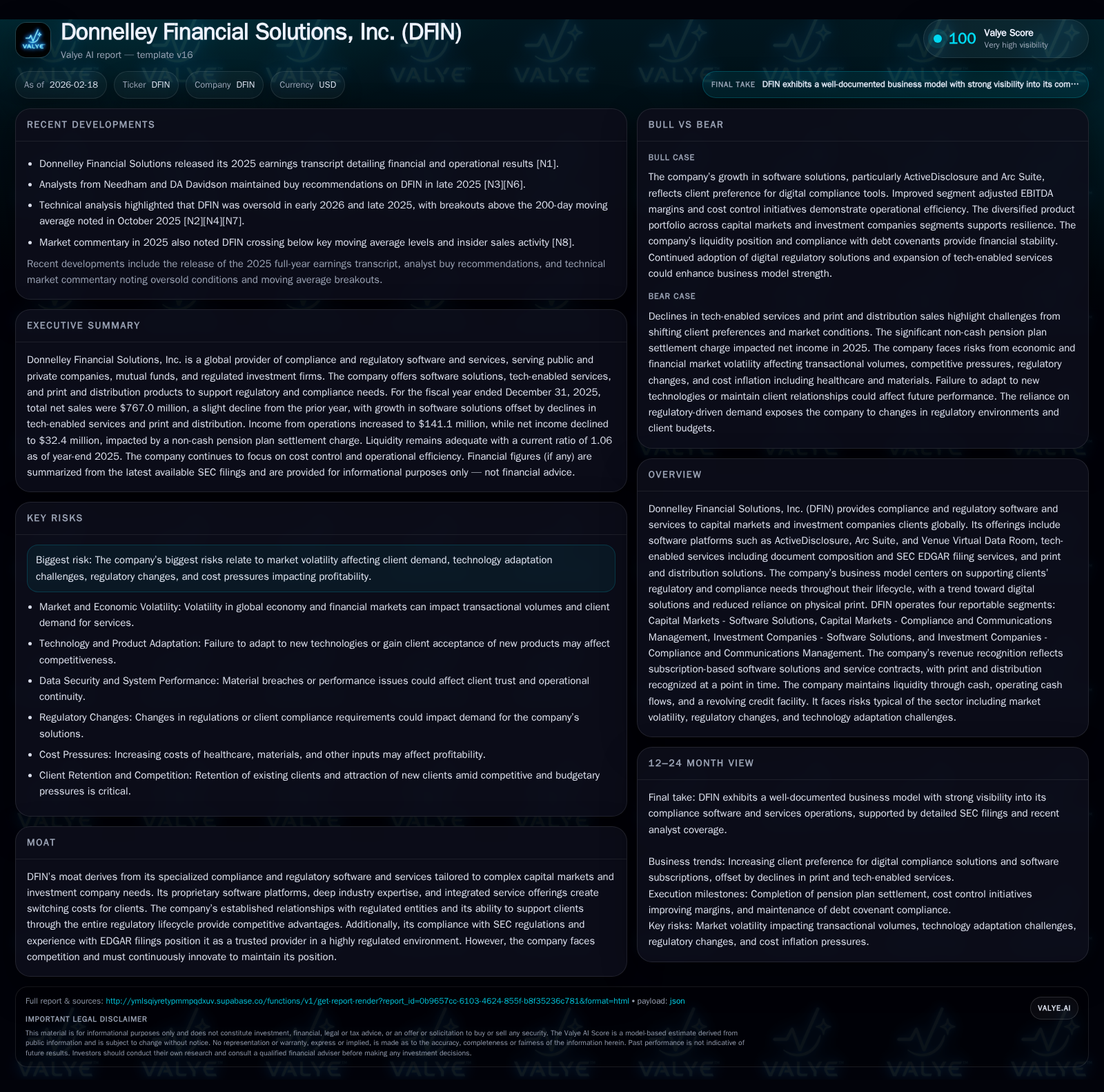
In 2025, Donnelley Financial Solutions, Inc. (DFIN) reported a 1.9% revenue decline to $767 million, driven by lower tech-enabled services and print/distribution volumes offset partially by software solutions growth. Operating income rose 3.3% to $141.1 million, reflecting effective cost management despite top-line challenges. Net income contracted sharply by nearly 65% to $32.4 million amid market headwinds and shifting client demand. The company maintained strong liquidity with $262 million available and deployed $185 million in stock buybacks while suspending dividends since 2019. Investors should monitor segment revenue trends, margin resilience, and covenant compliance as DFIN balances digital transformation against cyclical compliance volume risks [F1][S1][S4][S9].
Divergent Revenue Trends Reflect Transitional Market Dynamics
Donnelley Financial Solutions reported full-year net sales of $767 million for 2025, down 1.9% from $781.9 million in the prior year [F1][S1]. The decline was driven by lower tech-enabled services (-$22.5M) and print/distribution (-$21.1M), segments closely linked to physical document processing for capital markets compliance activities that continue to face secular volume pressures amid digital adoption [S1].
This was partially offset by a robust $28.7 million increase in software solutions revenue, fueled primarily by growth in ActiveDisclosure (+$12.7M) and Arc Suite (+$12.3M), underscoring the shift towards cloud-based regulatory lifecycle management solutions favored by clients [S1].
Historical performance (annual)
| FY | Net ($mm) | CFO ($mm) | OpInc ($mm) | Capex ($mm) | Net YoY |
|---|---|---|---|---|---|
| 2025 | 32 | 165 | 141 | 57 | -64.9% |
| 2024 | 92 | 171 | 137 | 66 | +12.4% |
| 2023 | 82 | 124 | 110 | 62 | -19.8% |
| 2022 | 103 | 150 | 145 | 54 |
Note: Omitted columns lack sufficient annual XBRL coverage in the provided tags (need ≥2 annual points): Rev, Div. Source: SEC companyfacts cache [F1].
Capital returns and efficiency (annual)
| FY | Buybacks ($mm) | FCF ($mm) | ROE% |
|---|---|---|---|
| 2025 | 185 | 108 | 8.5 |
| 2024 | 82 | 105 | 21.2 |
| 2023 | 40 | 62 | 20.4 |
| 2022 | 165 | 96 | 31.1 |
Source: SEC companyfacts cache [F1].
Note: Revenue data is limited for some years; focus is on recent performance metrics.
Market Pressures on Tech-Enabled Services and Print
The declines in tech-enabled services and print/distribution are primarily attributable to lower capital markets compliance volumes tied to SEC filing activity such as IPOs, mergers & acquisitions, proxy filings, and periodic reports—all sensitive to macroeconomic conditions affecting corporate transaction activity [S1][S2].
Increasing client preference for hybrid or fully digital workflows reduces reliance on outsourced physical printing and manual processes [S25][S26], compounded by budget constraints amid economic uncertainty.
Software Platforms as Growth Engines
Software solutions platforms like ActiveDisclosure provide cloud-based document lifecycle management tightly integrated with SEC EDGAR requirements enabling efficient collaboration and version control [S17][S18]. Arc Suite offers an end-to-end digital financial communications platform with modular subscription capabilities tailored especially for investment companies clients [S19][S22]. Venue Virtual Data Room extends secure deal management capabilities.
These proprietary platforms benefit from switching costs embedded in clients’ workflows enhancing retention prospects despite competitive pressures.
Operating Income Growth Through Cost Discipline
Operating income increased by $4.5 million or +3.3% to approximately $141 million despite revenue contraction [F1][S1], driven primarily by:
- Cost of sales reductions of $17.5 million via lower sales volumes combined with cost control initiatives,
- SG&A expense savings of around $13 million due to tighter incentive compensation controls, lower bad debt expense ($6.5M), overhead reductions,
- Partially offsetting increases included higher share-based compensation ($6.2M) and rising healthcare costs (~$2.3M) [S1].
This reflects management’s focus on preserving margins amid volatile top-line dynamics.
Capital Structure & Liquidity Profile
DFIN amended its credit facilities on March 13, 2025, establishing a $115 million Term Loan A Facility bearing SOFR plus a margin between 2%-2.5%, paired with a $300 million revolving credit facility maturing March 2030 [S4][S5][S6].
At December 31, 2025:
- Revolver borrowings stood at approximately $61 million,
- Letters of credit totaled about $1.4 million,
- Available liquidity was strong at roughly $262 million including cash on hand ($24.5M) plus revolving availability ($237M net),
- The company remained compliant with all debt covenants including minimum Interest Coverage Ratio and Consolidated Net Leverage Ratio,
- Scheduled quarterly principal repayments on the term loan commenced mid-2025,
- Voluntary prepayments are permitted without penalty offering financial flexibility.
Share Repurchases Amid Earnings Pressure
Despite net income falling nearly two-thirds year-over-year to approximately $32 million in fiscal year end December 31, 2025 from about $92 million previously, DFIN repurchased roughly $185 million of its common stock—a marked increase over prior years’ buybacks ($81M in FY24; $40M in FY23) [F1].
No dividends have been paid since Q3 of fiscal year 2019 indicating a shareholder return strategy heavily weighted toward buybacks supported by positive free cash flow generation (~$108M calculated as operating cash flow minus capex) which has allowed this capital deployment without reliance on external financing [F1].
Risks & Outlook
Key risks include economic sensitivity affecting transactional filing demand; evolving regulatory frameworks; cybersecurity challenges inherent in handling sensitive filings; competitive pricing pressures; technological adaptation needs; talent retention; and currency fluctuations owing to international operations [S2][S10].
Investor attention should focus on how effectively DFIN sustains software subscription growth amidst legacy service erosion while maintaining operating margins and liquidity.
Monitoring Metrics Ahead
Without explicit forward guidance available publicly or from recent earnings transcripts [N1], key indicators include:
- Revenue trajectory across software versus tech-enabled services segments,
- Operating margin trends balancing cost efficiencies against inflation or investment needs,
- Receivables quality as an indicator of demand stability,
- Liquidity status relative to credit covenant thresholds,
- Share repurchase pace signaling management confidence.
These metrics will illuminate whether current strategic initiatives position DFIN well for ongoing digital transition amid cyclical market headwinds.
Disclaimer: This is research-only, informational analysis and not investment advice. It may include AI-generated interpretation and general industry context. Always verify important details using primary sources.

Comments