
Casella Waste Systems' Expansion and Risk Management Shift Profitability Dynamics
Casella combines regional integration and recycling risk controls to balance robust revenue growth against compressed net margins.
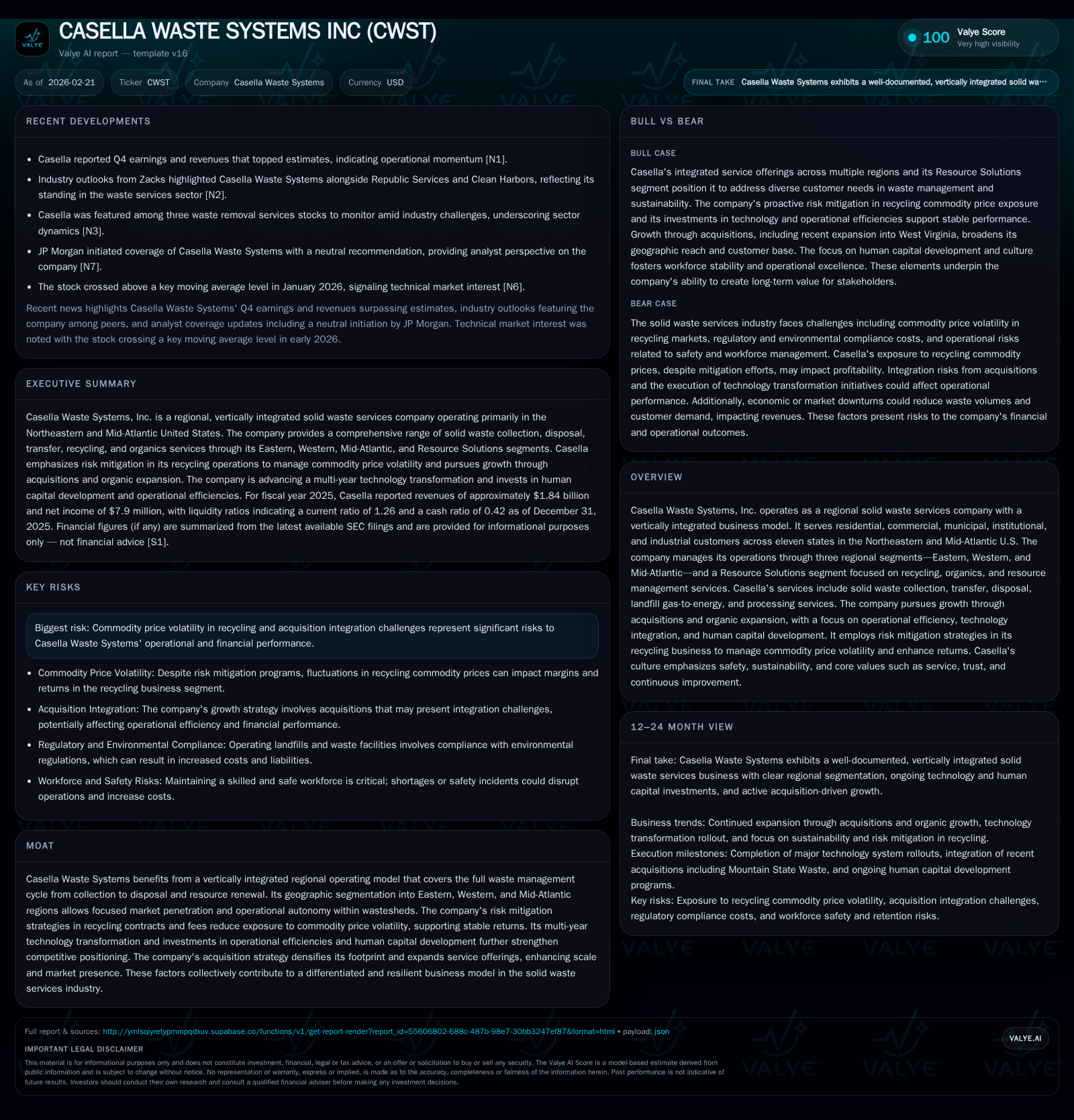
Casella Waste Systems, a vertically integrated regional solid waste services provider, has delivered strong revenue growth averaging 18% CAGR over the past four fiscal years through a blend of acquisitions and organic expansion focused mainly in the Northeast and Mid-Atlantic wastesheds. However, this growth has come amid significant profitability compression with operating income declining 12.5% year-over-year and net income down nearly 42%, primarily due to commodity price volatility in recycling and integration costs from acquisitions. The company’s segmented operational model across Eastern, Western, and Mid-Atlantic regions combined with its Resource Solutions segment supports comprehensive waste stream management from collection to landfill gas-to-energy. Strategic risk mitigation programs such as restructuring processing contracts, implementing sustainability recycling adjustment fees (SRA Fees), and capital investment in MRF upgrades serve to dampen earnings variability but face headwinds as recent acquisitions temporarily increase exposure to commodity cycles. Capital allocation remains focused on expansion and technology investments, driving capex growth exceeding 20% alongside healthy free cash flow generation but resulting in low reported ROE around 0.5%. Key milestones to monitor include successful integration of acquisition platforms, execution of technology transformation initiatives, and adaptability of risk mitigation strategies amid evolving recycling markets.
Casella Waste Systems presents a compelling case of a solid waste services provider navigating the tension between impressive top-line expansion and compressed bottom-line returns amid volatile recycling markets.
Historical Growth Fueled by Acquisition and Organic Expansion
Casella’s evolution over the past four fiscal years demonstrates an aggressive growth trajectory underpinned by both tuck-in acquisitions and organic market share gains within its core regional wastesheds spanning the Northeastern and Mid-Atlantic U.S.[F1][S1] Revenues surged from approximately $1.09 billion in FY2022 to nearly $1.84 billion in FY2025 — an 18% compounded annual growth rate — while operating income simultaneously declined from about $95 million to roughly $64 million over the same span (see Table 1). This disconnect hints at margin pressures arising from integration costs and market headwinds.
The company’s footprint densification strategy is clear: it completed 76 acquisitions since early 2018 totaling over $925 million in annualized revenues as of FY2025[S20]. The latest batch of nine acquisitions closed in FY2025 concentrated primarily on expanding Casella's Mid-Atlantic presence[S20], further asserting its regional cluster approach within targeted wastesheds.
Organic volume growth complements M&A efforts — notably a reported +6.6% lift in National Accounts volumes servicing broad sustainability mandates during FY2025 — which together help maintain momentum despite operational challenges[S6]. However, reduction in operating income margins (a roughly -12 percentage point decline year-over-year leading into FY2025) signals intensifying cost dynamics.
Historical performance (annual)
| FY | Rev ($mm) | Net ($mm) | CFO ($mm) | OpInc ($mm) | Rev YoY | Net YoY |
|---|---|---|---|---|---|---|
| 2025 | 1837 | 8 | 330 | 64 | +18.0% | -41.9% |
| 2024 | 1557 | 14 | 281 | 73 | +23.1% | -46.7% |
| 2023 | 1265 | 25 | 233 | 80 | +16.5% | -52.1% |
| 2022 | 1085 | 53 | 217 | 95 |
Note: Omitted columns lack sufficient annual XBRL coverage in the provided tags (need ≥2 annual points): Capex, Div, Buybacks. Source: SEC companyfacts cache [F1].
Capital returns and efficiency (annual)
| FY | FCF ($mm) | ROE% |
|---|---|---|
| 2025 | 85 | 0.5 |
| 2024 | 78 | 0.9 |
| 2023 | 78 | 2.5 |
| 2022 | 86 | 10.7 |
Source: SEC companyfacts cache [F1].
Table Note: Dividends & Buybacks omitted due to insufficient data.
Profitability Compression Amid Commodity Price Volatility
Behind Casella's revenue acceleration lies a sobering narrative of compressed profitability metrics dominated by the vagaries of recycling commodity prices and acquisition costs.[F1][N1][S1] Operating income shrank by approximately one-eighth (-12.5%) in FY2025 compared with the prior fiscal year, while net income plunged more precipitously (-41.9%) amid non-operating expenses linked partly to acquisitions and heightened market instability.
This fragmentation reflects cyclical swings in commodity values that challenge stable earnings delivery even as operational cash flows improve materially (+17% CFO increase in FY2025). The company highlights risks from orphaned contracts lacking embedded risk mitigations after acquisitions that amplify transient exposure to pricing shocks[S6]. Notwithstanding these risks, Casella managed an earnings beat relative to estimates for Q4 fiscal year-end December quarter[N1], underscoring some resilience within its complex business environment.
Regional Operational Model and Waste Stream Integration
Casella's vertically integrated business model segregates operations into three geographically oriented wastesheds: Eastern (Maine through eastern Connecticut), Western (Vermont through western New York), and Mid-Atlantic (Pennsylvania extending into West Virginia via recent acquisitions).[S6][S7]
Each wasteshed functions with operational autonomy but cohesively integrates collection routes, transfer station logistics, disposal via landfills including Subtitle D facilities, landfill gas-to-energy projects,[S11] and processing centers such as Materials Recovery Facilities (MRFs). This segmentation ensures deep market penetration customized for local regulatory environments and waste stream profiles.
The Resource Solutions segment overlays vertically integrated capabilities providing organics processing, large-scale technology-driven recycling operations incorporating advanced sorting systems (MRF upgrades), biosolids management, professional services brokerage for sustainability goals,[S6] and national accounts catering to commercial/municipal customers seeking diversified waste recycling solutions.
This configuration enables waste internalization enhancing yield economics — i.e., increased control of material streams culminating at owned transport or disposal assets — mitigating external vendor dependency risks.[S12]
Risk Mitigation Strategies in Recycling Commodity Pricing
Commodity price demands inherent volatility necessitate proactive risk mitigation frameworks deployed diligently by Casella[S6]. Primary measures include:
- Restructuring third-party processing contracts predominantly toward processing fees rather than commodity price exposure,
- Implementing Sustainability Recycling Adjustment Fees (SRA Fees) calibrated inversely with fluctuations in recovered material prices,
- Capital infusion into enhanced processing infrastructure upgrading MRF equipment for better quality post-sorted commodities reducing operating costs,
- Developing strategic partnerships with industrial consumers facilitating circular economy models ensuring material throughput stability.
These elements collectively limit downside earnings volatility while allowing upcycle participation via dynamic pricing adjustments reducing fees when commodities excel.[S6]
However, recently acquired entities often lack these mature protections temporarily increasing exposure before integration completion enacts standardized mitigation.[N1]
Outlook: Growth Opportunities and Headwinds
While explicit company guidance metrics remain limited,[N4] ongoing expansion continues via acquisition synergies particularly growing the footprint within Mid-Atlantic states including entry into West Virginia through Mountain State Waste[S20]. Enhanced pricing power manifests as landfill capacity tightens given closures reducing total Northeast site availability — heightening disposal contract stickiness favored by rail-served McKean Landfill developments.[S18]
Simultaneously, persistent commodity market uncertainties require execution focus on recycling adjustment fee implementations alongside technological advancements aimed at operational efficiency gains.[N5] Industry commentary stresses monitoring macroeconomic impacts influencing commercial waste volumes linked indirectly to economic activity fluctuations.
Thus, investors should watch milestones related to post-acquisition standardization of risk protocols; deployment progress of enterprise-wide Lead-to-Cash IT system rollouts targeting improved billing accuracy; adoption rate of fleet route optimization software; and effectiveness of workforce training programs targeting driver retention crucial for collection service continuity[S12][S26].
Capital Allocation Approach: Capex, Cash Flow, and Shareholder Returns
Capital intensity is a hallmark of Casella Waste Systems' business model reflective of landfills requiring ongoing investment for regulatory compliance, environmental controls such as methane capture technology tied to energy sales,[S11] and upgrading MRF facilities plus IT-enabled back-office modernization initiatives.[F1][S21]
Capex rose sharply by over +20% YoY reaching approximately $245 million in FY2025 coinciding with harvest increases in operating cash flow exceeding $329 million bolstering free cash flow near $85 million (CFO less capex approximation).[F1]
Despite strong cash inflows supporting capital expenditure needs, no dividend payments or share repurchases were recorded during available periods suggesting reinvestment priority focused on growth infrastructure[S20]. Leverage ratios remain conservative with net debt-to-adjusted EBITDA an estimated ~2.3x highlighting prudent financial positioning[S24].
Return on equity sits unusually low at roughly half a percent owing predominantly to depressed net margins relative to sizeable equity base swelling with retained earnings additions from prior years’ cumulative earnings[F1].
What to Watch Next: Earnings Drivers and Execution Risks
The path forward will pivot around effective integration of multiple acquired businesses encompassing system unification under digital transformation projects like Lead-to-Cash rollout phases,[S12] advancement in risk mitigation programs externally responsive yet contractually embedded within newly acquired assets,[S6]and maintaining efficiency improvements coupled with safety culture enhancements critical for sustainable labor force management.[S21][S26]
Market watchers should also track recycled materials price dynamics, especially how effectively SRA fees counterbalance adverse swings without deterring customer retention or profitability levels.[N5]
Innovation-driven facility upgrade outcomes including operational cost reduction from MRF automation will serve as key performance indicators along with cash flow trends evidencing margin restoration potential amid broader economic conditions impacting commercial waste generation[N1].
Disclosure: This analysis is based on publicly available SEC filings and verified news sources as cited; no forecasts or investment advice are intended or implied.
Disclaimer: This is research-only, informational analysis and not investment advice. It may include AI-generated interpretation and general industry context. Always verify important details using primary sources.

Comments