
Medifast’s Strategic Shift Confronts Metabolic Health Market Headwinds
Medifast faces revenue decline and operating losses in 2025 amid rising competition and evolving market demands for metabolic health solutions.
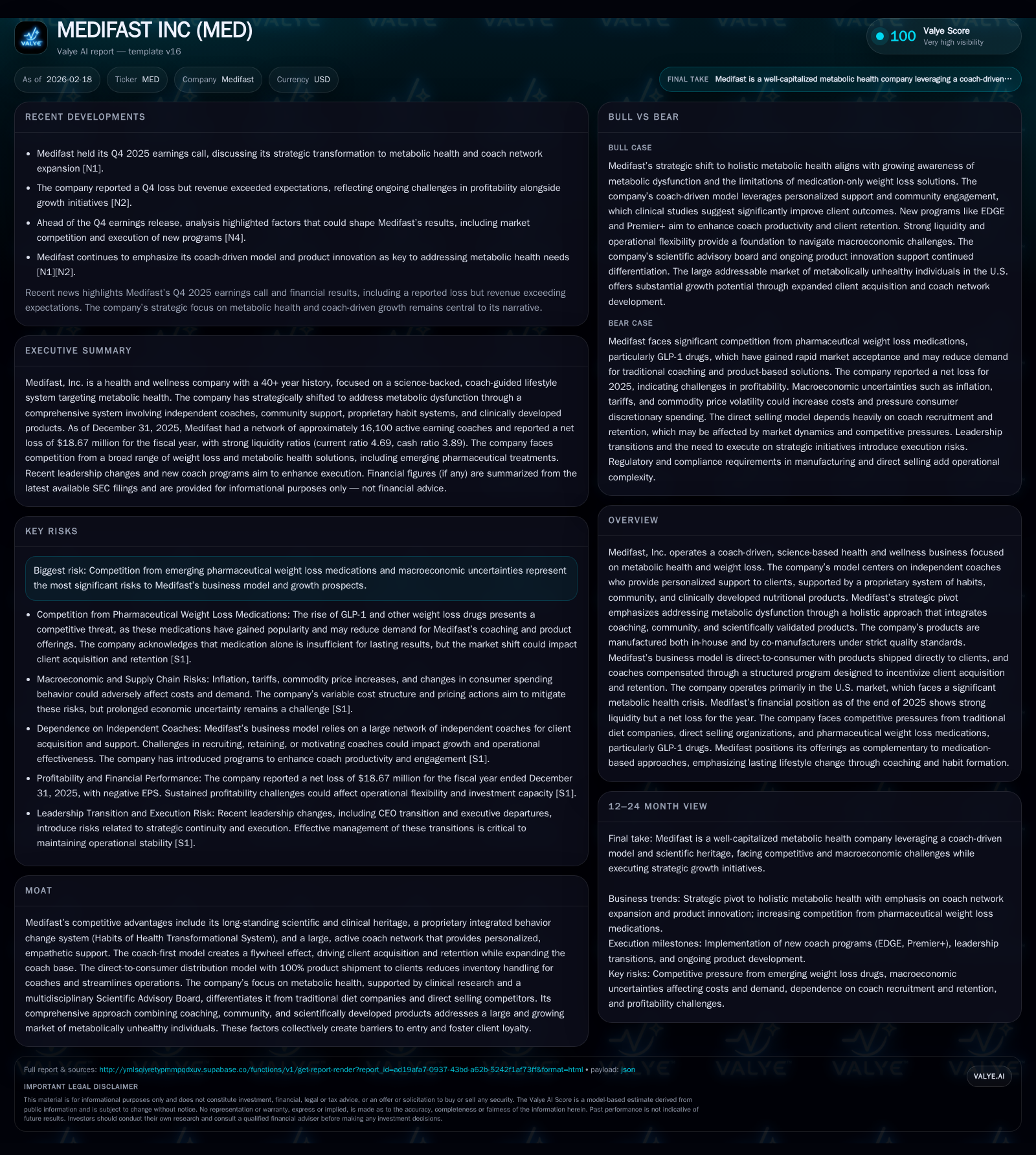
After years of robust growth driven by a coach-led direct-to-consumer model, Medifast encountered a significant inflection point in fiscal year 2025 with declining revenues and operating losses. The surge in pharmaceutical weight loss medications, particularly GLP-1 drugs, alongside macroeconomic pressures, disrupted its traditional momentum. The company’s strategic pivot toward a broader metabolic health framework aims to leverage its clinical heritage and coaching flywheel to rebuild growth, but near-term financial metrics reflect profitability challenges and subdued cash flow. Monitoring coach productivity, client retention, and new product adoption will be critical milestones to gauge Medifast’s recovery trajectory.
Historical Growth Trajectory and Inflection Point in FY2025
Medifast experienced an impressive growth arc over several years culminating in strong top-line expansion until 2024. Revenues surged from $78 million in FY2017 to nearly $390 million by FY2024, representing an approximate compounded annual growth rate of over 30%. This rapid scale-up was fueled by the company’s differentiated coach-driven flywheel effect—an integrated behavior change system leveraging independent coaches who provide personalized support that fosters client engagement and retention [F1][S17].
However, this momentum sharply reversed in FY2025. Revenue declined noticeably amidst intensifying competition and shifting consumer preferences. Operating income deteriorated from a peak of approximately $126 million profit in FY2023 to a negative $14 million loss by fiscal year-end 2025. Net income mirrored this shift, plunging from nearly $99 million earnings in 2023 to an $18.7 million loss in the same period [F1]. The company’s operating cash flow also contracted markedly by approximately 72% versus prior year as profits compressed and working capital dynamics tightened.
Historical performance (annual)
| FY | Net ($mm) | CFO ($mm) | OpInc ($mm) | Capex ($mm) | Net YoY |
|---|---|---|---|---|---|
| 2025 | -19 | 7 | -14 | 6 | -993.0% |
| 2024 | 2 | 24 | 3 | 7 | -97.9% |
| 2023 | 99 | 148 | 126 | 6 | -30.8% |
| 2022 | 144 | 195 | 185 | 17 |
Note: Omitted columns lack sufficient annual XBRL coverage in the provided tags (need ≥2 annual points): Rev. Source: SEC companyfacts cache [F1].
Capital returns and efficiency (annual)
| FY | Div ($mm) | Buybacks ($mm) | FCF ($mm) |
|---|---|---|---|
| 2025 | 0 | 0 | 1 |
| 2024 | 1 | 0 | 17 |
| 2023 | 73 | 4 | 141 |
| 2022 | 72 | 126 | 178 |
Source: SEC companyfacts cache [F1]. =14% | 2025 | Declined |>−10% vs’24 |= −14.2 |>−593% |= −18.7 |>−993% |=$6.8 |>−72% |=$5.6 |>−25%
Note: Exact revenue values for FY22–FY25 not disclosed here; growth rates derived from [F1] narrative data.
This abrupt financial pivot underscores the operational strain confronting Medifast as it strives to sustain profitability while navigating competitive headwinds disrupting its traditional metabolic health coaching platform.
Coach-Driven Model Under Pressure: Market Dynamics and Product Positioning
Medifast's cornerstone is its extensive network of approximately 16,100 active earning independent coaches as of December 31, 2025 [S17]. Approximately ninety percent of these coaches were once clients themselves—a powerful testament to the coach-first flywheel effect fostering client acquisition through personalized guidance rooted in shared experiences [S17][S29]. This proprietary Habits of Health Transformational System offers a scientifically backed behavioral framework supported by community connection that drives client success and retention.
Nonetheless, Medifast's coach-centric business model confronts escalating competitive pressures amid the growing prevalence of pharmacologic weight loss aids such as GLP-1 receptor agonists (e.g., semaglutide). These drugs have reshaped consumer expectations around weight loss efficacy due to their potent appetite suppression effects [S5][N1]. While Medifast recognizes the importance of lifestyle change even when using such medications—highlighting integration potentials between coaching-supported behavior change and pharmaceutical aids—the swift surge in GLP-1 adoption challenges the company's ability to retain clients solely through non-pharmacologic programs.
Moreover, according to research cited by Medifast, a notable proportion of people discontinue GLP-1s within six months to a year with weight regain common after cessation—offering an opening for Medifast's durable habit formation approach [S28]. Nevertheless, sustaining coach productivity is imperative to offset this evolving dynamic; growing the coach network while enhancing digital tools that streamline administrative tasks are focal points within Medifast's strategy going forward [N1][S16].
Coaches do not manage inventory or cash flows—they focus exclusively on client support—which differentiates MediFast from traditional MLM frameworks suffering often from inventory loading challenges [S9][S10]. Yet regulatory scrutiny into direct selling models continues tightening under FTC's evolving guidelines concerning earnings claims and compensation structures—a compliance landscape requiring cautious navigation lest operational flexibility constrains growth ambitions [S6][S7].
Financial Performance Breakdown: Revenues, Profitability, and Cash Flow Impact
The FY2025 annual results highlight significant deterioration across all core financial parameters linked directly to weakened demand and intensifying competitive pressures [N2][N10]. Revenue contraction interrupted years of compound growth exceeding fifty percent annually through FY2024 [F1]. The resulting compression triggered operating losses totaling roughly $14 million compared with profitable operations barely two years earlier.
Net income swung disproportionately negative ($18.7 million loss), reflecting both operating margin erosion and associated non-operating factors [F1]. Operating cash flow similarly declined by approximately seventy-two percent—a sharp reversal from record generation levels witnessed through previous expansion phases—although it remained positive at just under $7 million [F1]. Capital expenditure reductions partially offset this decline but investments remain focused on supporting future product innovation pipelines and technology upgrades essential for sustaining competitive differentiation [F1][S15].
Liquidity appears sufficient with cash & equivalents around $89 million versus current liabilities under $43 million at year-end—a current ratio approximating a comfortable ~4.7x provides some operational headroom despite earnings strain [F1]. However, approaching break-even or profitability restoration will be critical to avoiding deeper erosion of equity base which has already trimmed ROE into negative territory at approximately −9%. Dividends paid contracted sharply relative to prior years (down from ~$73 million paid in dividends last peak year to only ~$195K), while share repurchases have been suspended reflecting prudent capital preservation stance taken amid uncertainty [F1].
Strategic Initiatives Addressing Metabolic Health Market Evolution
Faced with accelerated acceptance of pharmaceutical weight loss treatments and evolving customer expectations, Medifast has recalibrated its business model towards encompassing broader metabolic health objectives rather than solely weight loss management [S1][N1]. The innovation centers on Metabolic Synchronization™, anchoring weight management within a comprehensive approach aimed at reversing underlying metabolic dysfunction rather than merely reducing scale numbers.
This adjusted strategy leverages the company’s deep scientific heritage built over four decades—including over a hundred peer-reviewed studies underpinning its product efficacy—to design integrated lifestyle programs that combine well-validated nutrition plans with scalable weekly habits coaching facilitated through technology-enabled personalized support networks [S20][S29].
Coaching enhancements include rolling out Premier+ auto-ship programs with tiered pricing discounts designed to improve client retention while simplifying purchasing decisions for coaches and clients alike [S16]. Investments targeting digital tools meant to streamline coach management functions free up coach time for high-impact client engagement activities —a vital pivot intended to boost overall productivity metrics across the field.
Medifast also commits to launching next-generation nutraceutical formulations explicitly tailored toward enhancing fat metabolism slated for introduction during calendar year 2026—a critical milestone representing tangible progress in science-driven metabolic intervention innovation aligned with strategic transformation goals [S29][N1][S28].
Capital Allocation Discipline Amid Operating Losses and Weaker Cash Generation
With earnings under pressure and cash flow contracting significantly relative to recent peak levels, Medifast has adopted a measured approach towards capital deployment prioritizing balance sheet strength over shareholder return distributions during this transition phase [F1][S1]. Dividend payouts diminished by over ninety-seven percent compared with historical highs reflective both of shrinking earnings capacity as well as conservative stewardship intentions.
Notably, stock repurchases have been halted after moderate activity ended post-FY2023—this signals management’s emphasis on conserving liquidity as uncertainties around regulatory changes affecting direct selling models persist alongside macroeconomic volatility impacting discretionary consumer spending habits within wellness sectors.
Despite operating losses pushing ROE below zero (-9% approximate), equity remains robust at near $199 million supported by sound current asset positioning giving the firm reasonable leeway against short-term shocks pending execution success on strategic plans leading into next fiscal periods [F1].
Risks and Regulatory Environment Shaping Future Growth Opportunities
Direct selling companies like Medifast face complex regulatory landscapes shaped by federal agencies including FTC oversight focusing keenly on anti-pyramid scheme enforcement frameworks plus advertising claim scrutiny arising from updated endorsement guidelines issued recently—intended to ensure clarity on typical consumer results versus testimonials provided by coaches or distributors [S6][S7][S23].
While Medifast believes it complies fully with existing rules—including exemptions pertinent to multi-level marketing businesses—it monitors proposals from FTC rulemaking processes closely that could impose additional reporting or modify compensation requirements potentially necessitating operational adjustments impacting go-to-market strategies [S12][S23].
Further litigation risks exist related primarily to product liability claims inherent given nature of ingestible nutritional goods although historical history shows no material adverse financial impacts; proactive insurance coverage arrangements mitigate downside exposures here [S8][S11].
Competitive threats stemming from pharmaceutical disruptors—chiefly GLP-1 class weight loss medications—pose meaningful long-term challenges not only by directly diverting customers but also reshaping the broader public discourse on acceptable weight management methods pushing holistic behavioral methods further into complementary rather than primary roles short term [S9][S28][N1].
Macroeconomic uncertainties including inflationary cost pressures affecting raw materials sourcing coupled with potential shifts in consumer discretionary budget allocations add layers of complexity challenging traditional operation leverage gains seen during prior growth cycles [S16][S24].
Investment Milestones to Watch: Indicators for Recovery or Further Decline
Absent firm guidance shared publicly beyond qualitative commentary surrounding strategic pivots outlined during recent earnings release periods, investors should keenly observe key performance indicators signaling either stabilization or acceleration trends:
- Quarterly top-line sales trends especially tracking sequential improvements post-Q4–FY25 declines which would evidence reactivated demand drivers or coach productivity gains.[N3]
- Growth or contraction in active earning coach counts beyond current ~16,100 level highlighting network scalability dynamics essential for sustainable client acquisition.[N7]
- Margin improvement initiatives catalyzed through Premier+ program uptake along with rising contribution margins driven by newer metabolic health product introductions planned for second half of calendar year.
- Digital tool adoption rates among coaches conveying improved operational efficiency that could accelerate customer conversion lifecycles ultimately impacting long-term unit economics metrics.
- Regulatory developments related to MLM rules or advertising liability bearing which may necessitate compensation plan adjustments materially altering incentive alignment mechanisms critical within their multi-tiered organizational structure.[S23]
Collectively these markers will illuminate whether Medifast can successfully counterbalance intensified pharmaceutical competition with its deep-seated behavioral science expertise channeled through its coach-driven community offering.
This analysis reflects information available as of early 2026 based on SEC filings ([F1],[S#]) and recent news releases ([N#]). It aims solely to provide an informed descriptive assessment without offering investment advice or predictions regarding future stock performance or corporate actions.
Disclaimer: This is research-only, informational analysis and not investment advice. It may include AI-generated interpretation and general industry context. Always verify important details using primary sources.

Comments