
CVR Energy’s Transition from Renewables Highlights Refining and Fertilizer Profitability Constraints
CVR Energy experienced a notable decline in revenue but improved operating income in 2025 amid segment shifts and commodity pressures.
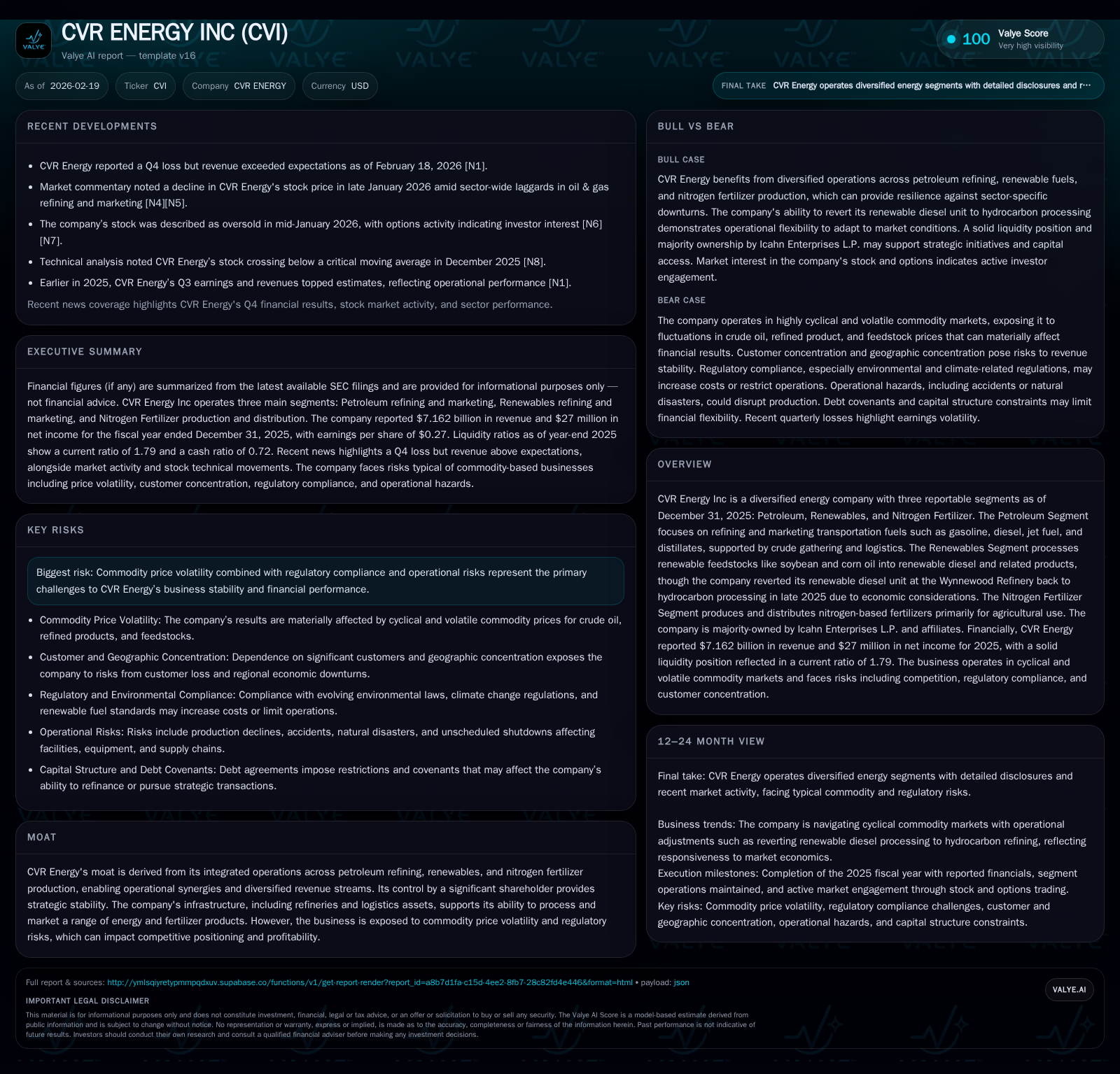
In 2025, CVR Energy Inc reported a revenue decline of nearly 6%, primarily reflecting headwinds in its petroleum refining and nitrogen fertilizer businesses. Despite top-line contraction, operating income rebounded significantly year-over-year, driven by operational efficiencies amid volatile commodity markets. The company reversed its renewable diesel strategy at the Wynnewood Refinery late in 2025, emphasizing hydrocarbon processing over renewables due to unfavorable economics. Capital expenditures remained consistent, though operating cash flow dropped sharply, culminating in negative free cash flow for the year. CVR Energy's capital structure benefits from amended credit facilities extending liquidity through 2031, while Icahn Enterprises maintains controlling interest influencing strategic stability.
Overview of CVR Energy
CVR Energy Inc is an integrated energy company operating three primary reportable segments: Petroleum refining, Renewables processing, and Nitrogen fertilizer production [S14]. The Petroleum segment refines crude into gasoline, diesel, jet fuel, and distillates while also supporting operations with crude gathering and logistic services. The Renewables segment had been focused on converting renewable feedstocks like soybean and corn oil into renewable diesel and related products but reversed this strategy late in 2025 due to adverse economics [S14]. The Nitrogen Fertilizer segment manufactures ammonia and urea ammonium nitrate (UAN), key inputs for agriculture.
Majority control by Icahn Enterprises L.P. (~70%) affords strategic stability but also concentrates governance [S14]. The company operates predominantly in the US market with integrated upstream logistics enhancing its refining footprint.
Historical Financial Performance and Drivers
CVR Energy faced a revenue contraction in recent years driven by fluctuating commodity prices and challenges across segments. Revenue declined from a high of almost $10.9 billion in FY2022 down to $7.16 billion in FY2025 [F1], representing a near-34% drop over three years.
However, operating income trends have been volatile but showed improvement in FY2025 with a sharp rebound from $58 million in FY2024 to $182 million—an increase of nearly 214%. This suggests effective cost control or improved product spreads partially offsetting volume or price weaknesses [F1]. Net income similarly showed tight margins with a small profit of $27 million.
Liquidity metrics reveal tightening operational cash flows that fell over 64% year-over-year from $404 million (FY2024) down to $144 million (FY2025). Capex spending has been relatively stable around the $180–200 million range annually, reflecting ongoing maintenance and investment needs [F1]. Due to declining operating cash flow against steady capital expenditure requirements, CVR Energy recorded negative free cash flow (approximately -$41 million).
The company's current ratio at fiscal year-end 2025 stood at an adequate 1.79x indicating reasonable short-term liquidity [F1]. However, cvR Energy’s returns remain moderate; the calculated ROE for FY2025 was only about 3.7%, signaling subdued profitability relative to shareholder equity.
Historical performance (annual)
| FY | Rev ($bn) | Net ($mm) | CFO ($mm) | OpInc ($mm) | Rev YoY | Net YoY |
|---|---|---|---|---|---|---|
| 2025 | 7.2 | 27 | 144 | 182 | -5.9% | +285.7% |
| 2024 | 7.6 | 7 | 404 | 58 | -17.7% | -99.1% |
| 2023 | 9.2 | 769 | 948 | 1123 | -15.1% | +66.1% |
| 2022 | 10.9 | 463 | 967 | 963 |
Note: Omitted columns lack sufficient annual XBRL coverage in the provided tags (need ≥2 annual points): Capex. Source: SEC companyfacts cache [F1].
Capital returns and efficiency (annual)
| FY | Div ($mm) | Buybacks ($mm) | FCF ($mm) |
|---|---|---|---|
| 2025 | 0 | -41 | |
| 2024 | 151 | 0 | 225 |
| 2023 | 453 | 0 | 743 |
| 2022 | 483 | 12 | 776 |
Source: SEC companyfacts cache [F1].
Note: Dividends represent payments to shareholders; buybacks data insufficient.
Segment Dynamics and Strategic Shifts
Petroleum Segment
This core segment remains focused on the refining and marketing of high-value transportation fuels including gasoline, diesel, jet fuel, and distillates [S14]. It benefits from integrated crude gathering logistics which help stabilize feedstock supply chains.
The recent two-to-one-to-one crack spread—a key indicator for refinery margins—faces pressure given global supply-demand fluctuations & regulatory costs such as Cap at the Rack (CAR) compliance fees adding cost burdens at wholesale pricing layers [S25]. Operational efficiency alongside feedstock optimization remains crucial.
Renewables Segment
Initially targeting renewable diesel production using soybean oil et al., CVR Energy reversed course at its Wynnewood Refinery toward traditional hydrocarbon processing late in the year [S14]. This was prompted by unprofitable economics characterized by feedstock price volatility, unfavorable renewables incentives relative to costs, plus logistical bottlenecks restricting throughput.
While this suspension weighs on potential clean fuel growth opportunities amid energy transition trends, management retains option flexibility should renewable diesel economics improve or subsidies favor reinvestment.
Nitrogen Fertilizer Segment
CVR’s fertilizer business focuses on nitrogen-based products such as ammonia and UAN [S14], servicing the farming industry with essential crop nutrients.
Profitability here correlates strongly with natural gas prices—a principal input—and agricultural demand cycles subject to weather variability [S27]. Transportation cost advantages over competitors contribute competitive positioning but risk erosion exists if logistics networks face disruption or cost inflation.
Capital Structure & Liquidity Considerations
Recent adjustments to credit facilities have enhanced liquidity options for CVR Energy's subsidiaries: Amended Asset-Based Lending (ABL) facilities raised total commitments from $345 million up to $550 million with an option to expand further up to $700 million [S9]. The credit agreement maturity extended through February 2031 improving medium-term financing flexibility.
Interest rates on borrowings reflect borrowing base conditions tied partly to excess availability percentages (above or below fifty percent), impacting cost of debt service accordingly [S18]. Debt covenants include customary financial tests limiting dividends, indebtedness levels, liens, asset sales, investments, and affiliate transactions ensuring creditor protection through restrictive clauses [S20].
At December 31, 2025 CVR Energy held approximately $511 million cash equivalents contributing positively to liquidity buffers amidst ongoing capital demands [F1]. No dividends were declared or paid during FY2025 after previous payouts totaling over $150 million in FY2024 suggesting caution on capital distribution given cash flow pressures.
Future Growth Prospects & Risks
Looking ahead, CVR Energy’s growth trajectory hinges on several variables:
- Renewable Diesel Re-engagement: Management may switch back the Wynnewood unit to renewable diesel should feedstock pricing improve or subsidies incentivize renewables investment again [S14]. This pivot could unlock incremental margin opportunities aligned with evolving regulatory frameworks favoring lower carbon fuels.
- Stabilization of Commodity Prices: Sustained or rising petroleum product crack spreads combined with manageable natural gas costs would enhance earnings visibility across refining and fertilizer segments respectively.
- Operational Reliability: Avoidance of unplanned outages in refining assets remains critical due to the substantial impact of downtime on production volumes and costs.
- Regulatory Environment: Compliance with accelerating environmental legislation relating to emissions caps or carbon intensity standards could impose additional incremental costs or require capital investments potentially straining margins further [S17].
- Geopolitical & Market Volatility: Global macro disruptions—from conflicts affecting oil supply chains to global economic slowdowns impacting transport fuel consumption—pose material uncertainty around commodity market fundamentals governing earnings.
- Customer Concentration: Dependence on major customers presents risks if contract volumes reduce or counterparties default affecting sales concentration dynamics adversely [S13].
What To Watch / Potential Milestones (Analysis)
Since explicit forward guidance was not disclosed in filings or news releases:
- Monitor management commentary on potential renewable diesel unit reactivation as policy incentives evolve post-2025 energy transition policies.
- Track quarterly EBITDA margins across segments revealing incremental effects of market stabilization or deterioration.
- Observe cash flow trends vis-à-vis capex funding ability that will determine need for further debt financing or equity issuance given no recent buybacks or dividend tax distributions.
- Note possible impacts from recently amended credit agreements allowing more flexible leverage capacity which may facilitate opportunistic capital projects [S9].
Returns & Capital Allocation Assessment
ROE remains subdued at roughly 3.7% reflecting net income pressures despite partial recovery compared against modest equity base [$27M net income / $730M equity] for fiscal year ended December 31, 2025 [F1]. The lack of dividend payments post-FY2024 signals prioritization of deleveraging or financial stability over shareholder distributions amidst volatile earnings.
Negative free cash flow reflects the growing gap between contracting operating cash flows (-64% YoY down to $144M) versus constant capex spending ($185M), implying limited internal funds for growth projects without external capital infusion or improved profitability measures [F1].
No share repurchases occurred since FY2022 indicating lack of excess liquidity earmarked for stock buybacks presently.
Sector Contextual Analysis (Non-firm data)
In petroleum refining under current geopolitical tensions tied largely to global oil market instability (e.g., Russia-Ukraine war), margins remain compressed yet can be highly cyclical depending on crack spreads calibration amidst inventory changes downstream. Regulatory costs related to greenhouse gas emissions continue weighing heavily on refining economics especially within coastal regions enforcing cap-and-trade programs impacting CAR components embedded into rack pricing structures.
Nitrogen fertilizer producers contend chiefly with natural gas input pricing—representing up to ~70% of manufacturing expenses—as well as agricultural commodity cycles determining demand elasticity for fertilizers influencing long-term contract pricing power.
Renewable diesel production economics currently face headwinds due primarily to feedstock price volatility exceeding fixed premium credits offered via Renewable Fuel Standards (RFS), placing renewables units at operational disadvantage relative to traditional hydrocarbons absent policy enhancements or resource cost declines.
Conclusion: Balancing Segment Cycles Amidst Strategic Repositioning
CVR Energy’s consolidated financials illustrate resilience tempered by ongoing challenges inherent in commodity-exposed sectors undergoing structural shifts toward sustainability. The company's pragmatic reversion of its renewable diesel operation underscores a measured approach focused on maximizing refinery utilization under prevailing market realities while keeping future optionality alive pending more favorable circumstances.
Stable financing backed by amended credit agreements supports necessary capital deployment yet cautious free cash flow generation warrants attention going forward coinciding with market developments influencing petroleum cracks and fertilizer input costs.
Investors should monitor upcoming quarterly results for evolving profit mix effects stemming from shifting segment contributions coupled with any strategic moves reverting renewed attention toward clean energy avenues aligned with regulatory climate trends.
Disclaimer: This analysis is based solely on publicly available information through February 19, 2026 ([N1]-[N7], [S1]-[S29], [F1]) without providing investment advice or financial recommendations.
Disclaimer: This is research-only, informational analysis and not investment advice. It may include AI-generated interpretation and general industry context. Always verify important details using primary sources.

Comments