
Leslie's, Inc. Struggles with Profitability Amid Strategic Store Closures
Leslie's faces steep profit declines alongside operational overhaul and legal challenges, testing its financial resilience.
Leslie's, Inc. has experienced a dramatic swing from operating profitability to significant losses in recent years, driven by deteriorating operating income and legal headwinds. The company is pursuing a strategic restructuring involving the closure of approximately 80-90 underperforming stores to streamline operations and reduce costs, though these efforts incur near-term impairment charges. Persistent material weaknesses in internal controls and ongoing securities litigation add layers of risk. Cash flow has contracted sharply, and the company shows negative stockholders’ equity, reflecting capital strain and challenging returns on equity. Looking ahead, Leslie's management signals potential operational improvements as store rationalization nears completion, but meaningful recovery depends on execution amid market cyclicality and risk factors.
From Profitability to Losses: Charting Leslie’s Recent Operating Performance
Leslie's trajectory over the past four fiscal years paints a stark picture of financial deterioration. After generating healthy operating profits above $238 million in FY2022 and maintaining profitability through FY2023 ($102 million) and FY2024 ($57 million), the company swung into a substantial operating loss of $170 million in FY2025 [F1]. This marks an almost 400% decline in operating income year-over-year.
The result was compounded at the net income level where Leslie's reported a substantial loss approaching $237 million in FY2025, contrasting with a modest net loss of $23 million in FY2024 and positive earnings earlier years [F1]. These figures underscore not only shrinking profitability but also escalating costs and impairments impacting the bottom line severely.
Operating cash flow also markedly contracted from $107 million in FY2024 down to less than $9 million in FY2025 (-92%) [F1], signaling stress on sustainable operational liquidity.
Historical performance (annual)
| FY | Net ($mm) | CFO ($mm) | OpInc ($mm) | Capex ($mm) | Net YoY |
|---|---|---|---|---|---|
| 2025 | -237 | 9 | -170 | 25 | -913.6% |
| 2024 | -23 | 107 | 57 | 47 | -185.8% |
| 2023 | 27 | 6 | 102 | 39 | -82.9% |
| 2022 | 159 | 67 | 239 | 32 |
Note: Omitted columns lack sufficient annual XBRL coverage in the provided tags (need ≥2 annual points): Rev, Div. Source: SEC companyfacts cache [F1].
Capital returns and efficiency (annual)
| FY | Buybacks ($mm) | FCF ($mm) | ROE% |
|---|---|---|---|
| 2025 | -17 | 58.1 | |
| 2024 | 0 | 60 | 13.2 |
| 2023 | 0 | -32 | -16.9 |
| 2022 | 152 | 35 | -80.3 |
Source: SEC companyfacts cache [F1].
Note: Revenues not available from provided tags.
Strategic Rationalization: Store Closures and Cost Implications
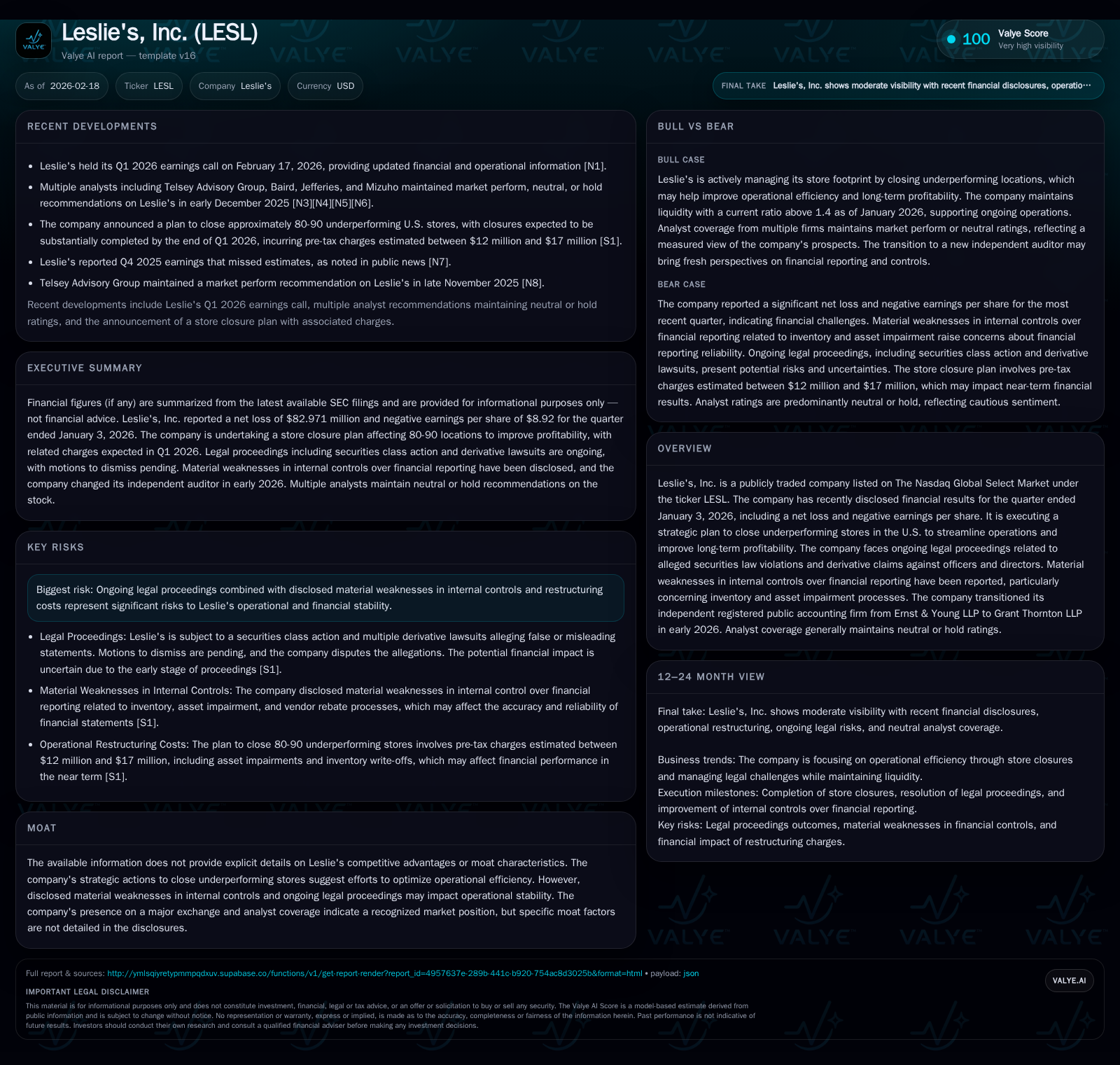
In late November 2025, Leslie’s announced a significant strategic pivot involving the planned closure of approximately 80-90 underperforming stores across the U.S., substantially completing these actions by the end of Q1 FY2026 [N1][S11]. This retail footprint rationalization is aimed at improving long-term cost efficiency by shedding loss-making locations.
The company expects related pre-tax charges between $12 million and $17 million for Q1 FY2026, consisting primarily of around $8 million in impairment of long-lived assets plus $4-$9 million inventory write-offs [S11]. While these charges depress near-term profitability figures through sizable noncash impairments, they align with common specialty retail restructuring practices designed to enhance margins over time.
This approach reflects sector norms where companies optimize physical presences reflecting shifts toward e-commerce competition or customer concentration areas—though expenses such as accelerated depreciation and inventory clearance typically weigh on initial earnings.
Legal Proceedings Impacting Confidence and Operational Focus
On the regulatory front, Leslie's remains embroiled in complex legal proceedings stemming from allegations of securities violations filed against it alongside former executives [S1][S4][S7]. These include a securities class action initiated by West Palm Beach Police Pension Fund and multiple derivative suits alleging misleading statements concerning financial guidance and operational prospects.
To date, courts have dismissed initial complaints but allowed amended filings—motions are pending without finalized rulings [S1]. Given early stages, material financial impacts cannot be reliably forecasted; nonetheless, these cases represent ongoing distractions potentially inflating risk premia for investors.
In parallel, the company's defense stance remains assertive while disclosing established reserves for probable claims are immaterial individually or collectively [S4]. Nonetheless, protracted litigation may pressure management bandwidth and investor confidence.
Evaluating Cash Flow Dynamics and Capital Structure Adjustments
Leslie’s declining operating cash flow—down nearly 92% YoY—illustrates the combined pressures from reduced profitability and operational reorientation during its restructuring phase [F1]. Despite this cash compression, capital expenditures have retreated almost by half compared to the prior fiscal year ($25.5 million vs $47 million), revealing prudence in cash deployment aligning with store rationalizations [F1].
Current assets stood at approximately $267 million at January-end 2026 against current liabilities near $188 million, implying a current ratio of about 1.42—a moderate liquidity buffer within retail norms though below safety zone benchmarks seen in less cyclical sectors [F1][S17].
Debt specifics from recent filings indicate continued obligations requiring ongoing scrutiny for covenant compliance and refinancing risks [S12][S17]. Working capital management efficiency will be crucial given inventory write-off impacts and store closures reducing asset bases but attendant cost structures.
Capital Allocation Evolution: ROE, Dividends, and Share Repurchase Activity
Shareholders face capital return headwinds evidenced by negative stockholders' equity around -$408 million at end-FY2025 [F1], predominantly driven by accumulated losses outpacing equity infusions or retained earnings.
Under these circumstances conventional Return on Equity computations yield misleading impressions—with approximation suggesting a high nominal ROE (~58%) due to negative denominator effects but clearly reflecting value erosion rather than value creation [F1].
Dividend distributions have ceased since fiscal year 2021 (last payment $1.24 million), reflecting cash conservation motives amid losses [F1]. Likewise, share repurchase activity halted after notable buybacks of roughly $152 million during FY2022; no repurchases followed in subsequent years aligned with restructuring priorities [F1][S9][S10][S23].
Capital stewardship appears focused on liquidity preservation while navigating transformational challenges rather than shareholder payouts or aggressive capital returns.
Future Growth Outlook: What the Company Indicates and Industry Context
Management commentary during the Q1 FY2026 earnings call indicated expectations for completing store closures shortly while aiming for improved operational leverage post-reshaping efforts [N1][N3]. The firm anticipates potential earnings surprises relative to market estimates driven by streamlined expense bases yet acknowledges uncertainty given general retail cyclicality.
Industry context suggests specialty retailers like Leslie’s often face extended periods adjusting to consumer demand variability especially when transitioning away from legacy store-heavy formats toward omni-channel models—a structural adjustment prevalent across home improvement or leisure goods retail segments.
Absent explicit forward guidance on revenues or margins beyond structural cost actions [N1], stakeholders should monitor sales trends post-rationalization closely as key signals of recovery viability.
Risks and Uncertainties: Internal Controls and Litigation Headwinds
Audit reports underline significant material weaknesses persist within Leslie's internal control environment particularly concerning inventory valuation processes and asset impairments affecting financial reporting reliability [S24][N1]. Ernst & Young issued adverse opinions citing these matters which reflect governance lapses that could heighten audit risk premiums.
Such deficiencies align with complexities inherent in managing extensive physical inventories combined with frequent asset write-downs during active restructurings common to retail operations.
Together with unresolved legal disputes around disclosures magnify managerial credibility risks potentially eroding stakeholder trust over medium term horizons.
Key Milestones to Monitor for Investment Sentiment Shifts
Upcoming quarterly filings including Q2 FY2026 results will provide first substantive updates post-announced store closures allowing evaluation of realized cost savings versus ongoing impairments [N1][S3]. Judicial decisions concerning existing litigation—though uncertain in timelines—may become pivotal if motions resolve or trials proceed clarifying potential liabilities [S7].
Completion of strategic closures without further escalations economically would likely recalibrate valuation multiples positively versus the currently cautious analyst consensus typically rated neutral or hold [N3]. Conversely, delays or fresh impairments could deepen pessimism.
Investors should track operational KPIs such as comparable store sales trends coupled with balance sheet metric stability alongside newsflow around legal outcomes to judge trajectory shifts effectively.
This report is intended solely for informational purposes based on publicly available data up to February 18, 2026.
Disclaimer: This is research-only, informational analysis and not investment advice. It may include AI-generated interpretation and general industry context. Always verify important details using primary sources.

Comments