
EQT Corp’s Financial Turnaround and Appalachian Integration Strengths
A detailed analysis of EQT Corporation’s robust financial rebound in 2025 underpinned by its integrated Appalachian natural gas operations and midstream investments, highlighting both growth drivers and regulatory risks.
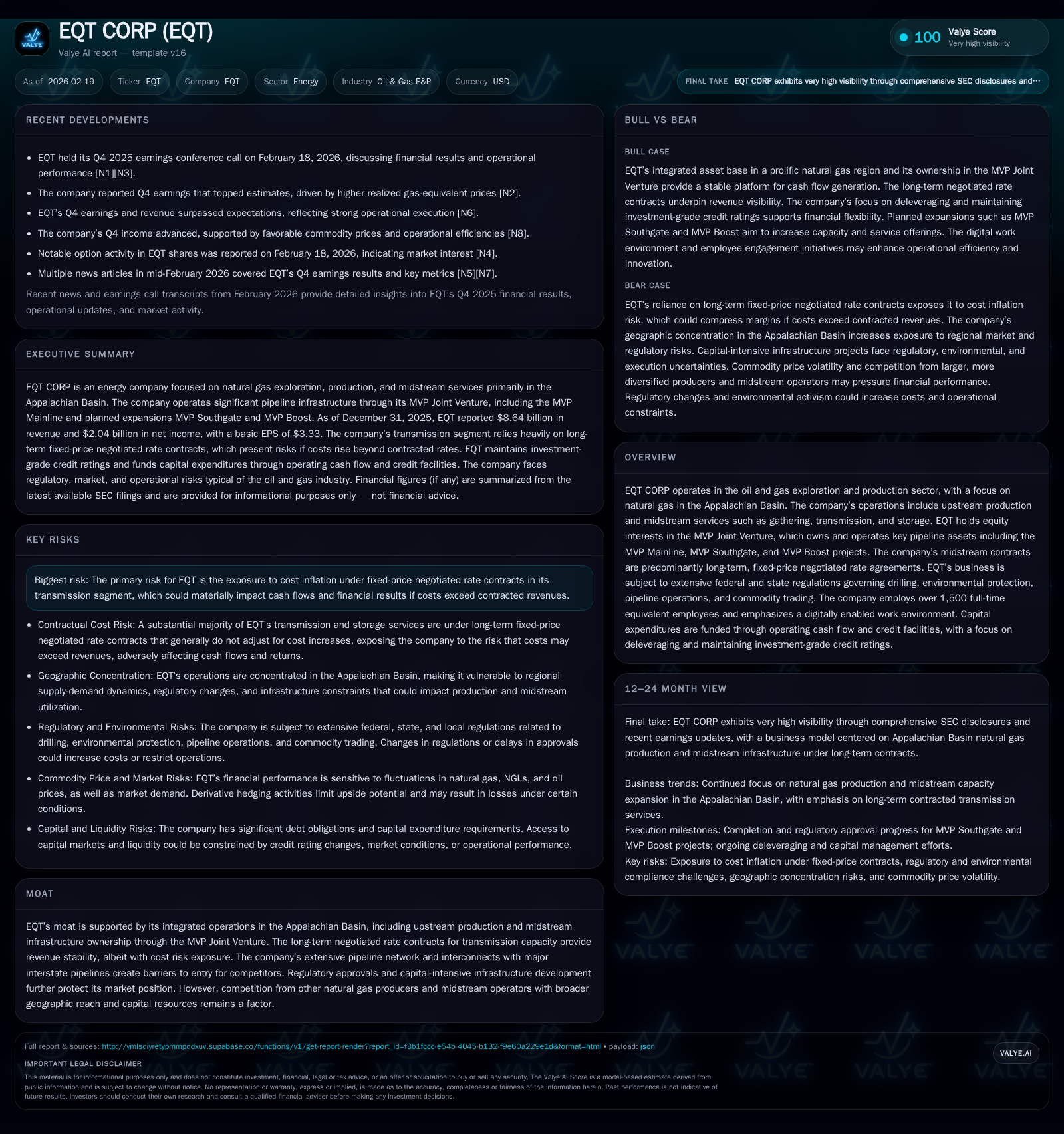
EQT Corp achieved transformative revenue and earnings growth in fiscal 2025, with revenues rising nearly 64% year-over-year driven largely by higher realized natural gas prices. The company's integrated model combining upstream production in the Appalachian Basin with equity stakes in critical midstream infrastructure via the MVP Joint Venture fortifies its competitive moat. Key expansion projects—MVP Southgate and MVP Boost—are slated for mid-2028 deployment, promising additional capacity but also capital commitment. Fixed-price negotiated rate contracts underpin stable midstream revenues while exposing EQT to cost inflation risks amid tight federal and state regulatory frameworks. Capital allocation favors balance sheet strengthening and steady dividends with buybacks absent since 2024. Going forward, close attention should be paid to regulatory approvals, contract renewals, and cost control dynamics that could influence margin sustainability.
Transformative Revenue and Earnings Growth in 2025
EQT Corporation delivered a remarkable financial turnaround in fiscal year (FY) 2025, underscored by an almost 64% year-over-year increase in total revenues to approximately $8.64 billion [F1]. This surge was primarily driven by higher realized natural gas equivalent prices across its Appalachian Basin upstream portfolio, benefiting from favorable market conditions despite noted seasonality effects typical of the region where demand peaks during colder months [S1]. Operating income more than quadrupled to $3.25 billion—a stunning +374% YoY increase—reflecting strong operational leverage combined with disciplined cost management strategies [F1][N2][N4]. Post-tax net income followed suit on a similar trajectory, expanding nearly eightfold from $230 million in FY24 to just above $2 billion in FY25 [F1].
Such top-line acceleration demonstrates how EQT is capitalizing on its geographic concentration within Appalachia, leveraging increasing commodity prices alongside an integrated infrastructure footprint which enhances both realization and margin capture.
Historical performance (annual)
| FY | Rev ($bn) | Net ($bn) | CFO ($bn) | OpInc ($bn) | Rev YoY | Net YoY |
|---|---|---|---|---|---|---|
| 2025 | 8.6 | 2.0 | 5.1 | 3.2 | +63.9% | +784.4% |
| 2024 | 5.3 | 0.2 | 2.8 | 0.7 | -23.7% | -86.7% |
| 2023 | 6.9 | 1.7 | 3.2 | 2.3 | -7.9% | -2.0% |
| 2022 | 7.5 | 1.8 | 3.5 | 2.7 |
Note: Omitted columns lack sufficient annual XBRL coverage in the provided tags (need ≥2 annual points): Capex. Source: SEC companyfacts cache [F1].
Capital returns and efficiency (annual)
| FY | Div ($mm) | Buybacks ($mm) | FCF ($bn) |
|---|---|---|---|
| 2025 | 390 | 0 | 2.8 |
| 2024 | 327 | 0 | 0.6 |
| 2023 | 228 | 201 | 1.2 |
| 2022 | 204 | 409 | 2.1 |
Source: SEC companyfacts cache [F1].
Note: Dividends paid and buybacks omitted from table due to insufficient multi-year data points.
Integrated Operations Powering a Defensible Moat
EQT’s ability to generate sustained profitability stems from its integrated operational model focused heavily on natural gas exploration, production (upstream), and crucially on midstream pipeline infrastructure ownership within the Appalachian Basin [S1]. The hallmark of this integration is EQT's equity interests in the Mountain Valley Pipeline (MVP) Joint Venture comprising three distinct series: MVP A owns the MVP Mainline; MVP B for MVP Southgate; and MVP C overseeing the MVP Boost assets.
The MVP Mainline spans approximately 303 miles featuring a robust 42-inch diameter capacity pipeline facilitating firm transportation up to two billion cubic feet per day (Bcf/d). It interconnects via three separate points with major third-party interstate pipelines such as Transcontinental Gas Pipe Line Company, LLC and Tennessee Gas Pipeline Company—strategically anchoring EQT’s gathering systems with broader national networks [S6][S25]. This extensive pipeline interconnectivity presents substantial barriers to entry for competitors lacking the geographic breadth or capital resources.
Furthermore, approximately 95% of the transmission segment’s contracted capacity is covered under long-term fixed-price negotiated rate contracts approved by FERC [S12][S16]. These contracts offer predictability in revenue streams amid volatile commodity prices but expose EQT to potential cost inflation risk since most negotiated rates do not adjust upwards if operating expenses rise unexpectedly.
Key Midstream Projects: MVP Southgate and MVP Boost Pipeline Expansions
Integral to EQT’s growth narrative are expansions through the MVP Southgate and MVP Boost projects currently underway within the joint venture structures [S1][S19][S25].
MVP Southgate involves constructing a new roughly 31-mile-long natural gas interstate pipeline extending from the terminus of MVP Mainline in Pittsylvania County, Virginia to delivery points in Rockingham County, North Carolina with design capacity at about 0.55 Bcf/d [S1]. The projected capital budget stands between $370 million and $430 million excluding allowance for funds used during construction (AFUDC). Pending receipt of outstanding regulatory approvals, full commissioning is targeted for mid-2028.
MVP Boost focuses on augmenting compression assets along the existing Mainline infrastructure by adding three compressor stations in West Virginia plus one new station in Virginia, aimed at enhancing pipeline throughput by an extra estimated capacity of roughly 0.6 Bcf/d [S1][S19]. This project carries an estimated investment range of approximately $400 million to $540 million excluding AFUDC costs with an analogous operational commencement window set for mid-2028.
The complexity surrounding these expansions reflects sizeable capital intensity intertwined with stringent federal regulatory oversight primarily via FERC certification processes [S13][S17]. Capital contributions are anticipated through pro-rata equity investments aligned with each partner’s participation level.
Regulatory Challenges and Cost Exposure in Fixed-Price Contracts
EQT’s exposure profile reveals nuanced challenges embedded within its dominant use of fixed-price negotiated rate contracts covering most transmission services which underpin stable cash flows but heighten vulnerability to input cost inflation [S19][S26]. Rising labor wages, material expenses linked to compression station operation, regulatory compliance costs especially related to environmental safeguards—such as methane emission controls—and other elements can amplify service costs without commensurate contract revenue adjustment opportunities.
While these contracts were designed under FERC policies allowing mutual agreement between provider and customer post-offer of recourse rates [S12], any prolonged mismatch where operational costs outpace agreed fees could erode returns materially impacting net operating margins . Compounding this sector-specific risk are continuous scrutiny layers from federal agencies and state regulators over permit issuance timelines and compliance enforcement [S13][S20]. For instance, environmental legislation targeting air emissions or water discharge standards may mandate additional capital expenditure or operational modifications increasing baseline cost structures.
Capital Structure, Liquidity Profile, and Debt Covenants
As of December 31, 2025, EQT reported total debt outstanding approximating $7.8 billion with credit ratings at investment grade levels: Moody's Baa3 with stable outlook; S&P BBB- stable; Fitch BBB- stable outlook [S4][F1]. Although stable presently, any deterioration due to commodity price shocks or operational disruption could pressure covenants potentially restricting borrowing flexibility or mandating earnings retention versus shareholder returns.
Material provisions include cross-default protections across revolving credit facilities and senior notes tied to aggregate indebtedness thresholds that could accelerate repayment obligations if triggered [S5][S7]. Revolving credit utilization remains pivotal given ongoing capex demands linked especially to pipeline expansions detailed earlier.
The company's current ratio based on latest reporting stands below unity at approximately 0.76 reflecting working capital tightness typical for capital intensive energy firms but offset by healthy medium-term liquidity arrangements [F1]. Continuous prudent management of leverage ratios will be critical amid planned infrastructure spending while balancing debt servicing requirements.
Cash Flow Generation, Capital Expenditure Trends, and Free Cash Flow
Consistent with operational earnings momentum was EQT's significant improvement in cash flow from operations which rose over +81% YoY reaching around $5.13 billion as of fiscal year-end '25 [F1]. Despite modest increases (~1–2%) in capex spending year-over-year totaling approximately $2.29 billion focusing on property plant & equipment acquisitions largely tied to midstream enhancements including compression facilities [F1], free cash flow generation remained robust at about $2.84 billion when subtracting capex from operating cash flow —a notable illustration of strong cash conversion efficiency amid growth investments.
This positive free cash flow dynamic supports balance sheet deleveraging efforts alongside maintaining operational resilience despite cyclical commodity price variation risks inherent within Appalachia-focused production assets.
Shareholder Returns: Dividends Versus Buybacks Dynamics
Capital returned directly to shareholders via dividends has seen a steady increase annually through fiscal '25 payments totaling roughly $390 million compared against approximately $203 million paid three years prior—a reflection of strategic emphasis on providing yield stability amid fluctuating commodity markets [F1][N11]. Conversely, share repurchases have been conspicuously halted since fiscal year '24 following cumulative buyback spends near $201 million in '23 down from prior periods indicating a deliberate recalibration towards prioritizing debt reduction over aggressive equity return strategies at present.
This bifurcation suggests management’s intent to reinforce financial prudence given sizeable capex needs associated with pipeline expansions ahead while maintaining shareholder distributions within sustainable thresholds inclusive of regulatory sensitivities governing energy sector dividends .
Outlook: Milestones to Monitor and Potential Headwinds
Looking forward through an analytical lens rather than prescriptive guidance:
- Monitoring timely receipt of final regulatory authorizations required for steady progress on MVP Southgate and Boost projects scheduled for service mid-2028 will be paramount given their outsized impact on incremental transportation capacity availability,
- Vigilance on inflationary pressures impacting operating costs especially under fixed-price contract regimes is warranted as potential overruns could compress EBITDA margins,
- Geographic concentration risk tied exclusively to Appalachian Basin assets exposes EQT strategically both operationally and competitively compared with diversified peers whose basins include Permian or Haynesville,
- Continued evolution of federal/state regulations—ranging from greenhouse gas emissions scrutiny under EPA jurisdiction to local permit issuance delays—could create additional compliance burdens raising capex intensity or causing operational slowdowns,
- Seasonal fluctuations remain notable influencing quarterly production volumes thus impacting short-term weather-dependent earnings volatility,
- Contract renewal negotiations require close attention as lapses or unfavorable terms amidst competitive pressures or shifts towards alternative energy sources might impair volume growth potential or revenue stabilization efforts.
In sum, EQT's tightly integrated upstream-midstream platform combined with disciplined capital spending has yielded a powerful financial comeback through FY25 supported by long-lived negotiated contract structures albeit shadowed by noteworthy cost inflation exposures and regulatory uncertainties requiring measured oversight moving forward.
This analysis synthesizes data available as of February 19, 2026 from publicly disclosed financial statements filings (10-K), company press releases, earnings call transcripts, industry-standard valuation metrics extracted from XBRL companyfacts cache ([F1]) along with direct citations of relevant SEC risk disclosures ([S#]) and pertinent recent news reports ([N#]). This report does not constitute investment advice but aims solely to provide rigorous financial insight into EQT Corporation’s current business positioning within the oil & gas exploration & production sector focused on Appalachian natural gas operations.
Disclaimer: This is research-only, informational analysis and not investment advice. It may include AI-generated interpretation and general industry context. Always verify important details using primary sources.

Comments