
ATLAS CRITICAL MINERALS Corp's Growth Constrained by Operational Pauses and Liquidity Challenges
The company's transition from trial operations to commercial mining is marked by revenue fluctuations, rising expenses, and capital-raising initiatives.
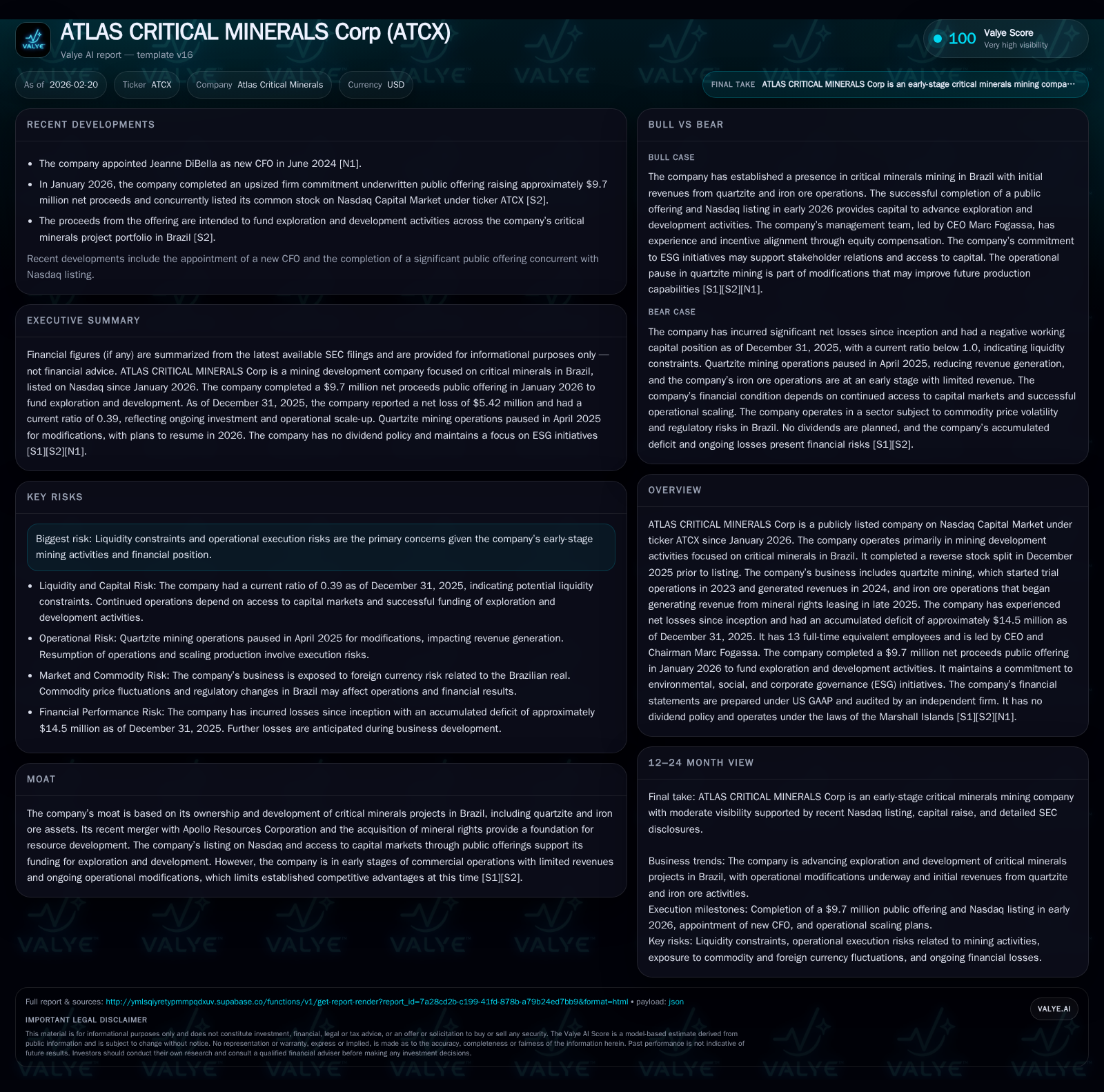
ATLAS CRITICAL MINERALS Corp (ATCX) focuses on developing critical minerals assets in Brazil, including quartzite and iron ore projects. Trial quartzite mining began in 2023 with revenues in 2024, but production paused in April 2025 for operational modifications, severely limiting 2025 revenues. The company recorded a net loss of $5.42 million in 2025, driven by increased administrative costs and negative gross margins during the quartzite production pause. A January 2026 public offering raised $9.7 million to fund exploration and development, addressing near-term liquidity concerns. However, operational execution risks and the early-stage nature of its mining activities constrain growth prospects and profitability in the short term.
Company Overview and Historical Performance
ATLAS CRITICAL MINERALS Corp (Nasdaq: ATCX) transitioned to a publicly listed entity on the Nasdaq Capital Market in January 2026 following a reverse stock split (1-for-12) completed in December 2025 [S1][S2]. The company's core business centers on mining development focused on critical minerals within Brazil, notably quartzite and iron ore assets.
Trial quartzite mining began in mid-2023, progressing into commercial-like operations that generated $748,654 in revenue during fiscal year 2024 with a healthy gross margin of approximately 35.49% ($265,694) [F1][S1]. The quartzite operation produced over 600 cubic meters of blocks and nearly 1,400 square meters of polished slabs in 2024, selling majority volumes but also building some inventory heading into the following year [S1].
However, a significant shift occurred during fiscal year 2025 when ATLAS paused quartzite block and slab production starting April to implement operational modifications aimed at improving process efficiency or capacity. Available data indicates this pause led to limited revenue generation with consequently negative gross margins totaling a loss of $59,431 across quartzite and iron ore segments combined for FY2025 [S1]. The company modestly initiated iron ore operations by leasing mineral rights on the Rio Piracicaba asset late in the year, generating net lease revenues of only $24,693 in December [S1].
The financial impact of these operational disruptions is reflected starkly in key profitability metrics: net losses ballooned to a substantial $5.42 million for FY2025 compared to a more contained net loss of $1.71 million in FY2024—an increase exceeding 216% YOY [F1][S1]. Operating income followed suit with a widening negative margin (-$5.35 million versus -$1.64 million), underscoring degraded core operating results amid higher expense absorption.
Historical performance (annual)
| FY | Net ($mm) | CFO ($mm) | OpInc ($mm) | Capex ($) | Net YoY |
|---|---|---|---|---|---|
| 2025 | -5 | -3 | -5 | 133424 | -216.4% |
| 2024 | -2 | -1 | -2 | 133424 | -59.8% |
| 2023 | -1 | -1 | -1 | -63.0% | |
| 2022 | -1 | -1 | -1 |
Note: Omitted columns lack sufficient annual XBRL coverage in the provided tags (need ≥2 annual points): Rev, Div, Buybacks. Source: SEC companyfacts cache [F1].
Capital returns and efficiency (annual)
| FY | FCF ($mm) | ROE% |
|---|---|---|
| 2025 | -3 | -673.8 |
| 2024 | -1 | -153.0 |
| 2023 | 333.2 | |
| 2022 | -1127.9 |
Source: SEC companyfacts cache [F1]. |*Net cash used indicated as negative values.
Revenues for FY2025 were minimal due to production pause; hence omitted from table where insufficient data exists.
Cost Structure and Expense Dynamics
General & administrative (G&A) expenses escalated considerably by over $2.3 million (+220%) reaching $3.37 million in FY2025 [S1]. This surge was primarily due to an increase of approximately $720K in payroll costs ensuing from workforce expansion linked to the November 2024 Apollo Resources merger integration alongside milestone-based employee bonuses not present previously [S1]. Additionally, third-party service costs jumped by over $1 million correlating with enhanced exploration activity support and investor relations expenditures grew near $300K reflecting elevated equity sales efforts [S1][S20].
Stock-based compensation expenses more than doubled (+126%), reaching roughly $1.92 million as executives received a larger volume of equity instruments with varying vesting timelines based on performance goals [S1]. This sizable non-cash charge weighs heavily on total expenses given the nascent stage of company revenues.
Capital expenditures held steady at around $133K for both years essentially focused on equipment acquisitions and minor land or mineral property investments supporting ongoing development efforts [F1][S12].
Liquidity Position and Capital Raising
ATLAS entered calendar year-end December 31, 2025 with constrained liquidity characterized by current assets totaling around $710K against current liabilities exceeding $1.8 million yielding an unfavorable current ratio ~0.39x [F1][S4]. Notably, significant current liabilities amounting over $1 million relate to payables owed to related party Atlas Lithium underscoring intercompany financial leverage usage to fund operations [S4].
Operating cash flows deteriorated substantially using nearly $3 million versus under $850K cash outflow the previous year signaling intense cash burn reflective of halted revenue streams coupled with heightened operating expenses [F1][S16]. After subtracting capex cash outflows (~$130K), free cash flow remains negative pushing subsequent reliance on external financing.
A pivotal step towards stabilizing liquidity arrived through an upsized public offering executed January 12, 2026 raising approximately net proceeds of $9.7 million after underwriting fees [N2][S2][S9]. The fresh capital injection bolsters ATLAS' balance sheet sufficiently to fund its planned exploration programs and operational restart prospects for at least the coming twelve months according to management guidance [S3][S9].
Future Growth Prospects and Constraints
Looking ahead, the resumption of quartzite mining operations expected during the second half of calendar year 2026 will be critical for ramping up revenue generation given that this segment previously showed promising gross margins above one-third [S1]. Furthermore, expansion of iron ore leasing or direct extraction could provide additional revenue streams if successfully developed.
However, growth is constrained by multiple factors:
- Operational execution risks linked to implementing modifications without further disruptions remain a principal uncertainty.
- The early developmental stage accompanied by limited historic commercial-scale output means scale efficiencies have yet to materialize.
- Dependence on capital markets financing persists given ongoing operating losses and negative free cash flow profile.
- External market factors including commodity price volatility and foreign exchange fluctuations (Brazilian Real vs USD exchange rates saw some variability but close was R$5.50/USD end-2025) may impact realized earnings [S22][F1].
Management’s strategic focus lies primarily on advancing exploration activities supported by new capital while optimizing existing asset utilization post-modification phase completion [N2][S9]. Monitoring quarterly progress updates concerning production restart timelines along with exploration milestones will be essential indicators for business trajectory assessment (analysis).
Capital Allocation & Returns Profile
The company’s historical retained losses culminate in an accumulated deficit near $14.5 million at the end of fiscal year 2025 highlighting ongoing investment burn without profitability achieved yet [S4][F1]. Return on equity approximated at negative ~674% signals severe capital consumption relative to shareholders’ equity base currently standing below $1 million—typical for companies transitioning from development phases.
Dividend distributions are not planned given reinvestment needs into exploration and mine development activities whereas share buyback or repurchase programs are non-existent aligning with capital preservation priorities [S7][S8]. Equity incentives form a prominent component of executive compensation intended to align management performance with corporate milestones though they inflate non-cash expense lines.
Moat Analysis & Industry Context
ATLAS CRITICAL MINERALS Corp’s competitive moat originates principally from its strategic ownership of critical mineral deposits within mineral-rich Brazilian terrains coupled with expanded resource base following its merger with Apollo Resources Corporation completed late-2024 providing scale and project diversification benefits [S10][S23]. However, the nascent commercialization stage limits operational advantages normally afforded by established producers such as pricing power or economies of scale.
Critical minerals like quartzite have specialized uses across construction materials markets while iron ore remains fundamental globally; nevertheless these sectors often operate under tight commodity price cycles impacting small producers’ margins unless they secure favorable off-take agreements or niche product positioning (analysis).
Summary and Outlook Considerations
In summary:
- ATLAS is still finding its footing operationally after moving out of trial-phase mining toward full-scale commercial production.
- Revenue volatility reflects temporary halts and adjustments required for sustainable output improvements.
- Elevated administrative costs reflect growing corporate infrastructure necessary for public listing compliance alongside integration efforts.
- Recently raised capital provides near-term runway though further funding rounds may become necessary absent positive cash flow conversion.
- Stakeholders should observe management’s ability to recommence quartzite operations effectively during H2-26 plus signs of incremental growth from iron ore ventures as key success indicators (analysis).
This company exemplifies many typical hurdles faced by junior critical minerals developers attempting transition into commercial producers amid complex regulatory environments and capital-intensive operating models.
Disclaimer: This analysis is based solely on publicly available filings as of February 20, 2026; it does not constitute investment advice or recommendations.
Disclaimer: This is research-only, informational analysis and not investment advice. It may include AI-generated interpretation and general industry context. Always verify important details using primary sources.

Comments