
Dominion Energy's Earnings Rebound Reflects Strategic Wins and Regulatory Challenges
Dominion Energy achieved a robust earnings recovery in FY2025, driven by regulatory rate growth and infrastructure investments, while facing regulatory and liquidity risks.
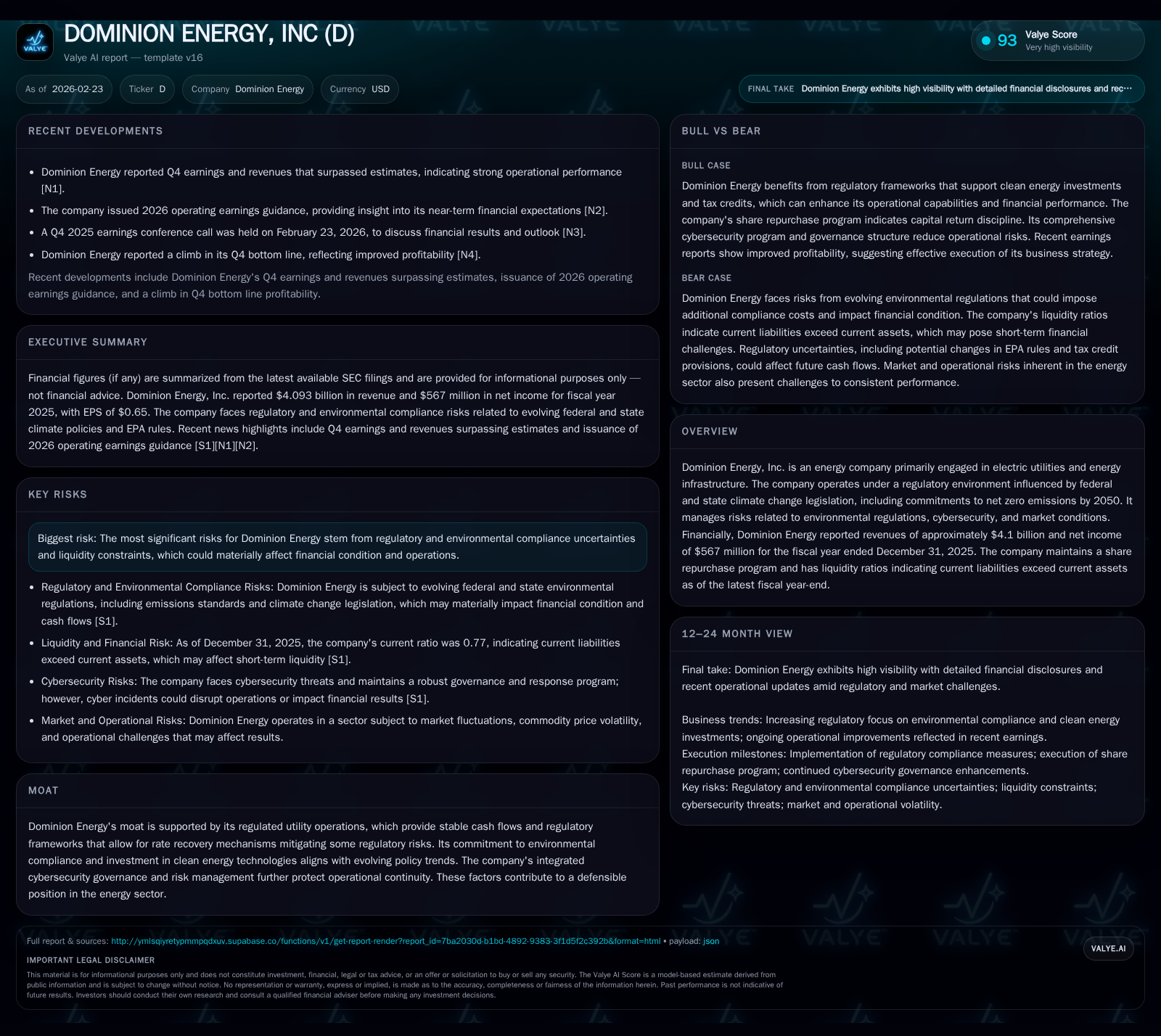
In the fiscal year ended 2025, Dominion Energy saw significant financial improvements, including a 20.4% revenue increase and nearly doubling operating income. These gains stem from its well-defended regulated utility operations benefiting from rate base growth and targeted clean energy investments aligned with evolving environmental policies. Nevertheless, liquidity constraints and regulatory uncertainties — especially around EPA emissions standards and climate legislation shifts — remain key challenges. The company’s capital allocation balances shareholder returns through steady dividends and opportunistic share buybacks within a constrained liquidity profile.
Strong Turnaround: FY2025 Performance Highlights
Dominion Energy reported a striking rebound in its fiscal 2025 results with revenue climbing to approximately $4.09 billion, marking a 20.4% increase over the prior year's $3.4 billion figure [F1]. Operating income more than doubled, increasing by 93.4% from $391 million in FY2024 to $756 million in FY2025, illustrating operational leverage driven primarily by regulatory rate recoveries and improved asset utilization. Net income experienced an even sharper rise of 291%, reaching $567 million versus $145 million in the previous year, showcasing the benefits of cost discipline and favorable regulatory treatment [F1]. This sequence of earnings growth underscores Dominion's ability to capitalize on its regulated utility model amidst a complex external environment.
Historical performance (annual)
| FY | Rev ($bn) | Net ($mm) | CFO ($bn) | OpInc ($mm) | Rev YoY | Net YoY |
|---|---|---|---|---|---|---|
| 2025 | 4.1 | 567 | 5.4 | 756 | +20.4% | +291.0% |
| 2024 | 3.4 | 145 | 5.0 | 391 | -3.8% | -46.9% |
| 2023 | 3.5 | 273 | 6.6 | 712 | -79.4% | -72.5% |
| 2022 | 17.2 | 994 | 3.7 | 1596 |
Note: Omitted columns lack sufficient annual XBRL coverage in the provided tags (need ≥2 annual points): Capex, Buybacks, FCF. Source: SEC companyfacts cache [F1].
Capital returns and efficiency (annual)
| FY | Div ($bn) | ROE% |
|---|---|---|
| 2025 | 2.3 | 1.9 |
| 2024 | 2.2 | 0.5 |
| 2023 | 2.2 | 1.0 |
| 2022 | 2.2 | 3.6 |
Source: SEC companyfacts cache [F1].
Note: Capex data insufficient for recent years; Buyback data not presented due to absence after FY2020 from provided tags.
Revenue and Profit Drivers Behind the Rebound
The rebound stemmed chiefly from Dominion’s ability to grow its rate base underpinned by robust regulatory rate recovery frameworks prevalent in its service territories, notably Virginia where the Virginia Clean Economy Act (VCEA) sets clear long-term emissions reduction mandates [N3][S1][S5]. This allowed the company to invest strategically in infrastructure upgrades and clean-energy projects such as offshore wind initiatives that not only meet policy objectives but also strengthen regulated asset value.
Cost controls further enhanced profitability; while capital expenditures increased modestly reflecting expansion in renewables and grid modernization efforts, efficiencies lowered ongoing operating costs relative to revenues yielding higher operating margins [N3][S1]. The company’s integrated approach fostering incremental rate adjustments directly tied to investment outlays mitigates traditional utility earnings volatility.
Environmental Regulations Shaping Operational Strategy
Dominion operates within an evolving regulatory landscape shaped by federal rollbacks juxtaposed against stringent state-level climate policies [S10][S9]. The VCEA mandates near-term emissions reductions aligning with Dominion’s net zero goal by 2050, spurring investments into renewable assets like offshore wind despite interim cost pressures.
At the federal level, the U.S.’s withdrawal from the Paris Agreement in January 2026 introduces policy uncertainty; concurrently, EPA’s recent moves to repeal or relax prior stringent CO₂ emission rules impact Dominion’s compliance requirements [S1][S9]. The company must balance adapting to these shifts while anticipating potential reinstatements or new regulations that could trigger capital spending upticks or operating cost increases.
More near-term regulatory developments relate to methane fees under the Inflation Reduction Act (IRA), PFAS exposure mitigation rules, and tightened air quality standards—all potentially elevating compliance costs even as some new tax credits for clean energy investments phase out post-2027 [S10][S16]. However, Dominion benefits from regulatory mechanisms allowing rate recovery of such expenditures which cushions financial impact.
Growth Outlook: Opportunities Tempered by Constraints
Looking ahead, Dominion Energy’s future revenue growth prospects rest on continued expansion of its regulated asset base supported by state approvals for clean energy projects including offshore wind farms like Coastal Virginia Offshore Wind (CVOW), whose completion timelines have recently extended into early 2027 accompanied by revised cost estimates near $11.5 billion due to temporary work suspensions and tariff pressures [N10][S29].
Regulatory rates underpinning return on equity encourage sustained investment though liquidity constraints highlighted by a current ratio of only ~0.77 at fiscal year-end spotlight working capital pressures wherein current liabilities outpace current assets—a structural challenge for capital-intensive utilities requiring careful cash flow management [F1][S25].
Company guidance anticipates modest topline growth coupled with stable or improving earnings as infrastructure projects come online; however, ongoing uncertainties regarding federal environmental policy changes and emerging litigation could cap upside near term [N4][N10]. Sequential quarterly monitoring of incremental earnings contributions from completed assets alongside regulatory developments remains critical.
Managing Risks: Cybersecurity and Regulatory Vigilance
Dominion employs an advanced converged security model merging cybersecurity with physical security under leadership including a former FBI veteran Chief Security Officer complemented by a seasoned CISO with over three decades at the firm overseeing IT risk management [S8][S14]. This governance framework ensures continuous monitoring, sophisticated incident response planning, annual multi-agency exercises simulating cyberattack scenarios, and frequent board-level risk updates.
Such rigorous cyber risk oversight is crucial given utilities’ growing exposure to sophisticated threats potentially disrupting grid reliability or data integrity [S7][S8]. Simultaneously, portfolio risk stemming from changing environmental regulations demands strong legal and compliance capabilities especially related to pending EPA emissions standards, methane reporting rules under IRA mandates, and PFAS regulations still evolving in scope [S9][S10].
These dual layers of risk surveillance illustrate Dominion’s proactive approach guarding operational continuity while adhering to complex external mandates.
Capital Allocation: Dividends, Buybacks, and Liquidity Position
Dominion sustains an attractive shareholder yield profile paying dividends of approximately $2.28 billion annually consistent over recent years with slight incremental increases reaffirming commitment despite volatile conditions [F1][S11]. While active share repurchases remained significant through early last decade (~$3 billion across multiple years up to FY2020), recent repurchases are minimal; at end-2025 roughly $920 million remained available under an open-ended $1 billion repurchase authorization initiated in November 2020 without fixed volume or pricing targets allowing opportunistic buybacks subject to market conditions [S4][S11].
Liquidity analysis reveals that despite robust operating cash flow generation ($5.36 billion in FY2025), higher short-term liabilities relative to assets create working capital strain demanding judicious capital deployment prioritizing dividend stability while preserving flexibility for strategic investments or debt servicing needs [F1][S25]. Financial policy likely emphasizes conservative leverage ratios given sector norms balancing growth funding against credit metrics.
Key Financial Ratios and Cash Flow Analysis
Operating cash flow reached $5.36 billion in FY2025 reflecting solid cash conversion even amid elevated capex ramping related primarily to renewables deployment; estimating free cash flow after capex yields roughly $381 million positive balance suggesting positive but narrowly balanced internal funding capacity excluding financing activities [F1].
ROE measured at about 1.9%, relatively low compared with unregulated industries but typical for regulated utilities where stable earnings base compensates for lower return metrics given quasi-monopolistic status secured through regulatory mechanisms ensuring authorized returns on capital investments.
Current ratio of approximately 0.77 (current assets ~$8.07 billion vs current liabilities ~$10.44 billion) flags working capital tightness particular to capital intensive sectors where substantial payables or near-term maturities can compress liquidity buffers necessitating cautious short-term financial management [F1].
Insights from the Latest Earnings Call and Guidance
Management commentary during Q4 FY2025 earnings calls emphasized confidence in maintaining momentum via steady project execution particularly around major renewables assets while acknowledging regulatory risks linked to potential EPA rule changes that could recalibrate compliance costs or project scope over time [N1][N4].
Investor discussions highlighted expectations for moderate revenue growth continuity supported by emerging offshore developments notwithstanding general macroeconomic uncertainty affecting cost structures such as inflation-driven tariff impacts [N12][N10]. Capital discipline remains core message with emphasis on maintaining dividend resilience alongside calibrated share repurchase activity within existing liquidity parameters.
What to Monitor: Upcoming Milestones and Market Triggers
Key near-term catalysts include progress updates on the CVOW project following court injunctions allowing resumption after suspension orders; changes in total estimated costs influenced by tariff adjustments remain consequential for overall project economics impacting future rate base growth trajectories [N13][S28][S29].
Regulatory developments surrounding EPA emission standards reforms—especially those affecting fossil fuel-fired generating units—and Federal climate policy re-engagement will be imperative variables shaping Dominion’s operational strategy consistency going forward.
Share repurchase activity adjustments reflecting opportunistic buy levels amid market volatility plus any dividend policy shifts tied to liquidity dynamics warrant close attention from stakeholders gauging capital return sustainability.
This analysis is intended solely for informational purposes without providing investment advice or recommendations regarding Dominion Energy securities or related financial instruments.
Disclaimer: This is research-only, informational analysis and not investment advice. It may include AI-generated interpretation and general industry context. Always verify important details using primary sources.

Comments