
LiveWire Group Faces Early-Stage Profitability Tradeoffs Amid Product Expansion and Capital Constraints
LiveWire Group is progressing in electric motorcycles and balance bikes while balancing losses, liquidity needs, and partnership dependencies.
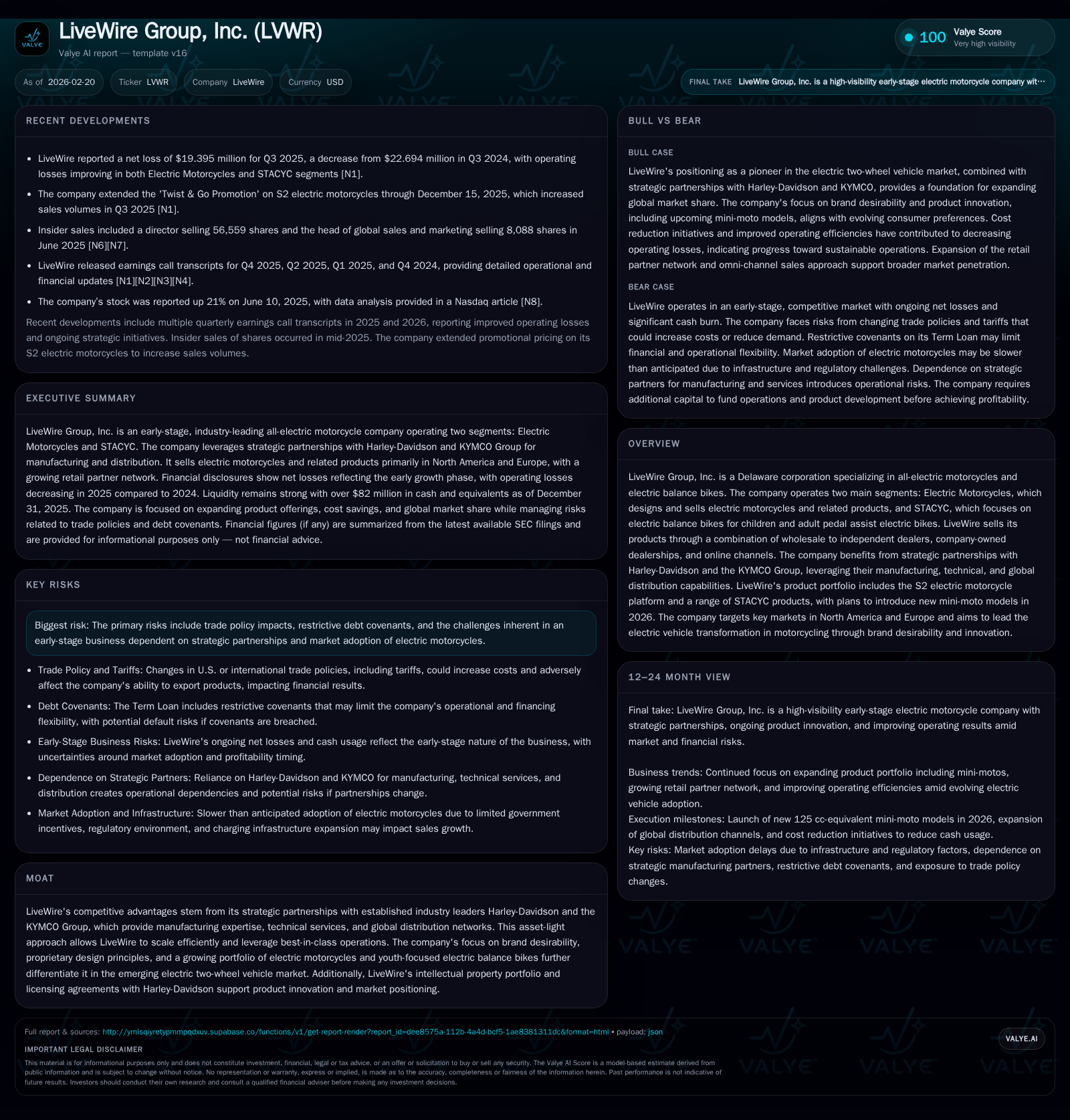
LiveWire Group, since its 2022 spin-off from Harley-Davidson, operates two main segments: electric motorcycles and electric balance bikes under the STACYC brand. Despite continued operating losses improving year over year, the company remains in an early funding phase and depends on strategic manufacturing partnerships with Harley-Davidson and KYMCO. Growth catalysts include new product launches scheduled for 2026 and expanded distribution via dealer networks. However, trade policy risks, debt covenants, and slower-than-anticipated electric vehicle adoption cap growth. Liquidity has improved with a $75 million term loan drawn in late 2025, but ongoing capital raises remain necessary to bridge to profitability.
Company Overview and Business Model
LiveWire Group, Inc., transitioned into a standalone public entity following its business combination separation from Harley-Davidson (H-D) in September 2022 [S1]. The company focuses on all-electric two-wheel vehicles through two distinct reportable segments: Electric Motorcycles, which markets the S2 platform motorcycles along with accessories and apparel mainly in the U.S. and select international territories; and STACYC, which designs and sells electric balance bikes for children as well as adult pedal assist electric bicycles launched in March 2025 [S1][S2][S12].
The commercial model for Electric Motorcycles entails wholesale distribution to independent dealers, operation of a company-owned retail dealership, plus direct online sales. STACYC products primarily move via wholesale channels to independent dealers or distributors, alongside direct-to-consumer online sales [S1][S2][S27]. The shift away from direct international retail sales toward wholesale channels occurred effective November 5, 2024 [S12].
LiveWire leverages key strategic partnerships with Harley-Davidson for manufacturing expertise, technology sharing, and cybersecurity oversight; and with the KYMCO Group providing technical services and global distribution reach , allowing an asset-light approach to production scalability.
Historical Performance Drivers
Post-separation financials illustrate an early-stage growth trajectory. Operating income losses improved meaningfully from -$110.4 million in FY24 to -$75.5 million in FY25 (31.6% improvement) while net loss narrowed from -$93.9 million to -$75.1 million (20% improvement) [F1]. This reflects the deployed "Twist & Go Promotion" during Q3-Q4 2025 offering pricing incentives on S2 motorcycles that helped increase unit volumes [S1][N1].
Operating losses at the segment level decreased notably: Electric Motorcycles' operating loss reduced from -$105.5 million (FY24) to -$73.8 million (FY25), while STACYC's operating loss more than halved to approximately -$1.7 million [S1]. These gains are aligned with scaling efficiencies, tighter cost management, inventory reductions (including reimbursement obligations related to excess inventory components held by H-D totaling ~$6 million) [S19], and elimination of prior capital spending bursts associated with models like Mulholland/Alpinista seen in FY24 [F1][S11].
Cash flow dynamics followed suit: net cash used by operations declined approximately 43% YoY to -$53.5 million; capital expenditures more than halved to around $3.8 million reflecting moderation after prior heavy R&D spend [F1]. Financing cash flows provided $75.7 million primarily through the drawdown of a newly amended $75 million Delayed Draw Term Loan facility from Harley-Davidson signed in late 2025 featuring a floating interest rate around ~7.6%, with borrowing secured against nearly all assets under restrictive covenants limiting dividends, new indebtedness, liens and asset sales [S16][S7].
The company’s liquidity position improved materially going into 2026 with cash plus equivalents totaling approximately $82.8 million on December 31, 2025 combined with access to an ATM equity issuance program enabling up to $50 million gross proceeds — though actual proceeds raised in FY25 were modest at about $2.2 million [F1][S5]. The current ratio at year-end stood robustly above four times current liabilities indicating short-term solvency cushion [F1].
Below is a summary table highlighting key consolidated financial metrics:
Historical performance (annual)
| FY | Net ($mm) | CFO ($mm) | OpInc ($mm) | Capex ($mm) | Net YoY |
|---|---|---|---|---|---|
| 2025 | -75 | -54 | -75 | 4 | +20.0% |
| 2024 | -94 | -94 | -110 | 8 | +14.3% |
| 2023 | -110 | -83 | -116 | 13 | -388.2% |
| 2022 | -22 | -90 | -85 | 14 |
Note: Omitted columns lack sufficient annual XBRL coverage in the provided tags (need ≥2 annual points): Rev, Div. Source: SEC companyfacts cache [F1].
Capital returns and efficiency (annual)
| FY | Buybacks ($) | FCF ($mm) | ROE% |
|---|---|---|---|
| 2025 | 1024000 | -57 | -163.2 |
| 2024 | 1444000 | -102 | -81.6 |
| 2023 | 1969000 | -97 | -53.2 |
| 2022 | -104 | -7.3 |
Source: SEC companyfacts cache [F1].
N/A columns omitted where data insufficient Sources: [F1]
Growth Prospects
LiveWire’s strategic growth hinges on several factors:
Product Expansion: Introduction planned for spring 2026 of two new mini-moto models branded as S4 Honcho TM designed for affordability expansion globally indicates broadening of addressable market beyond premium segments targeting younger or entry-level riders [S1].
Segment Diversification: Launch of adult pedal assist electric bicycles expanding the STACYC segment product range since March 2025 may tap rising urban micromobility trends [S1][N3].
Distribution Network Growth: Retail partner counts increased internationally post-November-2024 transition to wholesale strategy with independent retail partners growing from 88 at end-2024 to 96 at end-2025; STACYC partners remain high at over 2,000 despite slight decline largely due to model transition in Canada distributor restructure [S21]. Expansion here supports volume throughput critical for economies of scale.
Brand Leverage & Intellectual Property: LiveWire benefits substantially from Harley-Davidson’s brand heritage while maintaining own IP portfolio including dozens of utility patents spanning design innovation potentially protecting competitive features until early-mid-2040s permits sustained differentiation [S12].
Key challenges potentially capping growth:
Market Adoption Timing: Company commentary cites slower-than-anticipated EV adoption curves especially given limited governmental incentives and slower charging infrastructure rollout constraining potential customer conversion rates towards electric motorcycles compared with internal models formulated years earlier [S2].
Trade & Tariff Risks: Escalating tariffs between US-China among others impose input cost pressures particularly steel/lithium batteries raising component costs or forcing price increases that could dampen demand if not absorbed internally amid competitive pricing pressures [S9][S17].
Operational Dependencies: Heavy reliance on contract manufacturing agreements with H-D means minimum purchase commitments can trigger significant penalty payments risking margin exposure if volumes undershoot target levels starting calendar year 2027 onward [S19]. Also ongoing restrictive covenants embedded within term loans impose operational flexibility constraints potentially hindering opportunistic CAPEX or acquisitions.
What To Watch / Milestones Ahead (Analysis)
There is no explicit official guidance disclosed yet beyond qualitative emphasis on cost savings initiatives aimed at reducing cash burn coupled with new product rollouts including S4 Honcho mini-motos expected spring ‘26 [N1][S1]. Key operational milestones will include:
- Execution success on the S4 mini-moto launch,
- Progression towards sustained reduction in operating losses,
- Expansion pace of dealer network domestically and internationally,
- Effect of tariff environment changes on pricing strategies or input expenses,
- Ability to generate positive operating cash flow or substantially reduce cash burn,
- Further capital raises under ATM program or alternate funding sources.
Monitoring quarterly earnings comments plus dealer sales metric trends will be critical proxy inputs before formal guidance emerges.
Returns & Capital Allocation Review
ROE stands deeply negative at approximately -163%, reflecting sustained net losses exceeding diminished equity base post significant write-downs amid continued investment phase without profit realization so far [F1]. The equity base declined sharply from $115 million at FY24-end down below $46 million at FY25-end possibly due to accumulated net losses outpacing any capital raises.
Cash flow analysis confirms that LiveWire remains a net consumer of capital as it invests strategically ahead of scale efficiencies coming online: CFO negative by approximately $53 million while CAPEX stays modest around $3–4 million indicating disciplined spend but no free cash flow generation yet (approximate FCF negative near $57M) [F1].
Dividends have not been declared nor paid reflective of typical early-stage company profile prioritizing reinvestment over shareholder distributions.
Repurchase activity is minimal (~$1 million annually) primarily related to satisfying employee tax withholding obligations upon restricted stock vesting rather than opportunistic buybacks signaling management focus remains on preserving liquidity rather than recouping equity value.
The capital raise strategy relies heavily on equity issuance through available ATM programs capped at $50M authorized but only marginal proceeds raised so far [$2+ M actual] plus reliance on debt financing via term loan facilities provided by Harley-Davidson thus creating notable leverage although currently manageable based on compliance with covenants as of fiscal year-end period close [F1][S16].
Industry Context & Sector Nuances (Analysis)
Electric motorcycle adoption lags behind passenger EV penetration due partly to higher price sensitivity within discretionary vehicle segments as well as infrastructure gaps particular to two-wheel charging ecosystems which remain less standardized globally compared to cars. LiveWire's dual focus encompassing youth-oriented STACYC products opens exposure into near-term mass market potential owing to simpler mechanics but margins differ widely compared to full-sized motorcycles requiring careful product mix management. Manufacturing outsourcing while preserving design ownership is common among emerging EV two-wheeler brands as it accelerates time-to-market but also transfers supply chain risk management responsibilities back onto brand owners who must navigate component scarcity risks affecting battery packs or semiconductor shortages frequently observed across broader powersports industries. Trends towards modular design platforms supporting OTA firmware updates—as LiveWire offers over five-year update periods—are advantageous differentiators supporting long-term customer retention but require robust cybersecurity governance frameworks increasingly influenced by data privacy regulations across US/EU jurisdictions—a complexity LiveWire handles courtesy H-D’s CISO leadership as per filings [S17]-.
Conclusion & Forward View Summary
LiveWire Group finds itself navigating foundational growth phases characterized by material losses improving steadily under pragmatic cost control coupled with promising product innovation pipelines set for launches this calendar year particularly aimed at scaling affordability through mini-motos. Strategic alliances undergird operational capabilities yet constrain flexibility amid debt-related covenants requiring vigilant liquidity monitoring given ongoing burn rates. Trade policy turbulence introduces uncertainty necessitating further resilience planning around supply chain diversification. Continued transparency through quarterly disclosures around sales momentum especially from new model introductions combined with capital raise developments will be pivotal indicators shaping future valuation outlooks. Investors tracking LiveWire should weigh steady progress against persistent early-stage execution risks alongside evolving external macro variables impacting EV ecosystem maturation timelines.
This analysis is intended solely for informational purposes based on publicly available filings without offering investment advice or recommendations regarding LiveWire Group securities.
Disclaimer: This is research-only, informational analysis and not investment advice. It may include AI-generated interpretation and general industry context. Always verify important details using primary sources.

Comments