
Micromem Technologies Pursues Sensor Innovation Despite Financial Hurdles
The company advances proprietary Hall and nanowire sensor platforms through strategic partnerships while navigating persistent liquidity constraints.
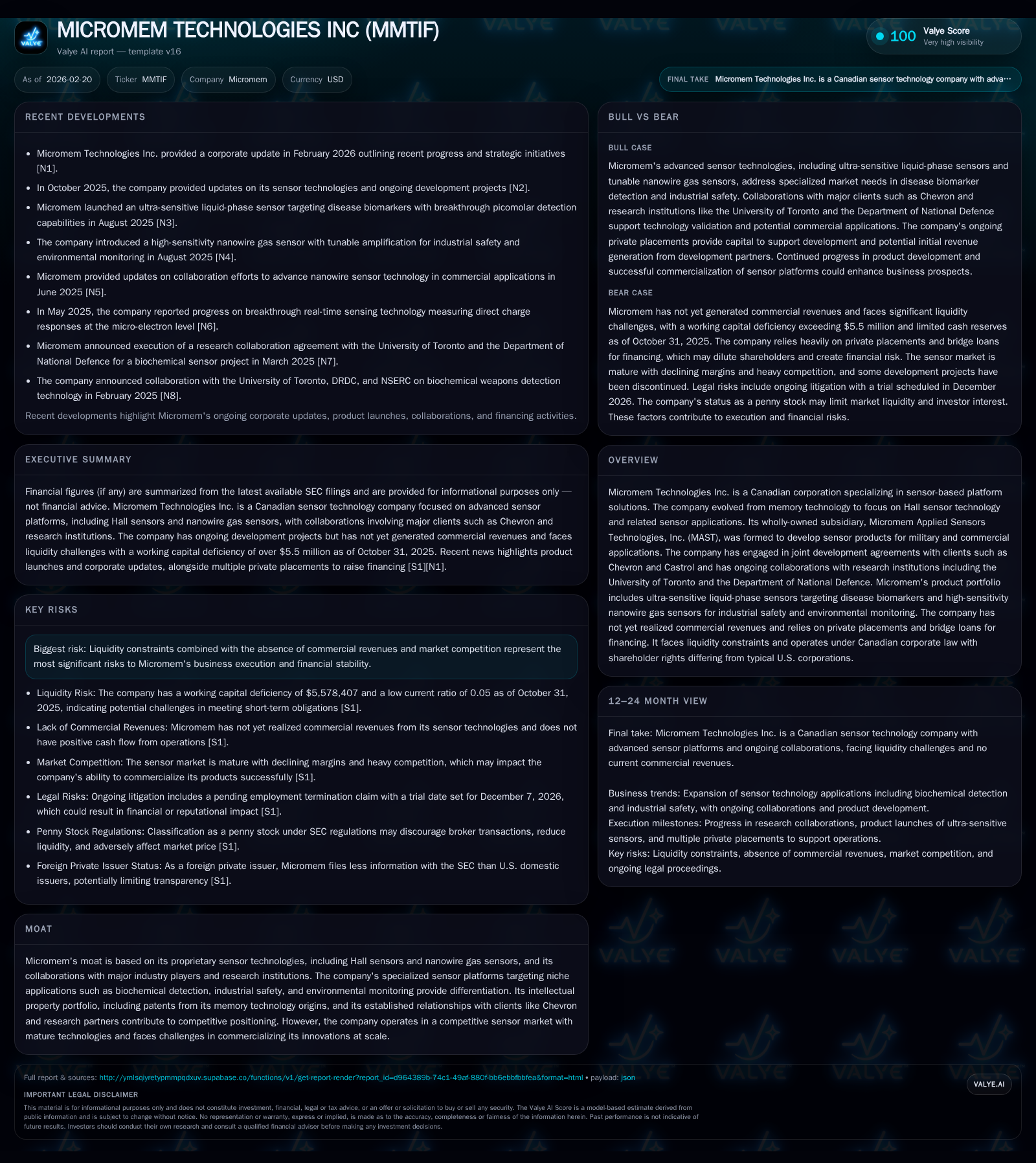
Micromem Technologies Inc., a Canadian innovator transitioning from MRAM memory technology to specialized sensor solutions, develops advanced Hall effect and nanowire gas sensors targeting niche industrial, biochemical, and defense applications. Despite building proprietary technology moats and collaborating with key industry players such as Chevron and BAE Systems, the company faces ongoing liquidity challenges, with a working capital deficiency exceeding $5.5 million as of fiscal 2025 and no commercial revenues realized yet. Recent private placements have extended runway into 2026, but capital allocation remains focused on R&D without dividends or buybacks. Future growth depends heavily on successful commercialization milestones and further financing.
Micromem's Origins and Transition from Memory to Sensor Platforms
Founded originally as Mine Lake Minerals Inc. in 1985 and evolving through various corporate identities before becoming Micromem Technologies Inc., the company’s strategic pivot focused sharply on sensor innovations beginning in the late 2000s. Its wholly-owned Delaware subsidiary, Micromem Applied Sensors Technologies (MAST), was established in 2008 in response to a contract with BAE Systems aimed at adapting MRAM technology for radiation-hardened military applications compliant with ITAR regulations [S22].
During this collaboration, it became evident that the embedded Hall sensor technology integral to MRAM designs possessed standalone value due to unique performance characteristics. Market analyses by Frost & Sullivan in 2009 revealed the Hall sensor market was robust but mature ($1.9B), highly competitive with declining margins—prompting Micromem's decision not to enter the commoditized component space directly but rather pursue differentiated sensor applications uniquely leveraging its patented technology [S22]. Consequently, internal proof-of-concept developments focused on products like magnetic gold sensors for oil drilling plug analysis and ultrahigh sensitivity liquid-phase chemical sensors.
Technological Differentiation: Hall Sensors and Nanowire Gas Sensors
Micromem’s core technological moat rests upon proprietary implementations of Hall effect sensors combined with novel ultra-sensitive nanowire gas sensors. These platforms target niche verticals where precision detection at trace levels offers competitive advantage — e.g., biochemical marker identification for disease diagnostics or industrial safety applications involving airborne contaminants measured at parts-per-billion levels [S22].
Patent portfolios inherited from memory technology origins underpin these innovations. The Hall sensor’s capability in environments requiring radiation hardness suits defense industry needs well—leveraging partnerships with BAE Systems and Canada's Department of National Defence—with concurrent commercial pursuits including collaborations with energy companies Chevron and Castrol [S22]. Technical sophistication includes magnetic gold sensing tailored to geological drilling efficiencies as well as unique circuit board form factors that embed miniature Hall sensors strategically.
Historical Financial Performance and Operating Expenses Trends
Micromem has yet to record commercial revenues from its sensor innovations. Financial statements reveal ongoing net losses driven primarily by steadily increasing operating expenses reflecting the R&D-intensive nature of its business model [F1][S1].
Historical performance (annual)
| FY |
|---|
| 2025 |
| 2024 |
| 2023 |
| 2022 |
Note: Omitted columns lack sufficient annual XBRL coverage in the provided tags (need ≥2 annual points): Rev, Net, CFO, OpInc, Capex, Div, Buybacks, FCF, ROE%. Source: SEC companyfacts cache [F1].
Note: Revenue figures are not available from provided tags; expenses reflect increased legal/audit fees and travel correlating with expanded development efforts.
Professional fees nearly doubled in FY2025 compared to FY2024 driven by legal costs ($261K), consulting fees ($83K), alongside higher salaries including CEO compensation increases. Interest expenses remain substantial due to financing via convertible debentures contributing materially to annual losses [F1][S1].
Collaborations and Intellectual Property Strengths
Micromem’s collaborative ecosystem validates its technology platforms despite commercialization challenges. Its client roster includes energy majors Chevron and Castrol (though some projects discontinued), academic partnerships with University of Toronto invigorate applied R&D programs. Defense ties maintained under ITAR rules enable work with BAE Systems and Canada's Department of National Defence focused on radiation-hardened environments suited for military-grade sensors [S22].
These relationships provide technical validation and access channels for future sales proposals via NineSigma’s open innovation platform which exposes Micromem technologies to Global Fortune 1000 companies seeking innovative sensing solutions. The intellectual property portfolio derived from legacy memory patents fortifies barriers against new entrants pursuing identical sensing modalities.
Liquidity Status and Recent Capital Raises
Liquidity constraints are significant. At October 31, 2025 the company had a working capital deficiency of approximately $5.58 million against cash reserves around $250K—a current ratio near 0.05—signaling constrained short-term liquidity [F1].
Recent private placements closed early in calendar year 2026 raised roughly $300K combined with ~$80K bridge loans extending runway into near term operations [N2][N3][S28][S29]. Liabilities remain elevated largely comprised of convertible debentures payable within one year.
The absence of credit lines reinforces dependence on equity injections for survival while highlighting material financial risk if anticipated commercialization events do not occur promptly.
Market Opportunity Size and Commercialization Challenges
Initial market studies pegged the Hall sensor market at nearly $2 billion in 2009; since then it has matured under intense competition with thinning margins [S22]. This environment compels Micromem toward targeting specialized sensing solutions emphasizing ultra-high sensitivity or robustness in harsh conditions rather than competing solely on raw sensor sales volume.
Target niches include biochemical detection platforms attuned for disease biomarkers identifiable at trace quantities requiring micro- or nano-scale resolution beyond standard industrial sensors—as well as environmental monitoring applications where ppm-to-ppb level gas detection is essential for safety compliance.
Barriers include unproven commercial scale production capabilities; export control regulations such as ITAR limiting international sales; lengthy qualification cycles typical in defense contracting delaying revenue realization; deployment cost considerations versus incumbent alternatives limiting rapid adoption despite performance advantages.
Growth Prospects Amid Industry Competition and Technological Barriers
Currently generating no commercial revenues; growth depends on achieving milestone-driven progress embedded within existing joint development agreements facilitated via NineSigma’s platform connecting blue-chip corporations seeking innovative sensing technologies [N1][S22].
Competition includes dominant suppliers offering mature Hall effect sensors integrated into broad portfolios plus emerging nanosensor startups deploying novel materials science advances potentially eclipsing current implementations.
Regulatory complexities such as ITAR impose export controls restricting customer base primarily domestic or allied nations thus constraining rapid global expansion.
While cautious optimism exists due to technological promise and strategic engagements, meaningful revenue ramp-up may require multiple years contingent upon validation success coupled with sufficient capital amidst uncertain macroeconomic conditions affecting fundraising.
Capital Allocation Focused on R&D Without Returns or Buybacks
Capital deployment centers predominantly on sustaining research pipelines alongside administrative overheads with no dividends declared historically nor planned given ongoing net losses [F1][S25]. No share repurchase activity reported.
Equity remains deeply negative though slightly improved from -$6.72M in FY24 to -$5.60M in FY25 indicating persistent erosion yet some stabilization possibly aided by recent financings [F1]. Return metrics like ROE are unavailable due to recurring net losses.
All research & development expenses have been fully expensed per IFRS guidelines without capitalization—indicating operating leverage tightly linked to R&D spend without amortization benefits impacting EBITDA.
Convertible debt instruments generate significant interest expense (~$614K FY25), materially contributing to loss levels approximately one-third the scale of professional fees.
Key Milestones Ahead for Investors to Monitor
- Anticipated initial commercialization revenues from development partners within fiscal year ending October 31, 2026 per management guidance suggest nascent sales may soon be reported [N1]
- Progression or awards on defense-related contracts managed via MAST especially those subject to ITAR compliance provide critical validation benchmarks potentially unlocking licensing revenue streams
- Additional equity raises or bridge financings likely required given limited cash runway unless operational break-even approaches within next two years
- Advancement through global Fortune1000 client proposals supported by NineSigma may reveal scalable product-market fit opportunities
- Ongoing monitoring of litigation outcomes related to prior legal actions ensures contingent liabilities remain controlled preserving financial stability [N2][N3]
While promising technologies form core operations foundation, sustainable commercialization remains paramount for Micromem Technologies’ transition from developmental entity toward monetizing smart sensor solutions either through manufacturing or licensing.
This analysis relies exclusively on publicly available documents including SEC filings (20-F/6-K), recent press releases from Nasdaq newswire sources, company disclosures and third-party industry commentary without extrapolating undocumented facts or issuing investment recommendations.
Disclaimer: This is research-only, informational analysis and not investment advice. It may include AI-generated interpretation and general industry context. Always verify important details using primary sources.

Comments