
LyondellBasell Battles Profitability Pressures Amid Oversupply and Impairments in 2025
The global chemical giant faced significant revenue decline and net losses due to market oversupply and asset impairments.
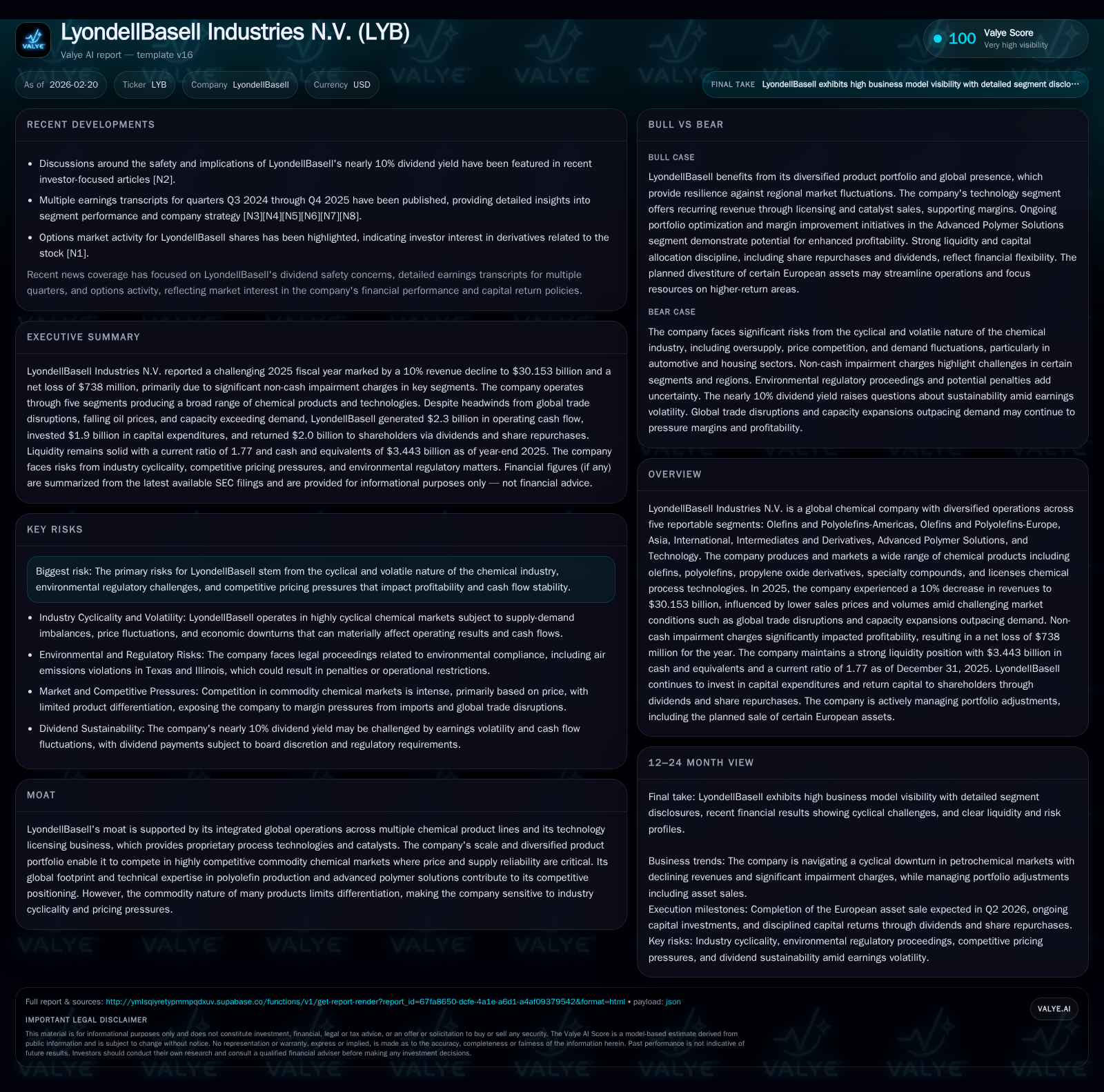
LyondellBasell Industries N.V. experienced a notable downturn in financial performance in 2025, marked by a 25% revenue decline to $30.15 billion and a net loss driven by non-cash impairments amid challenging commodity chemical markets. Oversupply, pricing pressure, and volume declines weighed heavily on results despite a strong liquidity position with over $3.4 billion cash on hand. The company is focused on cash improvement initiatives, capital discipline, and sustainability targets while navigating cyclical industry dynamics and regulatory risks. Future growth hinges on balancing capacity utilization, managing environmental investments, and maintaining competitiveness through technology licensing and advanced polymer solutions.
Historical Performance Overview
LyondellBasell’s earnings trajectory over recent years illustrates the volatility characteristic of the global chemical industry. Revenues declined sharply by approximately 25% year-over-year from roughly $40.3 billion in FY2024 to $30.15 billion in FY2025 [F1], driven primarily by subdued product prices and volume reductions during global oversupply particularly in olefins and polyolefins markets [N9]. This downturn reflected a reversal from more favorable conditions seen through 2022-2023.
Operating income deteriorated sharply from a positive $1.82 billion in FY2024 to an operating loss of $420 million in FY2025 [F1]. This swing was exacerbated by significant non-cash impairment charges related to goodwill and other asset write-downs tied to underperforming units during challenging market dynamics [N9]. The resultant net loss contrasts with the last positive full-year net income figure reported ($3.4 billion in FY2019) indicating an extreme cycle trough for the company’s earnings profile.
Cash flow generation also contracted markedly; operating cash flow dropped circa 41% year-over-year to about $2.26 billion in FY2025 while capital expenditures remained steady at nearly $1.88 billion as LyondellBasell prioritized maintenance capex alongside selective investments toward strategic projects such as advanced recycling technologies [F1][S6]. The resulting free cash flow remained positive but compressed at roughly $384 million.
Historical performance (annual)
| FY | Rev ($bn) | CFO ($bn) | OpInc ($bn) | Capex ($mm) | Rev YoY |
|---|---|---|---|---|---|
| 2025 | 30.2 | 2.3 | -0.4 | 1878 | -25.2% |
| 2024 | 40.3 | 3.8 | 1.8 | 1839 | -2.0% |
| 2023 | 41.1 | 4.9 | 3.1 | 1531 | -18.5% |
| 2022 | 50.5 | 6.1 | 5.1 | 1890 |
Note: Omitted columns lack sufficient annual XBRL coverage in the provided tags (need ≥2 annual points): Net, ROE%. Source: SEC companyfacts cache [F1].
Capital returns and efficiency (annual)
| FY | Div ($bn) | Buybacks ($mm) | FCF ($bn) |
|---|---|---|---|
| 2025 | 1.8 | 201 | 0.4 |
| 2024 | 1.7 | 195 | 2.0 |
| 2023 | 1.6 | 211 | 3.4 |
| 2022 | 3.2 | 420 | 4.2 |
Source: SEC companyfacts cache [F1].
Note: Net income figures for recent years unavailable except for historical peak years; latest net loss data from narrative.
Return on equity approximates at a healthy 33% based on trailing net income peaks relative to equity base ($10B equity FY2025), though absent positive recent net income data this metric is not meaningful currently [F1].
Business Segments & Operational Footprint
LyondellBasell operates through five key reportable segments:
- Olefins & Polyolefins-Americas: Focused on production of polyethylene, polypropylene and olefins; sticky commodity segment facing intense cyclicality.
- Olefins & Polyolefins-Europe/Asia/International: Similar product slate extended geographically.
- Intermediates & Derivatives: Includes propylene oxide derivatives, styrenes, acetyl chemicals which add diversification.
- Advanced Polymer Solutions: Specialized compounding services offering engineered plastics methods — higher margin and differentiation potential.
- Technology: Licensing of proprietary chemical processes and catalysts globally, supporting long-term competitive moats beyond commodities.
The segments face volatile pricing especially for high-volume polyolefins where global capacity expansions have outpaced demand growth causing steep price declines in late-cycle phases—a salient driver of earnings compression witnessed recently [N9][S16]. While the technology licensing segment provides stable recurring revenue streams protected by patents, reliance on large-volume commodity cycles dominates overall corporate profitability.
Geographically, LyondellBasell sells extensively across North America, Europe and Asia with exposures reflecting industrial end-market demand patterns including automotive, packaging and construction sectors that are sensitive to macroeconomic cycles [S11].
Growth Prospects & Market Drivers
Future growth avenues center on several catalysts:
- Expansion into circular economy solutions leveraging proprietary recycling technologies such as MoReTec industrial-scale chemical recycling plant inaugurated recently in Germany which supports ESG-oriented product offerings targeting recycled polymer volumes of ~800K metric tons annually by 2030 [S1].
- Climate targets including a goal of reducing absolute Scope 1 & Scope 2 greenhouse gas emissions by ~32% relative to baseline year of 2020 underpin sustainability-linked investments enhancing both regulatory compliance and customer appeal.
- Selective capital expenditure focusing on efficiency gains and product innovation within advanced polymers segment could drive margin improvement over time.
- Leveraging scale efficiencies across integrated olefins/polyolefins assets post global-brand consolidation may provide cost advantages.
However, these prospects are counterbalanced by:
- Continued industry-wide oversupply leading to structural downward pressure on realizations especially amid new mega plants entering production globally.
- Environmental regulatory tightening requiring sustained capex commitments—notably air emission litigations ongoing for U.S.-based subsidiaries impose operational risks with potential financial penalties [S1][S21].
- Raw material feedstock volatility—energy price shifts materially impact input costs feeding through tightly contested pricing power scenarios.
- Cyclic macroeconomic risks linked to end-use demand volatility across automotive/construction verticals particularly sensitive to recessions or geopolitical trade fluctuations.
Capital Allocation & Financial Strategy
LyondellBasell maintains a proactive capital allocation strategy balancing shareholder returns with liquidity preservation amid volatile earnings cycles:
- Quarterly dividend payments remain intact though recent Q1/26 declaration cut dividend per share by ~$0.68 reflecting prudent adjustment given cash flow constraints ([N11];[S6]). Dividend policy contingent upon business conditions, financial covenant restrictions (notably leverage capped near ~4x EBITDA) and liquidity needs.[S6]
- Share repurchases totaled ~$201 million in FY2025 down slightly from prior years maintaining moderate buyback activity aligned with cash availability [F1][S7]. The company authorized an active share repurchase program through late-2026 showing continued commitment albeit subject to market conditions.
- Debt maturation profile actively managed with sizeable note issuances completed during FY25 including new fixed rate notes maturing between 2031–2036 aimed at refinancing near-term maturities ($500M @5.125% due ’31; $1B @5.875% due ’36) thereby extending debt duration while maintaining investment-grade balance sheet metrics [S18][S19].
- Cash improvement programs unveiled since April 2025 have already exceeded targeted annualized run-rate savings ($800M vs planned $600M), focused on fixed cost reductions, capital deferrals and working capital optimization—aiming for further cumulative savings of ~$1.3B into FY2026 [[S6]]. These steps are essential given cyclical margin compression impacting internal free cash flow generation capacity.
Industry Context & Competitive Positioning
The chemical sector remains highly cyclical characterized by oscillations between tight supply/demand balance phases producing elevated margins versus oversupply phases triggering sharp contraction—as observed currently with large-scale olefin/polyolefin capacity additions worldwide leading to inventory builds and pricing discounts globally.
LyondellBasell’s broad product diversification across commodity chemicals supplemented by specialty polymers alongside process technology licensing forms a structural moat mitigating pure commoditized risk exposure somewhat. Yet despite scale advantages enabling cost competitiveness, its commodity pipeline products suffer limited differentiation leaving it vulnerable during market troughs when price wars intensify.
Moreover, evolving environmental regulations particularly across North America and Europe impose incremental compliance costs as well as litigation exposures for legacy emissions events recorded at Texas operations raising uncertainty around future capital expenditure needs or penalty accruals.[S8][S12]
Regulatory & Legal Risks
Key ongoing challenges include:
- Environmental suits initiated by various U.S. state agencies alleging air quality violations involving subsidiary Equistar Chemicals with pending enforcement actions requiring financial reserves or operational changes.[S1]
- Extensive compliance undertakings relating to GHG emissions reduction reporting responsibilities alongside REACH-like chemical regulation frameworks being implemented or revised internationally that may impact product portfolios or production permits.[S25]
- Cybersecurity remains a material area of focus given increasing frequency of sophisticated attacks targeting intellectual property or sensitive operational systems although no material breaches reported impacting results thus far.[S14][S19]
What To Watch Next
Absent explicit forward guidance points publicly disclosed ([N#],[S#]) analysts should monitor:
- Quarterly results releases for sales volumes/pricing dynamics within core polyolefin segments vis-à-vis global capacity developments particularly industry utilization rates.
- Progress updates regarding MoReTec plant ramp up production volumes underlying sustainability commitments towards recycled polymer outputs.
- Capital spending revisions balancing growth investments against maintenance capex under volatile market conditions.
- Environmental litigation outcomes or incremental provisions connected to pending regulatory cases impacting Texas-based operations or others.
- Capital allocation signals from quarterly dividend declarations or updates on share repurchase activity reflecting management confidence regarding free cash flow outlook.
Summary
LyondellBasell's performance metrics through FY2025 illustrate prevalent headwinds characteristic of cyclical commodity chemicals industries confronting persistent oversupply pressures that undermine margins despite broad product diversity supported by technological licensing businesses critical for longer-term resiliency. The company's active cost mitigation efforts alongside disciplined balance sheet management provide buffers amid a tough macro regime comprised of pricing weakness combined with structural investment demands linked to environmental compliance initiatives.
Its sizable liquidity cushion at over $3 billion plus substantial undrawn revolving credit affords flexibility during uncertain periods even as the company recalibrates shareholder return policies via dividend cuts reflecting prudent stewardship under cyclical stress scenarios.[Liquidity/sec docs] Upcoming milestones pivot around operational leverage recovery following planned circular economy expansion projects alongside resolving legacy legal cases associated with emissions-related lawsuits affecting profitability visibility.
Investors should keep abreast of LyondellBasell's evolving portfolio execution against dynamic regulatory backdrops alongside fundamental industry supply-demand economics shaping near-term earnings trajectories.
This analysis is based solely on publicly available information as cited without providing investment advice or recommendations.
Disclaimer: This is research-only, informational analysis and not investment advice. It may include AI-generated interpretation and general industry context. Always verify important details using primary sources.

Comments