
PNC Financial Services Group’s Strategic Growth and Capital Priorities in 2025
Reviewing PNC's financial advances, multi-segment performance, risk strategies, and capital returns in a dynamic banking environment.
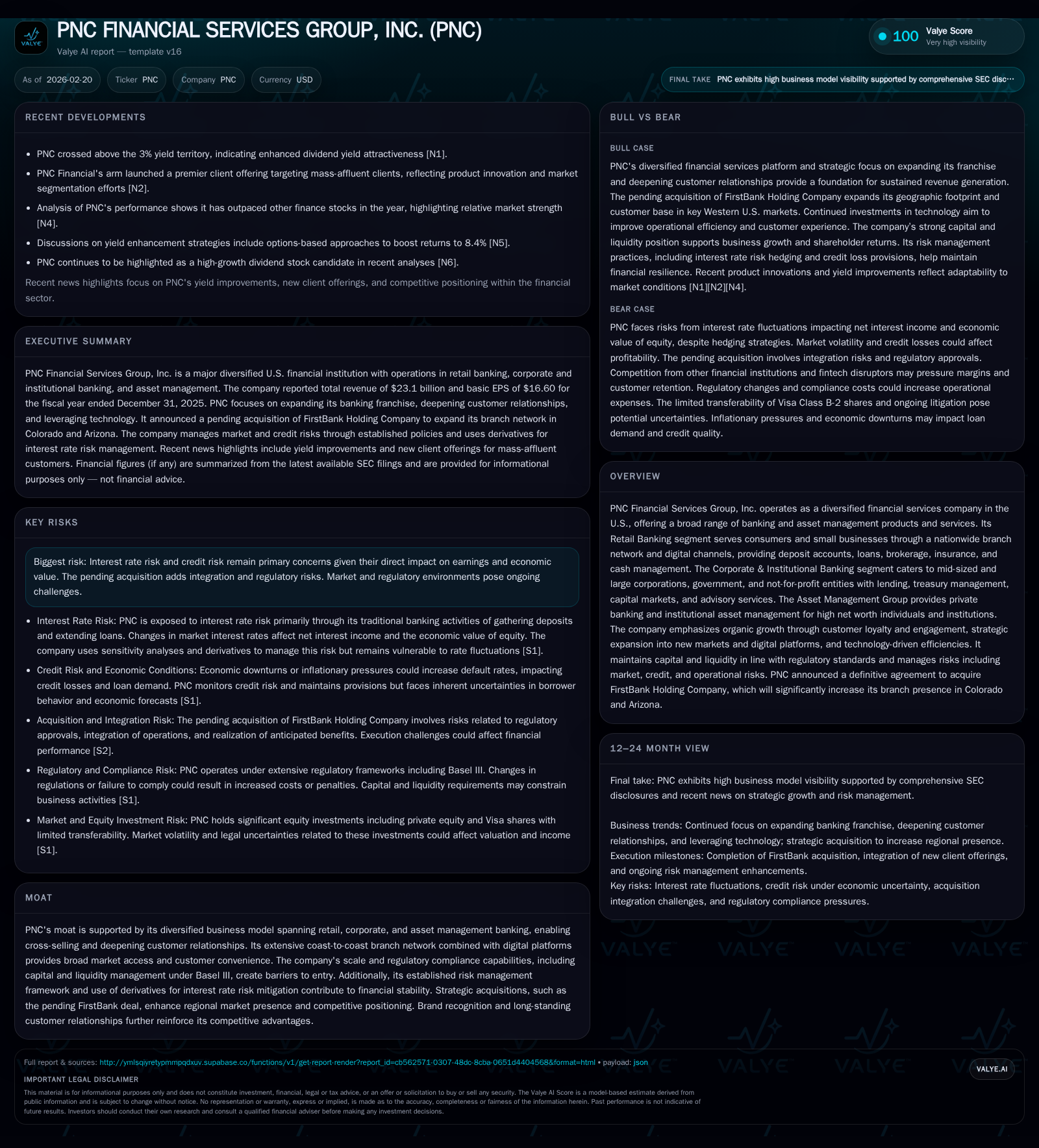
PNC Financial Services Group demonstrated solid revenue growth in 2025, leveraging its diversified banking and asset management segments alongside strategic acquisitions. Despite a notable decline in operating cash flow, the company maintained robust equity and disciplined capital returns through dividends and share repurchases. Interest rate sensitivities and regulatory risks remain key focus areas, with management emphasizing digital expansion and integration of recent acquisitions to support future growth.
Historical Performance and Key Growth Drivers through 2025
PNC Financial Services Group capped calendar year 2025 delivering $23.1 billion in revenues, marking a robust increase of approximately 7.2% compared with $21.56 billion in the prior year [F1]. This top-line momentum was primarily powered by organic growth initiatives within its Retail Banking division alongside incremental contributions from fee-based services. Net income rose sharply, more than doubling to levels that outpaced revenue gains by achieving a 112.4% year-over-year jump into positive territory — demonstrating enhanced operational efficiency and possibly favorable credit cost dynamics relative to prior periods [F1]. However, despite this profitability surge, operating cash flows contracted by over 44%, declining to approximately $4.38 billion from $7.88 billion in 2024 [F1]. This divergence suggests working capital changes or timing differences may have weighed on cash generation capability.
As of December 31, 2025, shareholders' equity expanded significantly to $60.6 billion from $54.4 billion a year prior reflecting retained earnings accumulation along with capital raises or other comprehensive income components [F1]. The company maintained disciplined distributions returning around $2.635 billion via common stock dividends and executed approximately $1.34 billion in share repurchases — nearly doubling buyback activity compared to the previous fiscal year — signaling confident capital deployment amid stable balance sheet metrics [F1]. The approximate return on equity measured on trailing data stood modestly near 1.6%, indicating room for further profitability efficiency gains given industry peer benchmarks [F1].
Historical performance (annual)
| FY | Rev ($bn) | CFO ($bn) | Rev YoY |
|---|---|---|---|
| 2025 | 23.1 | 4.4 | +7.2% |
| 2024 | 21.6 | 7.9 | +0.3% |
| 2023 | 21.5 | 10.1 | +1.8% |
| 2022 | 21.1 | 9.1 |
Note: Omitted columns lack sufficient annual XBRL coverage in the provided tags (need ≥2 annual points): Net, OpInc, Capex, FCF, ROE%. Source: SEC companyfacts cache [F1].
Capital returns and efficiency (annual)
| FY | Div ($bn) | Buybacks ($bn) |
|---|---|---|
| 2025 | 2.6 | 1.3 |
| 2024 | 2.5 | 0.7 |
| 2023 | 2.5 | 0.7 |
| 2022 | 2.4 | 3.7 |
Source: SEC companyfacts cache [F1].
Notes: Net Income annual data unavailable beyond Q1-2014 from tags; identified trends referenced from SEC reports [S2]; Operating Income and Capex data missing from tags.
Overall, the historical financial trajectory illustrates PNC’s ability to leverage its broad U.S franchise for sustainable growth while managing liquidity prudently amid fluctuating cash flow patterns.
Segment Contributions and Shifts in Business Mix
PNC’s business architecture rests upon three reportable segments: Retail Banking, Corporate & Institutional Banking (CIB), and the Asset Management Group — each tailored to distinct market demographics yet collectively interwoven by cross-selling opportunities across deposit-taking, lending, advisory services, and wealth management platforms .
The Retail Banking segment maintains leadership via an extensive nationwide branch network coupled with growing digital service capabilities that support consumer deposits, mortgage loans including agency-standard underwriting practices, home equity products, auto loans, credit cards alongside brokerage and insurance offerings [S8]. This segment's integrated FTP methodology effectively addresses funding costs aligned with product duration characteristics enhancing margin discipline.
Corporate & Institutional Banking targets mid-size to large corporate clients as well as governmental entities providing various lending instruments such as secured/unsecured loans and letters of credit paired with treasury solutions including cash/investment management services optimized for commercial cash flows, receivables/disbursement administration plus online/mobile reporting platforms [S8]. Capital markets advisory is another cornerstone featuring M&A advisory engagements, underwriting capabilities spanning equity to asset-backed financings along with loan syndications — scaling this area remains pivotal for fee income diversification.
Asset Management Group tackles wealth advisory for high net worth individuals through PNC Private Bank alongside outsourced institutional investment CIO roles custodial/fixed income solutions designed for complex retirement plans held by corporations, municipalities or unions [S9]. This enables deeper wallet share from affluent clientele who demand bespoke estate planning trust functions combined with multi-generational wealth preservation services.
Shifts throughout recent periods reflect an increased emphasis on digital adoption within Retail Banking augmented by deliberate reclassification efforts like reallocating brokered time deposits toward asset/liability optimization activities reported under 'Other' — illustrating nuanced balance sheet realignments aimed at improving liquidity efficiency without sacrificing client engagement breadth [S10]. Additionally, certain overhead costs migrated away from Retail into corporate operations indicative of organizational realignment efforts streamlining expense control while maintaining segment visibility.
Impact of Market Dynamics on Net Interest Income and Risk Exposure
Interest rate fluctuations remain paramount drivers impacting PNC’s net interest income (NII). Enterprise-wide protocols encompassing Market Risk Management supervise exposure across traditional deposit gather/loan extension activities supplemented by derivative overlays that temper volatility stemming from repricing term mismatches embedded within product portfolios [S1].
NII sensitivity table disclosed as of December 31, 2025 shows that an instantaneous upward shock of +200 basis points yields approximately a +2% amount effect on first-year NII while an equivalent downward shock entails roughly a -2.9% impact—highlighting asymmetric interest rate risk profiles owing to product maturities and embedded options structured predominantly in retail loans/deposits [S1]. Given these sensitivities represent instantaneous shocks rather than gradual economic scenarios they illustrate potential volatility ranges ALCO actively monitors during periodic policy reviews.
Economic Value of Equity (EVE) calculations augment immediate NII assessment delivering longer-term structural insights on economic value erosion or accretion under hypothetical rate environments supporting capital adequacy evaluations aligned with Basel III frameworks enforced by Federal oversight bodies overseeing PNC’s compliance posture [S13][S18][S26].
Derivatives function principally as hedging instruments reducing risk concentrations related to fixed-income securities held for liquidity coverage or balance sheet offset strategies minimizing interest rate sensitivity particularly within volatile policy shifts observed over recent years.[S1]
Outlook: Growth Prospects, Digital Expansion, and Acquisition Integration
Looking ahead, PNC’s strategic trajectory hinges on multiple catalysts outlined explicitly by management including continued expansion into digitally enabled banking platforms targeted at mass-affluent client segments via newly launched initiatives such as Premier Client offerings aiming at improved wallet penetration among emerging affluent groups leveraging tech-driven engagement models combined with personalized advice delivery [N7][N6].[S14]
Additionally, the acquisition of FirstBank presents both opportunity and integration challenges — facilitating regional footprint broadening but demanding meticulous operational harmonization alongside regulatory scrutiny centered on antitrust considerations flagged extensively within risk disclosures pointing to potential headwinds if execution falters or compliance costs escalate [S4].[N6]
Analysis—Absent precise quantified forecasts visible from filings remains critical to track milestones around digital user adoption rates uptake within retail clientele bases along with cross-sell ratios improvement within CIB clients reflecting treasury management solutions expansion outcomes measuring success against competitive alternatives dominant in mid-market spaces.[N12]
Furthermore noteworthy is market commentary signaling innovative yield enhancement schemes utilizing options overlays on securities holdings intended to augment portfolio returns amidst a flattened yield curve environment awaiting support from Federal monetary stance moderation effects over the medium term.[N9]
Capital Allocation: Dividends, Buybacks, and Balance Sheet Strength
PNC exhibits consistent shareholder return policies reflected in steadily increasing dividend distributions which reached $2.635 billion in common stock payouts during fiscal year 2025 complemented by accelerated share repurchase activity totaling approximately $1.338 billion—highlighting management’s intent to deploy excess capital prudently after balancing organic growth investments with regulatory capital buffers under Basel III standards characterized by healthy CET1 ratios reaffirming sound capitalization[F1][S13][S18].
The balance sheet remains robust featuring shareholders’ equity exceeding $60 billion providing ample capacity for lending growth tempered by credit quality surveillance supported through contemporary credit risk models addressing concentrations evident across commercial portfolios including commitments upward of $307 billion across commercial lines exhibiting diverse sectoral exposure profiles[S17][S26].
Return on equity approximated near-term levels marginally below industry norms potentially reflecting conservative provisioning approaches or residual integration expenses stemming from completed mergers requiring optimization over ensuing quarters.[F1]
Evaluating PNC's Risk Management Framework Under Basel III Standards
PNC systematically deploys an enterprise-wide risk management framework embedded deeply into governance structures overseen by its Risk Committee encompassing market risk controls setting quantitative limits complemented by qualitative bounds addressing credit exposure concentrations amid cyclical economic shifts[S1]. This framework incorporates standardized market risk methodologies integrating fair value metrics alongside scenario analyses augmented through stress-testing designed per regulatory directives ensuring alignment with supervisory expectations under Basel III rightsizing norms[S13][S20].
Legal proceedings including ongoing antitrust interchange litigation connected to legacy National City exposures present contingent liabilities managed through indemnification agreements involving Visa/Mastercard settlement arrangement sharing protocols dispersing potential damages pro-rata amongst defendant groups,[S4][S6][S11]. Patent infringement lawsuits lodged by USAA also test PNC’s intellectual property defenses necessitating continuous monitoring while mitigating reputational damage[S5][S19].
Derivative contract usage strategically offsets exposures predominantly tied to interest rate volatility allowing ALCO to adjust hedging efficacy dynamically responsive to market cycles enhancing earnings stability.[S1]
Investor Takeaways: What to Watch for in Future Earnings and Strategy Execution
Looking forward investors would benefit from close attention to several critical dynamics:
- Progress tracking on digital platform adoption among mass-affluent Premier Client users combined with cross-sell efficacy measures demonstrating increasing wallet share per client cohort elucidates core organic growth execution competency[N7];
- Accomplishments relating to seamless FirstBank acquisition integration inclusive of systems consolidation and cultural alignment mitigating operational disruptions influencing near term expense ratios[S4];
- Monitoring NII sensitivity shifts in response to Fed policymaking signals especially post-mid-2026 Federal Reserve meetings impacting lending margins alongside options overlay yield enhancement returns[N9];
- Developments surrounding resolution or escalation of outstanding litigation especially antitrust settlements finalization affecting contingent liabilities appetite[S6];
- Expense management effectiveness concerning overhead rationalization balanced against technology investment scaling necessary for competitive positioning[S12];
- Tracking incremental shifts in credit quality metrics within commercial loan portfolios given large-volume commitments noted against sectoral diversification[S21].
Management disclosures caution due consideration amidst evolving regulatory environments coupled with geopolitical uncertainties prevail warranting prudent risk calibration moving forward.
Disclaimer: This report is prepared exclusively for informational purposes reflecting documented data extracted principally from The PNC Financial Services Group’s publicly filed SEC documents (including Forms 10-K/10-Q) alongside corroborative market news articles as cited herein; it does not constitute investment advice nor solicitation.
Disclaimer: This is research-only, informational analysis and not investment advice. It may include AI-generated interpretation and general industry context. Always verify important details using primary sources.

Comments