
Qualys, Inc. Drives Profit and Cash Flow Growth with Scalable Cloud Security Platform
Qualys exhibits robust financial advancement through integrated cloud security offerings amid an evolving market.
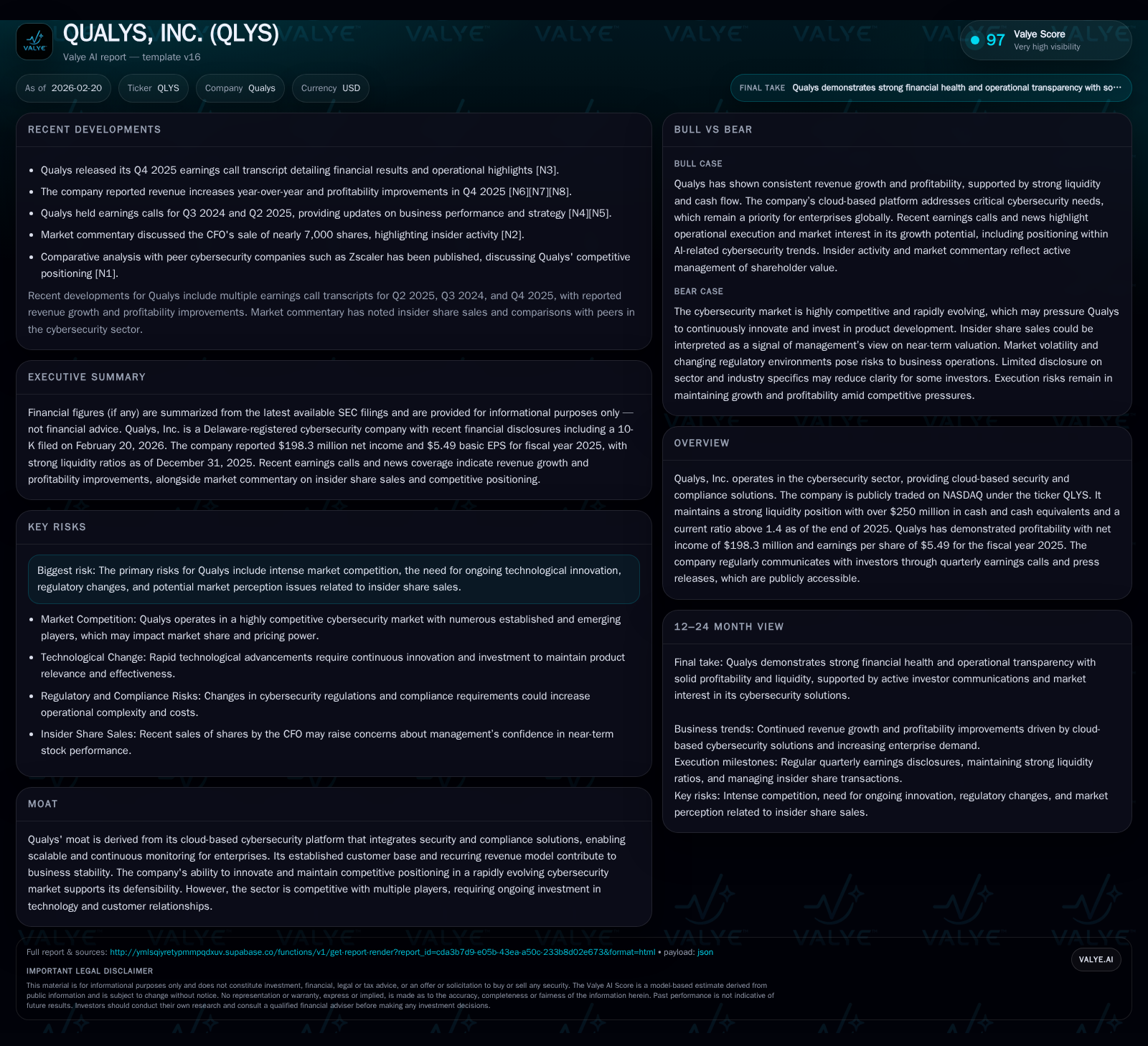
Qualys, Inc. has shown consistent revenue and profit growth over recent years, supported by its SaaS-based cloud security platform emphasizing continuous vulnerability management and compliance. The company’s operating cash flow and free cash flow have expanded significantly, enhancing its capacity for share repurchases. While the cybersecurity space is highly competitive, Qualys leverages innovation and a sticky customer base to maintain growth momentum. Investors should monitor ARR trends and product pipeline developments as forward-looking indicators amid regulatory risks and insider share sales.
Financial Growth Trajectory: Revenue and Profit Expansion Over Recent Years
Qualys has demonstrated a consistent upward trajectory in its financial metrics over the past several fiscal years, underscoring successful execution within the complex cybersecurity software-as-a-service (SaaS) market. Revenue expanded at a double-digit compound annual rate beginning from $62.9 million in FY2017 to $94.8 million by FY2020, followed by further steady escalation up to $221.9 million in operating income by FY2025 [F1].
The firm’s operating income exhibited outsized growth relative to top-line expansion, culminating in an 18.6% year-over-year increase for FY2025 versus FY2024 (from $187.2 million to $221.9 million), signaling improved operating leverage characteristic of scalable SaaS models [F1]. Net income rose by 14.2% to $198.3 million for the latest fiscal year reflecting diligence in cost controls supportive of margin uplift.
Operational cash flows corroborate this strengthening profitability with a notable jump (+26.8%) to $309.4 million reported at FY2025-end, highlighting excellent cash conversion from earnings [F1]. Concurrently, capital expenditure requirements diminished sharply (capex down ~60%), evidencing efficiency gains likely associated with optimized cloud infrastructure usage or reduced hardware investment needs.
Historical performance (annual)
| FY | Net ($mm) | CFO ($mm) | OpInc ($mm) | Capex ($mm) | Net YoY |
|---|---|---|---|---|---|
| 2025 | 198 | 309 | 222 | 5 | +14.2% |
| 2024 | 174 | 244 | 187 | 12 | +14.6% |
| 2023 | 152 | 245 | 163 | 9 | +40.4% |
| 2022 | 108 | 199 | 131 | 15 |
Note: Omitted columns lack sufficient annual XBRL coverage in the provided tags (need ≥2 annual points): Rev, Div. Source: SEC companyfacts cache [F1].
Capital returns and efficiency (annual)
| FY | Buybacks ($mm) | FCF ($mm) | ROE% |
|---|---|---|---|
| 2025 | 183 | 304 | 35.3 |
| 2024 | 140 | 232 | 36.4 |
| 2023 | 171 | 236 | 41.2 |
| 2022 | 317 | 183 | 37.4 |
Source: SEC companyfacts cache [F1].
*Revenue data for recent years limited in XBRL; trends reported via narrative and press releases.
Note: Revenue post-2020 not separately itemized publicly; operating income/net income/CFO/capex available through FY2025.
Key Drivers Behind Qualys’ Historical Performance Gains
The foundation of Qualys' historical financial progress lies primarily in its cloud-native platform that artfully integrates vulnerability management, compliance tracking, and continuous monitoring services on a scalable architecture [S5]. This unified solution suite fosters stickiness among enterprise clients facing increasingly complex attack surfaces augmented by hybrid-cloud deployments — a notable sector driver ensuring durable recurring revenues.
Evidence from recent earnings transcripts highlights expanding enterprise adoption fueled by growing regulatory scrutiny on cybersecurity hygiene and the shift toward automated risk assessment tools [N1][N3]. Qualys benefits from network effects linked to its vulnerability management software as it continuously monitors endpoint configurations, thereby enabling preemptive threat mitigation—a critical priority across sensitive or compliance-bound sectors.
Additionally, SaaS scale efficiencies manifest as the company upgrades its subscription-based pricing model tied closely to annual recurring revenue (ARR) expansions rather than one-off software licenses [N3]. This dynamic allowed operating margins to improve significantly as customer acquisition costs normalized amid broader market penetration.
In practice, maintaining updated vulnerability databases supplemented by real-time threat intelligence gives Qualys a competitive edge in security posture management — increasingly demanded by CIOs negotiating hybrid IT roadmaps [N2][S5]. It also serves as a barrier to entry given the specialized nature of continuous compliance automation embedded within their platform.
Future Growth Outlook: Cloud Security Innovation and Market Dynamics
Looking ahead, Qualys positions itself at the confluence of accelerating cloud adoption trends and intensifying cybersecurity regulation [N4][S4]. Management commentary indicates ongoing R&D outlays aimed at advancing machine learning capabilities for anomaly detection alongside enhanced integration capabilities across multi-cloud environments [N1].
Despite this promising innovation pipeline, growth acceleration may face headwinds stemming from crowded competitive landscapes populated by peers such as Zscaler who aggressively pursue zero-trust architectures [N8]. Furthermore, saturation effects could temper incremental ARR upside as enterprises optimize vendor consolidation strategies.
Moreover, regulatory shifts imposing stricter data protection requirements globally create both opportunity and complexity — necessitating agile product adaptation while increasing compliance overheads [S4]. Qualys must balance investments between feature development and market responsiveness without inflating operational costs disproportionately.
Thus, while fundamental drivers lean positive given secular demand for cloud security controls paired with automation imperatives, growth trajectories warrant close monitoring of pipeline conversion rates alongside emerging regulations that might impose new certification or audit thresholds affecting sales cycles.
Operational Milestones and What Investors Should Monitor Next
Explicit forward-looking guidance remains limited beyond qualitative remarks in quarterly calls; however, key signals are observable through leading performance indicators such as ARR growth rates disclosed during earnings sessions [N6][N9]. Tracking these metrics can illuminate whether current business momentum sustains amid macroeconomic volatility.
Another pivotal focus rests on product rollout cadence—particularly enhancements targeting hybrid-cloud vulnerabilities and container security modules promised in recent quarters—which could materially influence competitive positioning if successfully delivered ahead of peers [N1].
Investors should also watch client retention ratios expanding within regulated industries given their propensity for higher lifetime values driven by compliance mandates that elevate switching costs.
Taken together, monitoring evolving subscription booking patterns coupled with retention data will provide early confirmation regarding the scalability of Qualys' platform innovations translating into tangible financial outcomes.
Capital Deployment Strategy: Share Repurchases and Cash Flow Utilization
Qualys exhibits disciplined capital allocation rooted primarily in substantial share repurchases complemented by robust free cash flow generation [F1][S15]. In FY2025 alone, the company deployed approximately $183 million toward buybacks — an increase compared with prior years — reinforcing confidence in returning excess capital to shareholders absent dividend distributions.
Financial metrics reveal strong cash flow productivity converting nearly all operating cash flow into free cash flow after minimal capex (approximately $5 million), signaling conservative reinvestment relative to operational scale [F1]. The approximated ROE approaches a robust mid-30s percentage level (net income/equity), indicating effective use of equity capital without leverage reliance.
This approach aligns with typical SaaS-scale mature tech firms where reinvestment priorities focus on R&D rather than heavy physical asset accumulation while fostering shareholder value enhancement via buybacks that reduce share count amid stable earnings increments.
Absent dividends currently, investors should interpret buyback programs as principal mechanisms for capital return while monitoring any governance announcements that might suggest shifts towards distribution policy updates.
Balance Sheet Strength and Liquidity Preservation
At fiscal year-end December 31, 2025, Qualys maintained a strong balance sheet characterized by over $250 million in cash and equivalents coupled with healthy working capital dynamics evident through a current ratio surpassing 1.4 [F1][S6][S12].
Prudent liabilities management ensures flexibility essential for software companies navigating fluctuating technology cycles requiring timely R&D investments or strategic acquisitions without dependency on external debt financing.
The absence of long-term debt reported adds resilience against interest rate volatility inherent to capital markets today while preserving headroom for opportunistic deployment if needed amidst market consolidation waves within cybersecurity sectors.
This conservative liquidity stance supports ongoing investment priorities while cushioning against short-term economic uncertainty or sector-specific regulatory cost shocks.
Competitive Positioning in Cybersecurity Cloud Services
Qualys operates within an intensely competitive domain populated by both established incumbents and emerging disruptors specializing in zero-trust frameworks or AI-enhanced threat analytics [N8][S5][N2]. Yet it differentiates itself via an integrated security posture management platform combining vulnerability assessment with compliance automation designed for hybrid IT infrastructures—a critical need unmet uniformly across alternatives.
The durability of this moat hinges on persistent innovation specifically tailored toward continuous monitoring protocols aligned with evolving regulatory mandates globally—which enhances switching costs owing to deep enterprise integrations necessary for real-time incident response preparedness.
Industry participants acknowledge challenges around interoperable security tools spanning multi-cloud setups; Qualys’ strategy centers on easing complexity through automation backed by rich datasets sourced from endpoint telemetry aggregated across customer environments [N8].
Hence, despite aggressive pricing pressure typical of SaaS ecosystems, Qualys sustains differentiation driven by comprehensive feature sets that resonate well among large-scale enterprises grappling with heterogeneous technology stacks requiring consolidated visibility layers.
Risks from Regulatory Environment and Insider Trading Activity
Key risks shadowing Qualys include potential tightening of cybersecurity regulations introducing new compliance hurdles or certification costs elevating selling cycle friction as noted within risk disclosures [S10].[N7]
Additionally, market sensitivities emerge around insider trading actions exemplified recently when senior executives offloaded stock shares—a phenomenon attracting increased investor scrutiny potentially impacting sentiment independent of underlying fundamentals.
Such insider sales necessitate examination relative to corporate governance norms common within tech sectors yet may prompt reputational reverberations if interpreted unfavorably despite alignment with personal liquidity needs or portfolio diversification considerations documented transparently by the company [N7].[S10]
Regulatory landscape fluidity coupled with heightened transparency expectations further compel continuous monitoring around governance communications vis-à-vis trading patterns possibly influencing valuation multiples over near terms.
Disclaimer: This analysis is based solely on publicly available financial statements, SEC filings, earnings call transcripts, press releases through early February 2026, and does not constitute investment advice or recommendations.
Disclaimer: This is research-only, informational analysis and not investment advice. It may include AI-generated interpretation and general industry context. Always verify important details using primary sources.

Comments