
Red Rock Resorts Expands Operating Profit with Strategic Capital Discipline
RRR’s steady revenue growth and margin expansion reflect optimized asset deployment amid regulatory and financial constraints.
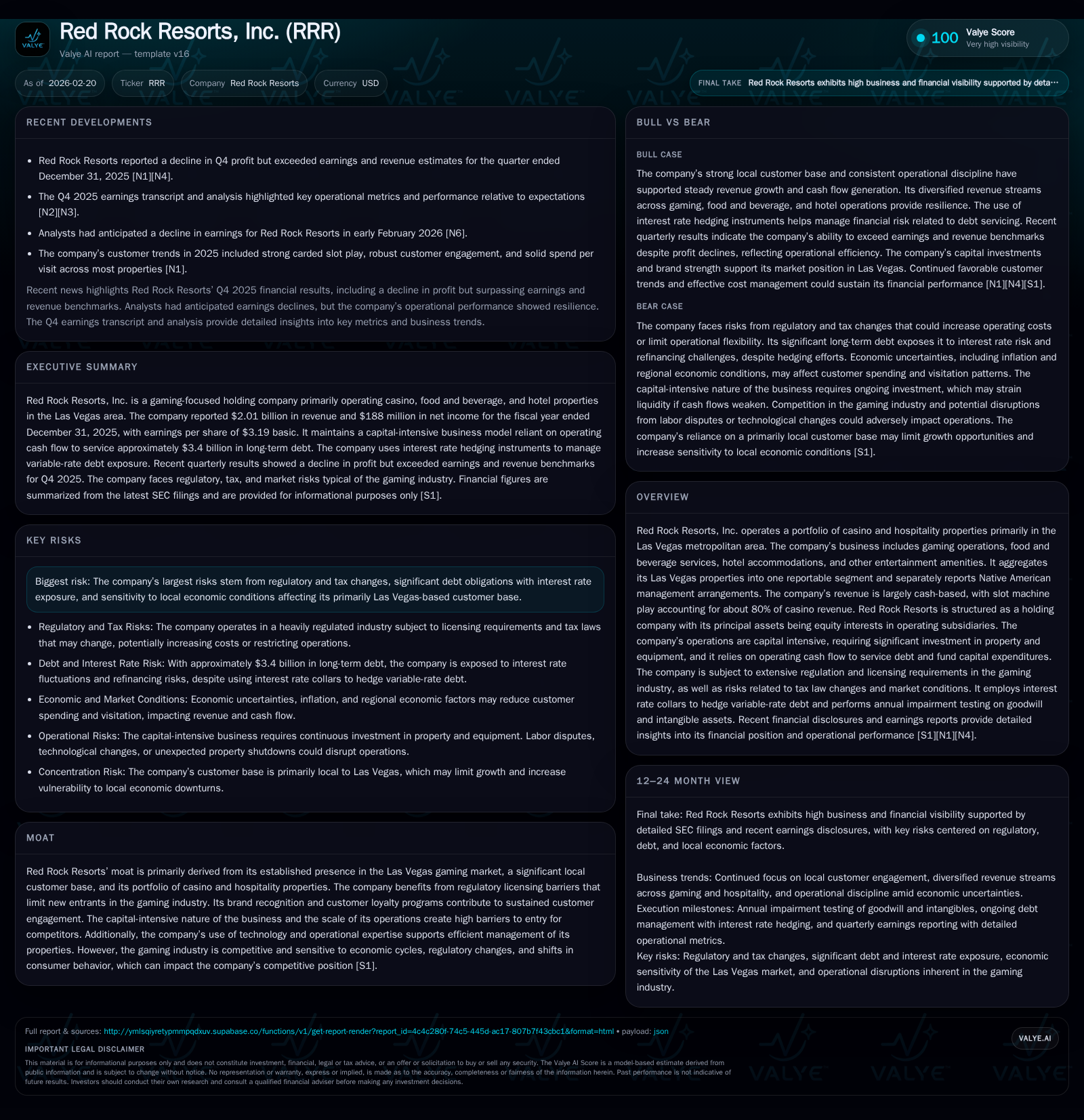
Red Rock Resorts, Inc. has demonstrated consistent revenue momentum alongside a notable increase in operating income during fiscal 2025, leveraging its Las Vegas-centric portfolio dominated by cash-based slot machine revenue. The company’s deliberate capital expenditure management, combined with prudent debt structuring—including interest rate collars and covenant compliance—supports its robust cash flow generation and shareholder return initiatives such as dividends and share repurchases. While operating within a highly regulated environment with labor-related litigation risks, RRR’s strong free cash flow and equity efficiency underline disciplined capital allocation that balances reinvestment with returning capital to shareholders.
Revenue Momentum and Profitability Trends in Recent Years
Over the period FY2022 through FY2025, Red Rock Resorts reported consistent top-line growth punctuated by improving profitability metrics [F1]. Revenues advanced from approximately $1.66 billion in 2022 to over $2.01 billion in 2025, reflecting a compound annual growth trend supported by gains in cash-based gaming segments, notably slot machines accounting for around 80% of casino revenue [S1]. The fiscal 2025 revenue increase of 3.7% compared with FY2024's $1.94 billion was complemented by a rise in operating income by over 5%, reaching nearly $597 million [F1]. Notably, net income expanded sharply by 22.1% to $188 million in FY2025 versus the prior year, underscoring effective earnings quality improvement despite capex investments.
Historical performance (annual)
| FY | Rev ($bn) | Net ($mm) | CFO ($mm) | OpInc ($mm) | Rev YoY | Net YoY |
|---|---|---|---|---|---|---|
| 2025 | 2.0 | 188 | 610 | 597 | +3.7% | +22.1% |
| 2024 | 1.9 | 154 | 548 | 569 | +12.5% | -12.5% |
| 2023 | 1.7 | 176 | 494 | 559 | +3.6% | -14.3% |
| 2022 | 1.7 | 205 | 542 | 561 |
Note: Omitted columns lack sufficient annual XBRL coverage in the provided tags (need ≥2 annual points): Capex. Source: SEC companyfacts cache [F1].
Capital returns and efficiency (annual)
| FY | Div ($mm) | Buybacks ($mm) | FCF ($mm) |
|---|---|---|---|
| 2025 | 121 | 79 | 291 |
| 2024 | 118 | 4 | 264 |
| 2023 | 59 | 0 | -205 |
| 2022 | 117 | 142 | 214 |
Source: SEC companyfacts cache [F1].
Note: Some YoY calculations for capex show volatility due to unusually elevated spending in FY2023.
Key Drivers Behind Year-Over-Year Operational Enhancements
Red Rock’s operational enhancements stem largely from its heavy reliance on gaming revenues generated mainly through slot machines on a near-cash basis, creating a relatively liquid revenue stream directly impacting operating cash flow [S1], [N1]. By integrating technology-driven efficiencies and leveraging established customer loyalty programs specific to its Nevada-focused clientele, RRR has achieved incremental expansions in EBITDA margins despite the competitive backdrop [S1]. The company’s portfolio concentration within Las Vegas provides familiarity with local market dynamics, allowing agile operational adjustments aligned with cyclical gaming demand patterns.
Optimized management of gaming floor layouts and food & beverage amenities further enhance dwell time and spending per visitor metrics — critical parameters underpinning revenue resilience across economic cycles common to hospitality sectors [S1]. Furthermore, enhancements to hotel accommodations paired with entertainment offerings contribute measurable yet secondary uplifts beyond pure gaming operations.
Capital Expenditure Patterns Reflecting Strategic Investment Focus
Capital expenditures have shown strategic elevation as Red Rock pursues renovation projects particularly aimed at refreshing flagship properties like Green Valley Ranch to preserve competitiveness in experience quality [F1]. The increase of capex by roughly $35 million or +12.4% year-over-year in FY2025 to $319 million coexists with measured operational gains indicating disciplined deployment rather than aggressive expansion.
Given the capital-intensive nature of casino-hospitality operations involving structures depreciated over decades (buildings amortized over up to ~45 years), these targeted investments primarily address maintenance capex alongside guest experience upgrades rather than speculative capacity growth [S4]. This conservative approach aligns with balancing cash flow allocations toward sustaining dividends and opportunistic share repurchases.
Liquidity Position and Debt Management Framework
Red Rock Resorts’ liquidity profile remains solid with roughly $142 million in cash equivalents at year-end [F1] complemented by substantial undrawn capacity under its revolving credit facility totaling approximately $898 million net after borrowings and letters of credit [S4], [S6]. The company structured its debt post-2024 refinancing around a $1.57 billion Term Loan B Facility maturing in March 2031 bearing variable rates tied to Term SOFR plus an adjusted margin capped via two zero-cost interest rate collars effective through April 2029—limiting exposure between floors (~2.89%) and ceilings (5.25%) [S1], [S9].
The credit agreements impose restrictive covenants including a maximum secured leverage ratio capped at five times assets-to-debt which RRR maintained comfortably below throughout FY2025 [S6], [S7]. Amortization schedules require quarterly principal reductions alongside mandatory excess cash flow applications when leverage exceeds thresholds; however, no such payments were mandated during FY2025 given conservative leverage management [S7]. This comprehensive framework preserves flexibility for general corporate purposes while safeguarding covenant compliance amidst variable rate debt exposure.
Insights into Dividends and Share Repurchase Activities
RRR maintains a prioritized approach towards returning value to shareholders evidenced by sustained dividend payments totaling approximately $121 million in FY2025—a marginal increase over the prior year—reflecting stable free cash flow generation capacity [F1], [S12]. Parallelly, share repurchases accelerated markedly during FY2025 with $79 million utilized for buybacks versus roughly $4 million in FY2024 under an extended authorization permitting up to an aggregate of $900 million repurchase volume through end-2027 [S14], [S15].
The board extended the equity repurchase program expiration date to December 31, 2027 increasing authorized repurchases by $300 million for a total authorization of $900 million; as of year-end there remained approximately $524 million available for future buybacks [S14], [S15]. Repurchases occurred primarily via open market transactions priced at mid-$50 levels per share alongside occasional Class B exchanges for Class A shares demonstrating strategic financial engineering aimed at optimizing capital structure without inducing undue leverage strain.
The company’s capacity to balance reinvestment needs while advancing shareholder payouts signals managerial confidence within prevailing regulatory confines barring dramatic market disruptions.
Growth Outlook and Regulatory Environment Considerations
Growth prospects hinge fundamentally on RRR’s entrenched Las Vegas footprint benefiting from significant local patronage reinforced by complex regulatory licensing regimes that erect high barriers against new entrants—a defensive moat ensuring stable market share retention over long horizons [S1]. Nevada’s biennial legislative sessions inject episodic uncertainty relating to potential alterations in gaming tax structures or tariffs that could pressurize margins; however, no immediate proposals were pending as of late-2025 filings [S27].
The company also holds development and management agreements with Native American entities providing modest diversification but lacks material geographic expansion beyond core Nevada properties limiting top-line upside absent market-wide growth or acquisitions [N6], [S27]. Economic cyclicality remains an inherent industry risk given discretionary wallet share sensitivity tied to consumer confidence indices.
Financial Metrics Critical for Monitoring Future Performance
Key metrics warranting investor scrutiny include sustained adherence to credit facility covenants—particularly the secured leverage ratio threshold of ≤5x—and the trajectory of operating cash flow vis-à-vis capex outlays determining free cash flow adequacy (estimated near $291 million for FY2025) which directly supports dividend coverage and buyback potential [F1], [S4], [S13]. Margins reflect sector cyclicality shaped by visitation trends but demonstrate resilience attributable to slot machine revenue composition (~80%) translating efficiently into cash inflows supporting liquidity profiles uncommon among diversified hospitality operators reliant on extended receivables cycles.
Return on equity remains exceptionally elevated above ~90%, predominantly driven by moderate equity bases relative to net income scales highlighting capital-efficient operating models fueled through asset turnover and disciplined leverage deployment [F1]. Monitoring labor relations impact costs remains salient given ongoing union certification disputes pertaining especially to non-gaming employee units led by LJEBLV contested through National Labor Relations Board proceedings that could introduce episodic EBITDA volatility if protracted or escalated litigation results arise [S27].
Labor Relations and Litigation Impact on Operational Risk Profile
Labor relations pose nuanced operational risk where ongoing union certification contests linked with the Local Joint Executive Board of Las Vegas spanning properties such as Green Valley Ranch create unresolved collective bargaining outcomes influencing wage structures and potential work stoppage costs [S27]. Despite certification recognition at Green Valley Ranch for non-gaming employees, bargaining agreements remain unsigned adding ambiguity concerning future labor cost trajectories.
Legal proceedings initiated by both the union faction and the NLRB contesting election results at Red Rock proper alongside repudiation of union representation at Boulder Station, Palace Station, and Sunset Station complicate workforce stability considerations necessitating close monitoring due to possible escalation costs or operational disruptions impacting EBITDA margins and gearing ratios.
This analysis synthesizes available financial data and disclosures as of February 20, 2026, without providing investment advice or recommendations. Readers should consider broader economic conditions alongside company-specific developments affecting future performance outcomes.
Disclaimer: This is research-only, informational analysis and not investment advice. It may include AI-generated interpretation and general industry context. Always verify important details using primary sources.

Comments