
Natural Health Trends Corp Faces Profitability Challenges and Navigates Global Trade Tariffs
NHTC’s multi-level direct-selling model in Greater China grapples with regulatory hurdles, trade tariffs, and profitability erosion.
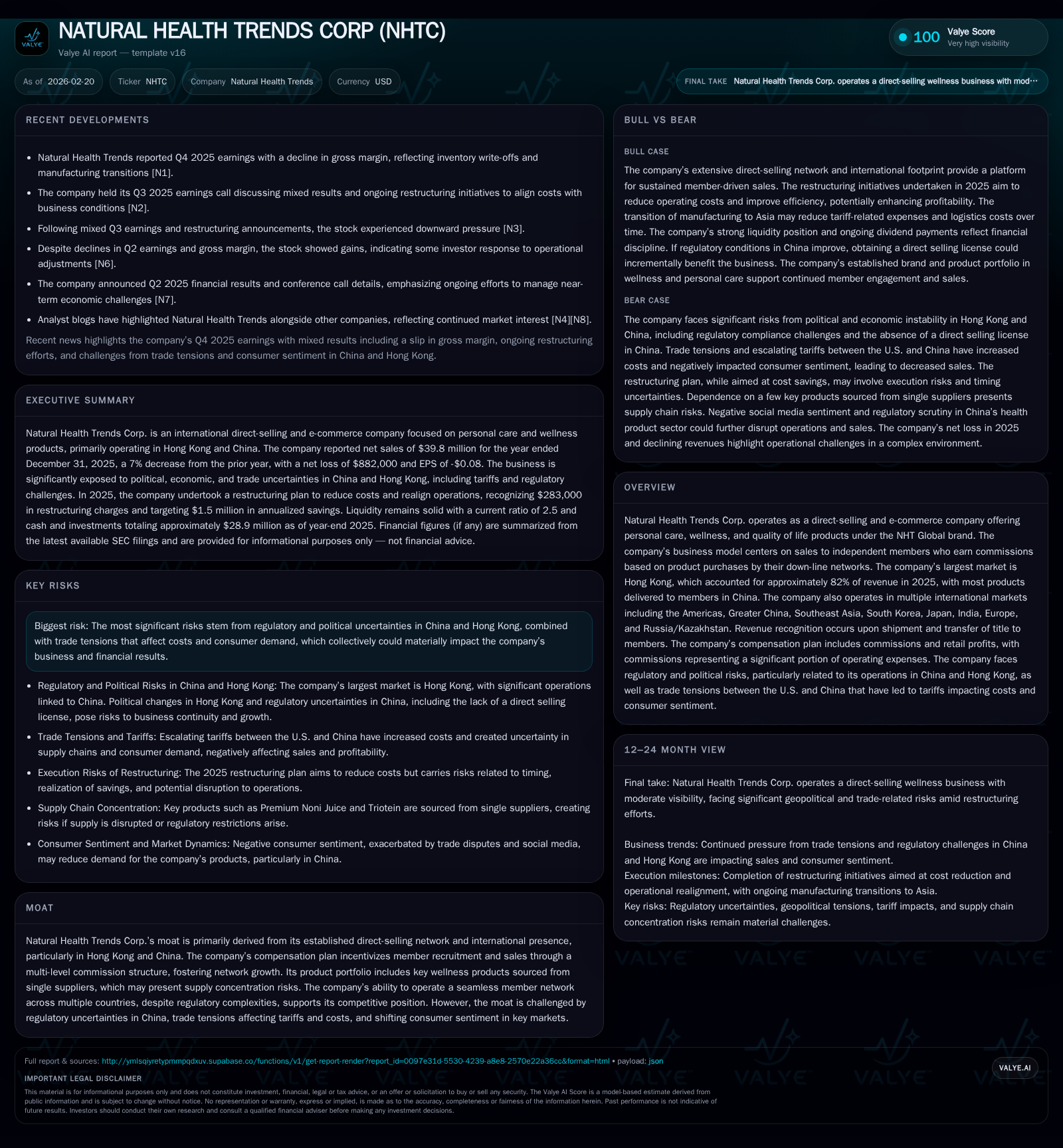
Natural Health Trends Corp (NHTC) operates an international direct-selling and e-commerce platform centered largely on Greater China markets, with over 80% of its revenues generated through Hong Kong e-commerce shipments to Chinese members. The company faces intense challenges from regulatory scrutiny in China and Hong Kong, volatile U.S.-China trade tariffs markedly increasing costs, and weakening consumer sentiment that have compressed operating income and cash flows. Despite a robust network incentivized by a multi-level commission structure, declining revenues and escalating costs alongside cautious capital allocation underscore near-term earnings pressures. Critical developments to monitor include the company’s efforts to secure a direct selling license in China, tariff negotiations, and the operational impact of its 2025 restructuring to realign costs.
From Expansion to Contraction: Historical Performance and Profitability Trends
Natural Health Trends Corp (NHTC) has experienced a marked deterioration in financial performance over the past several years, transitioning from modest operating losses toward deeper deficits as of fiscal year-end 2025. Operating income declined significantly from -$1.30 million in 2024 to -$1.81 million in 2025, representing a -39.2% year-over-year contraction driven primarily by margin pressures and reduced scale efficiency [F1]. Net income swung into loss territory after two years of positive net earnings reaching -$0.88 million by end-2025 from +$0.57 million in prior year. These losses equate approximately to a negative return on equity near -3.8%, underscoring worsening profitability despite continued business operations [F1]. Operating cash flow trends mirrored this decline with cash outflows deepening by over three-quarters year-over-year [-78%], indicative of tight liquidity conditions confronting the company.
Historical performance (annual)
| FY | Net ($) | CFO ($mm) | OpInc ($) | Capex ($) | Net YoY |
|---|---|---|---|---|---|
| 2025 | -882000 | -6 | -1808000 | 68000 | -254.2% |
| 2024 | 572000 | -3 | -1299000 | 57000 | +0.7% |
| 2023 | 568000 | -4 | -1671000 | 46000 | +81.5% |
| 2022 | 313000 | -5 | -270000 | 143000 |
Note: Omitted columns lack sufficient annual XBRL coverage in the provided tags (need ≥2 annual points): Rev, Buybacks. Source: SEC companyfacts cache [F1].
Capital returns and efficiency (annual)
| FY | Div ($mm) | FCF ($mm) | ROE% |
|---|---|---|---|
| 2025 | 9 | -6 | -3.8 |
| 2024 | 9 | -3 | 1.7 |
| 2023 | 9 | -4 | 1.4 |
| 2022 | 9 | -5 | 0.6 |
Source: SEC companyfacts cache [F1].
Table: Historical Financial Performance Summary (2022–2025)
This pattern reflects broader macroeconomic pressures including weak consumer demand contributing to revenue declines as reported elsewhere.
Direct Selling in China and Hong Kong: Regulatory Challenges and Market Dependence
Hong Kong operations dominate NHTC's revenue base, with roughly 82% of total sales originating there but mainly delivered across the border into mainland China members [S1], highlighting profound dependency on this geographic corridor tantamount to a single market exposure risk.
The company's business model relies on multi-level marketing through independent members incentivized via commissions linked to their direct sales volumes plus their recruited down-line networks [N2]. This model fuels rapid network growth but increasingly encounters hostile regulatory environments given China's vigorous crackdowns on unauthorized direct selling activities coupled with campaigns targeting false advertising or misleading health claims dating back to at least 2019—an enforcement effort still unresolved formally [S7][S20][S26].
NHTC previously withdrew its application for an official Chinese direct selling license following government advisories yet intends to reapply when conditions permit [S1]. However, pending uncertainty concerning licensing status constrains sustainable expansion monthly.
Meanwhile Hong Kong’s political atmosphere has shifted notably due to increasing PRC influence with rising operational risks; NHTC relocated its corporate headquarters from Hong Kong to California early in 2025 partly as a strategic hedge against these evolving dynamics [S1].
Tariffs Raise Cost Concerns: Impact of U.S.-China Trade Policies on Product Sourcing
From early-to-mid 2025 onwards, NHTC confronted volatile tariff impositions severely inflating costs on cross-border goods movement especially between the U.S., where manufacturing partly occurred historically, and China where primary consumers reside.
Tariffs initially set at around 34% escalated dramatically through several executive orders reaching spikes surpassing 120%, forcing temporary rollbacks amid negotiation cycles that remain unsettled entering Q1-Q2 of FY26 [S2].
These fluctuations strained supply chains causing additional operational expenses including rerouting manufacturing bases toward Asia to mitigate punitive duty impacts along with costs tied to product re-registration under new regimes [S15]. This complexity synergizes negatively with deteriorating consumer confidence linked partially to geopolitical tensions affecting discretionary wellness product purchases.
Cash Flow Strain Amid Declining Operating Margins
The cumulative effect of higher costs paired with lower revenues is vividly evident in plunging liquidity measures: operating cash flow registered near-$6 million usage for FY25—over twice worsened compared with FY24 [-78%]—while capital expenditures remained tightly controlled at $68K (near one-tenth percent of revenues), highlighting conservative investment approaches aimed more at preservation than growth reinvestment currently [F1][S6][S17].
Negative free cash flow approximating $-6 million raises concerns about funding operational working capital unless offset by marketable securities disposals or external financing which management notes are not planned imminently given ample existing resources [S11][S14].
Capital Allocation Review: Dividends, Buybacks, and Investment Priorities
Despite financial headwinds through FY25 including ongoing net losses and negative cash flows from operations, NHTC maintained quarterly dividends consistently at $0.20 per common share during both FY24 and FY25 resulting in $9.21 million annually distributed—a clear indication of management’s commitment toward shareholder returns amidst challenges [F1][S6][S10].
Conversely, share repurchases were dormant for multiple years but abruptly resumed via significant buyback agreements executed early February 2026 acquiring approximately 25% outstanding shares at $2 per share utilizing existing liquidity reserves mitigating dilution risk for remaining holders while reducing shares outstanding notably [S9][S19].
Capital deployment continues prioritizing core growth markets especially Greater China involving plans for manufacturing localization rollout alongside incremental resource allocation toward license acquisition efforts plus network development infrastructure abroad such as South Asia or South America contexts where member affiliations might supplement sales opportunities thereby balancing portfolio geographic exposures cautiously [S9].
Network Growth Dynamics and Compensation Expense Analysis
Central to NHTC’s value creation engine remains its multi-level commission-based incentive plan compensating active members not only for personal sales but also growing networks beneath them driving volume velocity albeit producing elevated commission expenses consuming around forty-one percent of product net sales—a double-edged sword enhancing member motivation but compressing realized gross margins especially when total sales volume weakens unexpectedly [S22][N2].
Such leverage necessitates delicate balancing: while aggressive recruitment could restore topline momentum theoretically pushing commissions higher proportionally costing operational leverage potentially accentuating near-term losses if new recruits fail maintaining productivity levels expected historically.
Investors would observe how effectively management moderates this dynamic via targeted retention or enhanced product offerings fostering stickiness among members while controlling payout ratios responsibly within overall SG&A limits going forward.
Global Footprint and Geographic Revenue Concentration Risks
Though natural health trend markets span multiple continents—including North/South America (US/Canada/Peru/Colombia), Southeast Asia (Malaysia/Singapore), South Korea, Japan, India as well as Russia/Kazakhstan through service providers—the geographic footprint outside Greater China remains modest both numerically (<20% combined revenues) and structurally non-core presently according to detailed segment disclosures [S4][S24].
Moreover trading complexities among these smaller regions including language/local regulation adaptations or slower digital adoption rates contribute less predictably effective contributions relative to concentrated exposure around Hong Kong-China cross-border commerce.
This geographic concentration clearly flags pronounced vulnerability should sociopolitical disturbances or intensified enforcement measures escalate unpredictably within key revenue zones thus necessitating vigilant portfolio risk monitoring combined with balanced international market cultivation complementary but unlikely alternating main revenue pillars imminently.
Outlook and Key Catalysts: What to Monitor in NHTC’s Recovery Path
Looking ahead into early-to-mid-2026 periods based on latest earnings communications ([N1],[N2]), watch-list triggers pivot heavily around several fronts:
- Successful reapplication progress toward securing direct selling licenses enabling legal expansion inside mainland China — anticipated increasing fixed overhead initially but potentially unlocking significant revenue uplifts long-term.
- Resolution or stabilization regarding U.S.-China tariff regimes critical for supply chain cost normalization potentially restoring gross margin integrity.
- Efficacy realization from restructuring efforts initiated late-2025 designed reportedly produce ~$1.5 million annualized cost savings validating operating expense discipline alignment plus office consolidation benefits.[S15]
- Enhancement or transformation within digital sales capabilities addressing pandemic-normalization shifts favoring e-commerce approaches over traditional brick-and-mortar / event reliant member meetings displaced previously by public health restrictions.
- Management’s continued pragmatic capital allocation track balancing shareholder remuneration demands versus critical reinvestment needs during recovery phases.
Each factor bears substantial impact potential on recovering profitability trajectories and stabilizing member engagement metrics supporting incremental organic growth fostering amid enduring externally imposed headwinds.
Disclaimer: This analysis is provided solely for informational purposes based on publicly available data as of February 20, 2026. It does not constitute investment advice or recommendations regarding any securities issued by Natural Health Trends Corp or any other entity.
Disclaimer: This is research-only, informational analysis and not investment advice. It may include AI-generated interpretation and general industry context. Always verify important details using primary sources.

Comments